Is Mad Hippie Vitamin C Serum Safe During Pregnancy? (Updated 2026 Guide)
Updated September 9, 2026
Mad Hippie Vitamin C Serum
Mad Hippie
Mad Hippie Vitamin C Serum receives a C grade, meaning caution rather than an unrestricted pregnancy safety recommendation. The main concerns are limited pregnancy evidence for topical chamomile and clary sage not the vitamin C itself and these uncertainties do not establish that ordinary facial use causes harm.
You can use this, but maybe don't make it your everyday go to. Not the end of the world if you've used it. Consult your OBGYN or midwife if you have concerns.
Pregnancy Safe is 100% independent and research driven. No companies pay to promote or sponsor products.
Stress Less This Pregnancy
Check your serum in the app

What Ingredients Are in Mad Hippie Vitamin C Serum?
Mad Hippie Vitamin C Serum has 19 ingredients. We flagged 2 ingredients to use with caution.
chamomile flower extract
CAUTION
Chamomile flower extract is a soothing botanical ingredient known for its calming, anti inflammatory, and skin soothing properties. Topical chamomile warrants caution because pregnancy specific evidence is inadequate, with irritation or allergy the clearest known topical concern.
clary sage
CAUTION
Clary sage is an aromatic herb known for its calming properties and distinctive, musky scent, often used in aromatherapy and herbal remedies. Clary sage warrants caution because pregnancy safety data are sparse and depend on timing, route, and concentration, without establishing that ordinary facial serum exposure stimulates labor.
aloe barbadensis leaf
LIKELY SAFE
Aloe barbadensis leaf is the gel filled leaf of the aloe vera plant, known for its soothing, moisturizing, and healing properties. Aloe barbadensis leaf is considered low concern in normal formulated topical cosmetics during pregnancy, unlike swallowed aloe preparations, although direct fetal safety data are limited.
vitamin e
LIKELY SAFE
Vitamin E is a powerful antioxidant that helps protect the skin and body from oxidative damage and supports overall health. Vitamin E is considered low concern in normal topical use during pregnancy because systemic exposure is expected to be minimal, and high dose oral supplement concerns do not apply directly.
deionized water
SAFE
Deionized water is purified water that has had its mineral ions removed through a process of ion exchange, resulting in highly pure, mineral free water. Deionized water is not a pregnancy concern in normal topical use, although the finished serum's preservation and other ingredients still matter.
SAFE
Glycerin is a colorless, odorless, and sweet tasting humectant commonly used in skincare products to attract and retain moisture in the skin. Glycerin is compatible with normal topical cosmetic use during pregnancy, with low systemic exposure expected.
SAFE
Hyaluronic acid is a powerful hydrating ingredient that attracts and retains moisture in the skin, promoting plumpness and smoothness. Hyaluronic acid is considered compatible with pregnancy in ordinary topical moisturizers because systemic exposure is expected to be low, although direct pregnancy studies are limited.
vegetable glycerin
SAFE
Vegetable glycerin is a clear, sweet, and viscous liquid derived from plant oils, commonly used as a moisturizer, humectant, or sweetener in various products. Vegetable glycerin is compatible with normal topical cosmetic use during pregnancy, with low systemic exposure expected.
SAFE
Vitamin C is a vital antioxidant that supports immune health, skin vitality, and overall cellular function. Vitamin C is compatible with ordinary topical cosmetic use during pregnancy, although direct pregnancy studies are limited and acidic formulas may irritate skin.
water
SAFE
Water is a clear, tasteless, and essential liquid that sustains all known forms of life. Water is not a pregnancy concern in normal topical use, but the finished product's ingredients and microbial quality remain important.
alkyl benzoate
SAFE
Alkyl benzoate is a lightweight, non greasy ester commonly used as an emollient and skin conditioning agent in cosmetics and skincare products. Alkyl benzoate is unflagged in this topical serum, but that does not establish pregnancy safety or provide a pregnancy specific dose assessment.
amorphophallus konjac root powder
SAFE
Amorphophallus konjac root powder is a natural, high fiber thickening agent derived from the konjac plant's tuber, commonly used in food and health products. Konjac root powder is unflagged here, but its use as a food thickener does not establish pregnancy safety for topical serum exposure.
ferulic acid
SAFE
Ferulic acid is a natural antioxidant found in plant cell walls that helps protect skin from environmental damage and enhances the stability of other skincare ingredients. Ferulic acid is unflagged in this serum, but its antioxidant role alone does not establish pregnancy safety for topical use.
grapefruit
SAFE
Grapefruit is a juicy, tangy citrus fruit known for its vibrant flavor and refreshing acidity. Grapefruit is unflagged here, but a general description of the fruit does not establish pregnancy safety for its use in a topical serum.
hydroxyethylcellulose
SAFE
Hydroxyethylcellulose is a water soluble, plant derived thickening and stabilizing agent commonly used in cosmetics and personal care products. Hydroxyethylcellulose is unflagged in this topical formula, but its thickening role does not establish pregnancy specific safety.
sodium anisate
SAFE
Sodium anisate is the sodium salt of anisic acid, commonly used as a flavoring agent and preservative with a sweet, licorice like aroma. Sodium anisate is unflagged in this serum, but pregnancy specific evidence for this topical exposure is not established in its ingredient assessment.
sodium levulinate
SAFE
Sodium levulinate is a salt derived from levulinic acid, commonly used as a skin conditioning agent and preservative in cosmetic and personal care products. Sodium levulinate is unflagged in this topical serum, which should not be interpreted as a confirmed pregnancy safety finding.
sodium phytate
SAFE
Sodium phytate is a salt derived from phytic acid that acts as a natural chelating agent, commonly used as an antioxidant and preservative in food and cosmetic products. Sodium phytate is unflagged here, but its cosmetic function does not establish pregnancy safety at the serum's application dose.
xanthan gum
SAFE
Xanthan gum is a natural thickening and stabilizing agent derived from fermented sugars, commonly used in gluten free baking and food processing. Xanthan gum is unflagged in this serum, but its food processing uses do not establish pregnancy safety for topical exposure.
Answering Your Questions
How much Mad Hippie Vitamin C Serum is safe during pregnancy?
If you choose to use it after discussing the formula with your prenatal clinician, follow the label amount for facial application rather than applying it generously over large areas. A pregnancy specific safe dose has not been established, and using less does not resolve the ingredient evidence gaps.
Can you use Mad Hippie Vitamin C Serum daily while pregnant?
Follow the label frequency if your clinician agrees with continued use; there is no established pregnancy specific application schedule. Stop if you develop burning, itching, or a rash, and consider a formula without chamomile or clary sage if you prefer to avoid these uncertainties.
Why does Mad Hippie Vitamin C Serum receive a C grade?
The C grade comes from ingredient based scoring, with chamomile flower extract and clary sage rated caution because pregnancy evidence is limited. Aloe and vitamin E are rated likely safe for normal topical use, while vitamin C is considered compatible with pregnancy in ordinary cosmetics. The grade is not a measured likelihood of harm.
Can I use Mad Hippie Vitamin C Serum while breastfeeding?
The pregnancy grade does not establish breastfeeding safety, and a breastfeeding assessment of the finished serum is not available here. Ask your clinician about continued facial use, and keep the serum away from the nipple and areas your baby may lick or touch with their mouth.
What alternative vitamin C serum should I look for during pregnancy?
Look for a simpler vitamin C formula without chamomile or clary sage, and have its full ingredient list reviewed rather than relying on the vitamin C label alone. If hydration is your main goal, a simple glycerin or hyaluronic acid moisturizer is another product type to consider; those ingredients are compatible with ordinary topical use during pregnancy.
Is vitamin C itself a pregnancy concern in this serum?
Vitamin C is considered compatible with pregnancy in ordinary leave on and rinse off cosmetics, although direct pregnancy studies of topical formulations are limited. It is not the reason for this serum's caution rating, and topical use should not be confused with taking oral supplements.
Are all Mad Hippie products suitable for pregnancy?
No brand wide conclusion follows from this review: each product needs its own ingredient assessment. This C grade applies specifically to Mad Hippie Vitamin C Serum, not to Super A Serum or other products in the range.
Does the clary sage in this serum cause contractions?
The available evidence does not establish that ordinary facial serum use causes contractions. Much of the human research concerns supervised aromatherapy, massage, or footbath exposure near term or during labor, not this formula; sparse safety data and traditional labor stimulation claims support caution without proving harm from cosmetic exposure.
Should I be concerned about chamomile if I have a ragweed allergy?
Topical chamomile can cause irritation or allergy, especially if you are sensitive to ragweed or other daisy family plants. Avoid this formula if you have a known chamomile allergy, and stop using it if a reaction develops; tolerating it does not establish pregnancy safety.
What Are Pregnancy Safe Alternatives to Mad Hippie Vitamin C Serum?
Here are some solid alternatives. Everything below has an A or B grade, meaning no flagged ingredients in our database.
| Grade | Product | Brand | Type |
|---|---|---|---|
| B+ | True Belly Serum | 8 Sheep Organics | serum |
| B+ | Byoma Hydrating Serum | Byoma | serum |
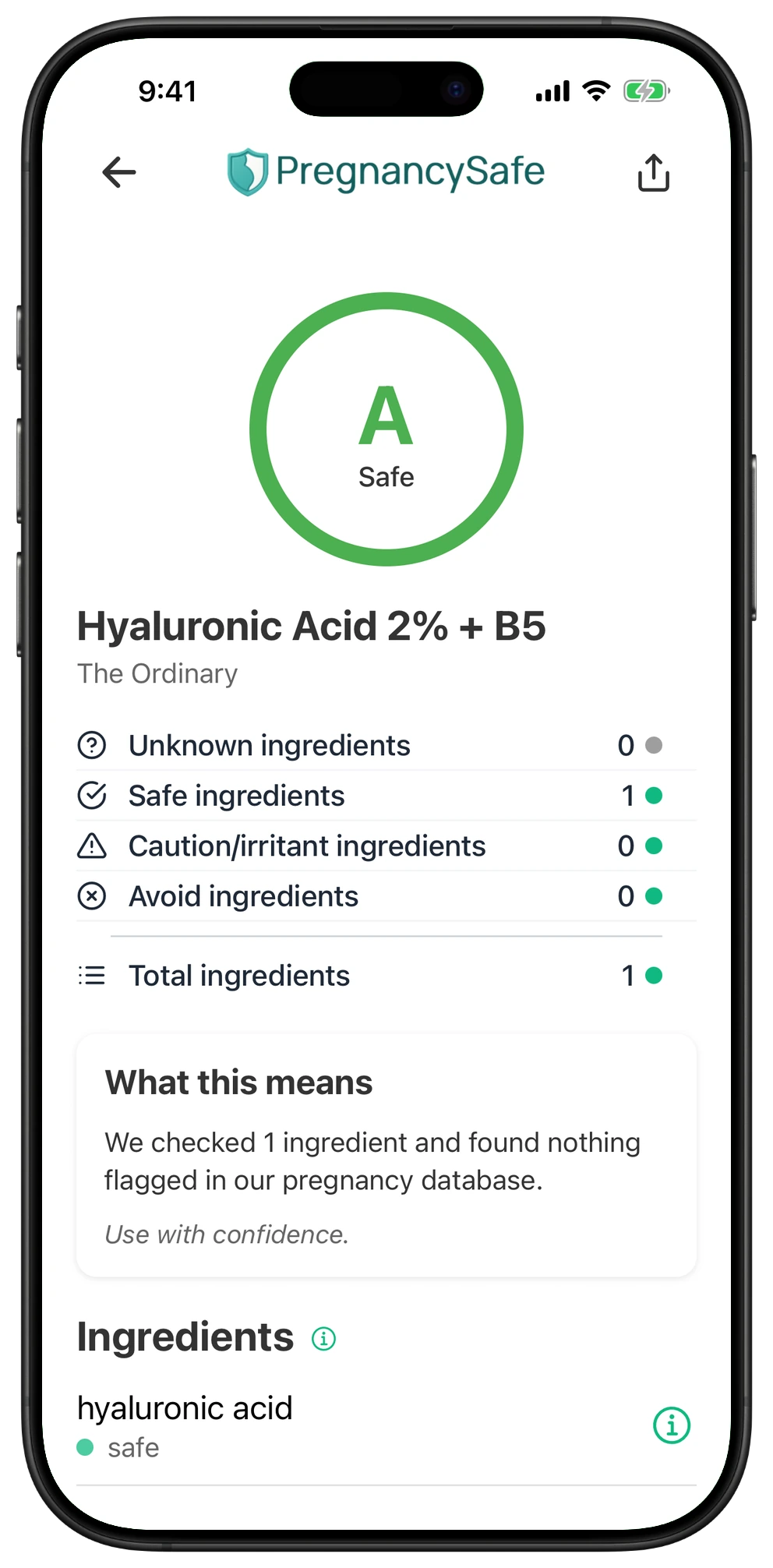
| A | Hyaluronic Acid 2% + B5 | The Ordinary | serum |
| A | E.L.F. Skin Holy Hydration Thirst Burst Drops Serum | E.L.F. Skin | serum |
Are Other Mad Hippie Products Safe During Pregnancy?
We looked at 10 other Mad Hippie products. 4 are pregnancy safe (A or B grade), while 6 need a closer look.
| Grade | Product | Type |
|---|---|---|
| B+ | Brightening Gel Moisturizer | moisturizer |
| B+ | Cleansing Oil | cleansing oil |
| B+ | Mad Hippie Cleanser, Cream, Normal To Dry Skin | cleanser |
| B+ | Mad Hippie Vitamin A Serum | serum |
How Does Mad Hippie Vitamin C Serum Compare to Other Serums?
We graded 1,128 Serums for pregnancy safety. Here's how they stack up:
Mad Hippie Vitamin C Serum earns a C grade, placing it among the majority of Serums. Only 3% of products in this category get an A grade, so it pays to choose carefully.
How Do We Score Products for Pregnancy Safety?
We analyze each product's ingredients and category to flag known risks and provide cautionary notices for general category safety concerns.
A - Safe
Excellent choice! All ingredients are considered safe during pregnancy.
What to do: Use with confidence.
B - Likely Safe
Pretty much safe with very minimal risk. Some ingredients may have limited pregnancy studies, but no significant safety concerns have been identified.
What to do: Use with confidence.
C - Limit
Contains ingredients with some pregnancy considerations. Research shows these ingredients may have limited safety data, potential for minor hormonal effects, or require caution based on animal studies.
What to do: Use sparingly and consider safer alternatives when available.
D - Caution
Similar to C grade but contains multiple cautionary ingredients. The combination increases overall concern.
What to do: Try to avoid if that makes you feel better. If you've already used it, no need to panic.
F - Avoid
Contains an ingredient Pregnancy Safe recommends avoiding during pregnancy. This may reflect an established risk or a precaution based on limited evidence; check the ingredient guidance and exposure context.
What to do: Do not use during pregnancy. If you've already used it, don't worry - contact your OBGYN if concerned.
People Also Checked
References
- https://www.nccih.nih.gov/health/aloe-vera
- https://journals.sagepub.com/doi/10.1080/10915810701351186
- https://pubmed.ncbi.nlm.nih.gov/28139161/
- https://pubmed.ncbi.nlm.nih.gov/28521546/
- https://webprod.hc-sc.gc.ca/nhpid-bdipsn/ingredReq?id=14944&wbdisable=true
- https://www.niehs.nih.gov/health/topics/agents/aloe
- https://www.nccih.nih.gov/health/chamomile
- https://www.ema.europa.eu/en/documents/herbal-monograph/final-european-union-herbal-monograph-matricaria-recutita-l-flos-first-version_en.pdf
- https://www.ema.europa.eu/en/documents/herbal-monograph/final-community-herbal-monograph-chamaemelum-nobile-l-all-flos_en.pdf
- https://journals.sagepub.com/doi/10.1177/1091581818801814
- https://journals.sagepub.com/doi/10.1177/1091581817705620
- https://pubmed.ncbi.nlm.nih.gov/40314057/
- https://pubmed.ncbi.nlm.nih.gov/40374153/
- https://pmc.ncbi.nlm.nih.gov/articles/PMC5721455/
- https://pmc.ncbi.nlm.nih.gov/articles/PMC10341564/
- https://pubmed.ncbi.nlm.nih.gov/21735438/
- https://pmc.ncbi.nlm.nih.gov/articles/PMC6428160/
- https://pmc.ncbi.nlm.nih.gov/articles/PMC7602146/
- https://pmc.ncbi.nlm.nih.gov/articles/PMC7956842/
- https://www.cancer.gov/about-cancer/treatment/cam/patient/aromatherapy-pdq
- https://www.mayoclinichealthsystem.org/hometown-health/speaking-of-health/essential-oils-and-pregnancy
- https://wisdom.nhs.wales/health-board-guidelines/aneurin-bevan-file/guideline-for-aromatherapy-use-in-maternity-care/
- https://cdnservices.industrialchemicals.gov.au/statements/EVA00103%20-%20Evaluation%20Statement%20-%2026%20June%202023.pdf
- https://journals.sagepub.com/doi/10.1177/1091581818794455
- https://pmc.ncbi.nlm.nih.gov/articles/PMC4154592/
- https://pubmed.ncbi.nlm.nih.gov/15868062/
- https://mothertobaby.org/fact-sheets/vitamin-e/
- https://www.personalcarecouncil.org/wp-content/uploads/2022/03/INCINomenclatureConventionsReferenceInformation2022_v1.pdf
- https://www.seslhd.health.nsw.gov.au/sites/default/files/groups/Royal_Hospital_for_Women/Mothersafe/documents/skinhaircareandcosmetictreatmentsapril2021.pdf
- https://www.nhs.uk/pregnancy/complications/itching-and-intrahepatic-cholestasis/
- https://www.fda.gov/cosmetics/resources-consumers-cosmetics/cosmetics-pregnancy
- https://www.fda.gov/cosmetics/cosmetics-guidance-documents/good-manufacturing-practice-gmp-guidelinesinspection-checklist-cosmetics
- https://www.fda.gov/cosmetics/potential-contaminants-cosmetics/microbiological-safety-and-cosmetics
- https://pubmed.ncbi.nlm.nih.gov/25153208/
- https://www.hfpappexternal.fda.gov/scripts/fdcc/index.cfm?id=GLYCERIN&set=FoodSubstances
- https://pubmed.ncbi.nlm.nih.gov/31840548/
- https://pmc.ncbi.nlm.nih.gov/articles/PMC7009851/
- https://www.medicinesinpregnancy.org/leaflets-a-z/glycerin-suppositories/
- https://mothertobaby.org/pregnancy-breastfeeding-exposures/cosmetics/
- https://pubmed.ncbi.nlm.nih.gov/35309882/
- https://www.cir-safety.org/sites/default/files/TR_Hyaluronates_032023_1.pdf
- https://pubmed.ncbi.nlm.nih.gov/19636067/
- https://www.aad.org/public/everyday-care/skin-care-secrets/routine/pregnancy-skin-care
- https://www.fda.gov/medical-devices/aesthetic-cosmetic-devices/dermal-fillers-soft-tissue-fillers
- https://pubmed.ncbi.nlm.nih.gov/28492048/
- https://onlinelibrary.wiley.com/doi/10.1111/ijd.70620
- https://www.cir-safety.org/sites/default/files/RRSum_AscorbicAcid_062025.pdf
- https://pubmed.ncbi.nlm.nih.gov/16154915/
- https://pubmed.ncbi.nlm.nih.gov/11207686/
- https://pmc.ncbi.nlm.nih.gov/articles/PMC5605218/