Best Pregnancy Safe Vitamin (Updated 2026 Guide)
Updated September 9, 2026
The Answer
A clinician selected prenatal can help meet pregnancy nutrient needs, but not every oral vitamin supplement is appropriate. Most products in the catalog have A or B+ grades; those grades do not verify complete labels, suitable doses or pregnancy safety.
For oral vitamins, the main considerations are nutrient forms, daily amounts and overlapping doses across supplements not simply whether a vitamin appears on the label. Avoid vanadium supplements, and have concentrated extras such as rutin and quercetin reviewed because pregnancy safety evidence is limited. Keep taking your clinician recommended prenatal unless they advise a change; a catalog ingredient flag alone is not a reason to stop it.
Pregnancy Safe is 100% independent and research driven. No companies pay to promote or sponsor products.
Stress Less This Pregnancy
Check your exact vitamin in the app

✓ What's Safe
- • Check the complete Supplement Facts panel and other ingredients on your exact package, rather than relying on a product title or letter grade.
- • Choose nutrient forms and daily amounts with your prenatal clinician, taking your diet, other supplements and individual needs into account.
- • Check the serving size: the listed nutrient amounts may require more than one capsule, tablet or gummy.
- • Look for a vitamin A declaration that distinguishes preformed vitamin A from beta carotene, so your clinician can assess the relevant amounts.
- • Prefer formulations without unnecessary concentrated botanical or flavonoid extras, and ask about pregnancy evidence before adding them.
- • Use the product list as a discussion aid with your clinician, not as a universal dose prescription or purchase recommendation.
✗ What to Avoid
- • Avoid stacking a prenatal, multivitamin and single nutrient supplements without checking their combined daily doses.
- • Avoid vanadium supplements during pregnancy; benefits are unproven and exposure studies raise developmental concerns.
- • Avoid starting isolated or high dose rutin or quercetin supplements without clinician review; ordinary food sources are a different exposure.
- • Avoid unnecessary supplemental nickel, particularly when its amount is unclear; higher exposure findings do not establish harm from ordinary dietary traces.
- • Avoid choosing spirulina supplements with unclear sourcing or contaminant testing, and do not use them to replace recommended prenatal iron or folate care.
- • Avoid assuming that a flag for bht, fd c red 40 or red 40 lake proves a prenatal is harmful. If you prefer fewer additives, compare nutritionally appropriate alternatives with your clinician rather than stopping supplementation.
Most Common Ingredients in Vitamin Products
We analyzed 4,779 vitamin products. Here are the most common ingredients, ranked by how often they appear:
Ingredients to Watch Out For in Vitamin
These are the most common flagged ingredients across 4,779 vitamin products we analyzed.
rutin
Caution
Rutin is a natural flavonoid compound found in various plants that exhibits antioxidant and anti inflammatory properties.
Is low concern in normal food amounts but has insufficient pregnancy safety data as an isolated or high dose supplement.
Rutin is a plant flavonoid sometimes added to oral antioxidant or vein support supplements. Ordinary food amounts are low concern, but isolated or high dose supplements have insufficient pregnancy safety evidence. Limited studies of related rutosides do not establish routine supplement safety.
Flagged in 179 of 4,779 products (4%)
vanadium
Avoid
Vanadium is a transition metal known for its strength and corrosion resistance, often used in steel alloys and industrial applications.
Should be avoided as a supplement or avoidable industrial exposure because pregnancy benefits are unproven and human and animal data raise fetal growth and developmental concerns.
Vanadium is a trace metal included in some supplements marketed for blood sugar or athletic benefits. Avoid supplemental vanadium during pregnancy: benefits are unproven, while human observational and higher exposure animal findings raise developmental concerns without quantifying risk for every supplement dose. This advice does not target ordinary trace amounts in food.
Flagged in 111 of 4,779 products (2%)
quercetin
Caution
Quercetin is a natural flavonoid antioxidant found in many fruits and vegetables that may help reduce inflammation and support immune health.
Is generally compatible at normal food amounts but warrants caution as a high dose supplement because pregnancy safety data are lacking and interactions or quality issues are possible.
Quercetin is a plant flavonol found in foods and sold as a concentrated oral supplement. Supplemental doses can greatly exceed dietary exposure, lack adequate human pregnancy safety data and may interact with medicines. Its presence in fruits and vegetables is not a reason to avoid those foods.
Flagged in 67 of 4,779 products (1%)
fd c red 40 lake
Caution
FD&C Red 40 Lake is a synthetic, water insoluble red dye used to add vibrant color to food, beverages, and cosmetics.
Has limited human pregnancy data and is allowed at regulated food additive levels, but child neurobehavior concerns and high dose animal findings make frequent high dye intake worth limiting.
FD&C Red 40 Lake is a water insoluble lake form of the synthetic red colorant used in some supplement coatings or gummies. Pregnancy specific evidence is limited; findings in children and high dose animals do not demonstrate fetal harm from a prenatal containing this colorant. The label name alone does not establish your exposure amount.
Flagged in 52 of 4,779 products (1%)
nickel
Caution
Nickel is a silvery white, hard, and ductile metal commonly used in alloys, plating, and industrial applications.
Has mixed but concerning developmental and birth outcome evidence at higher exposure levels, while ordinary brief consumer contact is mainly an allergy issue.
Nickel is a metal that may appear in trace mineral supplement formulas. Minimize unnecessary supplemental exposure and ask about the amount: higher exposure studies raise concerns, but human findings are mixed and affected by other exposures. Ordinary dietary traces and skin contact nickel allergy are separate issues.
Flagged in 48 of 4,779 products (1%)
bht
Caution
BHT (butylated hydroxytoluene) is a synthetic antioxidant commonly used as a preservative to prevent the oxidation of fats and oils in food products.
Has limited human pregnancy data, with low concern at reviewed cosmetic levels but reproductive and thyroid related findings in high dose oral animal studies.
BHT, or butylated hydroxytoluene, is an antioxidant preservative used to slow oxidation in some oral supplements. Pregnancy specific human data are limited, and reproductive concerns come mainly from high dose oral animal studies rather than demonstrated harm at a particular prenatal dose. Cosmetic use assessments do not establish oral supplement safety.
Flagged in 37 of 4,779 products (1%)
fd c red 40
Caution
FD&C Red 40 is a synthetic red dye commonly used to add vibrant color to foods, beverages, and cosmetics.
Has limited human pregnancy data and is allowed at regulated food additive levels, but child neurobehavior concerns and high dose animal findings make frequent high dye intake worth limiting.
FD&C Red 40 is a synthetic red dye used to color some vitamins and gummies. Human pregnancy data are limited, and child behavioral findings are not evidence that a supplement dose causes fetal harm. A dye free formulation is an option to discuss if its nutrient forms and amounts still meet your needs.
Flagged in 34 of 4,779 products (1%)
spirulina
Caution
Spirulina is a nutrient rich blue green algae known for its high protein, vitamin, and antioxidant content, often used as a dietary supplement.
Has limited pregnancy safety data and product quality concerns because contaminated blue green algae supplements can contain microcystins, heavy metals, or pathogenic bacteria.
Spirulina is dried blue green algae used in powders, capsules and supplement blends. Pregnancy evidence is limited, and poorly controlled products may contain microcystins, heavy metals or pathogenic bacteria. Ask your clinician before using it, check sourcing and contaminant testing, and do not replace recommended iron or folate treatment with spirulina.
Flagged in 33 of 4,779 products (1%)
How Do Vitamin Products Stack Up?
Our catalog contains ratings for 4,779 vitamin products. These are database grades, not independent safety certifications.
A letter grade does not establish that a supplement has a complete nutrient panel, the right forms or an appropriate dose. Some catalog records contain only other ingredients. Do not use this distribution to choose a prenatal or to stop recommended supplementation.
Best Pregnancy Safe Vitamin
Popular options from our catalog, prioritizing A and B ingredient grades, with C grade options used to fill remaining places. Within each group, products are ordered by searches in Pregnancy Safe, not retail sales. Read the cautions and guidance above; grades do not verify a complete current label or guarantee pregnancy safety.
| Grade | Product | Brand |
|---|---|---|
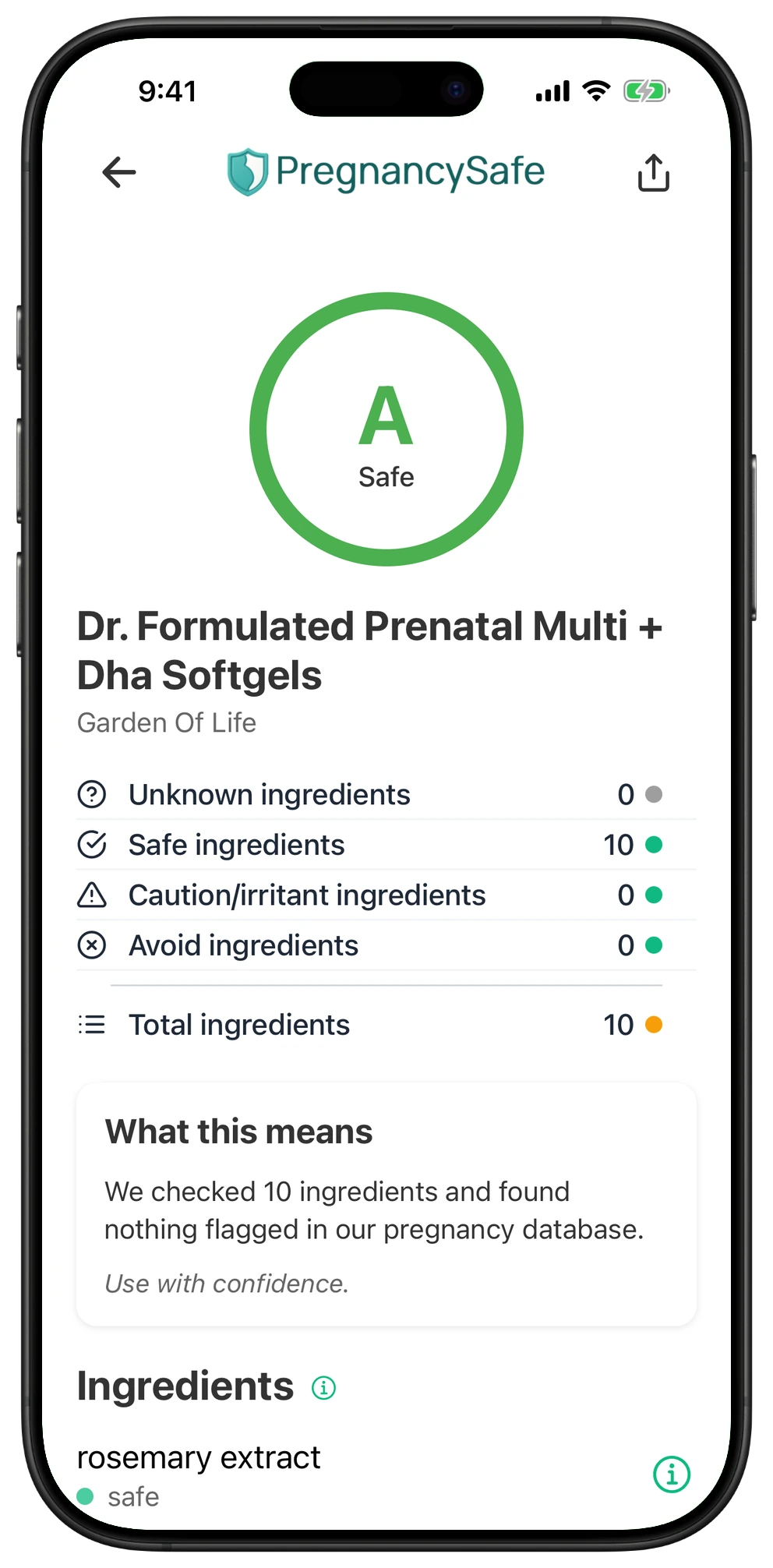
| A | Dr. Formulated Prenatal Multi + Dha Softgels | Garden Of Life |
| A | Vitafusion Prenatal Gummy Vitamins Raspberry Lemonade | Vitafusion |
| B+ | Nature Made Prenatal Multi + Dha Softgels | Nature Made |
| B+ | Nature Made Prenatal Multi + Dha 70 Softgels | Nature Made |
| A | Flawless Complexion | Olly Pbc |
Your Questions Answered
Are vitamins safe to take during pregnancy?
Some oral vitamins and prenatal supplements can help meet pregnancy nutrient needs when their forms and doses are appropriate for you. That does not make every multivitamin, high dose vitamin or supplement blend suitable. Review the complete label and your combined daily intake with your prenatal clinician, and do not stop recommended supplementation because of a catalog grade.
How do I choose a prenatal vitamin?
Start with the complete Supplement Facts panel, including nutrient forms, amounts and serving size. Ask your clinician how the formula fits your diet and whether you need any separately prescribed nutrients. Also review other ingredients and concentrated supplement extras. The product list is a discussion aid, not a claim that these products are right for everyone or that related formulas are equivalent.
Does an A grade mean a vitamin is safe or nutritionally complete?
No: the catalog contains 4,779 products, including 1,429 with A grades, but these are catalog grades rather than clinical approvals. Some records contain only other ingredients, so an A grade cannot establish a complete nutrient panel or appropriate doses. Likewise, an F grade does not mean that the individual product has been proven harmful in pregnancy. These counts describe catalog coverage, not a representative sample of the market.
Can I take extra vitamin C, vitamin D or other vitamins alongside my prenatal?
Do not add a separate vitamin solely because it sounds beneficial or has a favorable grade. First total the amounts in your prenatal and every additional supplement, then ask your clinician whether an extra dose is needed. Clinician directed supplementation may be appropriate, but overlapping products can supply more than intended. This page addresses swallowed supplements, not topical vitamin C serums.
Should I avoid all vitamin A during pregnancy?
Do not treat all vitamin A forms as interchangeable. Preformed vitamin A and beta carotene need to be distinguished when assessing an oral supplement, and excessive preformed vitamin A intake is a pregnancy concern. Ask your clinician to check the form and total amount across your supplements rather than rejecting every prenatal that lists vitamin A.
Are natural extras such as rutin, quercetin and spirulina safer choices?
Natural does not establish pregnancy suitability. Rutin and quercetin in ordinary foods differ from isolated, concentrated supplements, for which pregnancy safety evidence is insufficient. Spirulina supplements also require attention to possible contamination with microcystins, heavy metals or bacteria. Discuss these extras with your clinician rather than using them as substitutes for recommended prenatal nutrients.
Should I stop my prenatal if it contains a flagged dye or preservative?
A flag alone is not a reason to stop your clinician recommended prenatal. Concerns about Red 40 include limited pregnancy specific evidence, findings in children and high dose animal studies not demonstrated fetal harm from your prenatal dose. BHT concerns also rely substantially on high dose oral animal findings, which do not establish the risk of the amount in a particular supplement. If you want a formulation without these additives, ask your clinician or pharmacist to help compare the full nutrient panels before switching.
How Do We Score Products for Pregnancy Safety?
We analyze each product's ingredients and category to flag known risks and provide cautionary notices for general category safety concerns.
Grades reflect the ingredient and category information available to us. They don’t verify a complete, current label or account for dose, preparation, or contamination. Read them alongside the guidance above, not as a guarantee of pregnancy safety or proof that every use is harmful.
A - Safe
Excellent choice! All ingredients are considered safe during pregnancy.
What to do: Use with confidence.
B - Likely Safe
Pretty much safe with very minimal risk. Some ingredients may have limited pregnancy studies, but no significant safety concerns have been identified.
What to do: Use with confidence.
C - Limit
Contains ingredients with some pregnancy considerations. Research shows these ingredients may have limited safety data, potential for minor hormonal effects, or require caution based on animal studies.
What to do: Use sparingly and consider safer alternatives when available.
D - Caution
Similar to C grade but contains multiple cautionary ingredients. The combination increases overall concern.
What to do: Try to avoid if that makes you feel better. If you've already used it, no need to panic.
F - Avoid
Contains an ingredient Pregnancy Safe recommends avoiding during pregnancy. This may reflect an established risk or a precaution based on limited evidence; check the ingredient guidance and exposure context.
What to do: Do not use during pregnancy. If you've already used it, don't worry - contact your OBGYN if concerned.
People Also Checked
References
- https://ods.od.nih.gov/factsheets/Pregnancy-HealthProfessional/
- https://pmc.ncbi.nlm.nih.gov/articles/PMC7050615/
- https://pubmed.ncbi.nlm.nih.gov/17253454/
- https://pubmed.ncbi.nlm.nih.gov/26240050/
- https://pmc.ncbi.nlm.nih.gov/articles/PMC5598508/
- https://vkm.no/english/riskassessments/allpublications/rutinandquercetinhealthrisksofintakeoffoodsupplements.4.7cc8817a18c33cc0df9bd9bb.html
- https://www.ncbi.nlm.nih.gov/books/NBK592340/
- https://www.ncbi.nlm.nih.gov/books/NBK592350/table/ch1.tab6/?report=objectonly
- https://pubmed.ncbi.nlm.nih.gov/30318100/
- https://pubmed.ncbi.nlm.nih.gov/27381766/
- https://pubmed.ncbi.nlm.nih.gov/40174741/
- https://pubmed.ncbi.nlm.nih.gov/8738553/
- https://webprod.hc-sc.gc.ca/nhpid-bdipsn/dbImages/mono_quercetin_english.pdf
- https://pubmed.ncbi.nlm.nih.gov/29127724/
- https://www.drugs.com/npp/quercetin.html
- https://www.mskcc.org/cancer-care/integrative-medicine/herbs/quercetin
- https://www.nccih.nih.gov/health/using-dietary-supplements-wisely
- https://www.fda.gov/food/information-consumers-using-dietary-supplements/questions-and-answers-dietary-supplements
- https://pubmed.ncbi.nlm.nih.gov/36140900/
- https://www.hfpappexternal.fda.gov/scripts/fdcc/index.cfm?id=FDCRed40&set=ColorAdditives
- https://www.ecfr.gov/current/title-21/chapter-I/subchapter-A/part-74/subpart-A/section-74.340
- https://www.fda.gov/food/color-additives-information-consumers/tracking-food-industry-pledges-remove-petroleum-based-food-dyes
- https://www.efsa.europa.eu/en/efsajournal/pub/1327
- https://www.efsa.europa.eu/en/efsajournal/pub/4007
- https://apps.who.int/food-additives-contaminants-jecfa-database/Home/Chemical/2361
- https://oehha.ca.gov/risk-assessment/report/health-effects-assessment-potential-neurobehavioral-effects-synthetic-food-dyes-children
- https://pubmed.ncbi.nlm.nih.gov/6636206/
- https://pubmed.ncbi.nlm.nih.gov/2613118/
- https://pubmed.ncbi.nlm.nih.gov/7940558/
- https://www.atsdr.cdc.gov/toxprofiles/tp15-c1.pdf
- https://www.gov.uk/government/publications/nickel-properties-incident-management-and-toxicology/nickel-toxicological-overview
- https://pmc.ncbi.nlm.nih.gov/articles/PMC11326437/
- https://pmc.ncbi.nlm.nih.gov/articles/PMC6504320/
- https://pmc.ncbi.nlm.nih.gov/articles/PMC7855942/
- https://pubmed.ncbi.nlm.nih.gov/39326548/
- https://health.ec.europa.eu/system/files/2022-08/sccs_o_257.pdf
- https://pubmed.ncbi.nlm.nih.gov/37751543/
- https://pubmed.ncbi.nlm.nih.gov/12396675/
- https://pmc.ncbi.nlm.nih.gov/articles/PMC13151845/
- https://www.ecfr.gov/current/title-21/chapter-I/subchapter-B/part-172/subpart-B/section-172.115
- https://www.ecfr.gov/current/title-21/chapter-I/subchapter-B/part-182/subpart-D/section-182.3173
- https://www.fda.gov/news-events/press-announcements/fda-finalizes-food-chemical-safety-post-market-assessment-program-launches-reassessment-bht-ada
- https://www.fda.gov/food/natural-toxins-food/blue-green-algae-products-and-microcystins
- https://www.ncbi.nlm.nih.gov/books/NBK548312/
- https://www.ncbi.nlm.nih.gov/books/NBK501849/
- https://pubmed.ncbi.nlm.nih.gov/21793723/
- https://journal.ugm.ac.id/v3/InaJBCS/article/view/23573
- https://doi.org/10.4236/ojog.2017.71016
- https://pubmed.ncbi.nlm.nih.gov/37317149/
- https://pubmed.ncbi.nlm.nih.gov/37368655/
- https://pubmed.ncbi.nlm.nih.gov/23036452/
- https://pubmed.ncbi.nlm.nih.gov/21842336/
- https://wwwn.cdc.gov/TSP/ToxProfiles/ToxProfiles.aspx?id=191&tid=34
- https://pmc.ncbi.nlm.nih.gov/articles/PMC9681673/
- https://pmc.ncbi.nlm.nih.gov/articles/PMC10809980/
- https://www.cdc.gov/vaccine-safety/about/adjuvants.html
- https://www.fda.gov/vaccines-blood-biologics/safety-availability-biologics/common-ingredients-fda-approved-vaccines
- https://www.acog.org/womens-health/infographics/vaccines-during-pregnancy