Is Vitamin Water Safe During Pregnancy? (Updated 2026 Guide)
Updated September 9, 2026
The Answer
Vitamin water can fit into pregnancy, but check the exact formula, serving size and vitamin doses rather than assuming every version is suitable. Most entries in our catalog have B+ ingredient scores; those scores do not establish pregnancy safety or account for how much you drink.
Vitamin enhanced waters differ in sugar, caffeine, herbal ingredients and vitamin doses, so check each bottle and account for your prenatal supplement. Keep total caffeine below 200 mg per day, and do not treat fortified drinks as prenatal replacements. Retinyl palmitate needs assessment as dietary vitamin A at the actual dose not as a prescription retinoid while elderberry concerns depend on preparation and concentration, with limited pregnancy evidence for supplement use.
Pregnancy Safe is 100% independent and research driven. No companies pay to promote or sponsor products.
Stress Less This Pregnancy
Check your exact vitamin water in the app
✓ What's Safe
- • Read the current bottle's ingredient list and nutrition panel; different flavors and versions can have different formulas.
- • Check serving size and servings per bottle so you know the caffeine, sugar and vitamins in the amount you actually drink.
- • Choose caffeine free versions when practical, or count the drink toward a total below 200 mg of caffeine per day from all sources.
- • Compare vitamin amounts with your prenatal and other supplements before making fortified water a daily habit.
- • Compare sugar per bottle rather than relying on vitamin or hydration claims.
- • For herbal or hemp enhanced drinks, check the exact ingredient and amount rather than assuming the category name explains the contents.
✗ What to Avoid
- • Avoid repeatedly drinking fortified bottles without adding up their vitamin doses alongside your supplements.
- • Avoid caffeinated versions that would bring your total daily caffeine to 200 mg or more.
- • Avoid using vitamin water instead of an indicated prenatal supplement.
- • Avoid assuming zero sugar means caffeine free, herb free or appropriate at any quantity.
- • Avoid concentrated elderberry preparations for health purposes without discussing them with your clinician; raw or unripe elderberries and non berry plant parts can be toxic.
- • Avoid choosing a hemp enhanced drink solely because of a high ingredient score; hemp seed oil is distinct from CBD and THC, and the exact contents matter.
Most Common Ingredients in Vitamin Water Products
We analyzed 25 vitamin water products. Here are the most common ingredients, ranked by how often they appear:
Ingredients to Watch Out For in Vitamin Water
These are the most common flagged ingredients across 25 vitamin water products we analyzed.
Avoid
Retinyl palmitate is a form of vitamin A commonly used in skincare products for its anti aging and skin renewing properties.
Should be avoided in pregnancy because oral retinoids are teratogenic and topical retinoids are contraindicated or discouraged despite generally low absorption.
Flagged in 2 of 25 products (8%)
b12 retinyl palmitate
Avoid
Should be avoided in pregnancy because oral retinoids are teratogenic and topical retinoids are contraindicated or discouraged despite generally low absorption.
Flagged in 1 of 25 products (4%)
b7 retinyl palmitate
Avoid
Should be avoided in pregnancy because oral retinoids are teratogenic and topical retinoids are contraindicated or discouraged despite generally low absorption.
Flagged in 1 of 25 products (4%)
elderberry juice
Caution
Elderberry juice is a vibrant, antioxidant rich liquid made from the berries of the elderberry plant, known for its immune boosting and health supporting properties.
Has little pregnancy specific safety data for supplement doses and can be toxic if raw, unripe, or made with leaves, stems, bark, or roots.
Flagged in 1 of 25 products (4%)
Vitamin Water Products We've Analyzed
Our catalog contains ratings for 25 vitamin water products. These are database grades, not independent safety certifications.
Grades are ingredient scores, not clinical verdicts or measurements of pathogens, dose, preparation or current package contents. Cohorts include unreviewed catalog records and counts are not independently verified safe-product totals.
Pregnancy Safe Vitamin Water Products
Popular options from our catalog, prioritizing A and B ingredient grades, with C grade options used to fill remaining places. Within each group, products are ordered by searches in Pregnancy Safe, not retail sales. Read the cautions and guidance above; grades do not verify a complete current label or guarantee pregnancy safety.
| Grade | Product | Brand |
|---|---|---|
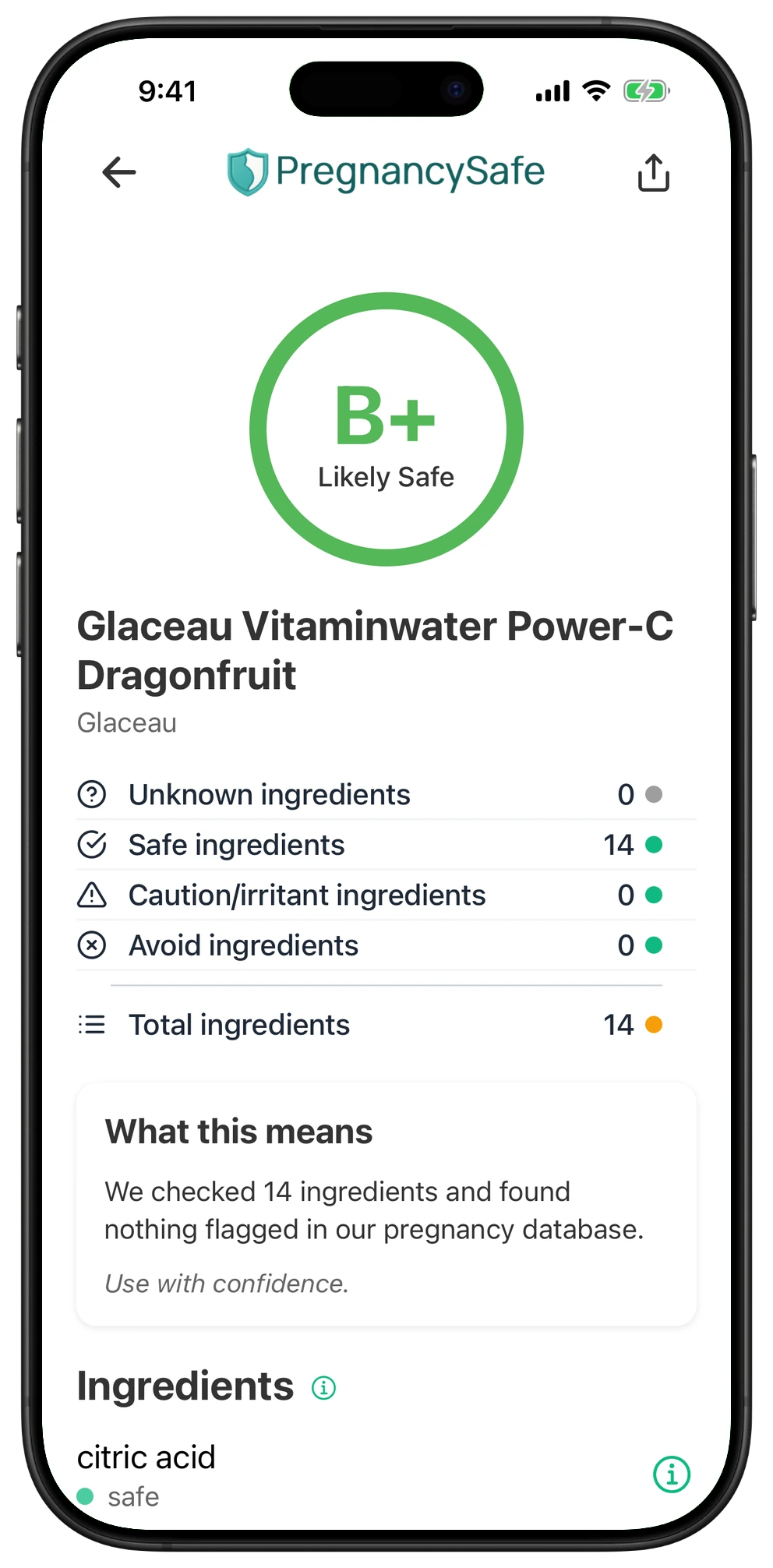
| B+ | Glaceau Vitaminwater Power-C Dragonfruit | Glaceau |
| B+ | Glaceau Vitaminwater Zero Sugar Re-Hydrate Pineapple Passionfruit | Glaceau |
| B+ | Glaceau Vitaminwater Xxx Acai-Blueberry-Pomegranate | Glaceau |
| B+ | Vitaminwater | Vitaminwater |
| B+ | Glaceau Vitamin Water Essential Orange | Glaceau |
Your Questions Answered
Can I drink vitamin water while pregnant?
It depends on the formula and how much you drink, rather than the vitamin water name alone. Check caffeine, sugar, herbal ingredients and vitamin amounts on the current bottle. Count vitamins alongside your supplements and keep total caffeine below 200 mg per day.
How much vitamin water can I drink each day?
There is no single bottle limit that fits every vitamin enhanced water. Bottle sizes, caffeine levels and vitamin doses vary, and your prenatal adds to your overall intake. Before drinking it daily or having multiple bottles, compare the full amounts with your supplements and ask your prenatal clinician if the overlap is unclear.
Is zero sugar vitamin water a better choice during pregnancy?
A zero sugar version can help you limit sugar from drinks, but that claim addresses only one part of the formula. It does not establish the caffeine level, herbal contents or vitamin doses. Check those separately rather than treating zero sugar as a pregnancy safety label.
Can vitamin water replace my prenatal vitamin?
No, an ordinary fortified drink is not a substitute for an indicated prenatal supplement. Its nutrient amounts may differ from what your prenatal care plan calls for. Keep following that plan, and account for the drink's added vitamins rather than assuming more is better.
Should I avoid vitamin water containing retinyl palmitate?
Retinyl palmitate is a form of preformed vitamin A, so the relevant question in a beverage is the amount you ingest alongside other sources. Evidence about prescription retinoids or topical skincare does not establish that a fortified beverage causes the same harm. Check the vitamin A amount and form with your prenatal clinician if you cannot determine the overlap with supplements. Label text that places B12 or B7 next to retinyl palmitate does not make those B vitamins the same ingredient as vitamin A.
Is elderberry juice in vitamin water unsafe during pregnancy?
Limited pregnancy evidence for concentrated elderberry supplements does not establish harm from a small amount of prepared juice in a beverage. Properly cooked ripe berries are different from raw or unripe berries and leaves, stems, bark or roots, which can contain toxic compounds. Check the preparation and concentration, and discuss supplement like use with your clinician rather than relying on immune support claims.
Does an A grade mean a vitamin water is proven safe for pregnancy?
No. Our catalog contains 25 entries: 5 graded A, 15 B+, 1 C+ and 4 F, but these are ingredient scores rather than independently verified safe product totals. Grades do not measure dose or confirm current package contents, and a low grade alone does not prove a drink is unsafe. The listed products are catalog comparison options, not confirmation of a complete current formula or appropriate nutrient doses.
How Do We Score Products for Pregnancy Safety?
We analyze each product's ingredients and category to flag known risks and provide cautionary notices for general category safety concerns.
Grades reflect the ingredient and category information available to us. They don’t verify a complete, current label or account for dose, preparation, or contamination. Read them alongside the guidance above, not as a guarantee of pregnancy safety or proof that every use is harmful.
A - Safe
Excellent choice! All ingredients are considered safe during pregnancy.
What to do: Use with confidence.
B - Likely Safe
Pretty much safe with very minimal risk. Some ingredients may have limited pregnancy studies, but no significant safety concerns have been identified.
What to do: Use with confidence.
C - Limit
Contains ingredients with some pregnancy considerations. Research shows these ingredients may have limited safety data, potential for minor hormonal effects, or require caution based on animal studies.
What to do: Use sparingly and consider safer alternatives when available.
D - Caution
Similar to C grade but contains multiple cautionary ingredients. The combination increases overall concern.
What to do: Try to avoid if that makes you feel better. If you've already used it, no need to panic.
F - Avoid
Contains an ingredient Pregnancy Safe recommends avoiding during pregnancy. This may reflect an established risk or a precaution based on limited evidence; check the ingredient guidance and exposure context.
What to do: Do not use during pregnancy. If you've already used it, don't worry - contact your OBGYN if concerned.
People Also Checked
References
- https://ods.od.nih.gov/factsheets/Pregnancy-HealthProfessional/
- https://www.acog.org/womens-health/experts-and-stories/ask-acog/how-much-coffee-can-i-drink-while-pregnant
- https://www.ema.europa.eu/en/news/updated-measures-pregnancy-prevention-during-retinoid-use
- https://www.ncbi.nlm.nih.gov/books/NBK582989/
- https://www.ncbi.nlm.nih.gov/books/NBK582775/
- https://pubmed.ncbi.nlm.nih.gov/26215715/
- https://pubmed.ncbi.nlm.nih.gov/41365815/
- https://pubmed.ncbi.nlm.nih.gov/36447117/
- https://dailymed.nlm.nih.gov/dailymed/drugInfo.cfm?setid=9f1c8971-c6dc-4708-848b-5cee50b6c32a
- https://dailymed.nlm.nih.gov/dailymed/drugInfo.cfm?setid=993a5325-cd10-4450-b5ea-1c0a90510df6
- https://dailymed.nlm.nih.gov/dailymed/lookup.cfm?setid=34d79c31-1568-4797-a4f5-31200c7788db
- https://www.nccih.nih.gov/health/elderberry
- https://pmc.ncbi.nlm.nih.gov/articles/PMC3941201/
- https://pmc.ncbi.nlm.nih.gov/articles/PMC8026097/
- https://pmc.ncbi.nlm.nih.gov/articles/PMC7961730/
- https://www.cdc.gov/mmwr/preview/mmwrhtml/00000311.htm
- https://www.fda.gov/food/information-consumers-using-dietary-supplements/questions-and-answers-dietary-supplements
- https://pubmed.ncbi.nlm.nih.gov/11518905/
- https://infantrisk.com/content/management-cold-and-flu-during-pregnancy