Is Licorice Safe During Pregnancy? (Updated 2026 Guide)
Updated September 9, 2026
The Answer
Avoid high dose or regular medicinal licorice during pregnancy, and check candy labels for real licorice root or extract rather than relying on color or flavor. Our catalog contains 23 A grade records out of 41, but those grades cannot establish glycyrrhizin dose or pregnancy suitability.
True licorice root and extract can contain glycyrrhizin, which can affect blood pressure and potassium; pregnancy evidence raises concern at high oral exposure. Fruit flavored candy without licorice extract differs from true licorice, but some red or cherry varieties still contain it. Added sugars and optional food colors are secondary considerations, not evidence that an occasional candy exposure causes fetal harm.
Pregnancy Safe is 100% independent and research driven. No companies pay to promote or sponsor products.
Stress Less This Pregnancy
Check your exact licorice in the app

✓ What's Safe
- • Read the exact package ingredient list for licorice or liquorice root and extract, including on fruit flavored candy.
- • If you want candy without the glycyrrhizin concern, choose a version whose label confirms it contains no real licorice root or extract.
- • Check herbal tea blends and oral remedies for licorice before using them regularly.
- • For candy without licorice extract, check serving size and added sugars and keep it an occasional treat.
- • Ask your prenatal clinician before using licorice supplements, concentrated extracts or deglycyrrhizinated licorice.
✗ What to Avoid
- • High dose or regular medicinal use of oral licorice root or extract during pregnancy.
- • Frequent or large amounts of true licorice candy when its glycyrrhizin content is unknown.
- • Assuming red, strawberry or cherry candy is free of licorice extract.
- • Treating an A grade, an alcohol free label or a DGL claim as pregnancy clearance.
- • Large, frequent candy portions containing sugar or high fructose corn syrup; replacing one sweetener with another does not remove the added sugar consideration.
Most Common Ingredients in Licorice Products
We analyzed 41 licorice products. Here are the most common ingredients, ranked by how often they appear:
Ingredients to Watch Out For in Licorice
These are the most common flagged ingredients across 41 licorice products we analyzed.
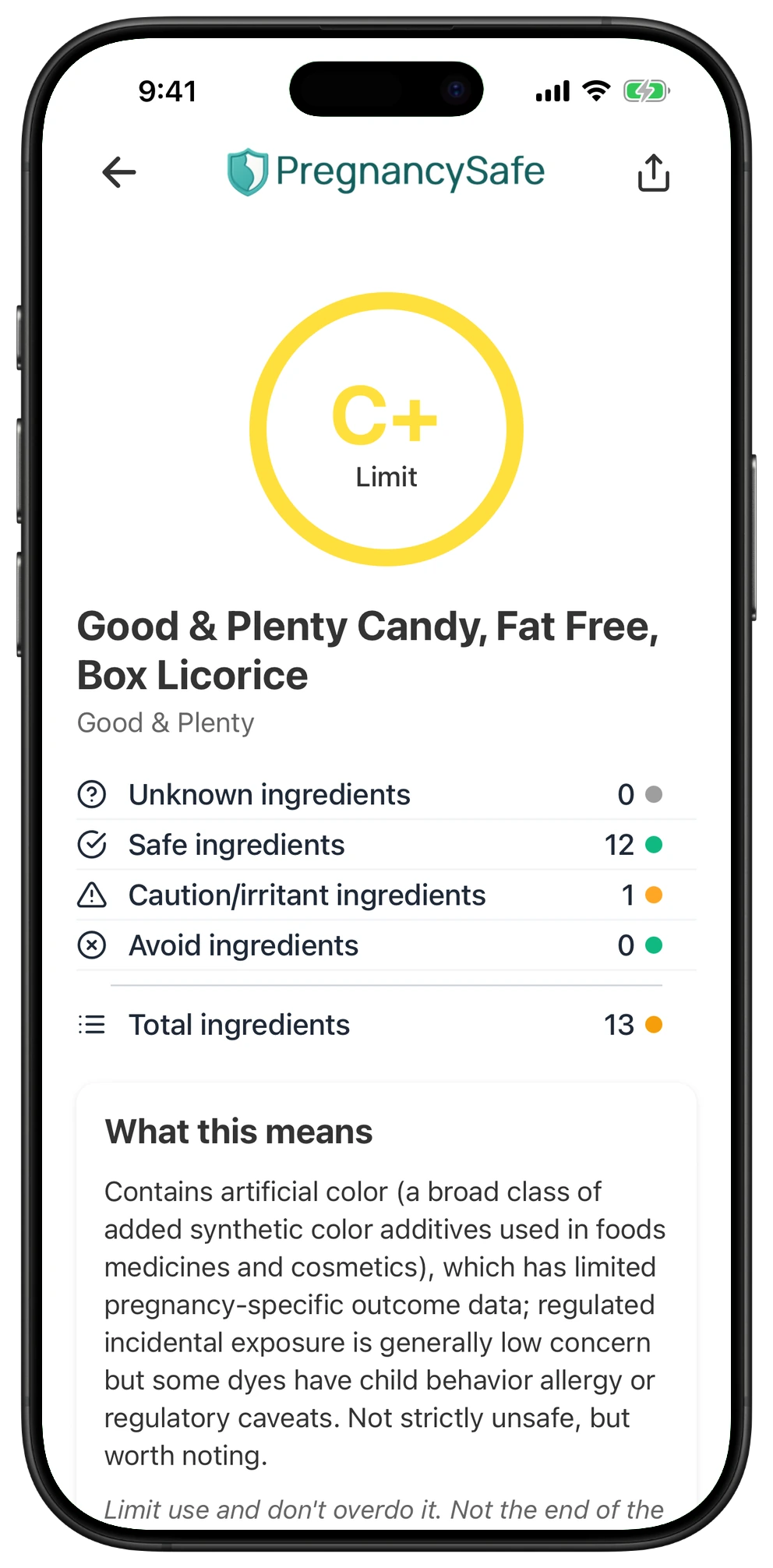
artificial color
Caution
Artificial color is a synthetic dye added to foods and products to enhance or alter their visual appearance.
Has limited pregnancy specific outcome data; regulated incidental exposure is generally low concern but some dyes have child behavior allergy or regulatory caveats.
Flagged in 3 of 41 products (7%)
red 3
Caution
Red 3 is a synthetic red dye commonly used to add vibrant color to food and beverages.
Has limited human pregnancy outcome data and is being phased out of U.S. foods and ingested drugs after high dose male rat thyroid tumor findings.
Flagged in 3 of 41 products (7%)
Caution
Red 40 is a synthetic food dye commonly used to add vibrant red color to candies, beverages, and processed foods.
Has limited human pregnancy data and is allowed at regulated food additive levels, but child neurobehavior concerns and high dose animal findings make frequent high dye intake worth limiting.
Flagged in 3 of 41 products (7%)
blue 1
Caution
Blue 1 is a synthetic blue dye commonly used to add vibrant color to foods, beverages, and cosmetics.
Has limited human pregnancy data; regulated food use is not shown to cause fetal harm, but high dose animal neurobehavior findings and child sensitivity concerns support minimizing frequent exposure.
Flagged in 2 of 41 products (5%)
high fructose corn syrup
Caution
High fructose corn syrup is a sweet, liquid sweetener made from corn starch, commonly used in processed foods and beverages.
Is not a known teratogen at occasional food amounts, but high added sugar intake can displace nutrients and raise gestational diabetes and metabolic concerns.
Flagged in 2 of 41 products (5%)
hydrogenated coconut oil
Caution
Hydrogenated coconut oil is a processed form of coconut oil that has been chemically altered to become solid at room temperature, often used in baking and processed foods.
Mainly raise concern when partially hydrogenated and high in artificial trans fat; fully hydrogenated oils are mostly a saturated fat limit rather than the same trans fat issue.
Flagged in 2 of 41 products (5%)
c blue 1
Caution
C.I. Blue 1 is a synthetic blue dye commonly used to add color to food, beverages, and cosmetics.
Has limited human pregnancy data; regulated food use is not shown to cause fetal harm, but high dose animal neurobehavior findings and child sensitivity concerns support minimizing frequent exposure.
Flagged in 1 of 41 products (2%)
c red 40
Caution
Cochineal Red 40 is a synthetic red dye commonly used to add vibrant color to foods, beverages, and cosmetics.
Has limited human pregnancy data and is allowed at regulated food additive levels, but child neurobehavior concerns and high dose animal findings make frequent high dye intake worth limiting.
Flagged in 1 of 41 products (2%)
Licorice Products We've Analyzed
Our catalog contains ratings for 41 licorice products. These are database grades, not independent safety certifications.
Ingredient grades cannot establish dose, preparation, label completeness, efficacy or pregnancy suitability. An A score is not an endorsement, and counts include unreviewed catalog records.
Your Questions Answered
Can pregnant ladies eat licorice?
It depends on whether the product contains real licorice root or extract and how much you consume. Avoid high dose or regular medicinal licorice during pregnancy because glycyrrhizin can affect blood pressure and potassium, and high oral exposure raises pregnancy concerns. Candy flavored without real licorice does not carry that same ingredient specific concern. Check the exact label rather than relying on the word licorice or the candy's color.
Is black licorice safe during pregnancy, and how much can I eat?
Check black licorice for real licorice root or extract, and avoid frequent or large amounts when glycyrrhizin content is unknown. An ingredient list or grade cannot establish a safe number of candies. A small incidental amount does not establish that fetal harm occurred. If you have eaten substantial amounts or used it regularly, tell your prenatal clinician what you consumed, how much and how often.
Is red or cherry licorice different from black licorice?
Fruit flavored candy made without real licorice root or extract differs from glycyrrhizin containing licorice. However, some red and cherry varieties still list licorice extract, so flavor is not a reliable shortcut. Read the exact version's label before choosing it. When it contains no real licorice, focus on ordinary candy considerations such as portion size and added sugar.
Can I drink licorice root tea or take DGL while pregnant?
Do not make licorice root tea or concentrated oral extracts a regular pregnancy remedy without discussing them with your prenatal clinician. These are oral exposures, and the ingredient name alone does not establish the glycyrrhizin dose. Deglycyrrhizinated licorice, or DGL, is not automatically cleared for pregnancy. Check blended teas too, rather than assuming a blend contains no licorice.
Is licorice skincare safe during pregnancy?
Applying a cosmetic to your skin is different from drinking licorice tea or swallowing an extract. Concerns from high oral exposure do not establish fetal harm from topical cosmetic use. That distinction also does not prove every licorice containing skincare product is suitable during pregnancy. Ask your clinician about the exact formulation and how you use it if you need product specific guidance.
Does an A grade mean a licorice product is pregnancy safe?
No. Our catalog contains 41 records, including 23 graded A, but those counts include unreviewed records and are not a count of independently verified safe products. Ingredient grades cannot establish glycyrrhizin dose, label completeness or pregnancy suitability. A lower grade also does not automatically mean a product is harmful; the exact ingredients, form and amount matter.
How Do We Score Products for Pregnancy Safety?
We analyze each product's ingredients and category to flag known risks and provide cautionary notices for general category safety concerns.
Grades reflect the ingredient and category information available to us. They don’t verify a complete, current label or account for dose, preparation, or contamination. Read them alongside the guidance above, not as a guarantee of pregnancy safety or proof that every use is harmful.
A - Safe
Excellent choice! All ingredients are considered safe during pregnancy.
What to do: Use with confidence.
B - Likely Safe
Pretty much safe with very minimal risk. Some ingredients may have limited pregnancy studies, but no significant safety concerns have been identified.
What to do: Use with confidence.
C - Limit
Contains ingredients with some pregnancy considerations. Research shows these ingredients may have limited safety data, potential for minor hormonal effects, or require caution based on animal studies.
What to do: Use sparingly and consider safer alternatives when available.
D - Caution
Similar to C grade but contains multiple cautionary ingredients. The combination increases overall concern.
What to do: Try to avoid if that makes you feel better. If you've already used it, no need to panic.
F - Avoid
Contains an ingredient Pregnancy Safe recommends avoiding during pregnancy. This may reflect an established risk or a precaution based on limited evidence; check the ingredient guidance and exposure context.
What to do: Do not use during pregnancy. If you've already used it, don't worry - contact your OBGYN if concerned.
References
- https://www.nccih.nih.gov/health/licorice-root
- https://www.fda.gov/food/color-additives-information-consumers/color-additives-questions-and-answers-consumers
- https://www.fda.gov/food/food-ingredients-packaging/color-additives-information-consumers
- https://www.fda.gov/cosmetics/cosmetic-ingredient-names/color-additives-permitted-use-cosmetics
- https://www.fda.gov/industry/color-additives/fdc-red-no-3
- https://pubmed.ncbi.nlm.nih.gov/35233072/
- https://pubmed.ncbi.nlm.nih.gov/35484553/
- https://pubmed.ncbi.nlm.nih.gov/35106984/
- https://www.federalregister.gov/documents/2025/01/16/2025-00830/color-additive-petition-from-center-for-science-in-the-public-interest-et-al-request-to-revoke-color
- https://efsa.onlinelibrary.wiley.com/doi/10.2903/j.efsa.2011.1854
- https://pubmed.ncbi.nlm.nih.gov/2824305/
- https://pubmed.ncbi.nlm.nih.gov/2177442/
- https://pubmed.ncbi.nlm.nih.gov/8296313/
- https://pubmed.ncbi.nlm.nih.gov/8386132/
- https://pmc.ncbi.nlm.nih.gov/articles/PMC9368057/
- https://www.hfpappexternal.fda.gov/scripts/fdcc/index.cfm?id=FDCRed40&set=ColorAdditives
- https://www.ecfr.gov/current/title-21/chapter-I/subchapter-A/part-74/subpart-A/section-74.340
- https://www.fda.gov/food/color-additives-information-consumers/tracking-food-industry-pledges-remove-petroleum-based-food-dyes
- https://www.efsa.europa.eu/en/efsajournal/pub/1327
- https://www.efsa.europa.eu/en/efsajournal/pub/4007
- https://apps.who.int/food-additives-contaminants-jecfa-database/Home/Chemical/2361
- https://oehha.ca.gov/risk-assessment/report/health-effects-assessment-potential-neurobehavioral-effects-synthetic-food-dyes-children
- https://pubmed.ncbi.nlm.nih.gov/6636206/
- https://pubmed.ncbi.nlm.nih.gov/2613118/
- https://pubmed.ncbi.nlm.nih.gov/7940558/
- https://www.hfpappexternal.fda.gov/scripts/fdcc/index.cfm?id=FDCBlue1&set=ColorAdditives
- https://www.ecfr.gov/current/title-21/chapter-I/subchapter-A/part-74
- https://efsa.onlinelibrary.wiley.com/doi/10.2903/j.efsa.2010.1853
- https://apps.who.int/food-additives-contaminants-jecfa-database/Home/Chemical/3309
- https://pubmed.ncbi.nlm.nih.gov/23208798/
- https://pubmed.ncbi.nlm.nih.gov/24257113/
- https://cdn.realfood.gov/DGA.pdf
- https://www.dietaryguidelines.gov/sites/default/files/2021-12/DGA_Pregnancy_FactSheet-508c.pdf
- https://www.acog.org/womens-health/faqs/healthy-eating-during-pregnancy
- https://www.cdc.gov/nutrition/php/data-research/added-sugars.html
- https://www.cdc.gov/diabetes/about/gestational-diabetes.html
- https://www.who.int/publications/i/item/9789241549028
- https://nesr.usda.gov/2025-dietary-guidelines-advisory-committee-systematic-reviews/dietary-patterns_gestational-diabetes
- https://www.fda.gov/food/food-additives-petitions/trans-fat
- https://www.fda.gov/food/hfp-constituent-updates/fda-completes-final-administrative-actions-partially-hydrogenated-oils-foods
- https://www.federalregister.gov/documents/2013/11/08/2013-26854/tentative-determination-regarding-partially-hydrogenated-oils-request-for-comments-and-for
- https://www.who.int/news-room/fact-sheets/detail/trans-fat
- https://www.fda.gov/food/people-risk-foodborne-illness/dietary-advice-and-during-pregnancy
- https://www.rcpi.ie/Portals/0/Document%20Repository/Institute%20of%20Obstetricians%20and%20Gynaecologists/National%20Clinical%20Guidelines/IOG_National%20Clinical%20Guidelines_Nutrition%20in%20pregnancy%20Guideline_2019.pdf
- https://pmc.ncbi.nlm.nih.gov/articles/PMC8027310/
- https://pmc.ncbi.nlm.nih.gov/articles/PMC3192475/
- https://hfpappexternal.fda.gov/scripts/fdcc/index.cfm?id=FDCYellow5&set=ColorAdditives
- https://www.ecfr.gov/current/title-21/chapter-I/subchapter-A/part-74#74.705
- https://www.fda.gov/food/nutrition-food-labeling-and-critical-foods/food-allergies
- https://apps.who.int/food-additives-contaminants-jecfa-database/Home/Chemical/3885
- https://efsa.onlinelibrary.wiley.com/doi/10.2903/j.efsa.2009.1331
- https://pubmed.ncbi.nlm.nih.gov/1628860/
- https://pmc.ncbi.nlm.nih.gov/articles/PMC7023231/
- https://pmc.ncbi.nlm.nih.gov/articles/PMC6354951/
- https://www.nccih.nih.gov/health/elderberry
- https://pmc.ncbi.nlm.nih.gov/articles/PMC3941201/
- https://pmc.ncbi.nlm.nih.gov/articles/PMC8026097/
- https://pmc.ncbi.nlm.nih.gov/articles/PMC7961730/
- https://www.cdc.gov/mmwr/preview/mmwrhtml/00000311.htm
- https://www.fda.gov/food/information-consumers-using-dietary-supplements/questions-and-answers-dietary-supplements
- https://pubmed.ncbi.nlm.nih.gov/11518905/
- https://infantrisk.com/content/management-cold-and-flu-during-pregnancy