Best Pregnancy Safe Serum (Updated 2026 Guide)
Updated September 9, 2026
The Answer
Some facial serums can fit a pregnancy skincare routine, but choose by the complete formula and intended use: avoid retinol and other topical retinoids, and assess lash serums separately. The catalog contains 1,397 products with grades ranging from A to F; those grades are screening information, not clinical safety approvals.
The main distinction is between ordinary facial skincare, stronger acid peels and products applied along the lash line. ACOG advises avoiding topical retinoids as a precaution despite low absorption, while allowing OTC topical salicylic acid acne products used as directed. Fragrance and several other flagged ingredients raise irritation, formulation quality or limited evidence concerns rather than demonstrating fetal harm from normal facial application.
Pregnancy Safe is 100% independent and research driven. No companies pay to promote or sponsor products.
Stress Less This Pregnancy
Check your exact serum in the app

✓ What's Safe
- • Check the complete ingredient list for the exact formula and size you have, rather than relying on a front label ingredient or catalog grade.
- • For hydration, look for formulations centered on glycerin or sodium hyaluronate, then check the remaining ingredients for retinoids and other relevant concerns.
- • Choose fragrance free formulations if scents trigger nausea, irritation or allergy.
- • For salicylic acid acne products, look for clearly stated strength and application instructions; distinguish ordinary OTC treatment from a concentrated peel.
- • Check whether the product is intended for the face or lash line. Have a clinician review the exact lash serum formula before use during pregnancy.
✗ What to Avoid
- • Avoid retinol and other topical retinoids during pregnancy, including in anti aging facial serums.
- • Avoid self directed high concentration salicylic acid peels or prolonged, covered, large area or broken skin application; these differ from directed OTC acne use.
- • Skip fragrance, parfum or parfum fragrance if you have fragrance sensitivity. These labels describe scent mixtures, not proof that a serum contains phthalates or harms a pregnancy.
- • Avoid adding concentrated lavandula angustifolia oil to a serum yourself; diluted cosmetic use and concentrated essential oil exposure are not equivalent.
- • Avoid choosing or rejecting a serum solely because it contains phenoxyethanol or bht. Their caution flags do not establish harm at reviewed cosmetic concentrations.
- • Avoid treating a facial serum assessment as clearance for lash line use, or treating an incomplete A grade record as a verified complete formula.
Most Common Ingredients in Serum Products
We analyzed 1,397 serum products. Here are the most common ingredients, ranked by how often they appear:
Ingredients to Watch Out For in Serum
These are the most common flagged ingredients across 1,397 serum products we analyzed.
Caution
Phenoxyethanol is a preservative commonly used in cosmetics and skincare products to prevent microbial growth and extend shelf life.
Has limited direct pregnancy data and possible infant oral exposure concerns from nipple area products, while regulated cosmetic concentrations are generally considered low systemic risk.
Phenoxyethanol preserves serums by limiting microbial growth. Direct pregnancy data are limited, but cosmetic reviews consider regulated concentrations acceptable; high dose animal findings do not establish harm from normal facial use. Nursing related warnings about infant ingestion from nipple products are a separate exposure, not evidence against ordinary facial application.
Flagged in 715 of 1,397 products (51%)
fragrance
Caution
A fragrant substance used to add a pleasant aroma to products or environments.
Can hide product specific mixtures and has been associated with higher DEP metabolite exposure in some pregnancy studies; fragrance allergens and VOCs may also irritate sensitive skin or airways.
Fragrance denotes a scent mixture whose individual components may not be disclosed. In a leave on serum, irritation or allergy is a practical concern, so fragrance free options may suit sensitive skin. Associations between fragranced product use and some exposure markers do not prove that every serum contains phthalates or causes pregnancy harm.
Flagged in 155 of 1,397 products (11%)
parfum
Caution
Parfum is a fragrant mixture of essential oils, aroma compounds, and solvents used to impart a pleasant scent.
Can hide product specific mixtures and has been associated with higher DEP metabolite exposure in some pregnancy studies; fragrance allergens and VOCs may also irritate sensitive skin or airways.
Parfum is a label term for a fragrance mixture, not a single defined chemical. Its composition may be undisclosed, and it can irritate sensitive facial skin. Choosing a parfum free serum can reduce scent exposure, but normal topical use is not established to cause fetal harm.
Flagged in 135 of 1,397 products (10%)
Avoid
Retinol is a form of vitamin A commonly used in skincare to promote cell turnover and reduce the appearance of aging.
Is generally avoided in pregnancy because retinoid class fetal risk concerns outweigh nonessential cosmetic benefits despite low topical absorption and reassuring inadvertent exposure data.
Retinol is a vitamin A alcohol used in facial serums for acne and signs of aging. Avoid it during pregnancy as a topical retinoid precaution, despite generally low skin absorption and reassuring inadvertent exposure findings. This advice should not be confused with the established risks of oral isotretinoin.
Flagged in 111 of 1,397 products (8%)
parfum fragrance
Caution
A parfum fragrance is a concentrated aromatic blend designed to impart a pleasing and lasting scent when applied to the skin or clothing.
Can hide product specific mixtures and has been associated with higher DEP metabolite exposure in some pregnancy studies; fragrance allergens and VOCs may also irritate sensitive skin or airways.
Parfum fragrance is combined label wording for a scent mixture; it does not establish a particular concentration or identify every component. In facial serums, the practical concerns are undisclosed composition and possible skin irritation or allergy. It is not evidence by itself of phthalate content or pregnancy harm.
Flagged in 89 of 1,397 products (6%)
Caution
Salicylic acid is a beta hydroxy acid commonly used in skincare to exfoliate the skin, unclog pores, and treat acne.
Is generally low concern in directed low dose topical acne use during pregnancy but needs caution with high concentration peels, wart or callus removers, large area, occlusive, broken skin, or raw chemical exposure; oral salicylates are separate medication exposures.
Salicylic acid is an exfoliating beta hydroxy acid used in acne serums. ACOG allows OTC topical acne use during pregnancy as directed; concentrated peels and prolonged, covered, large area or broken skin application need separate caution. Oral salicylate risks should not be applied directly to ordinary topical serum use.
Flagged in 87 of 1,397 products (6%)
bht
Caution
BHT (butylated hydroxytoluene) is a synthetic antioxidant commonly used as a preservative to prevent the oxidation of fats and oils in food products.
Has limited human pregnancy data, with low concern at reviewed cosmetic levels but reproductive and thyroid related findings in high dose oral animal studies.
BHT, or butylated hydroxytoluene, is an antioxidant that helps protect a serum's ingredients from oxidation. Cosmetic reviews consider specified topical concentrations acceptable, although direct pregnancy data are limited. Reproductive findings from high dose oral animal studies do not demonstrate harm from normal facial application.
Flagged in 85 of 1,397 products (6%)
glycyrrhiza glabra root extract
Caution
Glycyrrhiza glabra root extract is a natural compound derived from licorice root, commonly used for its soothing, anti inflammatory, and sweetening properties in skincare and herbal remedies.
Is low concern in typical topical cosmetics but warrants caution because oral licorice or glycyrrhizin exposure in pregnancy is linked to blood pressure effects, shorter gestation, preterm birth, and child neurodevelopment signals.
Glycyrrhiza glabra root extract is a licorice root extract used in serums for brightening and skin conditioning. Typical topical cosmetic use is lower concern than heavy oral licorice or glycyrrhizin exposure, although pregnancy specific skin use data are limited. Oral pregnancy findings do not establish the same effects from a facial serum; watch for local irritation.
Flagged in 61 of 1,397 products (4%)
Types of Serum
How Do Serum Products Stack Up?
Our catalog contains ratings for 1,397 serum products. These are database grades, not independent safety certifications.
These grades reflect recorded ingredients and category context, not verification of every complete formula. Facial and lash-line products have different exposure contexts. The listed products are selected using ingredient grades, app searches and record checks, not independent verification of every current label.
Best Pregnancy Safe Serum
Popular options from our catalog, prioritizing A and B ingredient grades, with C grade options used to fill remaining places. Within each group, products are ordered by searches in Pregnancy Safe, not retail sales. Read the cautions and guidance above; grades do not verify a complete current label or guarantee pregnancy safety.
| Grade | Product | Brand |
|---|---|---|
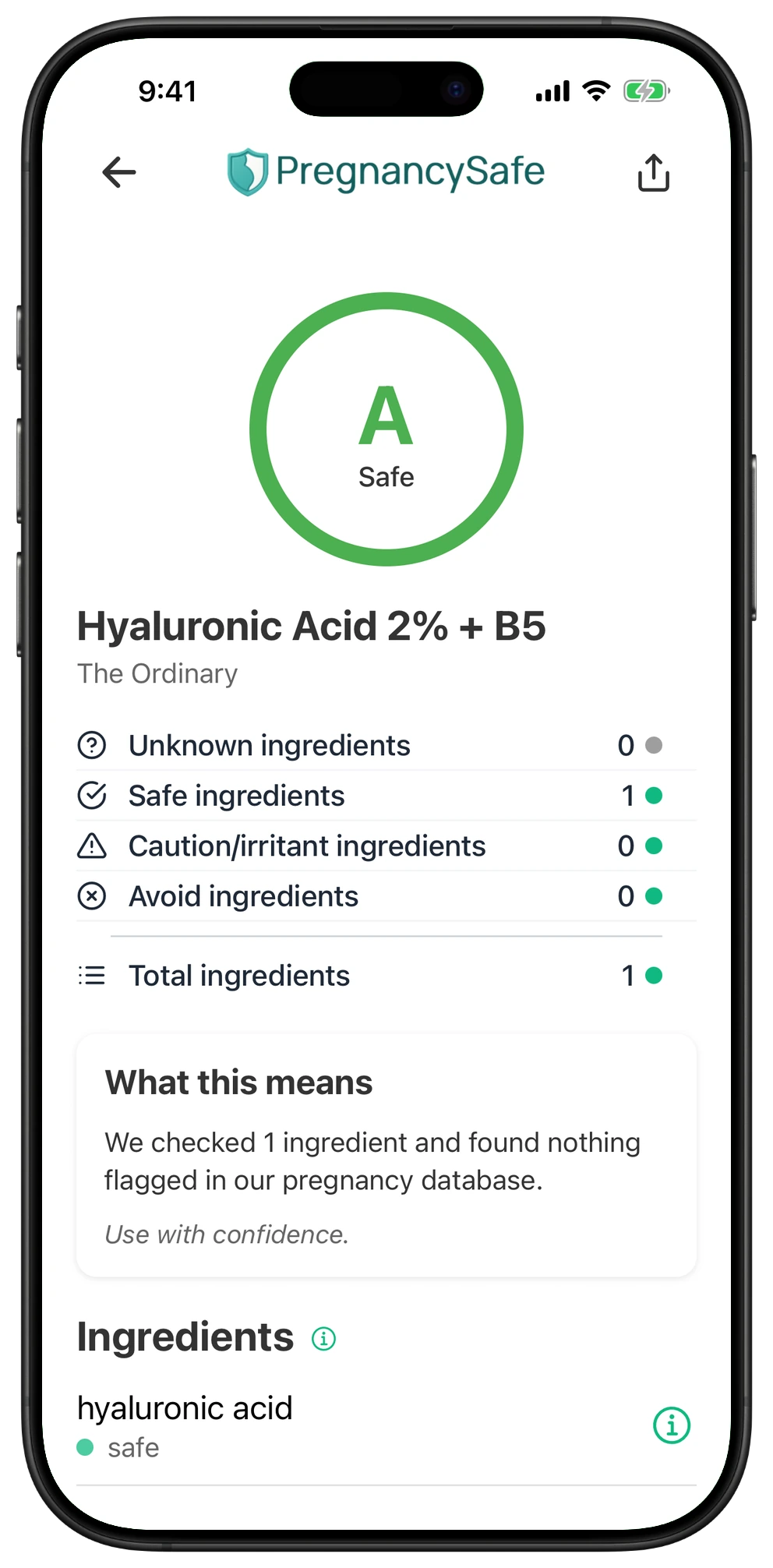
| A | Hyaluronic Acid 2% + B5 | The Ordinary |
| B+ | Byoma Hydrating Serum | Byoma |
| A | Vanicream Vitamin C Face Serum | Vanicream |
| B+ | Seoul Ceuticals Korean Skin Care Snail Mucin Serum - Korean Beauty Skincare Night Serum Hyaluronic Acid For Face - Contains 97.5% K Beauty Snail | Seoul Ceuticals |
| B+ | Byoma Brightening Serum | Byoma |
Your Questions Answered
Which facial serum should I choose during pregnancy?
Start with the job you need the serum to do, such as hydration, rather than a long list of active ingredients. A formula centered on glycerin or sodium hyaluronate is a practical starting point, but you still need to check the complete label. Avoid retinol and other topical retinoids, and consider fragrance free options if your skin is sensitive. Use the product only on its intended area and according to its directions.
Is eyelash serum safe during pregnancy?
A facial serum assessment cannot establish whether a lash serum is suitable during pregnancy. Lash line application needs its own review of the exact ingredients, directions and warnings. Oral or herbal evidence behind a background caution does not establish harm from lash line exposure, but it also does not provide pregnancy clearance. Ask your clinician to review the complete formula before starting or continuing an eyelash serum.
Can I use a salicylic acid serum while pregnant?
ACOG lists OTC topical salicylic acid among acne ingredients that can be used during pregnancy. Directed low dose topical acne treatment is different from a high concentration facial peel. Large area, prolonged, covered or broken skin application can increase absorption and irritation, so discuss those uses with your clinician. Oral aspirin and other oral salicylates require separate medication advice.
What if I used retinol before I knew I was pregnant?
Stop using the retinol serum and tell your prenatal clinician which product you used, how often and on what area. Topical retinol exposure is not equivalent to taking oral isotretinoin, which has established fetal risks. Human topical retinoid studies have not shown a clear increase in major malformations, although pregnancy data remain limited. Avoidance is a precaution, not a finding that your previous application caused harm.
Do I need to avoid every serum containing preservatives or fragrance?
No: a caution flag is not a blanket instruction to stop every product containing that ingredient. Phenoxyethanol helps prevent microbial growth, and cosmetic safety reviews consider it acceptable at regulated concentrations despite limited direct pregnancy data. Fragrance can trigger irritation or allergy, making fragrance free formulas useful for sensitive skin. Neither a fragrance label nor a preservative name alone proves fetal harm from ordinary facial use.
Do A grades mean a serum is pregnancy safe?
No. The catalog contains 1,397 products, including 38 with A grades, but the grades reflect recorded ingredients and category context rather than independently verified complete formulas or clinical outcomes. Incomplete labels make an A grade insufficient for recommending a product, and an F grade does not prove that an individual product caused harm. These counts describe catalog coverage, not a representative sample of the market.
How were these serum products selected?
The list prioritizes A/B ingredient grades, with C grades filling remaining slots, and uses searches in Pregnancy Safe within each group after deduplication and record checks. These are catalog comparison options, not independently verified current labels or pregnancy safety certifications. Check the complete label, intended application area and directions for your exact formulation. A listing does not establish suitability for every skin condition or extend to every size, reformulation or similarly named product.
How Do We Score Products for Pregnancy Safety?
We analyze each product's ingredients and category to flag known risks and provide cautionary notices for general category safety concerns.
Grades reflect the ingredient and category information available to us. They don’t verify a complete, current label or account for dose, preparation, or contamination. Read them alongside the guidance above, not as a guarantee of pregnancy safety or proof that every use is harmful.
A - Safe
Excellent choice! All ingredients are considered safe during pregnancy.
What to do: Use with confidence.
B - Likely Safe
Pretty much safe with very minimal risk. Some ingredients may have limited pregnancy studies, but no significant safety concerns have been identified.
What to do: Use with confidence.
C - Limit
Contains ingredients with some pregnancy considerations. Research shows these ingredients may have limited safety data, potential for minor hormonal effects, or require caution based on animal studies.
What to do: Use sparingly and consider safer alternatives when available.
D - Caution
Similar to C grade but contains multiple cautionary ingredients. The combination increases overall concern.
What to do: Try to avoid if that makes you feel better. If you've already used it, no need to panic.
F - Avoid
Contains an ingredient Pregnancy Safe recommends avoiding during pregnancy. This may reflect an established risk or a precaution based on limited evidence; check the ingredient guidance and exposure context.
What to do: Do not use during pregnancy. If you've already used it, don't worry - contact your OBGYN if concerned.
References
- https://www.aad.org/public/everyday-care/skin-care-secrets/routine/pregnancy-skin-care
- https://www.acog.org/womens-health/faqs/skin-conditions-during-pregnancy
- https://health.ec.europa.eu/system/files/2021-08/sccs_o_195_0.pdf
- https://ec.europa.eu/growth/tools-databases/cosing/details/28157
- https://journals.sagepub.com/doi/10.3109/10915819009078737
- https://link.springer.com/article/10.1007/s00204-024-03938-5
- https://www.sfda.gov.sa/en/warnings/1156
- https://www.industrialchemicals.gov.au/sites/default/files/Ethanol%2C%202-phenoxy-_Human%20health%20tier%20II%20assessment.pdf
- https://hero.epa.gov/reference/2857875
- https://books.publisso.de/sites/default/files/documents/series/mak/dam/Vol2019/Iss1/Alt006/mb12299kske6319_w.pdf
- https://www.fda.gov/cosmetics/cosmetic-ingredients/fragrances-cosmetics
- https://www.fda.gov/cosmetics/cosmetic-ingredients/phthalates-cosmetics
- https://www.fda.gov/cosmetics/cosmetic-ingredients/allergens-cosmetics
- https://pmc.ncbi.nlm.nih.gov/articles/PMC3110684/
- https://pmc.ncbi.nlm.nih.gov/articles/PMC4016195/
- https://pmc.ncbi.nlm.nih.gov/articles/PMC4097177/
- https://pmc.ncbi.nlm.nih.gov/articles/PMC8453372/
- https://pmc.ncbi.nlm.nih.gov/articles/PMC10999525/
- https://www.epa.gov/indoor-air-quality-iaq/volatile-organic-compounds-impact-indoor-air-quality
- https://mothertobaby.org/fact-sheets/topical-acne-treatments-pregnancy/
- https://mothertobaby.org/fact-sheets/tretinoin-retin-a-pregnancy/
- https://www.medicinesinpregnancy.org/leaflets-a-z/isotretinoin-gel/
- https://www.ema.europa.eu/en/news/updated-measures-pregnancy-prevention-during-retinoid-use
- https://dailymed.nlm.nih.gov/dailymed/lookup.cfm?setid=34d79c31-1568-4797-a4f5-31200c7788db
- https://pubmed.ncbi.nlm.nih.gov/26215715/
- https://pubmed.ncbi.nlm.nih.gov/41365815/
- https://pubmed.ncbi.nlm.nih.gov/16243460/
- https://health.ec.europa.eu/publications/revision-scientific-opinion-sccs157616-vitamin-retinol-retinyl-acetate-retinyl-palmitate_en
- https://www.aad.org/public/diseases/acne/derm-treat/pregnancy
- https://pmc.ncbi.nlm.nih.gov/articles/PMC9823189/
- https://www.accessdata.fda.gov/drugsatfda_docs/omuf/Order/Final%20Administrative%20Order%20OTC000013_M006-Topical%20Acne%20drug%20products%20for%20OTC%20Human%20Use.pdf
- https://health.ec.europa.eu/system/files/2023-06/sccs_o_268.pdf
- https://www.fda.gov/drugs/drug-safety-and-availability/fda-recommends-avoiding-use-nsaids-pregnancy-20-weeks-or-later-because-they-can-result-low-amniotic
- https://www.accessdata.fda.gov/drugsatfda_docs/omuf/monographs/OTCMonograph_M028-WartRemoverDrugProductsforOTCHumanUse10012021.pdf
- https://www.ncbi.nlm.nih.gov/books/NBK582985/
- https://pmc.ncbi.nlm.nih.gov/articles/PMC3114665/
- https://pubmed.ncbi.nlm.nih.gov/9269866/
- https://pubmed.ncbi.nlm.nih.gov/10026401/
- https://pubmed.ncbi.nlm.nih.gov/24472429/
- https://www.ecfr.gov/current/title-21/chapter-I/subchapter-D/part-333/subpart-D/section-333.310
- https://pubmed.ncbi.nlm.nih.gov/38453786/
- https://www.accessdata.fda.gov/drugsatfda_docs/omuf/monographs/OTC%20Monograph_M006-Topical%20Acne%20drug%20products%20for%20OTC%20Human%20Use%2011.23.2021.pdf
- https://www.fda.gov/safety/medical-product-safety-information/nonsteroidal-anti-inflammatory-drugs-nsaids-drug-safety-communication-avoid-use-nsaids-pregnancy-20
- https://dermnetnz.org/topics/acne-in-pregnancy
- https://www.inchem.org/documents/icsc/icsc/eics0563.htm
- https://www.ncbi.nlm.nih.gov/books/NBK582985
- https://pubmed.ncbi.nlm.nih.gov/23914887
- https://www.fda.gov/drugs/drug-alerts-and-statements/fda-warns-against-purchasing-or-using-chemical-peel-skin-products-without-professional-supervision
- https://health.ec.europa.eu/system/files/2022-08/sccs_o_257.pdf
- https://pubmed.ncbi.nlm.nih.gov/37751543/
- https://pubmed.ncbi.nlm.nih.gov/12396675/
- https://pmc.ncbi.nlm.nih.gov/articles/PMC13151845/
- https://www.ecfr.gov/current/title-21/chapter-I/subchapter-B/part-172/subpart-B/section-172.115
- https://www.ecfr.gov/current/title-21/chapter-I/subchapter-B/part-182/subpart-D/section-182.3173
- https://www.fda.gov/news-events/press-announcements/fda-finalizes-food-chemical-safety-post-market-assessment-program-launches-reassessment-bht-ada
- https://www.nccih.nih.gov/health/licorice-root
- https://cosmileeurope.eu/inci/detail/6154/glycyrrhiza-glabra-root-extract/
- https://pubmed.ncbi.nlm.nih.gov/11390327/
- https://pubmed.ncbi.nlm.nih.gov/12396997/
- https://pubmed.ncbi.nlm.nih.gov/28158597/
- https://pubmed.ncbi.nlm.nih.gov/28833680/
- https://pubmed.ncbi.nlm.nih.gov/16884839/
- https://www.cir-safety.org/sites/default/files/S-breakout-092020.pdf
- https://vkm.no/download/18.948158f1633d1b9fb95930/1525764185285/Hazard%20assessment%20of%20glycyrrhizic%20acid%20from%20liquorice.pdf
- https://pubmed.ncbi.nlm.nih.gov/23696578/
- https://health.ec.europa.eu/document/download/ac80d106-eb65-4248-a2f8-dde5d9d9996f_en
- https://www.industrialchemicals.gov.au/sites/default/files/Ethanol%2C%202%2C2%27%2C2%27%27-nitrilotris-_Human%20health%20tier%20II%20assessment.pdf
- https://www.ncbi.nlm.nih.gov/books/NBK390891/
- https://www.govinfo.gov/content/pkg/FR-2009-08-05/html/E9-18698.htm
- https://pubmed.ncbi.nlm.nih.gov/15213765/
- https://pubmed.ncbi.nlm.nih.gov/21673209/
- https://www.nccih.nih.gov/health/lavender
- https://www.mayoclinichealthsystem.org/hometown-health/speaking-of-health/essential-oils-and-pregnancy
- https://pubmed.ncbi.nlm.nih.gov/39685078/
- https://pubmed.ncbi.nlm.nih.gov/41192533/
- https://pubmed.ncbi.nlm.nih.gov/33673548/
- https://pubmed.ncbi.nlm.nih.gov/32147050/
- https://pubmed.ncbi.nlm.nih.gov/31393563/
- https://pubmed.ncbi.nlm.nih.gov/35663791/