Is Salicylic Acid Safe During Pregnancy?
Updated September 12, 2026
The Answer
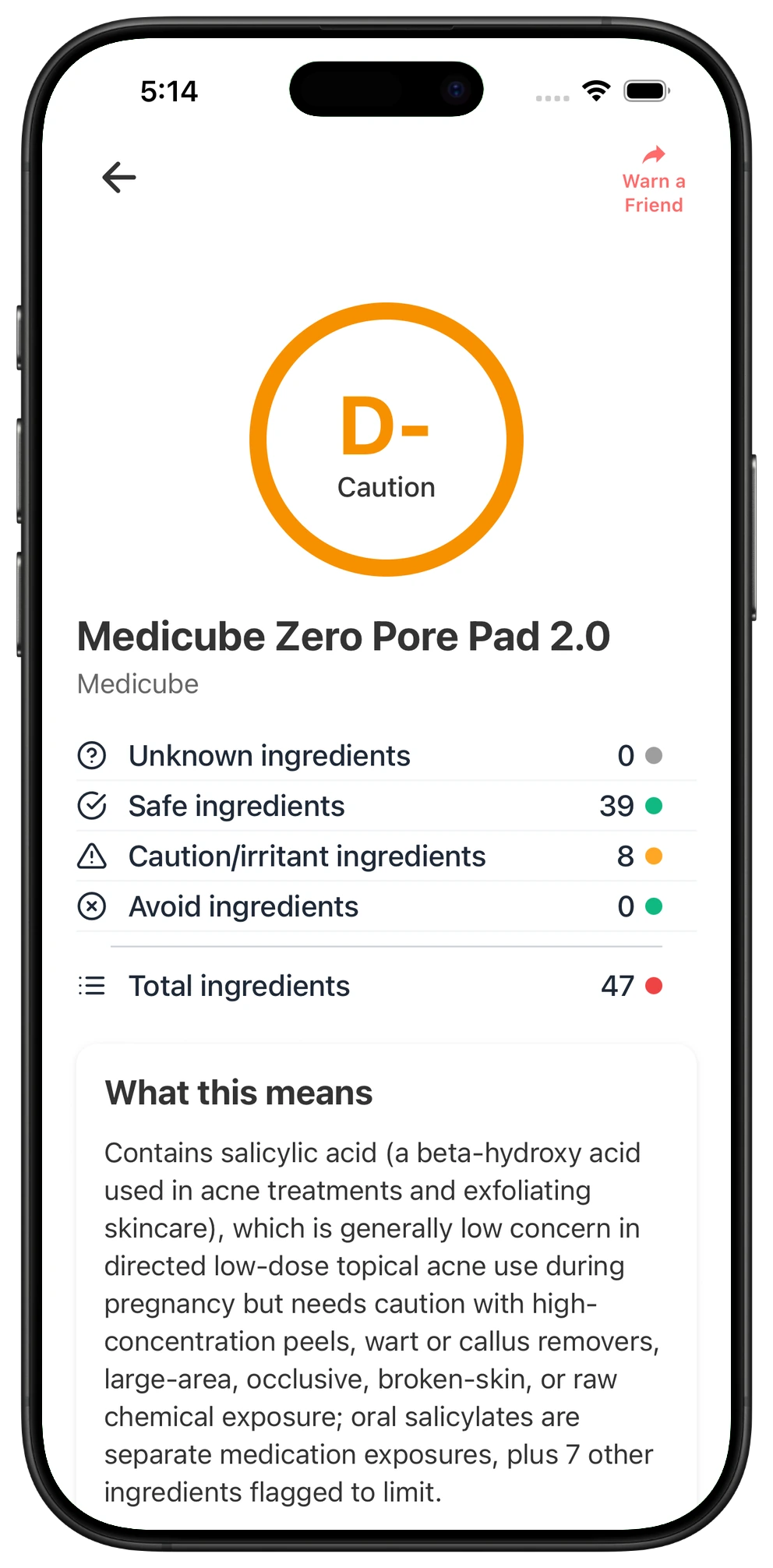
Salicylic acid is generally low concern during pregnancy when used as directed in low dose topical acne treatments. Its CAUTION rating concerns higher exposure uses, including strong peels, wart or callus removers, and application over large areas or broken skin; it does not mean that all skincare containing salicylic acid must be avoided.
Low dose topical acne treatment is different from high concentration or exposure increasing use, which can increase salicylate absorption and irritation.
ACOG lists OTC topical salicylic acid among acne ingredients that can be used during pregnancy; MotherToBaby and dermatology reviews describe small systemic absorption with directed low dose topical acne use.
Already used it? If you have already used it, check the product strength, area treated, contact time, and whether your skin was broken or covered. Directed low dose topical acne use is generally low concern; discuss strong peels, wart or callus treatments, or other higher exposure use with your clinician.
Pregnancy Safe is 100% independent and research driven. No companies pay to promote or sponsor products.
Stressless Pregnancy
Check your exact product with salicylic acid in the app
What Is Salicylic Acid?
You may also see it listed as: 2-hydroxybenzoic acid, o-hydroxybenzoic acid, phenol-2-carboxylic acid
Salicylic acid is a beta hydroxy acid used to exfoliate skin, unclog pores, and treat acne. You may find it in acne treatments, facial cleansers, body washes, toners, serums, scrubs, and acne patches. It also appears in stronger peels and wart or callus removers, which require a different exposure assessment.
What Other Ingredients Should You Look Out for in Products With Salicylic Acid?
A product's full ingredient list determines whether it's pregnancy-safe or not. These ingredients also appear in some of the salicylic acid products we analyzed and may deserve a closer look.
Retinoid
AvoidLook for retinyl acetate or retinyl palmitate in acne treatments and scrubs: these are vitamin A derivatives covered by guidance discouraging routine cosmetic retinoid use during pregnancy. Ask your clinician to review the formula rather than relying on its salicylic acid content alone.
Flagged in 7 products (5.2%) in this analysis.
Fragrance
CautionLook for fragrance or parfum in cleansers, washes, serums, and other skincare: these terms can conceal scent mixture details and may matter if your skin or airways are sensitive. Fragrance free or lower fragrance options can reduce exposure, but the label does not prove phthalate content or pregnancy harm.
Flagged in 35 products (26.1%) in this analysis.
Chamomile
CautionChamomilla recutita flower extract or flower water and Anthemis nobilis flower extract identify chamomile ingredients in washes, scrubs, and exfoliants. Pregnancy specific cosmetic evidence is inadequate; check these names against any known ragweed or daisy family allergy, since irritation and allergy are the clearest topical concerns.
Flagged in 8 products (6%) in this analysis.
Willow Bark
CautionLook for willow bark extract, Salix alba bark extract, or Salix nigra bark extract in washes, toners, serums, and acne treatments: these are salicylate containing botanicals. Dilute topical use is lower concern than oral use, but limited pregnancy data make concentration, treatment area, covered or broken skin, and salicylate sensitivity useful checks.
Flagged in 7 products (5.2%) in this analysis.
Does Salicylic Acid Strength or Product Type Matter During Pregnancy?
How you use salicylic acid matters more than the ingredient name alone. The low concern assessment applies to directed low dose topical acne use. High concentrations, large treatment areas, prolonged contact, covering the treated skin, and application to broken skin can increase exposure and irritation. Raw chemical handling is also outside routine skincare use. Oral aspirin, other NSAIDs, and other oral salicylates require separate medication guidance.
What Products Contain Salicylic Acid?
Pregnancy Safe has looked at 2,153 products that have salicylic acid as an ingredient. The category and grade breakdowns below use 134 products whose names mention Salicylic Acid or another name for it.
What Types of Products Contain Salicylic Acid?
Products You May Have That Contain Salicylic Acid
| Grade | Product | Brand | Type |
|---|---|---|---|
| C | Naturium The Perfector Salicylic Acid Skin Smoothing Body Wash - 16.9 Fl Oz | Naturium | Body Wash |
| C | Cerave Sa Face Wash Salicylic Acid Cleanser With Hyaluronic Acid And Niacinamide | Cerave | Face Wash |
| C+ | Cerave Blemish Control Face Cleanser With 2% Salicylic Acid & Niacinamide For Blemish-Prone Skin 236Ml | Cerave | Face Cleanser |
| C+ | La Roche - Posay Effaclar Medicated Gel Acne Face Wash With Salicylic Acid | La Roche - Posay Effaclar | Face Wash |
| C | Cetaphil Exfoliating Salicylic Acid Cleanser - 8 Fl Oz | Cetaphil | Facial Cleanser |
| C | Aveeno Clear Complexion Foaming Oil-Free Facial Cleanser With Soy Extract & Salicylic Acid For Acne-Prone Skin - 6 Fl Oz | Aveeno | Facial Cleanser |
| C | Prequel Gleanser + Sa Non-Drying Salicylic Acid Cleanser 13.5 Fl Oz | Prequel | Facial Cleanser |
| C | Cerave Sa Smoothing Cleanser With Salicylic Acid For Dry, Rough & Bumpy Skin 473Ml | Cerave | Facial Cleanser |
How Do Products Containing Salicylic Acid Score?
It can be helpful to see how products containing salicylic acid generally score during pregnancy. This does not tell you whether your exact product is safe, but it gives you a general idea of what we found. In this breakdown of 134 products, 81% receive a C grade. A C grade means the complete formula has some pregnancy considerations, so use it sparingly and consider a higher scoring alternative when one is available.
Frequently Asked Questions About Salicylic Acid During Pregnancy
Can I use a salicylic acid face wash while pregnant?
Salicylic acid in directed low dose topical acne use is generally low concern. Check the wash's strength and directions rather than assuming every cleanser qualifies; broken skin, large treatment areas, and prolonged contact can change the exposure. This does not assess the complete formula.
Does the same advice apply to a salicylic acid cream?
A cream is not automatically excluded from low dose topical acne guidance. Its strength, intended use, treatment area, and contact time matter. Prolonged or covered application needs more caution, and wart or callus creams should not be treated like routine acne skincare.
What percentage of salicylic acid is safe during pregnancy?
The available guidance supports directed low dose topical acne use but does not establish one pregnancy safe percentage for every product. Concentration alone is not enough: the amount of skin treated, skin condition, and duration of contact also matter.
Does the advice change by trimester?
The topical acne guidance described here does not specify different rules by trimester. Its boundaries remain low dose, directed topical use versus higher exposure applications. Oral salicylates have separate pregnancy warnings that should not be transferred to skincare.
Are salicylic acid peels covered by the acne treatment guidance?
High concentration peels are a caution context, not an extension of the low dose acne assessment. They can increase salicylate exposure and irritation, so discuss the specific strength and procedure with your clinician.
Is salicylic acid skincare the same exposure as taking aspirin?
No. This assessment concerns topical salicylic acid and does not cover oral aspirin, other NSAIDs, or other oral salicylates. Those medicines have separate pregnancy warnings and individual benefit risk decisions.
How Do We Score Products for Pregnancy Safety?
We analyze each product's ingredients and category to flag known risks and provide cautionary notices for general category safety concerns.
A - Safe
Excellent choice! All ingredients are considered safe during pregnancy.
What to do: Use with confidence.
B - Likely Safe
Pretty much safe with very minimal risk. Some ingredients may have limited pregnancy studies, but no significant safety concerns have been identified.
What to do: Use with confidence.
C - Limit
Contains ingredients with some pregnancy considerations. Research shows these ingredients may have limited safety data, potential for minor hormonal effects, or require caution based on animal studies.
What to do: Use sparingly and consider safer alternatives when available.
D - Caution
Similar to C grade but contains multiple cautionary ingredients. The combination increases overall concern.
What to do: Try to avoid if that makes you feel better. If you've already used it, no need to panic.
F - Avoid
Contains an ingredient Pregnancy Safe recommends avoiding during pregnancy. This may reflect an established risk or a precaution based on limited evidence; check the ingredient guidance and exposure context.
What to do: Do not use during pregnancy. If you've already used it, don't worry - contact your OBGYN if concerned.
Sources
- https://dermnetnz.org/topics/acne-in-pregnancy
- https://health.ec.europa.eu/system/files/2023-06/sccs_o_268.pdf
- https://mothertobaby.org/fact-sheets/topical-acne-treatments-pregnancy/
- https://pmc.ncbi.nlm.nih.gov/articles/PMC3114665/
- https://pmc.ncbi.nlm.nih.gov/articles/PMC9823189/
- https://pubmed.ncbi.nlm.nih.gov/10026401/
- https://pubmed.ncbi.nlm.nih.gov/23914887
- https://pubmed.ncbi.nlm.nih.gov/24472429/
- https://pubmed.ncbi.nlm.nih.gov/38453786/
- https://pubmed.ncbi.nlm.nih.gov/9269866/
- https://www.aad.org/public/diseases/acne/derm-treat/pregnancy
- https://www.aad.org/public/everyday-care/skin-care-secrets/routine/pregnancy-skin-care
- https://www.accessdata.fda.gov/drugsatfda_docs/omuf/Order/Final%20Administrative%20Order%20OTC000013_M006-Topical%20Acne%20drug%20products%20for%20OTC%20Human%20Use.pdf
- https://www.accessdata.fda.gov/drugsatfda_docs/omuf/monographs/OTC%20Monograph_M006-Topical%20Acne%20drug%20products%20for%20OTC%20Human%20Use%2011.23.2021.pdf
- https://www.accessdata.fda.gov/drugsatfda_docs/omuf/monographs/OTCMonograph_M028-WartRemoverDrugProductsforOTCHumanUse10012021.pdf
- https://www.acog.org/womens-health/faqs/skin-conditions-during-pregnancy
- https://www.ecfr.gov/current/title-21/chapter-I/subchapter-D/part-333/subpart-D/section-333.310
- https://www.fda.gov/drugs/drug-alerts-and-statements/fda-warns-against-purchasing-or-using-chemical-peel-skin-products-without-professional-supervision
- https://www.fda.gov/drugs/drug-safety-and-availability/fda-recommends-avoiding-use-nsaids-pregnancy-20-weeks-or-later-because-they-can-result-low-amniotic
- https://www.fda.gov/safety/medical-product-safety-information/nonsteroidal-anti-inflammatory-drugs-nsaids-drug-safety-communication-avoid-use-nsaids-pregnancy-20
- https://www.inchem.org/documents/icsc/icsc/eics0563.htm
- https://www.ncbi.nlm.nih.gov/books/NBK582985
- https://www.ncbi.nlm.nih.gov/books/NBK582985/
- https://www.ema.europa.eu/en/news/updated-measures-pregnancy-prevention-during-retinoid-use
- https://www.ncbi.nlm.nih.gov/books/NBK582989/
- https://www.ncbi.nlm.nih.gov/books/NBK582775/
- https://pubmed.ncbi.nlm.nih.gov/26215715/
- https://pubmed.ncbi.nlm.nih.gov/41365815/
- https://pubmed.ncbi.nlm.nih.gov/36447117/
- https://dailymed.nlm.nih.gov/dailymed/drugInfo.cfm?setid=9f1c8971-c6dc-4708-848b-5cee50b6c32a
- https://dailymed.nlm.nih.gov/dailymed/drugInfo.cfm?setid=993a5325-cd10-4450-b5ea-1c0a90510df6
- https://dailymed.nlm.nih.gov/dailymed/lookup.cfm?setid=34d79c31-1568-4797-a4f5-31200c7788db
- https://www.fda.gov/cosmetics/cosmetic-ingredients/fragrances-cosmetics
- https://www.fda.gov/cosmetics/cosmetic-ingredients/phthalates-cosmetics
- https://www.fda.gov/cosmetics/cosmetic-ingredients/allergens-cosmetics
- https://pmc.ncbi.nlm.nih.gov/articles/PMC3110684/
- https://pmc.ncbi.nlm.nih.gov/articles/PMC4016195/
- https://pmc.ncbi.nlm.nih.gov/articles/PMC4097177/
- https://pmc.ncbi.nlm.nih.gov/articles/PMC8453372/
- https://pmc.ncbi.nlm.nih.gov/articles/PMC10999525/
- https://www.epa.gov/indoor-air-quality-iaq/volatile-organic-compounds-impact-indoor-air-quality
- https://www.nccih.nih.gov/health/chamomile
- https://www.ema.europa.eu/en/documents/herbal-monograph/final-european-union-herbal-monograph-matricaria-recutita-l-flos-first-version_en.pdf
- https://www.ema.europa.eu/en/documents/herbal-monograph/final-community-herbal-monograph-chamaemelum-nobile-l-all-flos_en.pdf
- https://journals.sagepub.com/doi/10.1177/1091581818801814
- https://journals.sagepub.com/doi/10.1177/1091581817705620
- https://pubmed.ncbi.nlm.nih.gov/40314057/
- https://pubmed.ncbi.nlm.nih.gov/40374153/
- https://www.ema.europa.eu/en/medicines/herbal/salicis-cortex
- https://webprod.hc-sc.gc.ca/nhpid-bdipsn/dbImages/mono_willow-bark_english.pdf
- https://cir-safety.org/sites/default/files/SLR_Willow_092025.pdf