Is Byoma Hydrating Serum Safe During Pregnancy? (Updated 2026 Guide)
Updated September 9, 2026
Byoma Hydrating Serum
Byoma
Byoma Hydrating Serum is likely safe for ordinary topical use during pregnancy and receives a B+ ingredient based grade. Its scoring relevant ingredients are rated likely safe, not caution or avoid, but pregnancy specific evidence is limited and some supporting evidence is indirect.
Go ahead and use it. Nothing to worry about here.
Pregnancy Safe is 100% independent and research driven. No companies pay to promote or sponsor products.
Stress Less This Pregnancy
Check your serum in the app

What Ingredients Are in Byoma Hydrating Serum?
Byoma Hydrating Serum has 28 ingredients. All 28 ingredients are considered safe or likely safe for pregnancy.
dipotassium glycyrrhizate
LIKELY SAFE
Dipotassium glycyrrhizate is a potassium salt derived from licorice root extract, commonly used for its soothing and anti inflammatory properties in skincare products. Typical topical cosmetic use is likely safe because dermal absorption is poor, though direct pregnancy studies are lacking and oral licorice is a different exposure.
sodium stearoyl glutamate
LIKELY SAFE
Sodium stearoyl glutamate is a gentle, biodegradable surfactant and emulsifier derived from amino acids and fatty acids, commonly used in skincare and cosmetic formulations. This ingredient is rated likely safe, but the supporting glutamate evidence concerns food exposure and does not directly establish pregnancy safety for topical sodium stearoyl glutamate.
tocopherol
LIKELY SAFE
Tocopherol is a form of vitamin E commonly used as an antioxidant in skincare and cosmetic products. Normal topical vitamin E use is considered low concern during pregnancy because systemic exposure is expected to be minimal, unlike high dose oral supplementation.
caprylic capric triglyceride
SAFE
Caprylic/Capric Triglyceride is a lightweight, skin conditioning oil derived from coconut oil and glycerin that helps moisturize and improve the texture of the skin. Normal topical cosmetic use is compatible with pregnancy based on cosmetic safety evidence, although direct studies in pregnant users are lacking.
cholesterol
SAFE
Cholesterol is a waxy, fat like substance found in the blood and cells that is essential for hormone production and cell membrane integrity. Cholesterol is compatible with ordinary leave on cosmetic use during pregnancy based on cosmetic safety reviews, though direct pregnancy studies are limited.
SAFE
Glycerin is a colorless, odorless, and sweet tasting humectant commonly used in skincare products to attract and retain moisture in the skin. Glycerin is compatible with normal topical cosmetic use during pregnancy, with low systemic exposure expected.
hydrogenated lecithin
SAFE
Hydrogenated lecithin is a processed form of lecithin that acts as an emulsifier and stabilizer in food and cosmetic products. Normal topical lecithin use is considered low concern during pregnancy based on cosmetic and dermal evidence, not direct pregnancy outcome studies.
SAFE
Lactic acid is a naturally occurring alpha hydroxy acid commonly used in skincare for exfoliation and improving skin texture. Ordinary topical cosmetic use is generally compatible with pregnancy, while high strength, low pH peels are a separate exposure and this serum's concentration is unspecified.
oleic acid
SAFE
Oleic acid is a monounsaturated fatty acid commonly found in olive oil, known for its beneficial effects on heart health and skin nourishment. Normal topical cosmetic use is not expected to pose a pregnancy specific systemic risk, although concentrated or occlusive exposure can irritate skin.
ammonium acryloyldimethyltaurate vp copolymer
SAFE
Ammonium acryloyldimethyltaurate VP copolymer is a versatile synthetic polymer used in cosmetics and skincare products as a thickening, stabilizing, and film forming agent. This cosmetic thickener is unflagged in the serum, but that does not establish pregnancy safety for topical use.
aqua
SAFE
Aqua is the scientific term for water, commonly used as a solvent and base ingredient in various cosmetic and skincare products. Water forms the serum's base, but its presence does not establish the pregnancy suitability of the complete formula.
butylene glycol
SAFE
Butylene glycol is a versatile, colorless, and odorless solvent and humectant commonly used in skincare and cosmetic formulations to help retain moisture and improve product texture. This moisture retaining solvent is unflagged for this topical serum, rather than supported here by pregnancy specific safety evidence.
caprylhydroxamic acid
SAFE
Caprylhydroxamic acid is a natural chelating agent and preservative booster derived from coconut oil, commonly used in skincare and cosmetic formulations. This preservative booster is unflagged in the serum, but pregnancy specific evidence for its topical use is not established here.
caprylyl glycol
SAFE
Caprylyl glycol is a versatile moisturizing agent and skin conditioner commonly used in skincare products for its humectant and antimicrobial properties. This skin conditioning humectant is unflagged in the serum, which should not be taken as confirmed pregnancy safety.
ceramide np
SAFE
Ceramide NP is a lipid molecule that helps strengthen and restore the skin's natural barrier, providing hydration and protection against environmental stressors. This barrier supporting lipid is unflagged in the serum, but its function alone does not establish pregnancy specific topical safety.
dipropylene glycol
SAFE
Dipropylene glycol is a clear, colorless, and odorless solvent commonly used in cosmetics, fragrances, and industrial applications for its excellent solvency and low toxicity. This cosmetic solvent is unflagged in the serum, but pregnancy specific topical safety evidence is not established here.
ethylhexylglycerin
SAFE
Ethylhexylglycerin is a skin conditioning agent and preservative booster commonly used in cosmetics to enhance product stability and provide mild antimicrobial benefits. This skin conditioner and preservative booster is unflagged, rather than confirmed safe by pregnancy specific topical evidence.
glyceryl oleate
SAFE
Glyceryl oleate is a versatile emulsifier and skin conditioning agent derived from glycerin and oleic acid, commonly used in cosmetics and skincare products. This emulsifier and skin conditioner is unflagged in the serum, but pregnancy specific topical safety is not established here.
hydrogenated rapeseed alcohol
SAFE
This ingredient is unflagged in the serum, but no ingredient specific evidence is available here to establish pregnancy safety for topical use.
hydroxyacetophenone
SAFE
Hydroxyacetophenone is a chemical compound commonly used in skincare formulations for its antioxidant and skin soothing properties. This antioxidant ingredient is unflagged in the serum, but its cosmetic role does not establish pregnancy specific topical safety.
hydroxyethyl acrylate sodium acryloyldimethyl taurate copolymer
SAFE
This ingredient is unflagged in the serum, but no ingredient specific evidence is available here to establish pregnancy safety for topical use.
phytosphingosine
SAFE
Phytosphingosine is a naturally occurring sphingolipid that helps to strengthen the skin's barrier and provide antimicrobial benefits. This barrier supporting lipid is unflagged in the serum, but pregnancy specific topical safety evidence is not established here.
polyglyceryl 4 oleate
SAFE
This ingredient is unflagged in the serum, but no ingredient specific evidence is available here to establish pregnancy safety for topical use.
sodium phytate
SAFE
Sodium phytate is a salt derived from phytic acid that acts as a natural chelating agent, commonly used as an antioxidant and preservative in food and cosmetic products. This chelating ingredient is unflagged in the serum, rather than confirmed safe by pregnancy specific topical evidence.
sorbitan isostearate
SAFE
Sorbitan isostearate is a surfactant and emulsifier derived from sorbitol and isostearic acid, commonly used to stabilize and thicken cosmetic and skincare formulations. This cosmetic emulsifier is unflagged in the serum, but pregnancy specific topical safety is not established here.
squalane
SAFE
Squalane is a lightweight, stable, and moisturizing oil derived from plant sources or shark liver that helps hydrate and protect the skin. This moisturizing ingredient is unflagged in the serum, but its skin conditioning role does not establish pregnancy specific safety.
stearic acid
SAFE
Stearic acid is a naturally occurring saturated fatty acid commonly used as an emulsifier and thickening agent in cosmetics and skincare products. This cosmetic thickener and emulsifier is unflagged in the serum, rather than confirmed safe by pregnancy specific topical evidence.
xanthan gum
SAFE
Xanthan gum is a natural thickening and stabilizing agent derived from fermented sugars, commonly used in gluten free baking and food processing. This thickener is unflagged in the serum, but its food uses do not establish pregnancy safety for this topical formula.
Answering Your Questions
How much Byoma Hydrating Serum is safe during pregnancy?
Use a small amount sufficient to spread a thin layer over your face, following the directions on your bottle. Keep application to intact skin rather than using unusually large amounts or covering treated skin with an occlusive dressing.
Can you use Byoma Hydrating Serum daily while pregnant?
Follow the frequency on your bottle; no pregnancy specific application limit has been established here. When introducing it, start less frequently to check your skin's tolerance and stop if you develop persistent redness or burning.
Why does Byoma Hydrating Serum receive a B+ grade?
The B+ comes from ingredient based scoring, with dipotassium glycyrrhizate, sodium stearoyl glutamate, and tocopherol rated likely safe. None is classified as caution or avoid for this serum. That is not proof of pregnancy safety: direct topical pregnancy studies are limited, and the glutamate evidence concerns dietary exposure rather than this specific cosmetic ingredient.
Can I use Byoma Hydrating Serum while breastfeeding?
The pregnancy grade does not establish breastfeeding safety, and product specific nursing evidence is not available here. If you use it on your face, prevent your baby from licking treated skin and avoid applying it to the nipple or areola.
What alternatives can I consider during pregnancy?
Look for a straightforward hydrating serum or moisturizer with a reviewed full ingredient list, rather than choosing by a pregnancy safe marketing claim alone. A glycerin based moisturizer is one option to consider, but its other ingredients still need assessment.
Does Byoma Hydrating Serum contain hyaluronic acid?
Hyaluronic acid does not appear in this formula's ingredient list. Instead, ingredients such as glycerin and butylene glycol help retain moisture, while squalane and ceramide NP help condition skin and support its barrier.
Is the lactic acid in this serum a pregnancy concern?
Lactic acid is rated safe for ordinary topical cosmetic use during pregnancy; this is different from a high strength, low pH chemical peel. Its concentration and the serum's pH are not specified here, so the ingredient list alone cannot tell you its exfoliating strength.
Should I avoid this serum because it contains a licorice derived ingredient?
Dipotassium glycyrrhizate is a purified licorice derived salt rated likely safe in typical topical cosmetics because dermal absorption is expected to be poor. Concerns about swallowed licorice or glycyrrhizin supplements do not establish the same risk from ordinary facial application, although direct pregnancy studies of topical use are lacking.
Can I use Byoma Hydrating Serum instead of moisturizer?
It provides hydrating and skin conditioning ingredients, but whether it is enough depends on how your skin feels. If your skin remains dry or tight, follow it with a moisturizer whose full formula has been checked for pregnancy suitability.
What Are Pregnancy Safe Alternatives to Byoma Hydrating Serum?
Here are some solid alternatives. Everything below has an A or B grade, meaning no flagged ingredients in our database.
| Grade | Product | Brand | Type |
|---|---|---|---|
| B+ | True Belly Serum | 8 Sheep Organics | serum |
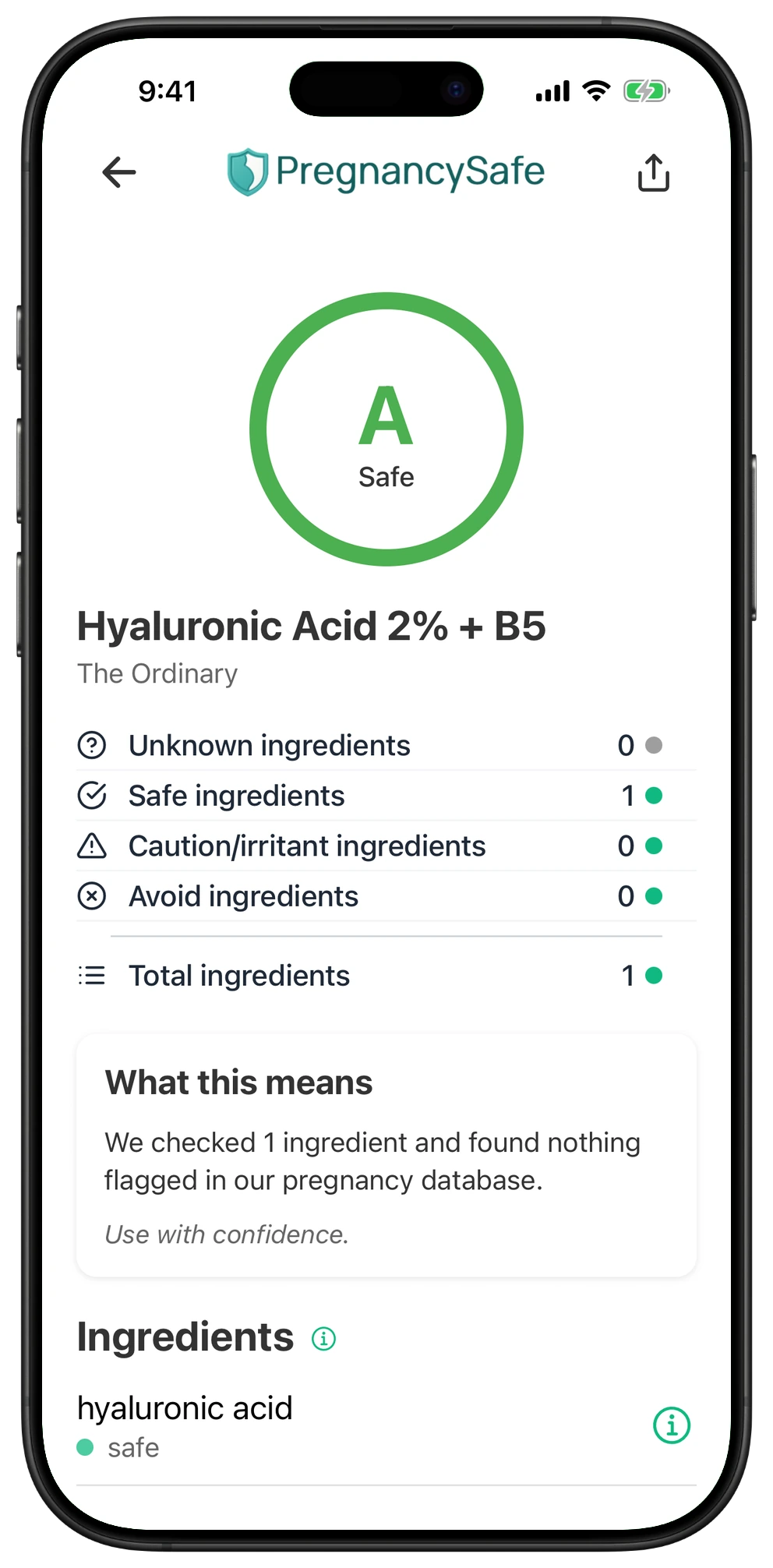
| A | Hyaluronic Acid 2% + B5 | The Ordinary | serum |
| A | E.L.F. Skin Holy Hydration Thirst Burst Drops Serum | E.L.F. Skin | serum |
| A | Hydrating Serum Ceramides Coconut 1.7Oz | Global Beauty Care | serum |
Are Other Byoma Products Safe During Pregnancy?
We looked at 11 other Byoma products. 5 are pregnancy safe (A or B grade), while 6 need a closer look.
| Grade | Product | Type |
|---|---|---|
| B+ | Byoma Moisturizing Rich Cream | moisturizer |
| B+ | Barrier+ Repair Treatment 50Ml | skin care treatment |
| B+ | Byoma Balancing Face Mist - 100 Ml / 3.38 Fl. Oz. | face mist |
| B+ | Byoma Balancing Face Mist - 3.38 Fl Oz | face mist |
How Does Byoma Hydrating Serum Compare to Other Serums?
We graded 1,128 Serums for pregnancy safety. Here's how they stack up:
Byoma Hydrating Serum earns a B+ grade, placing it among the top of Serums. Only 3% of products in this category get an A grade, so it pays to choose carefully.
How Do We Score Products for Pregnancy Safety?
We analyze each product's ingredients and category to flag known risks and provide cautionary notices for general category safety concerns.
A - Safe
Excellent choice! All ingredients are considered safe during pregnancy.
What to do: Use with confidence.
B - Likely Safe
Pretty much safe with very minimal risk. Some ingredients may have limited pregnancy studies, but no significant safety concerns have been identified.
What to do: Use with confidence.
C - Limit
Contains ingredients with some pregnancy considerations. Research shows these ingredients may have limited safety data, potential for minor hormonal effects, or require caution based on animal studies.
What to do: Use sparingly and consider safer alternatives when available.
D - Caution
Similar to C grade but contains multiple cautionary ingredients. The combination increases overall concern.
What to do: Try to avoid if that makes you feel better. If you've already used it, no need to panic.
F - Avoid
Contains an ingredient Pregnancy Safe recommends avoiding during pregnancy. This may reflect an established risk or a precaution based on limited evidence; check the ingredient guidance and exposure context.
What to do: Do not use during pregnancy. If you've already used it, don't worry - contact your OBGYN if concerned.
People Also Checked
References
- https://pubmed.ncbi.nlm.nih.gov/17613133/
- https://cir-reports.cir-safety.org/view-attachment/?id=49a63435-8e74-ec11-8943-0022482f06a6
- https://www.cir-safety.org/ingredient/dipotassium-glycyrrhizate
- https://pubchem.ncbi.nlm.nih.gov/compound/Glycyrrhizic-acid-dipotassium
- https://www.fda.gov/food/food-additives-petitions/questions-and-answers-monosodium-glutamate-msg
- https://efsa.onlinelibrary.wiley.com/doi/10.2903/j.efsa.2017.4910
- https://pubmed.ncbi.nlm.nih.gov/32625571/
- https://pmc.ncbi.nlm.nih.gov/articles/PMC6952072/
- https://pmc.ncbi.nlm.nih.gov/articles/PMC10104942/
- https://cdnservices.industrialchemicals.gov.au/statements/EVA00103%20-%20Evaluation%20Statement%20-%2026%20June%202023.pdf
- https://journals.sagepub.com/doi/10.1177/1091581818794455
- https://pmc.ncbi.nlm.nih.gov/articles/PMC4154592/
- https://pubmed.ncbi.nlm.nih.gov/15868062/
- https://mothertobaby.org/fact-sheets/vitamin-e/
- https://www.cir-safety.org/sites/default/files/trygly122017FAR.pdf
- https://pubmed.ncbi.nlm.nih.gov/11800053/
- https://pubmed.ncbi.nlm.nih.gov/9441714/
- https://pubmed.ncbi.nlm.nih.gov/32542693/
- https://www.fda.gov/cosmetics/resources-consumers-cosmetics/cosmetics-pregnancy
- https://cosmileeurope.eu/inci/detail/2584/caprylic-capric-triglyceride/
- https://www.olay.com/products/olay-firming-hydrating-body-lotion-with-collagen
- https://nationaleczema.org/eczema-products/eczema-honey-oatmeal-hand-cream/
- https://pubmed.ncbi.nlm.nih.gov/40932360/
- https://doi.org/10.3109/10915818609141922
- https://doi.org/10.1080/10915810600964618
- https://pubmed.ncbi.nlm.nih.gov/22209282/
- https://pubmed.ncbi.nlm.nih.gov/34921679/
- https://www.hfpappexternal.fda.gov/scripts/fdcc/index.cfm?id=GLYCERIN&set=FoodSubstances
- https://pubmed.ncbi.nlm.nih.gov/31840548/
- https://pmc.ncbi.nlm.nih.gov/articles/PMC7009851/
- https://www.medicinesinpregnancy.org/leaflets-a-z/glycerin-suppositories/
- https://mothertobaby.org/pregnancy-breastfeeding-exposures/cosmetics/
- https://doi.org/10.1177/1091581820953123
- https://pubmed.ncbi.nlm.nih.gov/32165223/
- https://pubmed.ncbi.nlm.nih.gov/8722607/
- https://efsa.onlinelibrary.wiley.com/doi/10.2903/j.efsa.2017.4742
- https://precision.fda.gov/ginas/app/ui/substances/834K0WOS5G
- https://www.acog.org/womens-health/faqs/skin-conditions-during-pregnancy
- https://mothertobaby.org/fact-sheets/topical-acne-treatments-pregnancy/
- https://www.fda.gov/cosmetics/cosmetic-ingredients/alpha-hydroxy-acids
- https://www.cir-safety.org/sites/default/files/ahas.pdf
- https://pmc.ncbi.nlm.nih.gov/articles/PMC9823189/
- https://pmc.ncbi.nlm.nih.gov/articles/PMC3114665/
- https://dermnetnz.org/topics/acne-in-pregnancy
- https://www.ecfr.gov/current/title-21/chapter-I/subchapter-B/part-184/subpart-B/section-184.1061
- https://www.merckmanuals.com/professional/nephrology/acid-base-regulation-and-disorders/lactic-acidosis
- https://cir-safety.org/sites/default/files/QRT-Update-Dec2025.pdf
- https://www.accessdata.fda.gov/drugsatfda_docs/omuf/order/supportDoc/OTC000039/3.3_Literature_References/rev_cir2019-magnesium-stearate_090026f88e126456.pdf
- https://pubmed.ncbi.nlm.nih.gov/20650257/
- https://pubmed.ncbi.nlm.nih.gov/9603659/
- https://pubmed.ncbi.nlm.nih.gov/37950377/
- https://pubmed.ncbi.nlm.nih.gov/22863639/