Is Lactic Acid Safe During Pregnancy?
Updated September 14, 2026
The Answer
Yes, lactic acid is generally compatible with pregnancy in ordinary leave on or rinse off skincare. Consumer cosmetic guidance supports products with 10% or less AHA, a pH of 3.5 or higher, and sun protection labeling; stronger, low pH peels are a different exposure.
Everyday cosmetic use is not equivalent to a high strength, low pH chemical peel, which can irritate skin and is not covered by the same reassurance.
The conclusion rests on limited skin absorption and indirect support from ACOG and MotherToBaby guidance listing related topical acne acids, such as glycolic acid, as pregnancy options.
Pregnancy Safe is 100% independent and research driven. No companies pay to promote or sponsor products.
Stressless Pregnancy
Check your exact product with lactic acid in the app

What Is Lactic Acid?
You may also see it listed as: 2-hydroxypropanoic acid, 2-hydroxypropionic acid, alpha-hydroxypropionic acid
Lactic acid is an alpha hydroxy acid (AHA) that exfoliates, helps retain moisture, and adjusts a formula’s pH. You’ll find it in serums, lotions, cleansers, body washes, toners, and exfoliating pads. It is also a normal metabolite in the body and an acidulant used in foods and gummy supplements.
What Other Ingredients Should You Look Out for in Products With Lactic Acid?
A product's full ingredient list determines whether it's pregnancy-safe or not. These ingredients also appear in some of the lactic acid products we analyzed and may deserve a closer look.
Retinoid
AvoidLook for “retinyl palmitate” in exfoliating formulas: it is a vitamin A derivative covered by guidance discouraging topical retinoids during pregnancy. Check the full ingredient list rather than judging the formula by its lactic acid content alone.
Flagged in 1 product (4.8%) in this analysis.
Retinol
AvoidCheck body treatment labels for “retinol,” a vitamin A ingredient generally avoided in pregnancy for nonessential cosmetic use despite low topical absorption and reassuring inadvertent exposure data. Its presence calls for a separate formula review, even when lactic acid is the headline ingredient.
Flagged in 1 product (4.8%) in this analysis.
Phenoxyethanol
Caution“Phenoxyethanol” is a preservative found in these leave on and rinse off formulas; direct pregnancy data are limited, but cosmetic safety reviews support typical regulated use levels. Check concentration information against the EU’s 1% preservative limit rather than treating its presence as an automatic avoid signal.
Flagged in 14 products (66.7%) in this analysis.
Fragrance
Caution“Fragrance,” “parfum,” or “parfum fragrance” identifies a scent mixture whose individual components may not be disclosed; the label does not prove it contains phthalates or causes pregnancy harm. If you want to reduce fragrance exposure or have sensitive skin, check for fragrance free options.
Flagged in 5 products (23.8%) in this analysis.
Glycyrrhiza Glabra
Caution“Glycyrrhiza glabra root extract” is licorice extract used for brightening and soothing in these skincare formulas. Check that you are assessing topical cosmetic use: it is lower concern than oral licorice, although pregnancy specific topical data are limited and irritation can occur.
Flagged in 5 products (23.8%) in this analysis.
Salicylic Acid
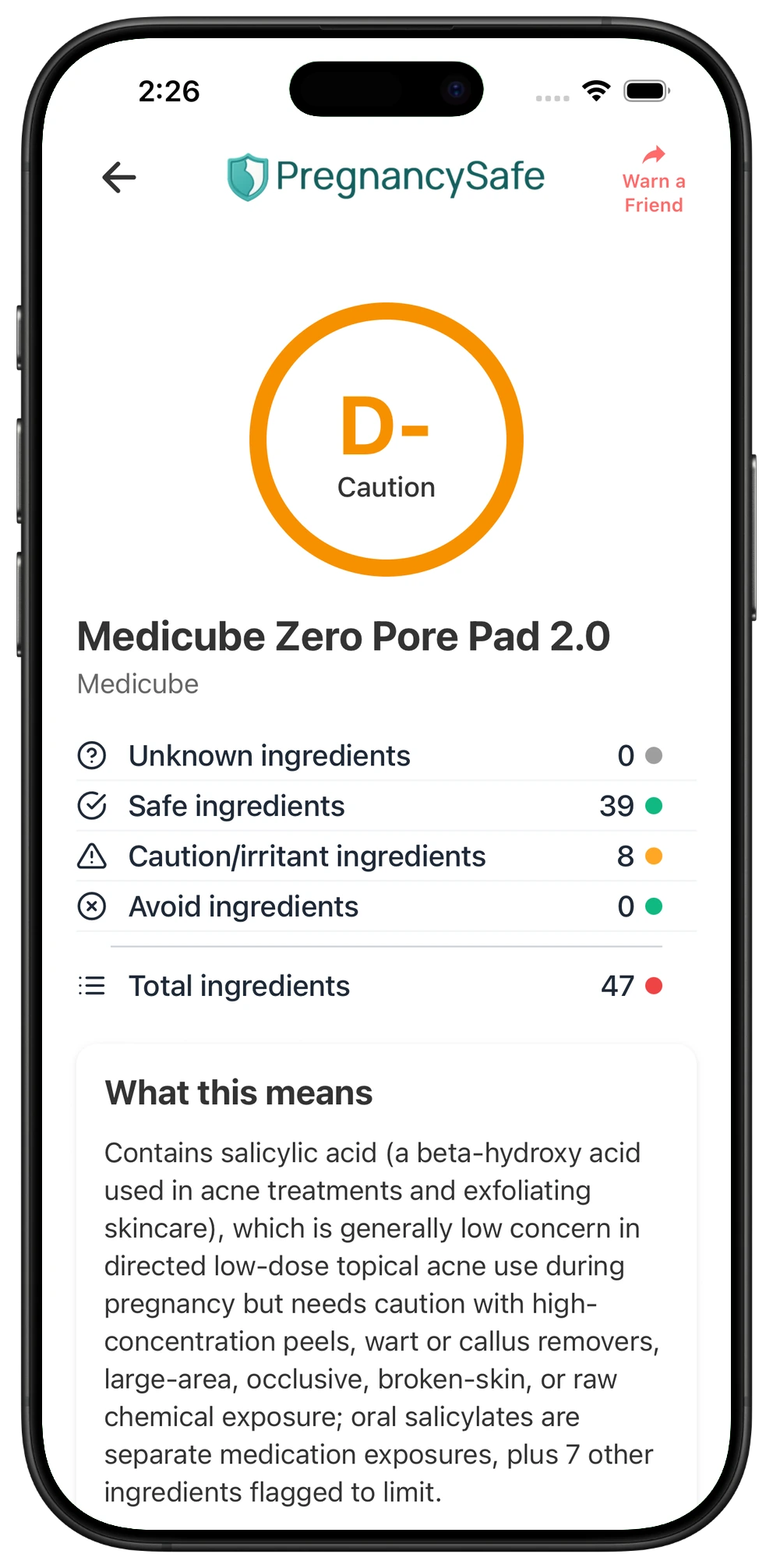
Caution“Salicylic acid” adds a beta hydroxy acid to these facial treatment and body wash formulas; directed low dose topical acne use is considered low concern in pregnancy. Check its strength and directions, because concentrated peels, large area or prolonged use, occlusion, and broken skin can increase exposure.
Flagged in 2 products (9.5%) in this analysis.
Does Lactic Acid Strength or Product Type Matter During Pregnancy?
For skincare, check both AHA strength and pH rather than relying on the lactic acid percentage alone. FDA/CIR consumer cosmetic guidance covers 10% or less AHA at pH 3.5 or higher with sun protection labeling; professional peels and stronger, lower pH formulas need separate consideration. In gummy vitamins, food grade lactic acid used as an acidity control ingredient at good manufacturing practice levels is generally compatible with pregnancy when the supplement is taken as directed. That does not establish safety for concentrated lactic acid dosing or for the supplement’s other ingredients.
What Products Contain Lactic Acid?
Pregnancy Safe has looked at 23,566 products that have lactic acid as an ingredient. The category and grade breakdowns below use 21 products whose names mention Lactic Acid or another name for it.
What Types of Products Contain Lactic Acid?
Products You May Have That Contain Lactic Acid
| Grade | Product | Brand | Type |
|---|---|---|---|
| C | Sunday Riley Good Genes All-In-One Lactic Acid Treatment Serum - Ulta Beauty | Sunday Riley | Serum |
| C | Ferulic Brew Antioxidant Facial Treatment With Lactic Acid | Kiehl'S | Facial Treatment |
| F | Power Cocktail Lactic Acid Repair Serum | Peach & Lily | Serum |
| C | Sunday Riley Good Genes All-In-One Lactic Acid Treatment (1 Fl. Oz.) | Sunday Riley | Skin Treatment |
| B+ | Lactic Acid 5% + Ha | The Ordinary | Skin Care Serum |
| C+ | The Ordinary Lactic Acid 5% + Ha 2% Superficial Peeling Formulation 30Ml | The Ordinary | Skin Care Serum |
| C+ | Agent Nateur Acid (Wash) Lactic Acid Skin Brightening Cleanser 4.05Oz | Agent Nateur | Cleanser |
| F | Alpha-H Retinol Reboot Exfoliating Body Treatment With 8% Glycolic Acid 2% Lactic Acid + 1% Encapsuladed Retinol | Alpha-H | Body Treatment |
How Do Products Containing Lactic Acid Score?
It can be helpful to see how products containing lactic acid generally score during pregnancy. This does not tell you whether your exact product is safe, but it gives you a general idea of what we found. In this breakdown of 21 products, 71% receive a C grade. A C grade means the complete formula has some pregnancy considerations, so use it sparingly and consider a higher scoring alternative when one is available.
Frequently Asked Questions About Lactic Acid During Pregnancy
Is 10% lactic acid within the guidance for pregnancy skincare?
Ten percent falls within FDA/CIR consumer cosmetic guidance only when the formula has 10% or less AHA, a pH of 3.5 or higher, and sun protection labeling. Percentage alone does not establish suitability, and this is cosmetic guidance rather than a pregnancy specific dose threshold.
Are lactic acid chemical peels covered by the same reassurance?
No. High strength, low pH products and professional chemical peels are a separate, irritation prone exposure. The conclusion for everyday cosmetics should not be extended to those treatments.
Can I judge The Ordinary or Sunday Riley products by their lactic acid content?
No. Check the exact formula’s AHA strength, pH, directions, and other ingredients. A product name or grade cannot establish pregnancy suitability from lactic acid alone; a grade describes the complete formula.
Does the guidance include cleansers and body washes as well as serums?
Yes. Ordinary rinse off and leave on cosmetic uses are both generally compatible with pregnancy. The important distinction is everyday cosmetic strength and pH versus stronger, low pH peel exposure, not simply whether you rinse it off.
Why is lactic acid listed in gummy vitamins?
It may control acidity, flavor, or pH rather than act as a nutrient. Food grade lactic acid at good manufacturing practice formulation levels is generally compatible with pregnancy when the supplement is taken as directed, but its other ingredients and amounts need their own assessment.
Is lactic acid skincare the same issue as elevated blood lactate?
No. Lactic acidosis is a medical disorder involving elevated blood lactate from illness, medications, or impaired metabolism. It is distinct from ordinary cosmetic lactic acid exposure; skincare guidance does not interpret a blood test result.
How Do We Score Products for Pregnancy Safety?
We analyze each product's ingredients and category to flag known risks and provide cautionary notices for general category safety concerns.
A - Safe
Excellent choice! All ingredients are considered safe during pregnancy.
What to do: Use with confidence.
B - Likely Safe
Pretty much safe with very minimal risk. Some ingredients may have limited pregnancy studies, but no significant safety concerns have been identified.
What to do: Use with confidence.
C - Limit
Contains ingredients with some pregnancy considerations. Research shows these ingredients may have limited safety data, potential for minor hormonal effects, or require caution based on animal studies.
What to do: Use sparingly and consider safer alternatives when available.
D - Caution
Similar to C grade but contains multiple cautionary ingredients. The combination increases overall concern.
What to do: Try to avoid if that makes you feel better. If you've already used it, no need to panic.
F - Avoid
Contains an ingredient Pregnancy Safe recommends avoiding during pregnancy. This may reflect an established risk or a precaution based on limited evidence; check the ingredient guidance and exposure context.
What to do: Do not use during pregnancy. If you've already used it, don't worry - contact your OBGYN if concerned.
Sources
- https://apps.who.int/food-additives-contaminants-jecfa-database/Home/Chemical/3367
- https://dermnetnz.org/topics/acne-in-pregnancy
- https://mothertobaby.org/fact-sheets/topical-acne-treatments-pregnancy/
- https://pmc.ncbi.nlm.nih.gov/articles/PMC3114665/
- https://pmc.ncbi.nlm.nih.gov/articles/PMC9823189/
- https://www.acog.org/womens-health/faqs/skin-conditions-during-pregnancy
- https://www.canada.ca/en/environment-climate-change/services/evaluating-existing-substances/screening-assessment-corn-steep-liquor.html
- https://www.centrum.com/content/dam/cf-consumer-healthcare/bp-wellness-centrum/en_CA/pdf/supplementfacts-centrummaternal-prenatal.pdf
- https://www.cir-safety.org/sites/default/files/ahas.pdf
- https://www.ecfr.gov/current/title-21/chapter-I/subchapter-B/part-184/subpart-A/section-184.1
- https://www.ecfr.gov/current/title-21/chapter-I/subchapter-B/part-184/subpart-B/section-184.1061
- https://www.fda.gov/cosmetics/cosmetic-ingredients/alpha-hydroxy-acids
- https://www.fda.gov/downloads/food/guidanceregulation/guidancedocumentsregulatoryinformation/ingredientsadditivesgraspackaging/ucm381316.pdf
- https://www.fda.gov/food/food-additives-and-gras-ingredients-information-consumers/understanding-how-fda-regulates-food-additives-and-gras-ingredients
- https://www.fda.gov/food/information-consumers-using-dietary-supplements/questions-and-answers-dietary-supplements
- https://www.merckmanuals.com/professional/nephrology/acid-base-regulation-and-disorders/lactic-acidosis
- https://www.target.com/p/-/A-13579345
- https://www.ema.europa.eu/en/news/updated-measures-pregnancy-prevention-during-retinoid-use
- https://www.ncbi.nlm.nih.gov/books/NBK582989/
- https://www.ncbi.nlm.nih.gov/books/NBK582775/
- https://pubmed.ncbi.nlm.nih.gov/26215715/
- https://pubmed.ncbi.nlm.nih.gov/41365815/
- https://pubmed.ncbi.nlm.nih.gov/36447117/
- https://dailymed.nlm.nih.gov/dailymed/drugInfo.cfm?setid=9f1c8971-c6dc-4708-848b-5cee50b6c32a
- https://dailymed.nlm.nih.gov/dailymed/drugInfo.cfm?setid=993a5325-cd10-4450-b5ea-1c0a90510df6
- https://dailymed.nlm.nih.gov/dailymed/lookup.cfm?setid=34d79c31-1568-4797-a4f5-31200c7788db
- https://www.aad.org/public/everyday-care/skin-care-secrets/routine/pregnancy-skin-care
- https://mothertobaby.org/fact-sheets/tretinoin-retin-a-pregnancy/
- https://www.medicinesinpregnancy.org/leaflets-a-z/isotretinoin-gel/
- https://pubmed.ncbi.nlm.nih.gov/16243460/
- https://health.ec.europa.eu/publications/revision-scientific-opinion-sccs157616-vitamin-retinol-retinyl-acetate-retinyl-palmitate_en
- https://health.ec.europa.eu/system/files/2021-08/sccs_o_195_0.pdf
- https://ec.europa.eu/growth/tools-databases/cosing/details/28157
- https://journals.sagepub.com/doi/10.3109/10915819009078737
- https://link.springer.com/article/10.1007/s00204-024-03938-5
- https://www.sfda.gov.sa/en/warnings/1156
- https://www.industrialchemicals.gov.au/sites/default/files/Ethanol%2C%202-phenoxy-_Human%20health%20tier%20II%20assessment.pdf
- https://hero.epa.gov/reference/2857875
- https://books.publisso.de/sites/default/files/documents/series/mak/dam/Vol2019/Iss1/Alt006/mb12299kske6319_w.pdf
- https://www.fda.gov/cosmetics/cosmetic-ingredients/fragrances-cosmetics
- https://www.fda.gov/cosmetics/cosmetic-ingredients/phthalates-cosmetics
- https://www.fda.gov/cosmetics/cosmetic-ingredients/allergens-cosmetics
- https://pmc.ncbi.nlm.nih.gov/articles/PMC3110684/
- https://pmc.ncbi.nlm.nih.gov/articles/PMC4016195/
- https://pmc.ncbi.nlm.nih.gov/articles/PMC4097177/
- https://pmc.ncbi.nlm.nih.gov/articles/PMC8453372/
- https://pmc.ncbi.nlm.nih.gov/articles/PMC10999525/
- https://www.epa.gov/indoor-air-quality-iaq/volatile-organic-compounds-impact-indoor-air-quality
- https://www.nccih.nih.gov/health/licorice-root
- https://cosmileeurope.eu/inci/detail/6154/glycyrrhiza-glabra-root-extract/
- https://pubmed.ncbi.nlm.nih.gov/11390327/
- https://pubmed.ncbi.nlm.nih.gov/12396997/
- https://pubmed.ncbi.nlm.nih.gov/28158597/
- https://pubmed.ncbi.nlm.nih.gov/28833680/
- https://pubmed.ncbi.nlm.nih.gov/16884839/
- https://www.cir-safety.org/sites/default/files/S-breakout-092020.pdf
- https://vkm.no/download/18.948158f1633d1b9fb95930/1525764185285/Hazard%20assessment%20of%20glycyrrhizic%20acid%20from%20liquorice.pdf
- https://www.aad.org/public/diseases/acne/derm-treat/pregnancy
- https://www.accessdata.fda.gov/drugsatfda_docs/omuf/Order/Final%20Administrative%20Order%20OTC000013_M006-Topical%20Acne%20drug%20products%20for%20OTC%20Human%20Use.pdf
- https://health.ec.europa.eu/system/files/2023-06/sccs_o_268.pdf
- https://www.fda.gov/drugs/drug-safety-and-availability/fda-recommends-avoiding-use-nsaids-pregnancy-20-weeks-or-later-because-they-can-result-low-amniotic
- https://www.accessdata.fda.gov/drugsatfda_docs/omuf/monographs/OTCMonograph_M028-WartRemoverDrugProductsforOTCHumanUse10012021.pdf
- https://www.ncbi.nlm.nih.gov/books/NBK582985/
- https://pubmed.ncbi.nlm.nih.gov/9269866/
- https://pubmed.ncbi.nlm.nih.gov/10026401/
- https://pubmed.ncbi.nlm.nih.gov/24472429/
- https://www.ecfr.gov/current/title-21/chapter-I/subchapter-D/part-333/subpart-D/section-333.310
- https://pubmed.ncbi.nlm.nih.gov/38453786/
- https://www.accessdata.fda.gov/drugsatfda_docs/omuf/monographs/OTC%20Monograph_M006-Topical%20Acne%20drug%20products%20for%20OTC%20Human%20Use%2011.23.2021.pdf
- https://www.fda.gov/safety/medical-product-safety-information/nonsteroidal-anti-inflammatory-drugs-nsaids-drug-safety-communication-avoid-use-nsaids-pregnancy-20
- https://www.inchem.org/documents/icsc/icsc/eics0563.htm
- https://www.ncbi.nlm.nih.gov/books/NBK582985
- https://pubmed.ncbi.nlm.nih.gov/23914887
- https://www.fda.gov/drugs/drug-alerts-and-statements/fda-warns-against-purchasing-or-using-chemical-peel-skin-products-without-professional-supervision