Is Retinol Safe During Pregnancy?
Updated September 14, 2026
The Answer
Retinol in topical anti aging and acne skin care is generally avoided during pregnancy, especially for nonessential cosmetic use. Absorption is usually low, but limited pregnancy data and retinoid class concerns support this precaution.
Topical retinol exposure is not equivalent to taking oral retinoid medicines: oral retinoids are established causes of birth defects, while human topical exposure data have not shown a clear increase in major malformations.
Human studies have not shown a clear increase in major malformations after first trimester topical retinoid exposure, but limited pregnancy data and established oral retinoid teratogenicity underpin the precautionary guidance.
Already used it? If you used retinol before realizing you were pregnant, discuss the product strength, amount and areas treated with your prenatal clinician, including whether your skin was irritated or damaged. Human topical retinoid exposure data are reassuring, but cannot guarantee an individual outcome.
Pregnancy Safe is 100% independent and research driven. No companies pay to promote or sponsor products.
Stressless Pregnancy
Check your exact product with retinol in the app

What Is Retinol?
You may also see it listed as: all-trans-retinol, retinyl alcohol, vitamin A alcohol
Retinol is a vitamin A alcohol used in over the counter skin care to promote cell turnover and reduce the appearance of aging, and in acne products. Your skin converts it toward retinoic acid pathways. Common products include serums, face and eye creams, night creams, facial oils and body lotions.
What Other Ingredients Should You Look Out for in Products With Retinol?
A product's full ingredient list determines whether it's pregnancy-safe or not. These ingredients also appear in some of the retinol products we analyzed and may deserve a closer look.
Retinoid
AvoidCheck for retinyl acetate, retinyl linoleate, retinyl palmitate and retinyl propionate alongside retinol. These are other vitamin A derivatives covered by precautionary guidance against routine topical retinoid use in pregnancy, so review the full ingredient list rather than looking only for “retinol.”
Flagged in 48 products (18.4%) in this analysis.
Butylphenyl Methylpropional
AvoidLook for butylphenyl methylpropional, also called Lilial, in fragranced eye masks and moisturizers. Its EU cosmetic prohibition and reproductive toxicity concerns, based largely on animal evidence, support avoiding this fragrance; check the current ingredient list for either name.
Flagged in 2 products (0.8%) in this analysis.
Phenoxyethanol
CautionPhenoxyethanol is a preservative found in many of these creams and serums; cosmetic reviews consider it acceptable at regulated levels despite limited direct pregnancy data. Check that the product is intended for ordinary skin use rather than interpreting this ingredient as an automatic reason to avoid it.
Flagged in 168 products (64.4%) in this analysis.
Butylated Hydroxytoluene
CautionBHT is the label name for butylated hydroxytoluene, an antioxidant that stabilizes cosmetic formulas. Check the product’s intended use: reviewed topical concentrations are low concern, and high dose oral animal findings should not be treated as evidence of pregnancy harm from ordinary skin application.
Flagged in 102 products (39.1%) in this analysis.
Fragrance
Caution“Fragrance” or “parfum” identifies a scent mixture without revealing every component; it does not mean the product necessarily contains phthalates. If you want to reduce fragrance exposure or have sensitive skin or airways, check for a fragrance free option.
Flagged in 73 products (28%) in this analysis.
DMDM Hydantoin
CautionDMDM hydantoin is a formaldehyde releasing preservative used in some of these creams and washes; contact allergy is the main concern at regulated cosmetic levels, and direct pregnancy data are lacking. Check for it particularly if you are formaldehyde sensitive or applying products to irritated skin.
Flagged in 10 products (3.8%) in this analysis.
Does Retinol Strength or Product Type Matter During Pregnancy?
The amount absorbed matters: high dose use, application over large body areas, and damaged or irritated skin can increase exposure. Stronger prescription retinoids also warrant separate consideration. Low absorption from ordinary cosmetic use helps explain reassuring accidental exposure findings, but does not establish a pregnancy safe strength or justify routine use.
What Products Contain Retinol?
Pregnancy Safe has looked at 558 products that have retinol as an ingredient. The category and grade breakdowns below use 261 products whose names mention Retinol or another name for it.
What Types of Products Contain Retinol?
Products You May Have That Contain Retinol
| Grade | Product | Brand | Type |
|---|---|---|---|
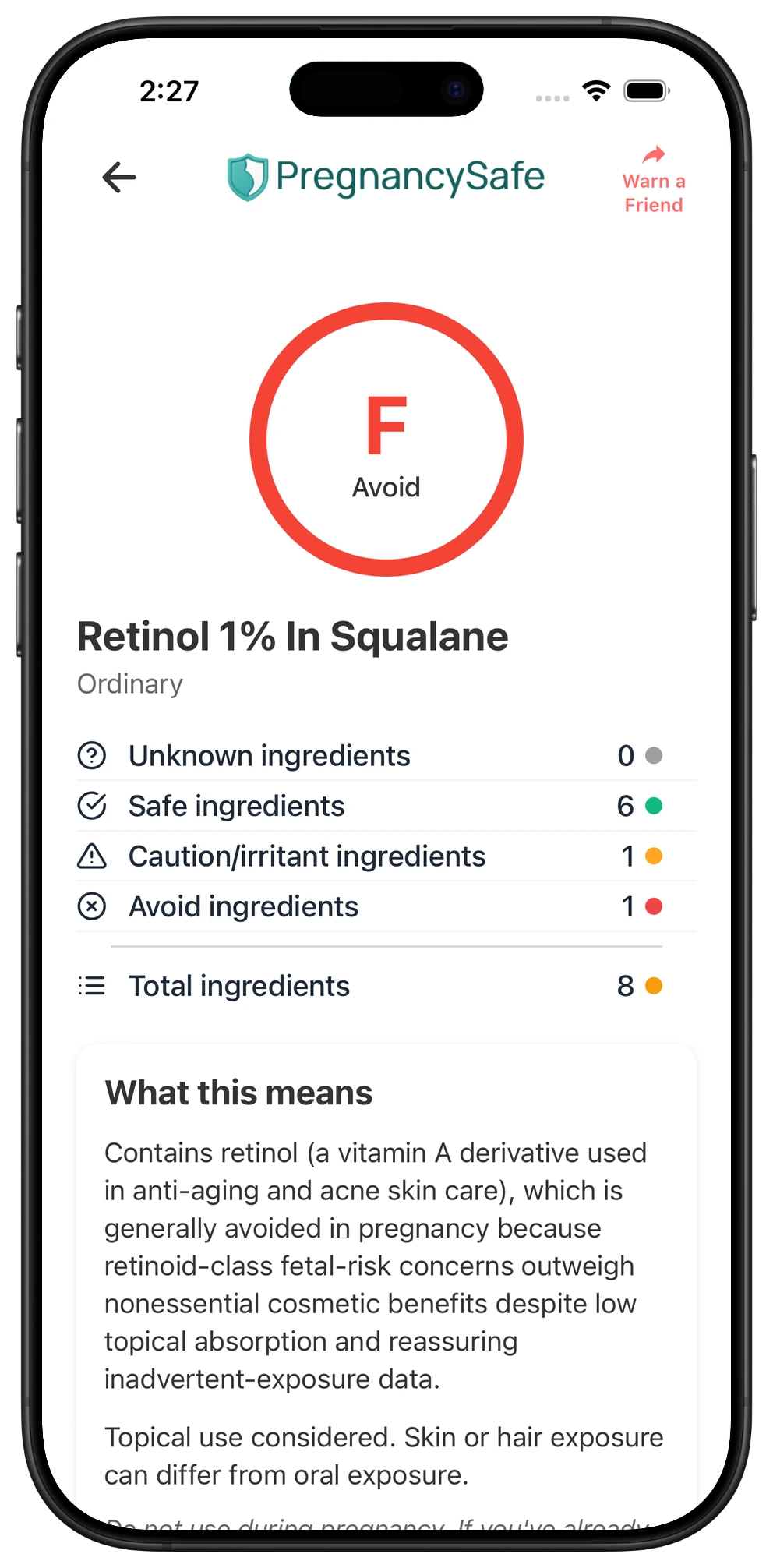
| F | Retinol 1% In Squalane | Ordinary | Skin Serum |
| F | Retinol Night Serum 1 Fl Oz | Trader Joe'S | Serum |
| F | Gold Bond Age Renew Retinol Overnight Body & Face Lotion | Gold Bond | Body Lotion |
| F | La Roche-Posay Redermic R Anti-Aging Concentrate Eye Serum With Retinol | La Roche-Posay | Eye Serum |
| F | Roc Retinol Correxion Line Smoothing Max Hydration Cream | Roc | Face Cream |
| F | Artnaturals Retinol Serum | Artnaturals | Serum |
| F | Cerave Resurfacing Retinol Face Serum - 1 Fl Oz | Cerave | Face Serum |
| F | Cerave Skin Renewing Retinol Face Serum For Fine Lines And Wrinkles - 1Oz | Cerave | Face Serum |
How Do Products Containing Retinol Score?
It can be helpful to see how products containing retinol generally score during pregnancy. This does not tell you whether your exact product is safe, but it gives you a general idea of what we found. In this breakdown of 261 products, 100% receive an F grade. An F grade means the complete formula contains an ingredient Pregnancy Safe recommends avoiding during pregnancy. The reason may be an established risk or a precaution based on limited evidence; check the ingredient guidance and exposure context.
Frequently Asked Questions About Retinol During Pregnancy
What if I used retinol before I knew I was pregnant?
Accidental topical use does not establish that harm occurred. Human data have not shown a clear increase in major malformations after first trimester topical retinoid exposure, although pregnancy evidence remains limited. Discuss your product and exposure details with your prenatal clinician.
Is a low strength retinol serum an exception?
Lower exposure is different from high dose use, but the available evidence does not establish a pregnancy safe retinol concentration. The precautionary recommendation still applies to routine cosmetic retinol use.
Can I use retinol in the second or third trimester?
The guidance is to avoid routine topical retinol throughout pregnancy. Reassuring findings after first trimester exposure do not establish that planned use in a later trimester is safe.
Does retinol face cream carry the same risk as oral retinoid medicine?
No. Oral retinoids are established human teratogens, whereas topical retinol usually has low systemic absorption. That distinction matters when assessing an exposure, even though routine topical use is still generally avoided.
Does using retinol on my body rather than my face matter?
Yes. Application over large body areas can increase absorption, as can damaged or irritated skin. A body lotion should not be treated as equivalent to a small area facial application simply because both contain retinol.
Is retinol body wash an exception because it rinses off?
Retinol appears in body washes as well as leave on products, but the available evidence does not establish a rinse off exception or a pregnancy safe contact time. The product format alone does not establish safety.
How Do We Score Products for Pregnancy Safety?
We analyze each product's ingredients and category to flag known risks and provide cautionary notices for general category safety concerns.
A - Safe
Excellent choice! All ingredients are considered safe during pregnancy.
What to do: Use with confidence.
B - Likely Safe
Pretty much safe with very minimal risk. Some ingredients may have limited pregnancy studies, but no significant safety concerns have been identified.
What to do: Use with confidence.
C - Limit
Contains ingredients with some pregnancy considerations. Research shows these ingredients may have limited safety data, potential for minor hormonal effects, or require caution based on animal studies.
What to do: Use sparingly and consider safer alternatives when available.
D - Caution
Similar to C grade but contains multiple cautionary ingredients. The combination increases overall concern.
What to do: Try to avoid if that makes you feel better. If you've already used it, no need to panic.
F - Avoid
Contains an ingredient Pregnancy Safe recommends avoiding during pregnancy. This may reflect an established risk or a precaution based on limited evidence; check the ingredient guidance and exposure context.
What to do: Do not use during pregnancy. If you've already used it, don't worry - contact your OBGYN if concerned.
Sources
- https://dailymed.nlm.nih.gov/dailymed/lookup.cfm?setid=34d79c31-1568-4797-a4f5-31200c7788db
- https://health.ec.europa.eu/publications/revision-scientific-opinion-sccs157616-vitamin-retinol-retinyl-acetate-retinyl-palmitate_en
- https://mothertobaby.org/fact-sheets/topical-acne-treatments-pregnancy/
- https://mothertobaby.org/fact-sheets/tretinoin-retin-a-pregnancy/
- https://pubmed.ncbi.nlm.nih.gov/16243460/
- https://pubmed.ncbi.nlm.nih.gov/26215715/
- https://pubmed.ncbi.nlm.nih.gov/41365815/
- https://www.aad.org/public/everyday-care/skin-care-secrets/routine/pregnancy-skin-care
- https://www.ema.europa.eu/en/news/updated-measures-pregnancy-prevention-during-retinoid-use
- https://www.medicinesinpregnancy.org/leaflets-a-z/isotretinoin-gel/
- https://www.ncbi.nlm.nih.gov/books/NBK582989/
- https://www.ncbi.nlm.nih.gov/books/NBK582775/
- https://pubmed.ncbi.nlm.nih.gov/36447117/
- https://dailymed.nlm.nih.gov/dailymed/drugInfo.cfm?setid=9f1c8971-c6dc-4708-848b-5cee50b6c32a
- https://dailymed.nlm.nih.gov/dailymed/drugInfo.cfm?setid=993a5325-cd10-4450-b5ea-1c0a90510df6
- https://www.canada.ca/en/health-canada/services/chemicals-product-safety/lilial.html
- https://www.canada.ca/en/environment-climate-change/services/evaluating-existing-substances/draft-assessment-phenylpropanoids-aldehydes-group.html
- https://health.ec.europa.eu/publications/safety-butylphenyl-methylpropional-p-bmhca-cosmetic-products-submission-ii_en
- https://eur-lex.europa.eu/legal-content/EN/TXT/PDF/?uri=CELEX%3A32021R1902
- https://chem.echa.europa.eu/100.001.173/harmonised/113759
- https://chem.echa.europa.eu/obligation-lists/candidateList
- https://pubmed.ncbi.nlm.nih.gov/32461162/
- https://health.ec.europa.eu/system/files/2021-08/sccs_o_195_0.pdf
- https://ec.europa.eu/growth/tools-databases/cosing/details/28157
- https://journals.sagepub.com/doi/10.3109/10915819009078737
- https://link.springer.com/article/10.1007/s00204-024-03938-5
- https://www.sfda.gov.sa/en/warnings/1156
- https://www.industrialchemicals.gov.au/sites/default/files/Ethanol%2C%202-phenoxy-_Human%20health%20tier%20II%20assessment.pdf
- https://hero.epa.gov/reference/2857875
- https://books.publisso.de/sites/default/files/documents/series/mak/dam/Vol2019/Iss1/Alt006/mb12299kske6319_w.pdf
- https://health.ec.europa.eu/system/files/2022-08/sccs_o_257.pdf
- https://pubmed.ncbi.nlm.nih.gov/37751543/
- https://pubmed.ncbi.nlm.nih.gov/12396675/
- https://pmc.ncbi.nlm.nih.gov/articles/PMC13151845/
- https://www.ecfr.gov/current/title-21/chapter-I/subchapter-B/part-172/subpart-B/section-172.115
- https://www.ecfr.gov/current/title-21/chapter-I/subchapter-B/part-182/subpart-D/section-182.3173
- https://www.fda.gov/news-events/press-announcements/fda-finalizes-food-chemical-safety-post-market-assessment-program-launches-reassessment-bht-ada
- https://www.fda.gov/cosmetics/cosmetic-ingredients/fragrances-cosmetics
- https://www.fda.gov/cosmetics/cosmetic-ingredients/phthalates-cosmetics
- https://www.fda.gov/cosmetics/cosmetic-ingredients/allergens-cosmetics
- https://pmc.ncbi.nlm.nih.gov/articles/PMC3110684/
- https://pmc.ncbi.nlm.nih.gov/articles/PMC4016195/
- https://pmc.ncbi.nlm.nih.gov/articles/PMC4097177/
- https://pmc.ncbi.nlm.nih.gov/articles/PMC8453372/
- https://pmc.ncbi.nlm.nih.gov/articles/PMC10999525/
- https://www.epa.gov/indoor-air-quality-iaq/volatile-organic-compounds-impact-indoor-air-quality
- https://journals.sagepub.com/doi/pdf/10.3109/10915818809023133
- https://pubmed.ncbi.nlm.nih.gov/37177794/
- https://ec.europa.eu/growth/tools-databases/cosing/reference/annexes/list/V
- https://eur-lex.europa.eu/eli/reg/2022/1181/oj/eng
- https://health.ec.europa.eu/system/files/2022-08/sccs_o_254.pdf
- https://www.industrialchemicals.gov.au/sites/default/files/Formaldehyde%20donors_Human%20health%20tier%20II%20assessment.pdf
- https://uktis.org/monographs/exposure-to-formaldehyde-in-pregnancy/
- https://www.cdc.gov/niosh/reproductive-health/prevention/formaldehyde.html