Best Pregnancy Safe Eye Cream (Updated 2026 Guide)
Updated September 9, 2026
The Answer
For pregnancy, choose a simple hydrating eye cream without retinol or other topical retinoids, and use it as directed around not in your eyes. Our catalog contains 425 entries with grades ranging from A to F, but these ingredient scores are not clinical pregnancy safety verdicts.
The main pregnancy precaution is avoiding topical retinoids, including retinol and retinyl palmitate, despite generally low skin absorption. Caution flags for ingredients such as phenoxyethanol, bht and licorice extract do not establish harm from small area eye cream use; some concerns come from oral or much higher dose exposures. Fragrance can irritate sensitive skin, which is a separate concern from fetal risk.
Pregnancy Safe is 100% independent and research driven. No companies pay to promote or sponsor products.
Stress Less This Pregnancy
Check your exact eye cream in the app

✓ What's Safe
- • Choose a hydration focused formula with ingredients such as glycerin or sodium hyaluronate rather than a retinoid based wrinkle treatment.
- • Look for fragrance free formulations, especially if the skin around your eyes is sensitive.
- • Read the full current ingredient list on the exact package, checking the country, size and version rather than relying on an older online listing.
- • Follow eye area application directions and use only the directed amount on intact skin, keeping the cream out of your eyes.
- • Assess the complete formula: palmitoyl peptides are not retinol or prostaglandins, and their names alone are not a reason to reject a cream.
✗ What to Avoid
- • Avoid eye creams containing retinol during pregnancy, including products marketed primarily for wrinkles or skin renewal.
- • Skip retinyl palmitate and other topical retinoids as a pregnancy precaution; a different vitamin A name does not remove that precaution.
- • Avoid fragrance or parfum if they trigger stinging, redness or allergy; choosing fragrance free also reduces exposure to undisclosed scent mixtures.
- • Avoid choosing solely by an A grade, a short ingredient list or a clean or natural claim; none certifies pregnancy safety or label completeness.
- • Avoid applying cream to irritated or damaged skin, getting it in your eyes, or continuing use after irritation develops.
Most Common Ingredients in Eye Cream Products
We analyzed 425 eye cream products. Here are the most common ingredients, ranked by how often they appear:
Ingredients to Watch Out For in Eye Cream
These are the most common flagged ingredients across 425 eye cream products we analyzed.
Caution
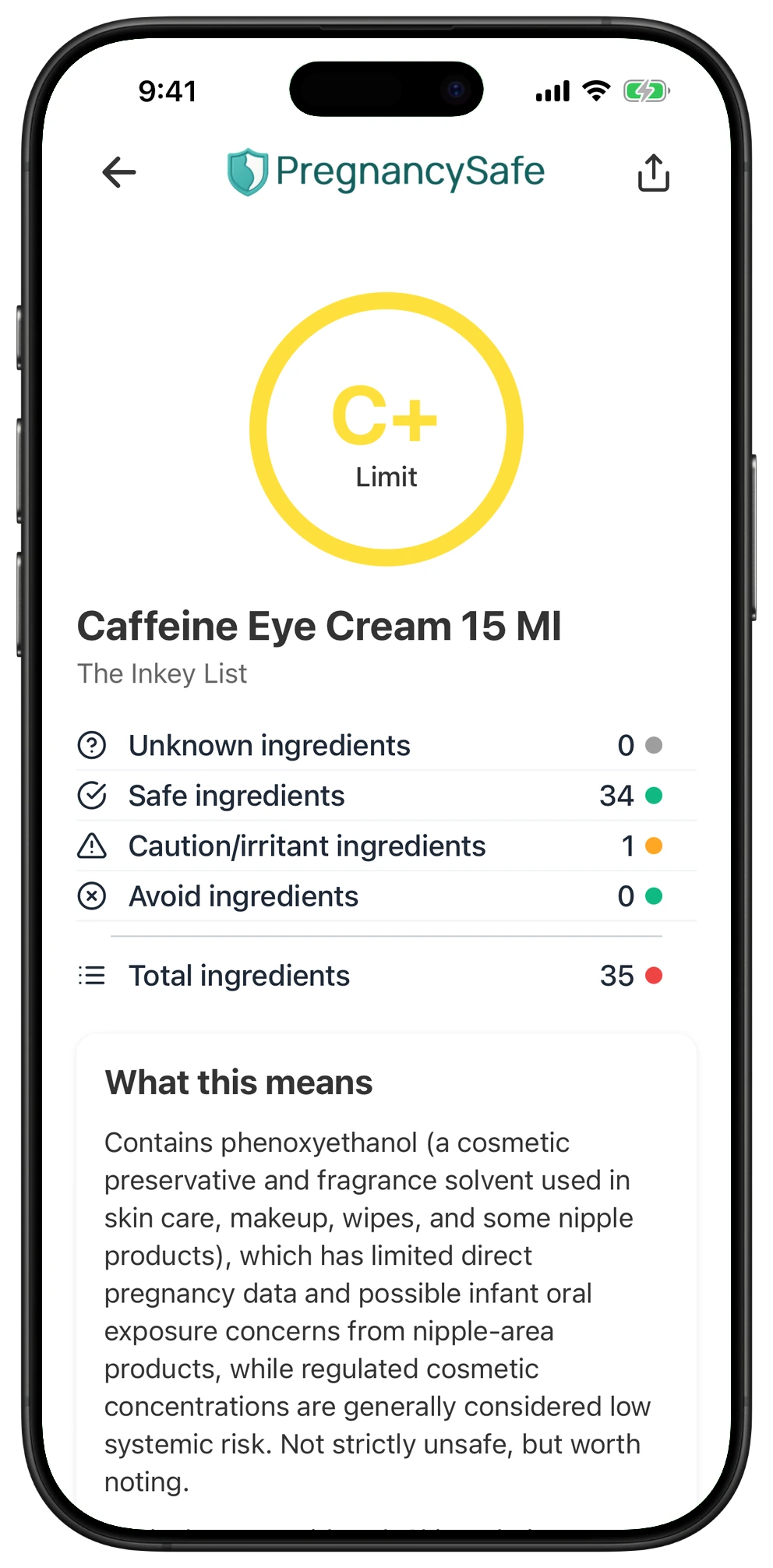
Phenoxyethanol is a preservative commonly used in cosmetics and skincare products to prevent microbial growth and extend shelf life.
Has limited direct pregnancy data and possible infant oral exposure concerns from nipple area products, while regulated cosmetic concentrations are generally considered low systemic risk.
This preservative helps prevent microbial growth in eye cream. Reviews consider regulated cosmetic concentrations acceptable, although direct pregnancy outcome data are limited. Infant ingestion concerns from nipple products should not be applied to small area topical eye cream use.
Flagged in 240 of 425 products (56%)
bht
Caution
BHT (butylated hydroxytoluene) is a synthetic antioxidant commonly used as a preservative to prevent the oxidation of fats and oils in food products.
Has limited human pregnancy data, with low concern at reviewed cosmetic levels but reproductive and thyroid related findings in high dose oral animal studies.
BHT is an antioxidant that helps stabilize an eye cream formula. Pregnancy concerns largely draw on high dose oral animal studies, not ordinary application around the eyes. Reviewed cosmetic concentrations are considered low concern, with limited direct human pregnancy data.
Flagged in 39 of 425 products (9%)
fragrance
Caution
A fragrant substance used to add a pleasant aroma to products or environments.
Can hide product specific mixtures and has been associated with higher DEP metabolite exposure in some pregnancy studies; fragrance allergens and VOCs may also irritate sensitive skin or airways.
Fragrance identifies a scent mixture that may not disclose its individual components. Around the eyes, irritation or allergy is a practical reason to choose fragrance free. Exposure associations do not establish that every fragrance contains phthalates or that typical eye cream use harms pregnancy.
Flagged in 39 of 425 products (9%)
Avoid
Retinol is a form of vitamin A commonly used in skincare to promote cell turnover and reduce the appearance of aging.
Is generally avoided in pregnancy because retinoid class fetal risk concerns outweigh nonessential cosmetic benefits despite low topical absorption and reassuring inadvertent exposure data.
Retinol is a vitamin A alcohol used in anti aging eye creams. Avoid it during pregnancy as a precaution despite generally low topical absorption and reassuring inadvertent exposure findings. Small area skin use is not equivalent to oral retinoid exposure.
Flagged in 39 of 425 products (9%)
glycyrrhiza glabra root extract
Caution
Glycyrrhiza glabra root extract is a natural compound derived from licorice root, commonly used for its soothing, anti inflammatory, and sweetening properties in skincare and herbal remedies.
Is low concern in typical topical cosmetics but warrants caution because oral licorice or glycyrrhizin exposure in pregnancy is linked to blood pressure effects, shorter gestation, preterm birth, and child neurodevelopment signals.
This licorice root extract is used for brightening and soothing in eye creams. The main pregnancy concerns involve oral licorice or glycyrrhizin intake, not low concentration topical use. Pregnancy specific skin use data remain limited, but oral findings do not make this an automatic eye cream avoidance ingredient.
Flagged in 24 of 425 products (6%)
hydrogenated vegetable oil
Caution
Hydrogenated vegetable oil is a processed fat created by adding hydrogen to liquid vegetable oils to make them solid or semi solid at room temperature.
Mainly raise concern when partially hydrogenated and high in artificial trans fat; fully hydrogenated oils are mostly a saturated fat limit rather than the same trans fat issue.
Hydrogenated vegetable oil is a hardened oil that can contribute texture to an eye cream. Evidence about eating partially hydrogenated oils and trans fats does not establish pregnancy harm from applying this ingredient to skin. Its presence alone is not a supported reason to reject an eye cream.
Flagged in 24 of 425 products (6%)
methylparaben
Caution
Methylparaben is a synthetic preservative commonly used in cosmetics and personal care products to inhibit microbial growth and extend shelf life.
Has mixed human pregnancy biomonitoring signals and weak endocrine activity, while regulated cosmetic levels are generally considered low concern.
Methylparaben preserves eye cream against microbial growth. Human pregnancy exposure studies have mixed findings, while cosmetic reviews consider regulated concentrations acceptable. Low dose topical use is not established as a pregnancy toxin.
Flagged in 22 of 425 products (5%)
Avoid
Retinyl palmitate is a form of vitamin A commonly used in skincare products for its anti aging and skin renewing properties.
Should be avoided in pregnancy because oral retinoids are teratogenic and topical retinoids are contraindicated or discouraged despite generally low absorption.
Retinyl palmitate is a vitamin A ester used in cosmetic skin care, not a palmitoyl peptide. Avoid it in eye cream during pregnancy under the precaution for cosmetic retinoids. This class based precaution does not mean its topical exposure has the same established risk as oral retinoid medicines.
Flagged in 22 of 425 products (5%)
How Do Eye Cream Products Stack Up?
Our catalog contains ratings for 425 eye cream products. These are database grades, not independent safety certifications.
Catalog ingredient scores are not clinical pregnancy verdicts or independent current-label/contaminant checks. Unreviewed, mixed-route or incompletely sourced records can affect counts. Follow exact product form, active ingredients, exposure and directions rather than choosing solely by grade.
Best Pregnancy Safe Eye Cream
Popular options from our catalog, prioritizing A and B ingredient grades, with C grade options used to fill remaining places. Within each group, products are ordered by searches in Pregnancy Safe, not retail sales. Read the cautions and guidance above; grades do not verify a complete current label or guarantee pregnancy safety.
| Grade | Product | Brand |
|---|---|---|
| B+ | Nourish Organic Renewing & Hydrating Eye Cream - Avocado & Argan | Nourish Organic |
| B+ | Resveratrol-Lift Firming Eye Gel Cream | Caudalie |
| B+ | Skin1004 Madagascar Centella Probio-Cica Bakuchiol Eye Cream | Skin1004 |
| B+ | E.L.F. Holy Hydration! Eye Cream | E.L.F. |
| A | Shiseido Benefiance Wrinkle Smoothing Eye Cream | Shiseido |
Your Questions Answered
Is eye cream safe during pregnancy?
A simple hydrating eye cream without topical retinoids is a practical choice during pregnancy. Check the exact formula rather than assuming every eye cream has the same ingredients. Apply only as directed to intact skin around the eyes and stop if it irritates. Eye cream is optional skin care, not a treatment for unexpected visual changes, which need clinical attention.
What skincare to avoid in pregnancy?
For eye creams, the clearest precaution is to avoid topical retinoids, including retinol and retinyl palmitate. Check the ingredient list even when the front label emphasizes hydration or brightening. Fragrance may be worth avoiding for irritation, but ordinary preservatives, silicones and cosmetic pigments should not automatically be treated as fetal toxins. Ask your clinician about prescription skin treatments rather than applying cosmetic shopping rules to every medicine.
What if I accidentally use retinol while pregnant?
Stop using the retinol eye cream and discuss the exposure with your pregnancy clinician, sharing the product, frequency and amount used. Topical absorption is generally low, and human studies of inadvertent topical retinoid exposure have not shown a clear increase in major malformations. That is reassuring, but it does not establish that continued use is safe. A small topical exposure is not equivalent to taking an oral retinoid.
Do I need to avoid phenoxyethanol or methylparaben in eye cream?
Neither ingredient is an automatic reason to discard an otherwise suitable eye cream. Cosmetic safety reviews consider them acceptable at reviewed concentrations, although direct pregnancy evidence is limited or mixed. Phenoxyethanol warnings involving infant ingestion from nipple products do not describe ordinary eye area use during pregnancy. Choosing an alternative is a preference, not evidence that a properly formulated cream containing these preservatives is harmful.
Are peptide eye creams the same as retinol eye creams?
No. Palmitoyl peptides are not retinol, retinyl palmitate or prostaglandins, despite some similar looking ingredient names. A peptide claim does not certify the whole formula, so still check for retinoids and ingredients that irritate your skin. A hydration focused formula can be a simpler choice than adding multiple anti aging treatments.
Does an A grade mean an eye cream is proven pregnancy safe?
No. Our catalog contains 8 A grade entries among 425 eye cream entries, but these are ingredient scores rather than independently verified safe products. A low grade likewise does not prove that a product is harmful; incomplete information or evidence from a different exposure route can affect scores. A listed product is not a safety guarantee or clinical endorsement, and you should match its exact current version before buying.
How Do We Score Products for Pregnancy Safety?
We analyze each product's ingredients and category to flag known risks and provide cautionary notices for general category safety concerns.
Grades reflect the ingredient and category information available to us. They don’t verify a complete, current label or account for dose, preparation, or contamination. Read them alongside the guidance above, not as a guarantee of pregnancy safety or proof that every use is harmful.
A - Safe
Excellent choice! All ingredients are considered safe during pregnancy.
What to do: Use with confidence.
B - Likely Safe
Pretty much safe with very minimal risk. Some ingredients may have limited pregnancy studies, but no significant safety concerns have been identified.
What to do: Use with confidence.
C - Limit
Contains ingredients with some pregnancy considerations. Research shows these ingredients may have limited safety data, potential for minor hormonal effects, or require caution based on animal studies.
What to do: Use sparingly and consider safer alternatives when available.
D - Caution
Similar to C grade but contains multiple cautionary ingredients. The combination increases overall concern.
What to do: Try to avoid if that makes you feel better. If you've already used it, no need to panic.
F - Avoid
Contains an ingredient Pregnancy Safe recommends avoiding during pregnancy. This may reflect an established risk or a precaution based on limited evidence; check the ingredient guidance and exposure context.
What to do: Do not use during pregnancy. If you've already used it, don't worry - contact your OBGYN if concerned.
People Also Checked
References
- https://www.aad.org/public/everyday-care/skin-care-secrets/routine/pregnancy-skin-care
- https://www.fda.gov/cosmetics/resources-consumers-cosmetics/cosmetics-pregnancy
- https://health.ec.europa.eu/system/files/2021-08/sccs_o_195_0.pdf
- https://ec.europa.eu/growth/tools-databases/cosing/details/28157
- https://journals.sagepub.com/doi/10.3109/10915819009078737
- https://link.springer.com/article/10.1007/s00204-024-03938-5
- https://www.sfda.gov.sa/en/warnings/1156
- https://www.industrialchemicals.gov.au/sites/default/files/Ethanol%2C%202-phenoxy-_Human%20health%20tier%20II%20assessment.pdf
- https://hero.epa.gov/reference/2857875
- https://books.publisso.de/sites/default/files/documents/series/mak/dam/Vol2019/Iss1/Alt006/mb12299kske6319_w.pdf
- https://health.ec.europa.eu/system/files/2022-08/sccs_o_257.pdf
- https://pubmed.ncbi.nlm.nih.gov/37751543/
- https://pubmed.ncbi.nlm.nih.gov/12396675/
- https://pmc.ncbi.nlm.nih.gov/articles/PMC13151845/
- https://www.ecfr.gov/current/title-21/chapter-I/subchapter-B/part-172/subpart-B/section-172.115
- https://www.ecfr.gov/current/title-21/chapter-I/subchapter-B/part-182/subpart-D/section-182.3173
- https://www.fda.gov/news-events/press-announcements/fda-finalizes-food-chemical-safety-post-market-assessment-program-launches-reassessment-bht-ada
- https://www.fda.gov/cosmetics/cosmetic-ingredients/fragrances-cosmetics
- https://www.fda.gov/cosmetics/cosmetic-ingredients/phthalates-cosmetics
- https://www.fda.gov/cosmetics/cosmetic-ingredients/allergens-cosmetics
- https://pmc.ncbi.nlm.nih.gov/articles/PMC3110684/
- https://pmc.ncbi.nlm.nih.gov/articles/PMC4016195/
- https://pmc.ncbi.nlm.nih.gov/articles/PMC4097177/
- https://pmc.ncbi.nlm.nih.gov/articles/PMC8453372/
- https://pmc.ncbi.nlm.nih.gov/articles/PMC10999525/
- https://www.epa.gov/indoor-air-quality-iaq/volatile-organic-compounds-impact-indoor-air-quality
- https://mothertobaby.org/fact-sheets/topical-acne-treatments-pregnancy/
- https://mothertobaby.org/fact-sheets/tretinoin-retin-a-pregnancy/
- https://www.medicinesinpregnancy.org/leaflets-a-z/isotretinoin-gel/
- https://www.ema.europa.eu/en/news/updated-measures-pregnancy-prevention-during-retinoid-use
- https://dailymed.nlm.nih.gov/dailymed/lookup.cfm?setid=34d79c31-1568-4797-a4f5-31200c7788db
- https://pubmed.ncbi.nlm.nih.gov/26215715/
- https://pubmed.ncbi.nlm.nih.gov/41365815/
- https://pubmed.ncbi.nlm.nih.gov/16243460/
- https://health.ec.europa.eu/publications/revision-scientific-opinion-sccs157616-vitamin-retinol-retinyl-acetate-retinyl-palmitate_en
- https://www.nccih.nih.gov/health/licorice-root
- https://cosmileeurope.eu/inci/detail/6154/glycyrrhiza-glabra-root-extract/
- https://pubmed.ncbi.nlm.nih.gov/11390327/
- https://pubmed.ncbi.nlm.nih.gov/12396997/
- https://pubmed.ncbi.nlm.nih.gov/28158597/
- https://pubmed.ncbi.nlm.nih.gov/28833680/
- https://pubmed.ncbi.nlm.nih.gov/16884839/
- https://www.cir-safety.org/sites/default/files/S-breakout-092020.pdf
- https://vkm.no/download/18.948158f1633d1b9fb95930/1525764185285/Hazard%20assessment%20of%20glycyrrhizic%20acid%20from%20liquorice.pdf
- https://www.fda.gov/food/food-additives-petitions/trans-fat
- https://www.fda.gov/food/hfp-constituent-updates/fda-completes-final-administrative-actions-partially-hydrogenated-oils-foods
- https://www.federalregister.gov/documents/2013/11/08/2013-26854/tentative-determination-regarding-partially-hydrogenated-oils-request-for-comments-and-for
- https://www.who.int/news-room/fact-sheets/detail/trans-fat
- https://cdn.realfood.gov/DGA.pdf
- https://www.fda.gov/food/people-risk-foodborne-illness/dietary-advice-and-during-pregnancy
- https://www.rcpi.ie/Portals/0/Document%20Repository/Institute%20of%20Obstetricians%20and%20Gynaecologists/National%20Clinical%20Guidelines/IOG_National%20Clinical%20Guidelines_Nutrition%20in%20pregnancy%20Guideline_2019.pdf
- https://pmc.ncbi.nlm.nih.gov/articles/PMC8027310/
- https://pmc.ncbi.nlm.nih.gov/articles/PMC3192475/
- https://www.fda.gov/cosmetics/cosmetic-ingredients/parabens-cosmetics
- https://health.ec.europa.eu/system/files/2023-12/sccs_o_276_final.pdf
- https://pubmed.ncbi.nlm.nih.gov/19101832/
- https://pubmed.ncbi.nlm.nih.gov/32283359/
- https://pubmed.ncbi.nlm.nih.gov/33477047/
- https://pubmed.ncbi.nlm.nih.gov/36709902/
- https://pubmed.ncbi.nlm.nih.gov/40117576/
- https://pubmed.ncbi.nlm.nih.gov/27156397/
- https://www.ncbi.nlm.nih.gov/books/NBK582989/
- https://www.ncbi.nlm.nih.gov/books/NBK582775/
- https://pubmed.ncbi.nlm.nih.gov/36447117/
- https://dailymed.nlm.nih.gov/dailymed/drugInfo.cfm?setid=9f1c8971-c6dc-4708-848b-5cee50b6c32a
- https://dailymed.nlm.nih.gov/dailymed/drugInfo.cfm?setid=993a5325-cd10-4450-b5ea-1c0a90510df6
- https://pubmed.ncbi.nlm.nih.gov/23696578/
- https://health.ec.europa.eu/document/download/ac80d106-eb65-4248-a2f8-dde5d9d9996f_en
- https://www.industrialchemicals.gov.au/sites/default/files/Ethanol%2C%202%2C2%27%2C2%27%27-nitrilotris-_Human%20health%20tier%20II%20assessment.pdf
- https://www.ncbi.nlm.nih.gov/books/NBK390891/
- https://www.govinfo.gov/content/pkg/FR-2009-08-05/html/E9-18698.htm
- https://pubmed.ncbi.nlm.nih.gov/15213765/
- https://pubmed.ncbi.nlm.nih.gov/21673209/