Is Dimethicone Safe During Pregnancy?
Updated September 14, 2026
The Answer
Yes, dimethicone is considered safe during pregnancy for normal topical cosmetic use and dimethicone based head lice treatment. Very little is expected to reach your bloodstream, although direct pregnancy data are limited.
This conclusion applies to topical use, not inhalation: avoid breathing in airbrush or aerosolized products.
CIR reports little or no skin absorption, and UKTIS/BUMPS supports topical dimethicone head lice treatment on low exposure grounds, although large human pregnancy cohort data for dimethicone itself are lacking.
Already used it? If you have already used a topical dimethicone product, check its label for precautions about eye irritation, flammability, and allergic reactions.
Pregnancy Safe is 100% independent and research driven. No companies pay to promote or sponsor products.
Stressless Pregnancy
Check your exact product with dimethicone in the app
What Is Dimethicone?
You may also see it listed as: dimeticone, polydimethylsiloxane, dimethylpolysiloxane, PDMS
Dimethicone is a silicone polymer that conditions skin and hair, gives cosmetics a smooth, silky feel, and forms a protective skin barrier. You may find it in moisturizers, foundations, sunscreens, conditioners, OTC skin protectants, and physical head lice lotions.
What Other Ingredients Should You Look Out for in Products With Dimethicone?
A product's full ingredient list determines whether it's pregnancy-safe or not. These ingredients also appear in some of the dimethicone products we analyzed and may deserve a closer look.
Phenoxyethanol
CautionLook for phenoxyethanol, a preservative in skin care: direct pregnancy data are limited, but SCCS and CIR consider typical cosmetic use acceptable. Check the intended application and use directions; its caution does not mean occasional use of properly regulated cosmetics must be avoided.
Flagged in 1 product (100%) in this analysis.
Does Dimethicone Strength or Product Type Matter During Pregnancy?
Normal application to skin or hair is the relevant exposure here. UKTIS/BUMPS guidance specifically supports dimethicone based head lice treatment because appreciable amounts are not expected to enter the bloodstream. Large human pregnancy cohorts for dimethicone itself are lacking, so low absorption, rather than direct proof of fetal safety, underpins the conclusion.
What Products Contain Dimethicone?
Pregnancy Safe has looked at 8,388 products that have dimethicone as an ingredient. The category and grade breakdowns below use 1 product whose name mentions Dimethicone or another name for it.
What Types of Products Contain Dimethicone?
Products You May Have That Contain Dimethicone
| Grade | Product | Brand | Type |
|---|---|---|---|
| C+ | First Aid Beauty Ultra Repair Rescue Barrier Balm With Dimethicone 63.7G | First Aid Beauty | Skin Care |
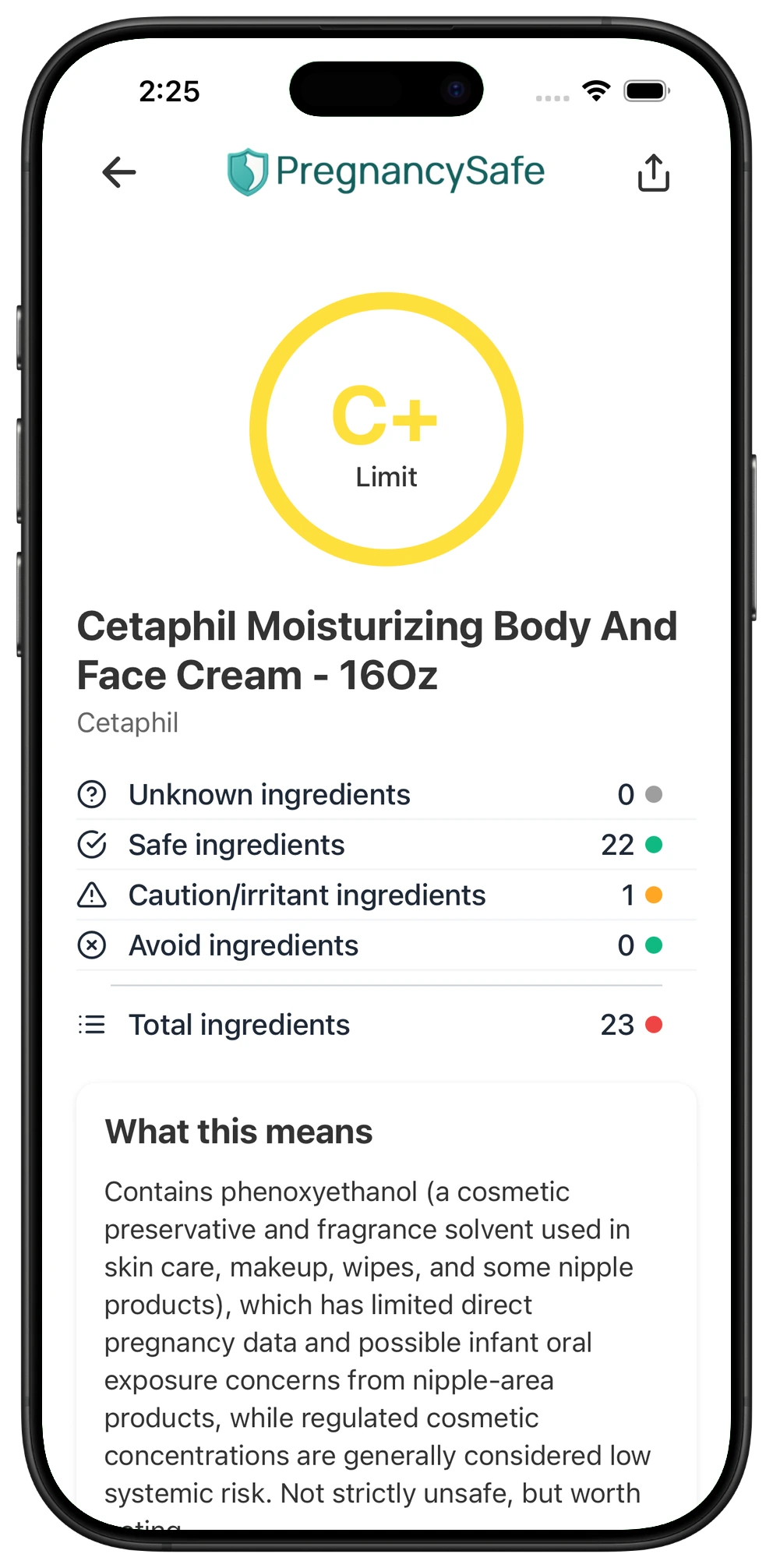
| C+ | Cetaphil Moisturizing Body And Face Cream - 16Oz | Cetaphil | Moisturizer |
| A | Luminous Silk Natural Glow Blurring Foundation | Giorgio Armani | Foundation |
| B+ | La Roche-Posay Toleriane Double Repair Face Moisturizer | La Roche-Posay | Face Moisturizer |
| C | Blue Lizard Sensitive Mineral Sunscreen Lotion - Spf 50+ - 5 Fl Oz | Blue Lizard | Sunscreen |
| D- | Am Facial Moisturizing Lotion Spf 30 | Cerave | Facial Moisturizer |
| C+ | Sensitive Mineral Sunscreen Spray Spf 50 | Blue Lizard | Sunscreen |
| C | Daily Moisturizing Lotion | Cerave | Moisturizer |
How Do Products Containing Dimethicone Score?
It can be helpful to see how products containing dimethicone generally score during pregnancy. This does not tell you whether your exact product is safe, but it gives you a general idea of what we found. In this breakdown of 1 product, 100% receive a C grade. A C grade means the complete formula has some pregnancy considerations, so use it sparingly and consider a higher scoring alternative when one is available.
Frequently Asked Questions About Dimethicone During Pregnancy
Can I use a moisturizer or foundation containing dimethicone?
Dimethicone itself is considered safe for normal topical cosmetic use during pregnancy. Check the rest of the formula separately; its presence does not establish that the whole product is pregnancy safe.
Does the advice change in the first, second, or third trimester?
The available evidence does not establish trimester specific differences. The conclusion is based on very low expected absorption during normal topical use, rather than separate safety studies for each trimester.
Can dimethicone be used for head lice during pregnancy?
UKTIS/BUMPS guidance allows dimethicone based topical head lice treatment because it is not expected to enter the maternal bloodstream in appreciable amounts. Follow the product's application instructions and safety precautions.
Are there precautions beyond pregnancy safety?
Yes. Follow product warnings about eye irritation, flammability, and hypersensitivity, and avoid inhaling airbrush or aerosolized products. Low skin absorption does not remove these precautions.
Does this topical advice also cover dimethylpolysiloxane in food?
No. Dimethylpolysiloxane is another name for this polymer and is also used as an anti foaming agent in food processing, but the pregnancy conclusion here concerns topical use, not ingestion.
Why can products with dimethicone have different grades?
A product grade reflects the complete formula, not dimethicone alone. Other ingredients can change the assessment even when dimethicone is considered safe for normal topical use.
How Do We Score Products for Pregnancy Safety?
We analyze each product's ingredients and category to flag known risks and provide cautionary notices for general category safety concerns.
A - Safe
Excellent choice! All ingredients are considered safe during pregnancy.
What to do: Use with confidence.
B - Likely Safe
Pretty much safe with very minimal risk. Some ingredients may have limited pregnancy studies, but no significant safety concerns have been identified.
What to do: Use with confidence.
C - Limit
Contains ingredients with some pregnancy considerations. Research shows these ingredients may have limited safety data, potential for minor hormonal effects, or require caution based on animal studies.
What to do: Use sparingly and consider safer alternatives when available.
D - Caution
Similar to C grade but contains multiple cautionary ingredients. The combination increases overall concern.
What to do: Try to avoid if that makes you feel better. If you've already used it, no need to panic.
F - Avoid
Contains an ingredient Pregnancy Safe recommends avoiding during pregnancy. This may reflect an established risk or a precaution based on limited evidence; check the ingredient guidance and exposure context.
What to do: Do not use during pregnancy. If you've already used it, don't worry - contact your OBGYN if concerned.
Sources
- https://mothertobaby.org/fact-sheets/lice-scabies-pregnancy/
- https://uktis.org/monographs/use-of-head-lice-treatments-in-pregnancy/
- https://www.cir-safety.org/sites/default/files/FAR_Methicones_032022.pdf
- https://www.ecfr.gov/current/title-21/chapter-I/subchapter-D/part-347/subpart-B/section-347.10
- https://www.medicines.org.uk/emc/product/4860/smpc
- https://www.medicinesinpregnancy.org/leaflets-a-z/dimethicone/
- https://www.sps.nhs.uk/articles/treating-lice-during-breastfeeding/
- https://health.ec.europa.eu/system/files/2021-08/sccs_o_195_0.pdf
- https://ec.europa.eu/growth/tools-databases/cosing/details/28157
- https://journals.sagepub.com/doi/10.3109/10915819009078737
- https://link.springer.com/article/10.1007/s00204-024-03938-5
- https://www.sfda.gov.sa/en/warnings/1156
- https://www.industrialchemicals.gov.au/sites/default/files/Ethanol%2C%202-phenoxy-_Human%20health%20tier%20II%20assessment.pdf
- https://hero.epa.gov/reference/2857875
- https://books.publisso.de/sites/default/files/documents/series/mak/dam/Vol2019/Iss1/Alt006/mb12299kske6319_w.pdf