Is Phenoxyethanol Safe During Pregnancy?
Updated September 8, 2026
The Answer
Use caution, but phenoxyethanol is not an automatic avoid for occasional use of properly regulated cosmetics at allowed levels. Direct pregnancy data are limited, and leave on or nipple area products deserve extra scrutiny because the exposure differs from ordinary rinse off skin care.
Ordinary cosmetic skin contact is different from nipple area use that could lead to an infant swallowing product during nursing.
SCCS and CIR cosmetic safety reviews found phenoxyethanol acceptable at typical cosmetic levels, but pregnancy specific human outcome data remain limited and the supporting toxicity evidence is largely indirect.
Already used it? If you already used an ordinary cosmetic containing phenoxyethanol occasionally, the available evidence does not make that use an automatic avoid concern. Check whether it was a standard cosmetic or a nipple area product, since the exposure context changes the interpretation.
Pregnancy Safe is 100% independent and research driven. No companies pay to promote or sponsor products.
Stressless Pregnancy
Check your exact product with phenoxyethanol in the app

What Is Phenoxyethanol?
You may also see it listed as: 2-phenoxyethanol, phenoxyethyl alcohol, ethylene glycol monophenyl ether
Phenoxyethanol is a preservative that helps prevent microbial growth and extend a product’s shelf life. It also works as a fragrance solvent and appears across moisturizers, cleansers, wipes, makeup, sunscreen, shampoos, conditioners, serums, and some nipple or breast products.
What Other Ingredients Should You Look Out for in Products With Phenoxyethanol?
A product's full ingredient list determines whether it's pregnancy-safe or not. These ingredients also appear in some of the phenoxyethanol products we analyzed and may deserve a closer look.
Butylphenyl Methylpropional
AvoidLook for butylphenyl methylpropional or Lilial in fragranced skin and hair products. It is prohibited in EU cosmetics and has reproductive toxicity concerns based largely on animal evidence, so choosing a product without it is the lower regret check during pregnancy.
Flagged in 462 products (2.7%) in this analysis.
Galaxolide
AvoidLook for hexamethylindanopyran, also known as galaxolide or HHCB, in fragranced personal care products. Human biomonitoring confirms exposure can occur, but pregnancy outcome evidence at trace consumer levels is limited; avoiding intentionally fragranced products listing it is a precautionary option.
Flagged in 78 products (0.5%) in this analysis.
Hydroxypinacolone Retinoate
AvoidLook for hydroxypinacolone retinoate, HPR, or Granactive Retinoid in anti aging and acne style products. It lacks direct human pregnancy data, and pregnancy guidance advises avoiding topical retinoids despite low expected absorption.
Flagged in 33 products (0.2%) in this analysis.
Fragrance
CautionLook for fragrance, parfum, perfume, or fragrance oil. These umbrella terms may conceal a product specific scent mixture, so choosing fragrance free or lower fragrance products can reduce avoidable uncertainty, especially if scents also irritate your skin or airways.
Flagged in 9,651 products (57%) in this analysis.
Butylated Hydroxytoluene
CautionLook for BHT or butylated hydroxytoluene, an antioxidant used to slow product rancidity. Reviewed topical cosmetic levels are considered low concern, while the reproductive signal comes from high dose oral animal studies, so distinguish normal cosmetic use from food or supplement exposure.
Flagged in 1,281 products (7.6%) in this analysis.
Avobenzone
CautionLook for avobenzone, butyl methoxydibenzoylmethane, or butylmethoxydibenzoylmethane in sunscreen. Pregnancy specific outcome data are limited and high use testing found systemic absorption without establishing harm; mineral filters offer a lower uncertainty option when practical, but do not skip sun protection.
Flagged in 805 products (4.8%) in this analysis.
Does Phenoxyethanol Strength or Product Type Matter During Pregnancy?
The cautious conclusion applies to regulated cosmetic use at typical levels; the EU permits phenoxyethanol as a preservative up to 1.0%. Skin absorption occurs, but animal systemic toxicity appeared at much higher exposures than cosmetic use. Leave on use creates longer contact than rinse off use, while nipple area products add a separate possibility of infant oral exposure during nursing. The FDA related warning involved a nipple cream containing phenoxyethanol with chlorphenesin, not ordinary pregnancy skin care.
What Products Contain Phenoxyethanol?
Pregnancy Safe has looked at 16,935 products that have phenoxyethanol as an ingredient. The category and grade breakdowns below use 16,935 products with an exact ingredient match.
What Types of Products Contain Phenoxyethanol?
Products You May Have That Contain Phenoxyethanol
| Grade | Product | Brand | Type |
|---|---|---|---|
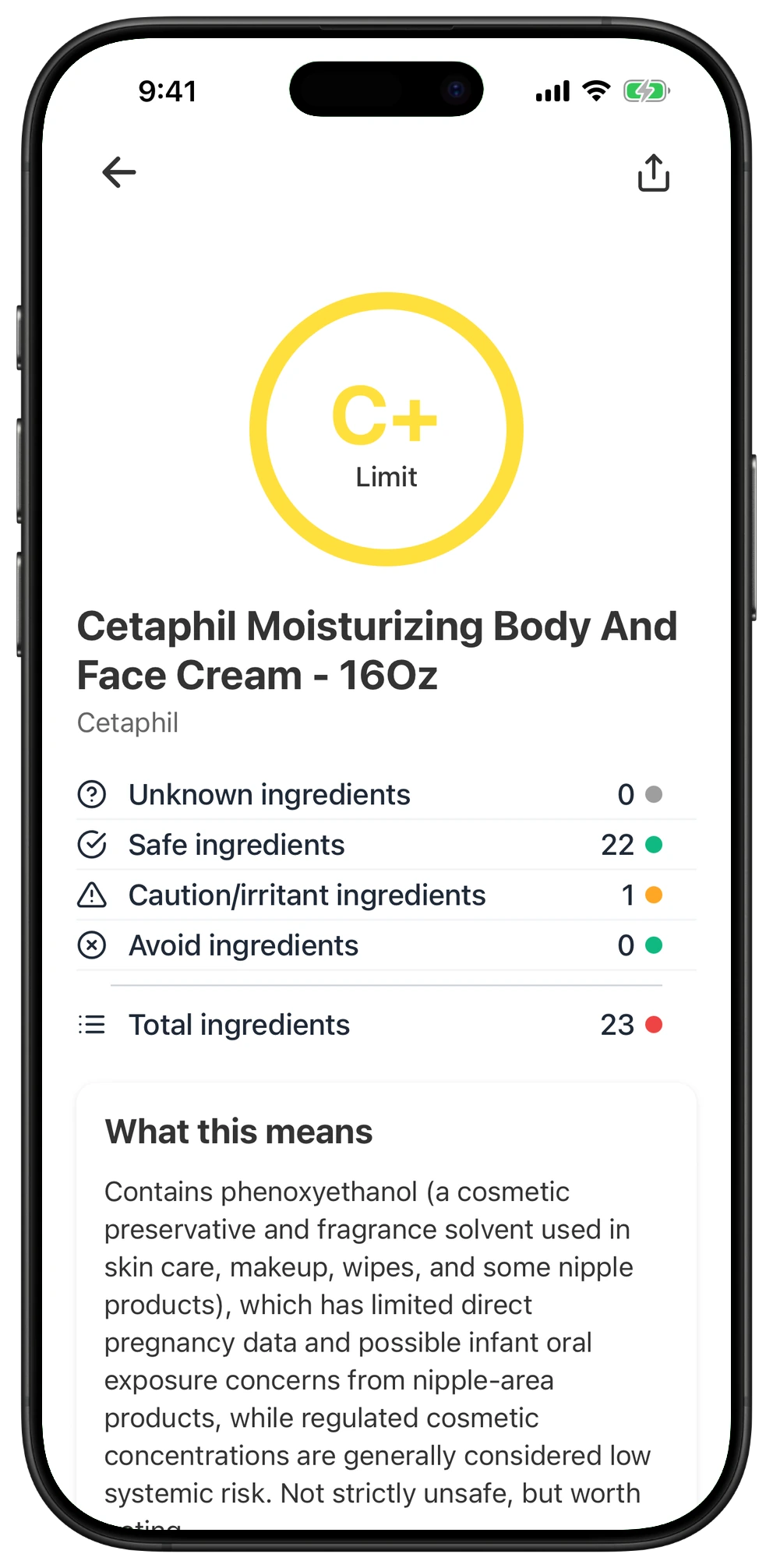
| C+ | Cetaphil Moisturizing Body And Face Cream - 16Oz | Cetaphil | Moisturizer |
| C+ | Hydrating Facial Cleanser | Cerave | Facial Cleanser |
| C | Eos Shea Better Moisture Body Lotion - Vanilla Cashmere - 16 Fl Oz | Eos | Body Lotion |
| C+ | Skin Renewing Night Cream | Cerave | Night Cream |
| C+ | Cerave Acne Foaming Cream Cleanser With Benzoyl Peroxide - 5 Fl Oz | Cerave | Facial Cleanser |
| C- | Cerave Hydrating 100% Mineral Sunscreen For Body - Spf 50 - 5 Fl Oz | Cerave | Sunscreen |
| C | Ultra Repair Cream Intense Hydration | First Aid Beauty | Moisturizer |
| C- | Cetaphil Daily Facial Cleanser | Cetaphil | Facial Cleanser |
How Do Products Containing Phenoxyethanol Score?
It can be helpful to see how products containing phenoxyethanol generally score during pregnancy. This does not tell you whether your exact product is safe, but it gives you a general idea of what we found. In this breakdown of 16,935 products, 64% receive a C grade. A C grade means the complete formula has some pregnancy considerations, so use it sparingly and consider a higher scoring alternative when one is available.
Frequently Asked Questions About Phenoxyethanol During Pregnancy
Why is phenoxyethanol rated caution instead of avoid?
Direct human pregnancy outcome data are limited, but cosmetic safety reviews consider it acceptable at typical use levels, and animal systemic toxicity appeared at much higher exposures. That supports caution rather than a blanket avoid rating for occasional, regulated cosmetic use.
Does the answer change in the first or third trimester?
The available evidence does not establish a trimester specific distinction for cosmetic phenoxyethanol use. The more meaningful differences are the product’s concentration, whether it is rinse off or leave on, and whether it is applied near the nipple.
Is rinse off phenoxyethanol different from leave on use?
Yes. Rinse off products generally involve shorter skin contact, while moisturizers, serums, makeup, and other leave on products remain on the skin longer. The evidence does not provide a separate numeric pregnancy limit for each format.
Why is phenoxyethanol used in so many cosmetics?
It helps prevent microbial growth and extend shelf life, and it can also act as a fragrance solvent. It is commonly found in skin care, hair care, makeup, wipes, cleansers, and sunscreen.
Does phenoxyethanol absorb through the skin?
Dermal absorption occurs, but the systemic toxicity seen in animals appeared at exposures much higher than typical cosmetic use. Direct pregnancy outcome evidence for regulated cosmetic exposure remains limited.
Why do nipple area products require separate consideration?
A product applied to the nipple can create possible infant oral exposure during nursing, which is different from ordinary skin contact during pregnancy. The warning described in the evidence involved a nipple cream containing both phenoxyethanol and chlorphenesin.
How Do We Score Products for Pregnancy Safety?
We analyze each product's ingredients and category to flag known risks and provide cautionary notices for general category safety concerns.
A - Safe
Excellent choice! All ingredients are considered safe during pregnancy.
What to do: Use with confidence.
B - Likely Safe
Pretty much safe with very minimal risk. Some ingredients may have limited pregnancy studies, but no significant safety concerns have been identified.
What to do: Use with confidence.
C - Limit
Contains ingredients with some pregnancy considerations. Research shows these ingredients may have limited safety data, potential for minor hormonal effects, or require caution based on animal studies.
What to do: Use sparingly and consider safer alternatives when available.
D - Caution
Similar to C grade but contains multiple cautionary ingredients. The combination increases overall concern.
What to do: Try to avoid if that makes you feel better. If you've already used it, no need to panic.
F - Avoid
Contains an ingredient Pregnancy Safe recommends avoiding during pregnancy. This may reflect an established risk or a precaution based on limited evidence; check the ingredient guidance and exposure context.
What to do: Do not use during pregnancy. If you've already used it, don't worry - contact your OBGYN if concerned.
Sources
- https://books.publisso.de/sites/default/files/documents/series/mak/dam/Vol2019/Iss1/Alt006/mb12299kske6319_w.pdf
- https://ec.europa.eu/growth/tools-databases/cosing/details/28157
- https://health.ec.europa.eu/system/files/2021-08/sccs_o_195_0.pdf
- https://hero.epa.gov/reference/2857875
- https://journals.sagepub.com/doi/10.3109/10915819009078737
- https://link.springer.com/article/10.1007/s00204-024-03938-5
- https://www.industrialchemicals.gov.au/sites/default/files/Ethanol%2C%202-phenoxy-_Human%20health%20tier%20II%20assessment.pdf
- https://www.sfda.gov.sa/en/warnings/1156
- https://www.canada.ca/en/health-canada/services/chemicals-product-safety/lilial.html
- https://www.canada.ca/en/environment-climate-change/services/evaluating-existing-substances/draft-assessment-phenylpropanoids-aldehydes-group.html
- https://health.ec.europa.eu/publications/safety-butylphenyl-methylpropional-p-bmhca-cosmetic-products-submission-ii_en
- https://eur-lex.europa.eu/legal-content/EN/TXT/PDF/?uri=CELEX%3A32021R1902
- https://chem.echa.europa.eu/100.001.173/harmonised/113759
- https://chem.echa.europa.eu/obligation-lists/candidateList
- https://pubmed.ncbi.nlm.nih.gov/32461162/
- https://pubmed.ncbi.nlm.nih.gov/25256814/
- https://pubmed.ncbi.nlm.nih.gov/17612154/
- https://pubmed.ncbi.nlm.nih.gov/10630712/
- https://pubmed.ncbi.nlm.nih.gov/12217637/
- https://pubmed.ncbi.nlm.nih.gov/40379007/
- https://www.anses.fr/en/content/anses-proposes-classifying-galaxolide-toxic-reproduction-european-clp-regulation
- https://www.epa.gov/assessing-and-managing-chemicals-under-tsca/risk-evaluation-134678-hexahydro-466788
- https://www.industrialchemicals.gov.au/sites/default/files/2021-09/EVA00039%20-%20Evaluation%20Statement%20-%2014%20September%202021%20%5B833%20KB%5D.pdf
- https://fragrancematerialsafetyresource.elsevier.com/sites/default/files/1222-05-5.pdf
- https://pubchem.ncbi.nlm.nih.gov/compound/Hydroxypinacolone-Retinoate
- https://pubmed.ncbi.nlm.nih.gov/36762391/
- https://health.ec.europa.eu/publications/revision-scientific-opinion-sccs157616-vitamin-retinol-retinyl-acetate-retinyl-palmitate_en
- https://eur-lex.europa.eu/eli/reg/2024/996/oj/eng
- https://www.ema.europa.eu/en/news/updated-measures-pregnancy-prevention-during-retinoid-use
- https://www.ncbi.nlm.nih.gov/books/NBK582989/
- https://www.acog.org/womens-health/faqs/skin-conditions-during-pregnancy
- https://www.aad.org/public/diseases/acne/derm-treat/pregnancy
- https://pubmed.ncbi.nlm.nih.gov/26215715/
- https://academic.oup.com/bjd/article/194/4/640/8375699
- https://www.fda.gov/cosmetics/cosmetic-ingredients/fragrances-cosmetics
- https://www.fda.gov/cosmetics/cosmetic-ingredients/phthalates-cosmetics
- https://www.fda.gov/cosmetics/cosmetic-ingredients/allergens-cosmetics
- https://pmc.ncbi.nlm.nih.gov/articles/PMC3110684/
- https://pmc.ncbi.nlm.nih.gov/articles/PMC4016195/
- https://pmc.ncbi.nlm.nih.gov/articles/PMC4097177/
- https://pmc.ncbi.nlm.nih.gov/articles/PMC8453372/
- https://pmc.ncbi.nlm.nih.gov/articles/PMC10999525/
- https://www.epa.gov/indoor-air-quality-iaq/volatile-organic-compounds-impact-indoor-air-quality
- https://health.ec.europa.eu/system/files/2022-08/sccs_o_257.pdf
- https://pubmed.ncbi.nlm.nih.gov/37751543/
- https://pubmed.ncbi.nlm.nih.gov/12396675/
- https://pmc.ncbi.nlm.nih.gov/articles/PMC13151845/
- https://www.ecfr.gov/current/title-21/chapter-I/subchapter-B/part-172/subpart-B/section-172.115
- https://www.ecfr.gov/current/title-21/chapter-I/subchapter-B/part-182/subpart-D/section-182.3173
- https://www.fda.gov/news-events/press-announcements/fda-finalizes-food-chemical-safety-post-market-assessment-program-launches-reassessment-bht-ada
- https://www.fda.gov/drugs/understanding-over-counter-medicines/sunscreen-how-help-protect-your-skin-sun
- https://www.fda.gov/drugs/understanding-over-counter-medicines/questions-and-answers-fda-posts-deemed-final-order-and-proposed-order-over-counter-sunscreen
- https://www.aad.org/public/everyday-care/skin-care-secrets/routine/pregnancy-skin-care
- https://www.aad.org/media/stats-sunscreen
- https://mothertobaby.org/baby-blog/screening-your-sunscreen-during-pregnancy/
- https://pmc.ncbi.nlm.nih.gov/articles/PMC6990686/
- https://pubmed.ncbi.nlm.nih.gov/40910486/
- https://pmc.ncbi.nlm.nih.gov/articles/PMC11984416/
- https://pmc.ncbi.nlm.nih.gov/articles/PMC12317922/