Best Pregnancy Safe Sunscreen (Updated 2026 Guide)
Updated September 9, 2026
The Answer
Keep using sun protection during pregnancy: choose a broad spectrum, water resistant SPF 30+ sunscreen, with zinc oxide or titanium dioxide as practical mineral options. Most sunscreens in the catalog have grades below A, but those grades do not establish fetal harm or make the seven A grade entries verified safe choices.
The main consideration is maintaining effective UV protection while choosing a formulation you tolerate; the American Academy of Dermatology recommends SPF 30+ alongside shade and protective clothing. Some chemical filters have limited pregnancy specific evidence and measurable absorption under repeated, large area testing, but absorption is not proof of fetal harm. Fragrance may cause irritation, while other caution flags depend on concentration and exposure rather than establishing that ordinary topical use is harmful.
Pregnancy Safe is 100% independent and research driven. No companies pay to promote or sponsor products.
Stress Less This Pregnancy
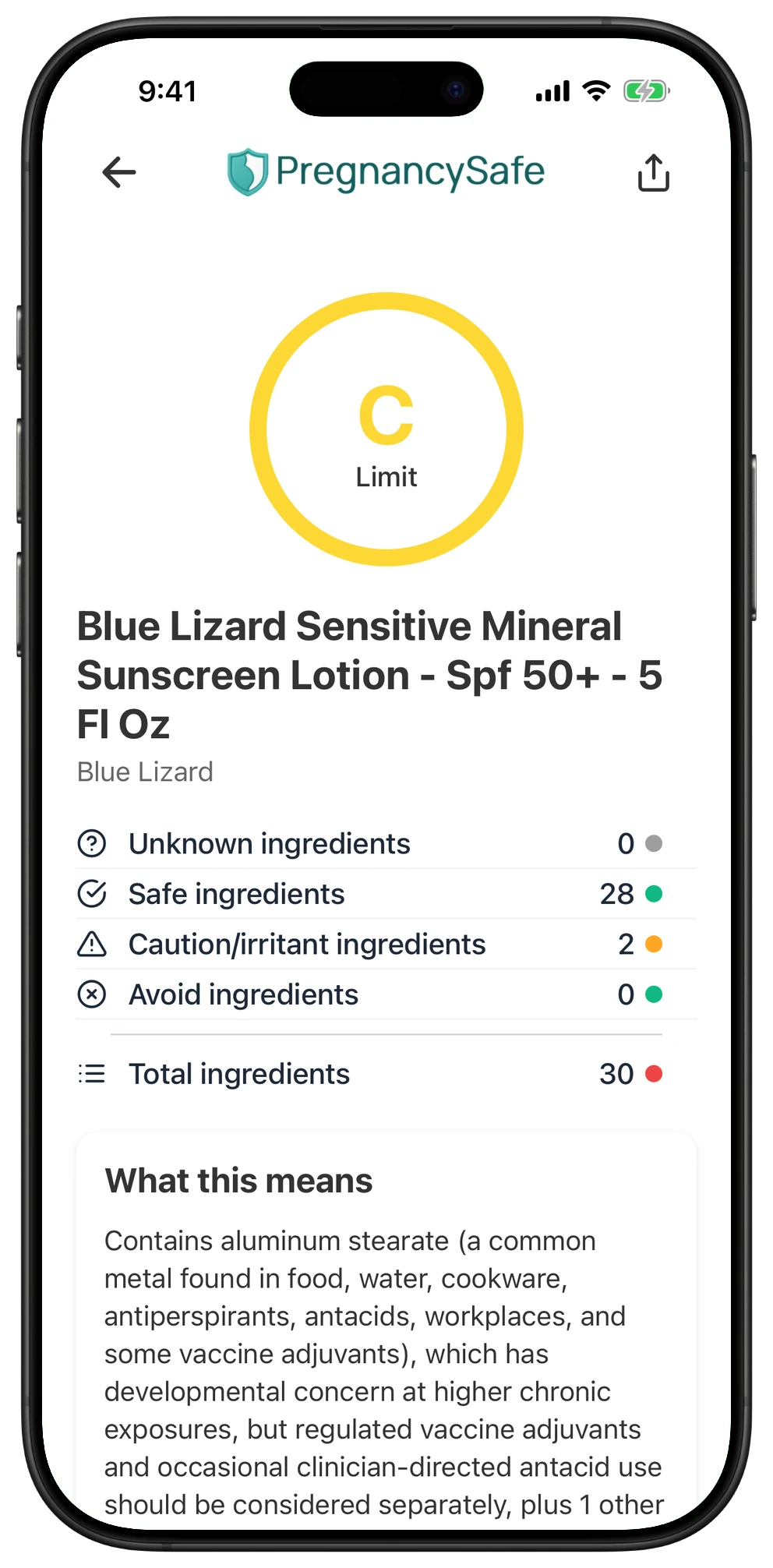
Check your exact sunscreen in the app
✓ What's Safe
- • Choose broad spectrum, water resistant SPF 30 or higher rather than relying on a pregnancy safe marketing claim.
- • Look for zinc oxide or titanium dioxide as active filters if you prefer a practical mineral option with fewer pregnancy related uncertainties.
- • Read both active and inactive ingredient lists on the exact formula and size you plan to use; a mineral label does not describe every ingredient.
- • Consider fragrance free formulations, especially if your skin reacts to scented products.
- • Choose a texture you can apply adequately and reapply according to the package directions; add shade and protective clothing.
✗ What to Avoid
- • Avoid choosing by catalog grade alone: an A grade can reflect an incomplete ingredient record rather than a fully checked formula.
- • If you want to reduce chemical filter uncertainty, choose a mineral alternative without octocrylene or homosalate rather than skipping sunscreen.
- • Avoid assuming avobenzone or octisalate has been proven to harm babies; their caution flags reflect limited pregnancy evidence and absorption findings.
- • Avoid fragrance or parfum if scented sunscreen irritates your skin; their presence does not establish fetal harm.
- • Avoid treating phenoxyethanol or butyloctyl salicylate as automatic pregnancy contraindications based on oral, high dose or breastfeeding evidence.
- • Avoid applying less sunscreen or delaying reapplication to reduce ingredient exposure; change formulations while maintaining adequate protection.
Most Common Ingredients in Sunscreen Products
We analyzed 1,865 sunscreen products. Here are the most common ingredients, ranked by how often they appear:
Ingredients to Watch Out For in Sunscreen
These are the most common flagged ingredients across 1,865 sunscreen products we analyzed.
octocrylene
Caution
Octocrylene is a chemical compound commonly used in sunscreens to absorb UVB rays and stabilize other UV filters.
Has limited pregnancy specific outcome data despite measurable systemic absorption, inconclusive endocrine signals, and benzophenone impurity or degradation concerns.
Octocrylene is a chemical UV filter that also helps stabilize sunscreen formulas. Repeated, large area application studies show systemic absorption, while direct pregnancy outcome evidence remains limited; benzophenone impurity and degradation concerns add uncertainty. Choosing an octocrylene free mineral sunscreen is an option, but these findings do not establish fetal harm from ordinary topical use.
Flagged in 704 of 1,865 products (38%)
Caution
Phenoxyethanol is a preservative commonly used in cosmetics and skincare products to prevent microbial growth and extend shelf life.
Has limited direct pregnancy data and possible infant oral exposure concerns from nipple area products, while regulated cosmetic concentrations are generally considered low systemic risk.
Phenoxyethanol preserves sunscreen by limiting microbial growth. Cosmetic safety reviews consider regulated concentrations acceptable, although direct pregnancy outcome data are limited. High dose animal findings and infant ingestion concerns involving nipple products should not be treated as evidence that normal topical sunscreen use harms a pregnancy.
Flagged in 699 of 1,865 products (37%)
homosalate
Caution
Homosalate is a chemical compound commonly used in sunscreens to help absorb and block ultraviolet (UV) rays from the sun.
Has limited pregnancy specific data, measurable systemic absorption after topical use, and equivocal endocrine/reproductive concerns that regulators address with concentration limits.
Homosalate is a chemical UVB filter, with absorption demonstrated after topical sunscreen application. Pregnancy specific data are limited, and concentration dependent safety assessments support caution rather than proof of human fetal harm. For frequent body application, you can choose a mineral alternative instead of reducing the amount of sunscreen you apply.
Flagged in 637 of 1,865 products (34%)
Caution
Avobenzone is a chemical compound used in sunscreens to provide broad spectrum protection against UVA rays.
Has limited pregnancy specific outcome data and systemic absorption under high use testing, making mineral sunscreen filters the lower uncertainty option when practical.
Avobenzone provides UVA protection in chemical and hybrid sunscreens. High coverage, repeated use studies in nonpregnant adults detected it in blood but did not establish clinical harm. Its pregnancy caution reflects limited outcome evidence; a mineral alternative is practical if you prefer, without abandoning sun protection.
Flagged in 573 of 1,865 products (31%)
butyloctyl salicylate
Caution
Butyloctyl salicylate is a lightweight, skin friendly ester used in cosmetics and sunscreens to enhance SPF protection and improve product spreadability.
Has limited pregnancy specific data and salicylate exposure may matter with high dose or large area topical use, although routine cosmetic use appears low concern.
Butyloctyl salicylate is a salicylic acid ester used as an emollient and solvent in sunscreen formulations. Direct human pregnancy studies are lacking, while cosmetic reviews are reassuring at assessed use levels when formulas avoid irritation. It is not identical to salicylic acid, and oral NSAID risks do not establish harm from routine topical sunscreen exposure; concentration, broken skin and extensive application matter when assessing uncertainty.
Flagged in 555 of 1,865 products (30%)
octisalate
Caution
Octisalate is a sunscreen agent used to absorb UVB rays and protect the skin from sun damage.
Has limited pregnancy specific safety data and measurable systemic absorption after large area sunscreen use, though normal topical sunscreen exposure is not comparable to oral salicylates.
Octisalate, also called ethylhexyl salicylate, is a chemical UVB filter. Large area sunscreen studies demonstrate absorption, but direct pregnancy outcome evidence is lacking. Normal topical use should not be equated with oral aspirin or high dose topical pain relief salicylates; its caution flag is not a finding of demonstrated fetal harm.
Flagged in 538 of 1,865 products (29%)
fragrance
Caution
A fragrant substance used to add a pleasant aroma to products or environments.
Can hide product specific mixtures and has been associated with higher DEP metabolite exposure in some pregnancy studies; fragrance allergens and VOCs may also irritate sensitive skin or airways.
Fragrance describes a scent mixture rather than one defined chemical in your sunscreen. It can irritate sensitive skin, and incomplete mixture disclosure creates product specific uncertainty. Associations between fragranced product use and phthalate biomarkers do not mean every fragrance contains phthalates or that typical sunscreen use causes pregnancy harm.
Flagged in 354 of 1,865 products (19%)
butyl methoxydibenzoylmethane
Caution
Butyl methoxydibenzoylmethane is a chemical compound commonly used as a UVA sunscreen agent to protect the skin from ultraviolet radiation.
Has limited pregnancy specific outcome data and systemic absorption under high use testing, making mineral sunscreen filters the lower uncertainty option when practical.
Butyl methoxydibenzoylmethane is the ingredient label name for avobenzone, the UVA sunscreen filter, not a separate filter with a different pregnancy assessment. Repeated, high coverage topical testing found systemic absorption without establishing clinical harm. Limited pregnancy specific evidence supports a cautious choice of mineral filters when practical, not stopping sunscreen.
Flagged in 332 of 1,865 products (18%)
How Do Sunscreen Products Stack Up?
Our catalog contains ratings for 1,865 sunscreen products. These are database grades, not independent safety certifications.
Some A-grade records lose ingredients between the source label and catalog. Two source-confirmed non-skin-sunscreen records were excluded from this category count. Remaining grades have not all been label-verified; choose sun protection using its full label, not this distribution.
Best Pregnancy Safe Sunscreen
Popular options from our catalog, prioritizing A and B ingredient grades, with C grade options used to fill remaining places. Within each group, products are ordered by searches in Pregnancy Safe, not retail sales. Read the cautions and guidance above; grades do not verify a complete current label or guarantee pregnancy safety.
| Grade | Product | Brand |
|---|---|---|
| B+ | Native Mineral Sunscreen Lotion Spf 30 | Native |
| B+ | Native Mineral Sunscreen Spray Unscented Spf 30 | Native |
| B+ | Blue Lizard Sensitive Mineral Sunscreen Stick - Spf 50+ | Blue Lizard |
| B+ | Supergoop! Mineral Mattescreen Spf 40 | Supergoop! |
| B+ | Daily Mineral Sunscreen With Zinc Oxide, Spf 30 | Badger |
Your Questions Answered
What happens if I use sunscreen during pregnancy?
Sunscreen helps protect your skin from UV exposure, and sun protection remains recommended during pregnancy. The American Academy of Dermatology advises broad spectrum, water resistant SPF 30 or higher, along with shade and protective clothing. Zinc oxide or titanium dioxide are practical choices if you want a mineral formulation. Use the amount and reapplication schedule on the package rather than reducing protection because of ingredient concerns.
What if I already used chemical sunscreen while pregnant?
Using chemical sunscreen does not by itself mean you harmed your baby. Studies showing absorption of some filters involved repeated, high coverage application and did not establish fetal harm. Pregnancy specific outcome evidence remains limited, so you can choose a mineral formulation going forward if you prefer. Keep protecting your skin rather than stopping sunscreen out of worry.
Is chemical sunscreen pregnancy safe?
There is no single pregnancy verdict that applies to every chemical sunscreen formulation. Filters such as octocrylene, homosalate, avobenzone and octisalate have evidence gaps, and some enter the bloodstream during maximal use testing. These findings are not proof that normal topical use harms a fetus. A broad spectrum mineral sunscreen is a practical alternative when you want to reduce that uncertainty without sacrificing UV protection.
What should I look for in sunscreen during pregnancy?
Start with broad spectrum, water resistant SPF 30 or higher, then check the full ingredient label. Zinc oxide or titanium dioxide are practical mineral filters, and a fragrance free formulation may suit sensitive skin. Do not assume a mineral sunscreen contains only mineral filters and otherwise concern free ingredients. Choose a formula you tolerate well enough to apply adequately and follow its reapplication directions.
Do A grades mean a sunscreen is proven safe during pregnancy?
No: the catalog contains 1,865 entries, including seven graded A, but those seven are not a verified safe product count. Some A grade records omit ingredients found on source labels, and remaining grades have not all been checked against complete labels. This is catalog coverage, not a representative market sample, and lower grades do not mean each product is clinically contraindicated. Use the full package label and sun protection guidance rather than treating the rating chart as a clinical verdict.
How were these sunscreen products selected?
The list prioritizes A/B ingredient grades, with C grades filling remaining slots, and ranks products within each group by searches in Pregnancy Safe after deduplication and record checks. The displayed ingredient grades do not independently verify every complete current label or establish clinical superiority. Match the exact formulation and read the qualifications. Follow the package directions and continue using shade and protective clothing.
How Do We Score Products for Pregnancy Safety?
We analyze each product's ingredients and category to flag known risks and provide cautionary notices for general category safety concerns.
Grades reflect the ingredient and category information available to us. They don’t verify a complete, current label or account for dose, preparation, or contamination. Read them alongside the guidance above, not as a guarantee of pregnancy safety or proof that every use is harmful.
A - Safe
Excellent choice! All ingredients are considered safe during pregnancy.
What to do: Use with confidence.
B - Likely Safe
Pretty much safe with very minimal risk. Some ingredients may have limited pregnancy studies, but no significant safety concerns have been identified.
What to do: Use with confidence.
C - Limit
Contains ingredients with some pregnancy considerations. Research shows these ingredients may have limited safety data, potential for minor hormonal effects, or require caution based on animal studies.
What to do: Use sparingly and consider safer alternatives when available.
D - Caution
Similar to C grade but contains multiple cautionary ingredients. The combination increases overall concern.
What to do: Try to avoid if that makes you feel better. If you've already used it, no need to panic.
F - Avoid
Contains an ingredient Pregnancy Safe recommends avoiding during pregnancy. This may reflect an established risk or a precaution based on limited evidence; check the ingredient guidance and exposure context.
What to do: Do not use during pregnancy. If you've already used it, don't worry - contact your OBGYN if concerned.
People Also Checked
References
- https://www.aad.org/public/everyday-care/skin-care-secrets/routine/pregnancy-skin-care
- https://health.ec.europa.eu/document/download/2928185b-f8b7-474e-937a-052a90a90970_en
- https://www.fda.gov/drugs/understanding-over-counter-medicines/questions-and-answers-fda-posts-deemed-final-order-and-proposed-order-over-counter-sunscreen
- https://www.fda.gov/drugs/understanding-over-counter-medicines/sunscreen-how-help-protect-your-skin-sun
- https://pubmed.ncbi.nlm.nih.gov/31058986/
- https://pubmed.ncbi.nlm.nih.gov/31961417/
- https://www.tga.gov.au/sites/default/files/2025-04/safety-review-seven-active-sunscreen-ingredients.pdf
- https://www.tga.gov.au/resources/publication/corporate-reports/safety-review-benzophenone
- https://pubmed.ncbi.nlm.nih.gov/33682414/
- https://pubmed.ncbi.nlm.nih.gov/21030064/
- https://www.frontiersin.org/journals/medicine/articles/10.3389/fmed.2025.1563369/full
- https://health.ec.europa.eu/system/files/2021-08/sccs_o_195_0.pdf
- https://ec.europa.eu/growth/tools-databases/cosing/details/28157
- https://journals.sagepub.com/doi/10.3109/10915819009078737
- https://link.springer.com/article/10.1007/s00204-024-03938-5
- https://www.sfda.gov.sa/en/warnings/1156
- https://www.industrialchemicals.gov.au/sites/default/files/Ethanol%2C%202-phenoxy-_Human%20health%20tier%20II%20assessment.pdf
- https://hero.epa.gov/reference/2857875
- https://books.publisso.de/sites/default/files/documents/series/mak/dam/Vol2019/Iss1/Alt006/mb12299kske6319_w.pdf
- https://health.ec.europa.eu/publications/homosalate_en
- https://health.ec.europa.eu/system/files/2022-08/sccs_o_260.pdf
- https://eur-lex.europa.eu/legal-content/EN/TXT/HTML/?uri=CELEX%3A32022R2195
- https://jamanetwork.com/journals/jama/fullarticle/2759002
- https://www.tga.gov.au/resources/explore-topic/sunscreens/sunscreen-ingredients
- https://mothertobaby.org/baby-blog/screening-your-sunscreen-during-pregnancy/
- https://link.springer.com/article/10.1007/s00204-024-03935-8
- https://www.aad.org/media/stats-sunscreen
- https://pmc.ncbi.nlm.nih.gov/articles/PMC6990686/
- https://pubmed.ncbi.nlm.nih.gov/40910486/
- https://pmc.ncbi.nlm.nih.gov/articles/PMC11984416/
- https://pmc.ncbi.nlm.nih.gov/articles/PMC12317922/
- https://www.cir-safety.org/sites/default/files/salicy042019FAR.pdf
- https://pubmed.ncbi.nlm.nih.gov/41243163/
- https://pubmed.ncbi.nlm.nih.gov/38539266/
- https://health.ec.europa.eu/system/files/2023-06/sccs_o_268.pdf
- https://www.ncbi.nlm.nih.gov/books/NBK582985/
- https://www.fda.gov/drugs/drug-safety-and-availability/fda-recommends-avoiding-use-nsaids-pregnancy-20-weeks-or-later-because-they-can-result-low-amniotic
- https://webprod.hc-sc.gc.ca/nhpid-bdipsn/ingredReq?id=11175
- https://ec.europa.eu/health/scientific_committees/consumer_safety/opinions/sccnfp_opinions_97_04/sccp_out26_en.htm
- https://pmc.ncbi.nlm.nih.gov/articles/PMC11402844/
- https://pmc.ncbi.nlm.nih.gov/articles/PMC5744631/
- https://mothertobaby.org/baby-blog/national-safety-month-can-beauty-products-in-my-bathroom-be-bad-for-baby/
- https://www.fda.gov/cosmetics/cosmetic-ingredients/fragrances-cosmetics
- https://www.fda.gov/cosmetics/cosmetic-ingredients/phthalates-cosmetics
- https://www.fda.gov/cosmetics/cosmetic-ingredients/allergens-cosmetics
- https://pmc.ncbi.nlm.nih.gov/articles/PMC3110684/
- https://pmc.ncbi.nlm.nih.gov/articles/PMC4016195/
- https://pmc.ncbi.nlm.nih.gov/articles/PMC4097177/
- https://pmc.ncbi.nlm.nih.gov/articles/PMC8453372/
- https://pmc.ncbi.nlm.nih.gov/articles/PMC10999525/
- https://www.epa.gov/indoor-air-quality-iaq/volatile-organic-compounds-impact-indoor-air-quality