Best Pregnancy Safe Tinted Moisturizer (Updated 2026 Guide)
Updated September 9, 2026
The Answer
You can choose a tinted moisturizer for pregnancy by checking the exact formula, avoiding retinoids and maintaining broad spectrum sun protection. Our catalog contains 82 products with grades from B+ to F and no A grades, but these ingredient scores do not establish clinical pregnancy suitability.
For a leave on facial tint, prioritize avoiding retinoids such as retinyl palmitate and checking sunscreen actives rather than treating every caution ingredient as harmful. Concerns about phenoxyethanol, butyloctyl salicylate and several UV filters involve limited pregnancy specific evidence or exposure dependent uncertainty, not established harm from ordinary facial use. Oral antacid, high dose animal and loose powder inhalation findings should not be treated as equivalent to applying a tinted moisturizer to skin.
Pregnancy Safe is 100% independent and research driven. No companies pay to promote or sponsor products.
Stress Less This Pregnancy
Check your exact tinted moisturizer in the app

✓ What's Safe
- • Check the full ingredient list for your exact shade and formula, including any separately listed sunscreen actives.
- • Choose a retinoid free formula; check anti aging tints for retinyl palmitate as well as other vitamin A derivatives.
- • Consider a broad spectrum mineral SPF formula using zinc oxide or titanium dioxide if you prefer to minimize uncertainty around organic UV filters.
- • Look for sunscreen application and reapplication directions you can follow; use separate sunscreen if you only want a sheer layer of tint.
- • Choose a formula your skin tolerates, with fragrance free options if fragrance triggers irritation or allergy.
- • Read the qualifications attached to any listed product and match its exact version rather than relying on its name or grade.
✗ What to Avoid
- • Avoid tinted moisturizers containing retinyl palmitate or other retinoids during pregnancy.
- • Avoid assuming homosalate, octisalate or octinoxate are required for an SPF tint; consider mineral alternatives if their pregnancy data gaps concern you, without giving up sun protection.
- • Avoid treating butyloctyl salicylate as interchangeable with salicylic acid or as proof that a tint is an acne treatment.
- • Avoid rejecting a formula solely because it contains phenoxyethanol or aluminum hydroxide; nursing related ingestion warnings and oral antacid precautions do not establish harm from facial use.
- • Avoid breathing airborne talc from accompanying loose powders; this is a different exposure from talc incorporated into a cream or liquid tint.
- • Avoid relying on a thin makeup layer for labeled SPF or treating clean, natural or high grade labels as pregnancy certification.
Most Common Ingredients in Tinted Moisturizer Products
We analyzed 82 tinted moisturizer products. Here are the most common ingredients, ranked by how often they appear:
Ingredients to Watch Out For in Tinted Moisturizer
These are the most common flagged ingredients across 82 tinted moisturizer products we analyzed.
Caution
Phenoxyethanol is a preservative commonly used in cosmetics and skincare products to prevent microbial growth and extend shelf life.
Has limited direct pregnancy data and possible infant oral exposure concerns from nipple area products, while regulated cosmetic concentrations are generally considered low systemic risk.
This preservative helps prevent microbial growth in tinted moisturizer. Cosmetic safety reviews support use at regulated concentrations, although direct pregnancy data are limited. Warnings involving infant ingestion from nipple creams do not establish harm from ordinary facial application.
Flagged in 39 of 82 products (48%)
aluminum hydroxide
Caution
Aluminum hydroxide is a compound commonly used as an antacid to neutralize stomach acid and as an adjuvant in vaccines.
Is generally low concern for short term labeled antacid use but needs caution with chronic high dose use, kidney disease, constipation, or medication and iron interactions.
Its presence in a topical tint should not be assessed as though you were taking an aluminum hydroxide antacid. The cited precautions concern oral dosing, especially chronic high dose use and medication interactions; they do not establish reproductive harm from facial cosmetic exposure.
Flagged in 26 of 82 products (32%)
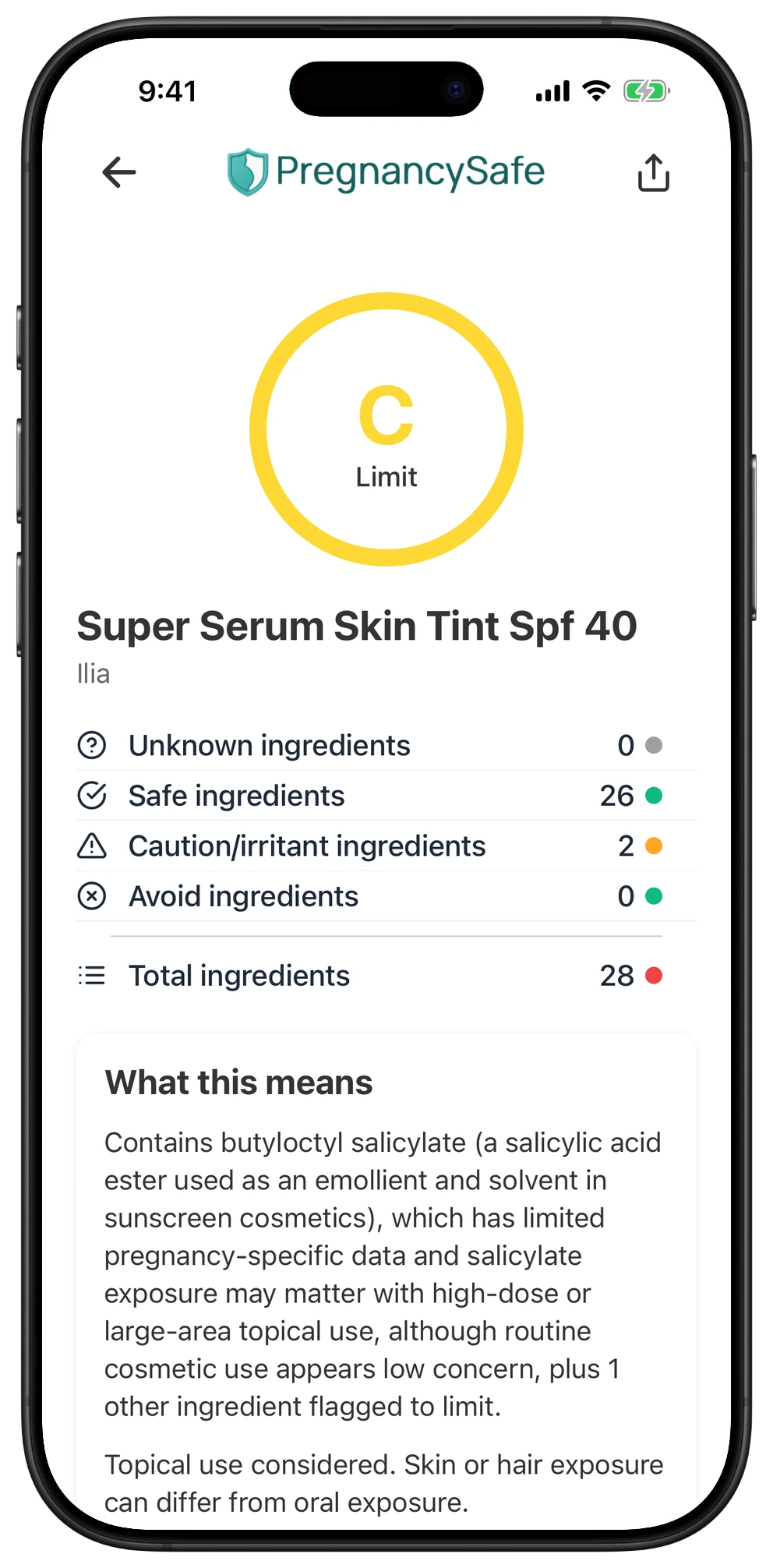
butyloctyl salicylate
Caution
Butyloctyl salicylate is a lightweight, skin friendly ester used in cosmetics and sunscreens to enhance SPF protection and improve product spreadability.
Has limited pregnancy specific data and salicylate exposure may matter with high dose or large area topical use, although routine cosmetic use appears low concern.
This emollient and solvent is a distinct ingredient from salicylic acid, not evidence that a tinted moisturizer is an acne treatment. Cosmetic reviews are reassuring at reviewed use levels, but direct pregnancy studies are lacking. High percentage, large area or broken skin exposure warrants more caution than ordinary use of a facial tint.
Flagged in 20 of 82 products (24%)
homosalate
Caution
Homosalate is a chemical compound commonly used in sunscreens to help absorb and block ultraviolet (UV) rays from the sun.
Has limited pregnancy specific data, measurable systemic absorption after topical use, and equivocal endocrine/reproductive concerns that regulators address with concentration limits.
This UVB filter can be absorbed through skin, and pregnancy specific outcome evidence is limited. Endocrine and reproductive concerns remain uncertain rather than proven harm from facial use. A broad spectrum mineral tint is an alternative if you prefer to minimize this uncertainty.
Flagged in 9 of 82 products (11%)
glycyrrhiza glabra root extract
Caution
Glycyrrhiza glabra root extract is a natural compound derived from licorice root, commonly used for its soothing, anti inflammatory, and sweetening properties in skincare and herbal remedies.
Is low concern in typical topical cosmetics but warrants caution because oral licorice or glycyrrhizin exposure in pregnancy is linked to blood pressure effects, shorter gestation, preterm birth, and child neurodevelopment signals.
This licorice root extract is used for soothing and brightening in skincare. Typical low concentration topical use is lower concern than consuming licorice or glycyrrhizin, although pregnancy specific topical data are limited. Findings from heavy oral intake do not establish the same effects from tinted moisturizer.
Flagged in 8 of 82 products (10%)
octisalate
Caution
Octisalate is a sunscreen agent used to absorb UVB rays and protect the skin from sun damage.
Has limited pregnancy specific safety data and measurable systemic absorption after large area sunscreen use, though normal topical sunscreen exposure is not comparable to oral salicylates.
Also called ethylhexyl salicylate, this ingredient is a UVB sunscreen filter. Large area sunscreen studies show absorption, but direct pregnancy outcome data are lacking and normal topical use is not equivalent to oral aspirin or high dose salicylate treatments. Its caution status is not a reason to abandon sun protection.
Flagged in 7 of 82 products (9%)
talc
Caution
Talc is a soft mineral composed primarily of magnesium, silicon, and oxygen, commonly used in cosmetics and personal care products for its absorbent and smoothing properties.
Has limited pregnancy specific data plus contamination and inhalation concerns with loose body powders, while modern asbestos tested pressed cosmetics appear lower concern.
Talc can help adjust a tint's texture. Its main concerns involve asbestos contamination and inhaling airborne powder; talc incorporated into a cream or liquid does not create the same powder cloud exposure. Limited pregnancy data do not establish asbestos tested cosmetic talc as a reproductive toxicant.
Flagged in 7 of 82 products (9%)
bht
Caution
BHT (butylated hydroxytoluene) is a synthetic antioxidant commonly used as a preservative to prevent the oxidation of fats and oils in food products.
Has limited human pregnancy data, with low concern at reviewed cosmetic levels but reproductive and thyroid related findings in high dose oral animal studies.
BHT, or butylated hydroxytoluene, helps protect a tinted moisturizer's ingredients from oxidation. Cosmetic reviews support specified use concentrations, while reproductive findings largely involve high dose oral animal exposure. Those findings do not establish harm from ordinary topical use, though direct human pregnancy evidence is limited.
Flagged in 6 of 82 products (7%)
How Do Tinted Moisturizer Products Stack Up?
Our catalog contains ratings for 82 tinted moisturizer products. These are database grades, not independent safety certifications.
Grades are catalog ingredient scores, not measurements of current labels, preparation, pathogens, dose or clinical pregnancy suitability. Unreviewed products remain in the aggregate counts.
Best Pregnancy Safe Tinted Moisturizer
Popular options from our catalog, prioritizing A and B ingredient grades, with C grade options used to fill remaining places. Within each group, products are ordered by searches in Pregnancy Safe, not retail sales. Read the cautions and guidance above; grades do not verify a complete current label or guarantee pregnancy safety.
| Grade | Product | Brand |
|---|---|---|
| B+ | Bareminerals Complexion Rescue Tinted Hydrating Gel Cream Spf 30 - - Ulta Beauty | Bareminerals |
| B+ | Neutrogena Radiant Tinted Moisturizer With Spf 30 | Neutrogena |
| B+ | Tarte Bb Blur Tinted Moisturizer Broad Spectrum Spf 30 Sunscreen - - Ulta Beauty | Tarte |
| B+ | Complexion Rescue Tinted Moisturizer With Hyaluronic Acid And Mineral Spf 30 | Bareminerals |
| B+ | Honest Beauty Cc Tinted Moisturizer With Vitamin C And Blue Light Defense - Spf 30 | Honest Beauty |
Your Questions Answered
Is tinted moisturizer safe during pregnancy?
Tinted moisturizer can fit into a pregnancy skincare routine, but the exact formula matters more than the category name. Choose a retinoid free version and check its sunscreen actives and directions. Ordinary cosmetic preservatives and mineral pigments are not automatically proven fetal toxins. Discuss prescription or medicated formulas with your pregnancy clinician.
What are the best ways to treat melasma during pregnancy?
Keep broad spectrum sun protection central to your routine rather than relying on tint alone. A tinted moisturizer can provide cosmetic coverage, but coverage is not the same as treating pigmentation. Ask your dermatologist or pregnancy clinician about pregnancy appropriate treatment options, and avoid retinoid containing products.
Can I rely on tinted moisturizer with SPF if I have pregnancy melasma?
Only rely on its labeled protection when you apply and reapply it according to the sunscreen directions. A thin layer used for color may not deliver the stated SPF. If you prefer sheer coverage, use a separate broad spectrum sunscreen as directed rather than expecting a small amount of tint to provide full protection.
Is butyloctyl salicylate the same as salicylic acid?
No. Butyloctyl salicylate is a distinct salicylic acid ester used as an emollient and solvent in cosmetic formulas. Its presence does not establish the same concentration, exposure or purpose as a salicylic acid acne treatment. Pregnancy specific studies are lacking, but ordinary cosmetic use should not be equated with oral salicylate exposure or high dose medicated topical use.
Should I avoid chemical sunscreen filters in tinted moisturizer?
Homosalate, octisalate and octinoxate have limited direct pregnancy outcome data, and sunscreen studies show that skin absorption can occur. Measurable absorption does not by itself demonstrate fetal harm. A broad spectrum mineral formula is a practical option if you want to reduce that uncertainty. Do not stop sun protection simply because your existing tint contains an organic UV filter.
Does a low grade mean my tinted moisturizer is unsafe?
No. Our catalog contains 82 tinted moisturizers, but grades are ingredient scores rather than clinical pregnancy assessments or confirmation of every current label. A low grade does not prove that a product causes harm, and no A grades does not mean the category is unusable. Check the exact formula and ingredient specific qualifications; a listed product is not a safety guarantee or a clinical endorsement.
What if I used a tinted moisturizer containing retinyl palmitate before knowing I was pregnant?
Stop using that formula and share the ingredient list, frequency and approximate amount used with your pregnancy clinician. Retinyl palmitate is a vitamin A derivative that should be avoided in pregnancy skincare as a precaution. Inadvertent low level topical exposure is not equivalent to taking an oral retinoid, and topical retinoid studies have not shown a clear increase in major malformations. That is reassuring context, not a precise risk estimate for your particular product.
How Do We Score Products for Pregnancy Safety?
We analyze each product's ingredients and category to flag known risks and provide cautionary notices for general category safety concerns.
Grades reflect the ingredient and category information available to us. They don’t verify a complete, current label or account for dose, preparation, or contamination. Read them alongside the guidance above, not as a guarantee of pregnancy safety or proof that every use is harmful.
A - Safe
Excellent choice! All ingredients are considered safe during pregnancy.
What to do: Use with confidence.
B - Likely Safe
Pretty much safe with very minimal risk. Some ingredients may have limited pregnancy studies, but no significant safety concerns have been identified.
What to do: Use with confidence.
C - Limit
Contains ingredients with some pregnancy considerations. Research shows these ingredients may have limited safety data, potential for minor hormonal effects, or require caution based on animal studies.
What to do: Use sparingly and consider safer alternatives when available.
D - Caution
Similar to C grade but contains multiple cautionary ingredients. The combination increases overall concern.
What to do: Try to avoid if that makes you feel better. If you've already used it, no need to panic.
F - Avoid
Contains an ingredient Pregnancy Safe recommends avoiding during pregnancy. This may reflect an established risk or a precaution based on limited evidence; check the ingredient guidance and exposure context.
What to do: Do not use during pregnancy. If you've already used it, don't worry - contact your OBGYN if concerned.
People Also Checked
Face Moisturizer
279 products
Moisturizer
1,342 products
Self Tanner
191 products
Bb Cream
46 products
See our full guide to moisturizer during pregnancy.
References
- https://www.aad.org/public/everyday-care/skin-care-secrets/routine/pregnancy-skin-care
- https://health.ec.europa.eu/system/files/2021-08/sccs_o_195_0.pdf
- https://ec.europa.eu/growth/tools-databases/cosing/details/28157
- https://journals.sagepub.com/doi/10.3109/10915819009078737
- https://link.springer.com/article/10.1007/s00204-024-03938-5
- https://www.sfda.gov.sa/en/warnings/1156
- https://www.industrialchemicals.gov.au/sites/default/files/Ethanol%2C%202-phenoxy-_Human%20health%20tier%20II%20assessment.pdf
- https://hero.epa.gov/reference/2857875
- https://books.publisso.de/sites/default/files/documents/series/mak/dam/Vol2019/Iss1/Alt006/mb12299kske6319_w.pdf
- https://www.ncbi.nlm.nih.gov/books/NBK573943/
- https://pmc.ncbi.nlm.nih.gov/articles/PMC9439837/
- https://pmc.ncbi.nlm.nih.gov/articles/PMC2821234/
- https://dailymed.nlm.nih.gov/dailymed/drugInfo.cfm?setid=27848ae0-3b2f-4bfe-8856-4b8de419091e
- https://pubmed.ncbi.nlm.nih.gov/39249590/
- https://pubmed.ncbi.nlm.nih.gov/7565498/
- https://www.ncbi.nlm.nih.gov/books/NBK526049/
- https://www.cir-safety.org/sites/default/files/salicy042019FAR.pdf
- https://pubmed.ncbi.nlm.nih.gov/41243163/
- https://pubmed.ncbi.nlm.nih.gov/38539266/
- https://health.ec.europa.eu/system/files/2023-06/sccs_o_268.pdf
- https://www.ncbi.nlm.nih.gov/books/NBK582985/
- https://www.fda.gov/drugs/drug-safety-and-availability/fda-recommends-avoiding-use-nsaids-pregnancy-20-weeks-or-later-because-they-can-result-low-amniotic
- https://webprod.hc-sc.gc.ca/nhpid-bdipsn/ingredReq?id=11175
- https://health.ec.europa.eu/publications/homosalate_en
- https://health.ec.europa.eu/system/files/2022-08/sccs_o_260.pdf
- https://eur-lex.europa.eu/legal-content/EN/TXT/HTML/?uri=CELEX%3A32022R2195
- https://www.fda.gov/drugs/understanding-over-counter-medicines/questions-and-answers-fda-posts-deemed-final-order-and-proposed-order-over-counter-sunscreen
- https://jamanetwork.com/journals/jama/fullarticle/2759002
- https://www.tga.gov.au/resources/explore-topic/sunscreens/sunscreen-ingredients
- https://www.tga.gov.au/sites/default/files/2025-04/safety-review-seven-active-sunscreen-ingredients.pdf
- https://mothertobaby.org/baby-blog/screening-your-sunscreen-during-pregnancy/
- https://link.springer.com/article/10.1007/s00204-024-03935-8
- https://www.nccih.nih.gov/health/licorice-root
- https://cosmileeurope.eu/inci/detail/6154/glycyrrhiza-glabra-root-extract/
- https://pubmed.ncbi.nlm.nih.gov/11390327/
- https://pubmed.ncbi.nlm.nih.gov/12396997/
- https://pubmed.ncbi.nlm.nih.gov/28158597/
- https://pubmed.ncbi.nlm.nih.gov/28833680/
- https://pubmed.ncbi.nlm.nih.gov/16884839/
- https://www.cir-safety.org/sites/default/files/S-breakout-092020.pdf
- https://vkm.no/download/18.948158f1633d1b9fb95930/1525764185285/Hazard%20assessment%20of%20glycyrrhizic%20acid%20from%20liquorice.pdf
- https://www.fda.gov/drugs/understanding-over-counter-medicines/sunscreen-how-help-protect-your-skin-sun
- https://ec.europa.eu/health/scientific_committees/consumer_safety/opinions/sccnfp_opinions_97_04/sccp_out26_en.htm
- https://pmc.ncbi.nlm.nih.gov/articles/PMC6990686/
- https://pmc.ncbi.nlm.nih.gov/articles/PMC11402844/
- https://pmc.ncbi.nlm.nih.gov/articles/PMC5744631/
- https://mothertobaby.org/baby-blog/national-safety-month-can-beauty-products-in-my-bathroom-be-bad-for-baby/
- https://www.fda.gov/cosmetics/cosmetic-ingredients/talc
- https://www.fda.gov/cosmetics/cosmetics-news-events/fda-releases-data-agencys-2023-testing-talc-containing-cosmetic-products-asbestos
- https://www.federalregister.gov/documents/2025/11/28/2025-21407/testing-methods-for-detecting-and-identifying-asbestos-in-talc-containing-cosmetic-products
- https://publications.iarc.who.int/Book-And-Report-Series/Iarc-Monographs-On-The-Identification-Of-Carcinogenic-Hazards-To-Humans/Talc-And-Acrylonitrile-2025
- https://www.cancer.org/cancer/risk-prevention/chemicals/talcum-powder-and-cancer.html
- https://www.cdc.gov/niosh/npg/npgd0584.html
- https://pmc.ncbi.nlm.nih.gov/articles/PMC6310682/
- https://recalls-rappels.canada.ca/en/alert-recall/talc-health-risks-associated-inhalation-and-exposure-female-genital-area
- https://health.ec.europa.eu/system/files/2022-08/sccs_o_257.pdf
- https://pubmed.ncbi.nlm.nih.gov/37751543/
- https://pubmed.ncbi.nlm.nih.gov/12396675/
- https://pmc.ncbi.nlm.nih.gov/articles/PMC13151845/
- https://www.ecfr.gov/current/title-21/chapter-I/subchapter-B/part-172/subpart-B/section-172.115
- https://www.ecfr.gov/current/title-21/chapter-I/subchapter-B/part-182/subpart-D/section-182.3173
- https://www.fda.gov/news-events/press-announcements/fda-finalizes-food-chemical-safety-post-market-assessment-program-launches-reassessment-bht-ada
- https://health.ec.europa.eu/document/download/3166a978-06de-4526-b25e-8d5a66943a2e_en?filename=sccs_o_294.pdf
- https://pubmed.ncbi.nlm.nih.gov/31961417/
- https://pubmed.ncbi.nlm.nih.gov/15191542/
- https://www.ncbi.nlm.nih.gov/books/NBK581587/
- https://pubmed.ncbi.nlm.nih.gov/32108942/
- https://pubmed.ncbi.nlm.nih.gov/40212279/
- https://health.ec.europa.eu/publications/sccs-opinion-ethylhexyl-methoxycinnamate-ehmc-cas-no-5466-77-383834-59-7-ec-no-226-775-7629-661-9_en
- https://www.federalregister.gov/documents/2019/02/26/2019-03019/sunscreen-drug-products-for-over-the-counter-human-use
- https://pubmed.ncbi.nlm.nih.gov/26151237/
- https://pubmed.ncbi.nlm.nih.gov/31195281/
- https://pubmed.ncbi.nlm.nih.gov/35767664/
- https://pubmed.ncbi.nlm.nih.gov/15833384/
- https://pubmed.ncbi.nlm.nih.gov/21059369/
- https://www.ema.europa.eu/en/news/updated-measures-pregnancy-prevention-during-retinoid-use
- https://www.ncbi.nlm.nih.gov/books/NBK582989/
- https://www.ncbi.nlm.nih.gov/books/NBK582775/
- https://pubmed.ncbi.nlm.nih.gov/26215715/
- https://pubmed.ncbi.nlm.nih.gov/41365815/
- https://pubmed.ncbi.nlm.nih.gov/36447117/
- https://dailymed.nlm.nih.gov/dailymed/drugInfo.cfm?setid=9f1c8971-c6dc-4708-848b-5cee50b6c32a
- https://dailymed.nlm.nih.gov/dailymed/drugInfo.cfm?setid=993a5325-cd10-4450-b5ea-1c0a90510df6
- https://dailymed.nlm.nih.gov/dailymed/lookup.cfm?setid=34d79c31-1568-4797-a4f5-31200c7788db