Is Titanium Dioxide Safe During Pregnancy?
Updated September 12, 2026
The Answer
Titanium dioxide is likely safe during pregnancy in normal, regulated topical sunscreen and cosmetic lotion or cream use. Frequent oral exposure through supplements or processed foods, and inhalation of loose powders or sprays, deserve more caution.
How you are exposed matters: applying a cream or lotion is different from swallowing titanium dioxide or breathing airborne particles.
Low dermal absorption supports the topical assessment, although pregnancy specific human outcome data are limited; EFSA’s unresolved genotoxicity concern concerns oral food additive exposure, not evidence of harm from sunscreen creams.
Already used it? If you have already used a titanium dioxide sunscreen cream or lotion, this ingredient alone is not a reason to forgo sun protection during pregnancy. Check the product form before applying concerns about swallowed or inhaled titanium dioxide to your use.
Pregnancy Safe is 100% independent and research driven. No companies pay to promote or sponsor products.
Stressless Pregnancy
Check your exact product with titanium dioxide in the app

What Is Titanium Dioxide?
You may also see it listed as: CI 77891, C.I. 77891, TiO2, pigment white 6, E171, INS 171
Titanium dioxide is a white mineral pigment used to add whiteness and opacity to cosmetics and foods, and as a mineral UV filter in sunscreens. You may encounter it in sunscreen lotions, foundation, concealer, toothpaste, candies, and supplements.
What Other Ingredients Should You Look Out for in Products With Titanium Dioxide?
A product's full ingredient list determines whether it's pregnancy-safe or not. These ingredients also appear in some of the titanium dioxide products we analyzed and may deserve a closer look.
Butyloctyl Salicylate
CautionLook for butyloctyl salicylate, an emollient and solvent used in sunscreen formulas: routine cosmetic use appears low concern, but direct human pregnancy studies are lacking. Check concentration and whether use involves large areas, broken skin, or covered skin, since these contexts warrant extra caution.
Flagged in 1 product (100%) in this analysis.
Phenoxyethanol
CautionPhenoxyethanol is a preservative whose cosmetic safety reviews are reassuring at typical use levels, although direct pregnancy data are limited. If its concentration is unclear, check with the manufacturer; the EU preservative limit is 1.0%, not a pregnancy specific safety threshold.
Flagged in 1 product (100%) in this analysis.
Talc
CautionIf talc appears on your sunscreen label, check whether the manufacturer provides asbestos testing information, because contamination is a key concern. Breathing loose talc powder is a separate exposure and should not be equated with its presence in a fluid sunscreen.
Flagged in 1 product (100%) in this analysis.
Does Titanium Dioxide Strength or Product Type Matter During Pregnancy?
Regulated sunscreen use has low absorption through the skin, supporting a different assessment from ingestion or inhalation. Loose powders and sprays warrant extra caution when particles can be breathed in. Frequent oral supplement or processed food exposure carries unresolved food additive uncertainty; the available evidence does not establish a pregnancy specific intake limit.
What Products Contain Titanium Dioxide?
Pregnancy Safe has looked at 16,924 products that have titanium dioxide as an ingredient. The category and grade breakdowns below use 1 product whose name mentions Titanium Dioxide or another name for it.
What Types of Products Contain Titanium Dioxide?
Products You May Have That Contain Titanium Dioxide
| Grade | Product | Brand | Type |
|---|---|---|---|
| D | La Roche Posay Anthelios Tinted Face Sunscreen Spf 50, Ultra-Light Fluid Mineral Face Sunscreen With Titanium Dioxide - Spf 50 - 1.7 Fl Oz | La Roche Posay | Sunscreen |
| B+ | Vanicream Unscented Gentle Facial Cleanser - 8 Fl Oz | Vanicream | Facial Cleanser |
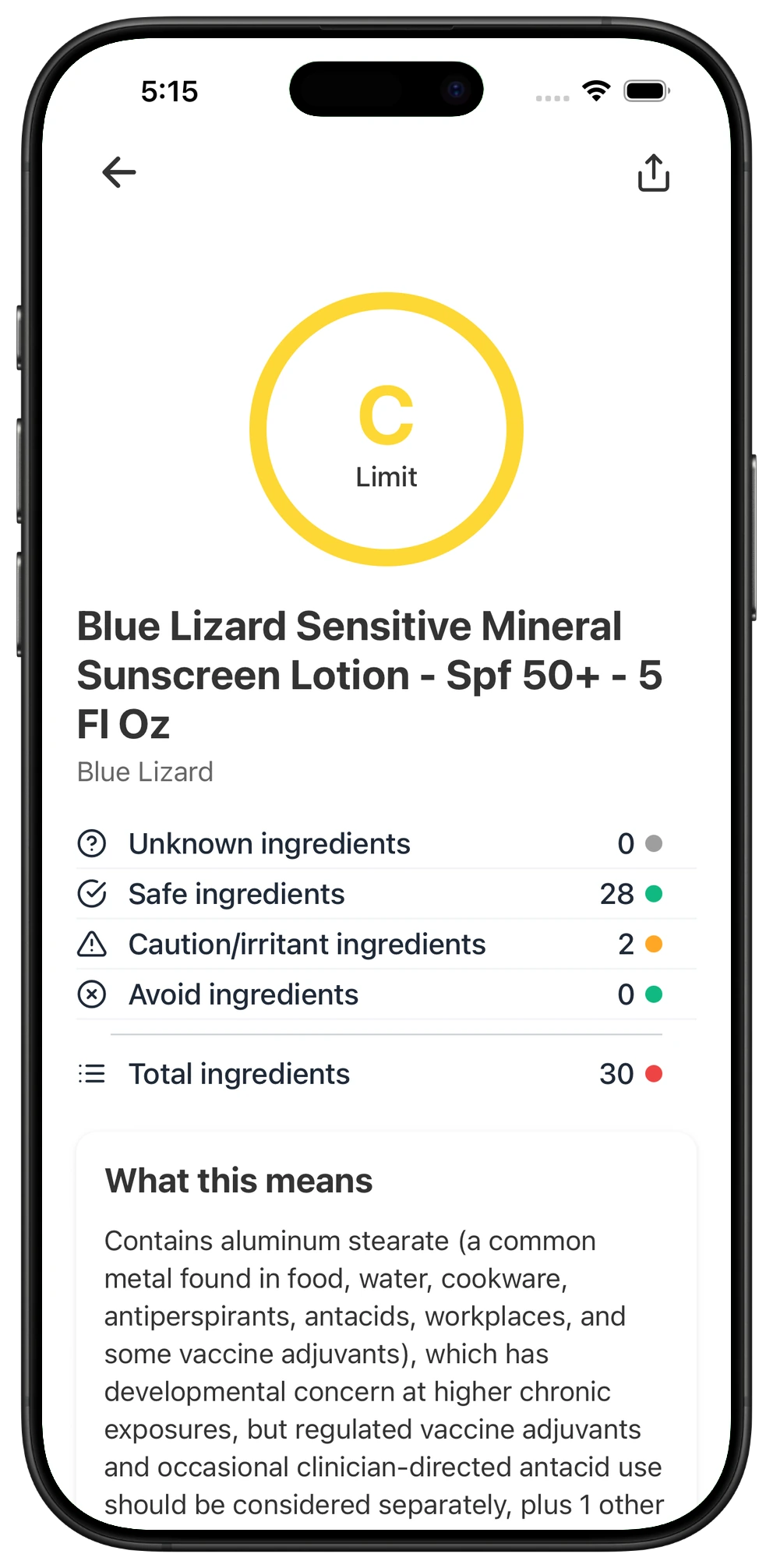
| C | Blue Lizard Sensitive Mineral Sunscreen Lotion - Spf 50+ - 5 Fl Oz | Blue Lizard | Sunscreen |
| C | Revealer Concealer | Kosas | Concealer |
| C | Super Serum Skin Tint Spf 40 | Ilia | Tinted Moisturizer |
| C- | Cerave Hydrating 100% Mineral Sunscreen For Body - Spf 50 - 5 Fl Oz | Cerave | Sunscreen |
| B+ | Avene High Protection Mineral Tinted Compact Spf 50, Uva/Uvb Protection, Honey | Avene | Sunscreen |
| C- | Cetaphil Sheer Mineral Sunscreen For Face & Body - Spf 50 - 3 Fl Oz | Cetaphil | Sunscreen |
How Do Products Containing Titanium Dioxide Score?
It can be helpful to see how products containing titanium dioxide generally score during pregnancy. This does not tell you whether your exact product is safe, but it gives you a general idea of what we found. In this breakdown of 1 product, 100% receive a D grade. A D grade means the complete formula has multiple cautionary ingredients, so consider avoiding it or choosing a higher scoring alternative.
Frequently Asked Questions About Titanium Dioxide During Pregnancy
Do I need to avoid titanium dioxide in sunscreen?
Not solely because it contains titanium dioxide. Normal, regulated sunscreen cream or lotion use is a likely safe context, and sun protection should not be avoided because of this ingredient. Inhaled sprays and loose powders need a different assessment.
What about titanium dioxide in makeup?
Normal, regulated cosmetic cream and lotion use is generally low concern. Pay attention to the form: loose makeup powder that can become airborne raises inhalation concerns that are different from applying a cream.
Why was titanium dioxide banned in EU foods?
EFSA concluded that E171 could no longer be considered safe as a food additive because it could not rule out genotoxicity, meaning potential damage to genetic material. The European Commission then removed it from EU foods. This food additive decision does not establish harm from topical sunscreen use.
Is titanium dioxide in food or supplements assessed the same way as sunscreen?
No. Frequent oral exposure warrants more caution. The FDA still permits titanium dioxide in U.S. foods within regulatory limits, while JECFA did not find convincing genotoxicity evidence and EFSA reached a more cautious conclusion. These differing assessments leave oral food additive uncertainty unresolved.
Does the answer change between the first and second trimester?
The available evidence does not establish different conclusions by trimester. The supported distinction is exposure through the skin versus swallowing it or breathing particles, rather than a particular stage of pregnancy.
Does a likely safe ingredient assessment mean my whole sunscreen is pregnancy safe?
No. Titanium dioxide’s assessment applies to that ingredient in the stated exposure context. Other ingredients need their own assessment, and a product grade describes the complete formula rather than titanium dioxide alone.
How Do We Score Products for Pregnancy Safety?
We analyze each product's ingredients and category to flag known risks and provide cautionary notices for general category safety concerns.
A - Safe
Excellent choice! All ingredients are considered safe during pregnancy.
What to do: Use with confidence.
B - Likely Safe
Pretty much safe with very minimal risk. Some ingredients may have limited pregnancy studies, but no significant safety concerns have been identified.
What to do: Use with confidence.
C - Limit
Contains ingredients with some pregnancy considerations. Research shows these ingredients may have limited safety data, potential for minor hormonal effects, or require caution based on animal studies.
What to do: Use sparingly and consider safer alternatives when available.
D - Caution
Similar to C grade but contains multiple cautionary ingredients. The combination increases overall concern.
What to do: Try to avoid if that makes you feel better. If you've already used it, no need to panic.
F - Avoid
Contains an ingredient Pregnancy Safe recommends avoiding during pregnancy. This may reflect an established risk or a precaution based on limited evidence; check the ingredient guidance and exposure context.
What to do: Do not use during pregnancy. If you've already used it, don't worry - contact your OBGYN if concerned.
Sources
- https://ec.europa.eu/newsroom/sante/items/732079/en
- https://pubmed.ncbi.nlm.nih.gov/33023621/
- https://www.ecfr.gov/current/title-21/chapter-I/subchapter-A/part-73/subpart-A/section-73.575
- https://www.ecfr.gov/current/title-21/chapter-I/subchapter-D/part-352
- https://www.efsa.europa.eu/en/news/titanium-dioxide-e171-no-longer-considered-safe-when-used-food-additive
- https://www.fda.gov/industry/color-additives/titanium-dioxide-color-additive-foods
- https://www.tga.gov.au/resources/publication/corporate-reports/literature-review-safety-titanium-dioxide-and-zinc-oxide-nanoparticles-sunscreens
- https://www.who.int/publications/m/item/jecfa-risk-assessment-of-titanium-dioxide-risk-released-background-information
- https://www.cir-safety.org/sites/default/files/salicy042019FAR.pdf
- https://pubmed.ncbi.nlm.nih.gov/41243163/
- https://pubmed.ncbi.nlm.nih.gov/38539266/
- https://health.ec.europa.eu/system/files/2023-06/sccs_o_268.pdf
- https://www.ncbi.nlm.nih.gov/books/NBK582985/
- https://www.fda.gov/drugs/drug-safety-and-availability/fda-recommends-avoiding-use-nsaids-pregnancy-20-weeks-or-later-because-they-can-result-low-amniotic
- https://webprod.hc-sc.gc.ca/nhpid-bdipsn/ingredReq?id=11175
- https://health.ec.europa.eu/system/files/2021-08/sccs_o_195_0.pdf
- https://ec.europa.eu/growth/tools-databases/cosing/details/28157
- https://journals.sagepub.com/doi/10.3109/10915819009078737
- https://link.springer.com/article/10.1007/s00204-024-03938-5
- https://www.sfda.gov.sa/en/warnings/1156
- https://www.industrialchemicals.gov.au/sites/default/files/Ethanol%2C%202-phenoxy-_Human%20health%20tier%20II%20assessment.pdf
- https://hero.epa.gov/reference/2857875
- https://books.publisso.de/sites/default/files/documents/series/mak/dam/Vol2019/Iss1/Alt006/mb12299kske6319_w.pdf
- https://www.fda.gov/cosmetics/cosmetic-ingredients/talc
- https://www.fda.gov/cosmetics/cosmetics-news-events/fda-releases-data-agencys-2023-testing-talc-containing-cosmetic-products-asbestos
- https://www.federalregister.gov/documents/2025/11/28/2025-21407/testing-methods-for-detecting-and-identifying-asbestos-in-talc-containing-cosmetic-products
- https://publications.iarc.who.int/Book-And-Report-Series/Iarc-Monographs-On-The-Identification-Of-Carcinogenic-Hazards-To-Humans/Talc-And-Acrylonitrile-2025
- https://www.cancer.org/cancer/risk-prevention/chemicals/talcum-powder-and-cancer.html
- https://www.cdc.gov/niosh/npg/npgd0584.html
- https://pmc.ncbi.nlm.nih.gov/articles/PMC6310682/
- https://recalls-rappels.canada.ca/en/alert-recall/talc-health-risks-associated-inhalation-and-exposure-female-genital-area