Is Zinc Oxide Safe During Pregnancy?
Updated September 14, 2026
The Answer
Zinc oxide is likely safe during pregnancy for conventional topical use on intact skin, such as in sunscreen lotions and skin protectant creams. Avoid inhaling zinc oxide powders or sprays.
Applying zinc oxide to intact skin is different from breathing it in: the low concern assessment for conventional topical use does not extend to inhaled powders or sprays.
MotherToBaby guidance and pregnancy photoprotection reviews commonly prefer mineral sunscreen filters such as zinc oxide; FDA sunscreen materials also identify it as an active proposed as generally recognized as safe and effective.
Already used it? If you already applied a conventional zinc oxide lotion or cream to intact skin, that use falls within the low concern pregnancy assessment. For future applications, avoid breathing in powders or spray mist.
Pregnancy Safe is 100% independent and research driven. No companies pay to promote or sponsor products.
Stressless Pregnancy
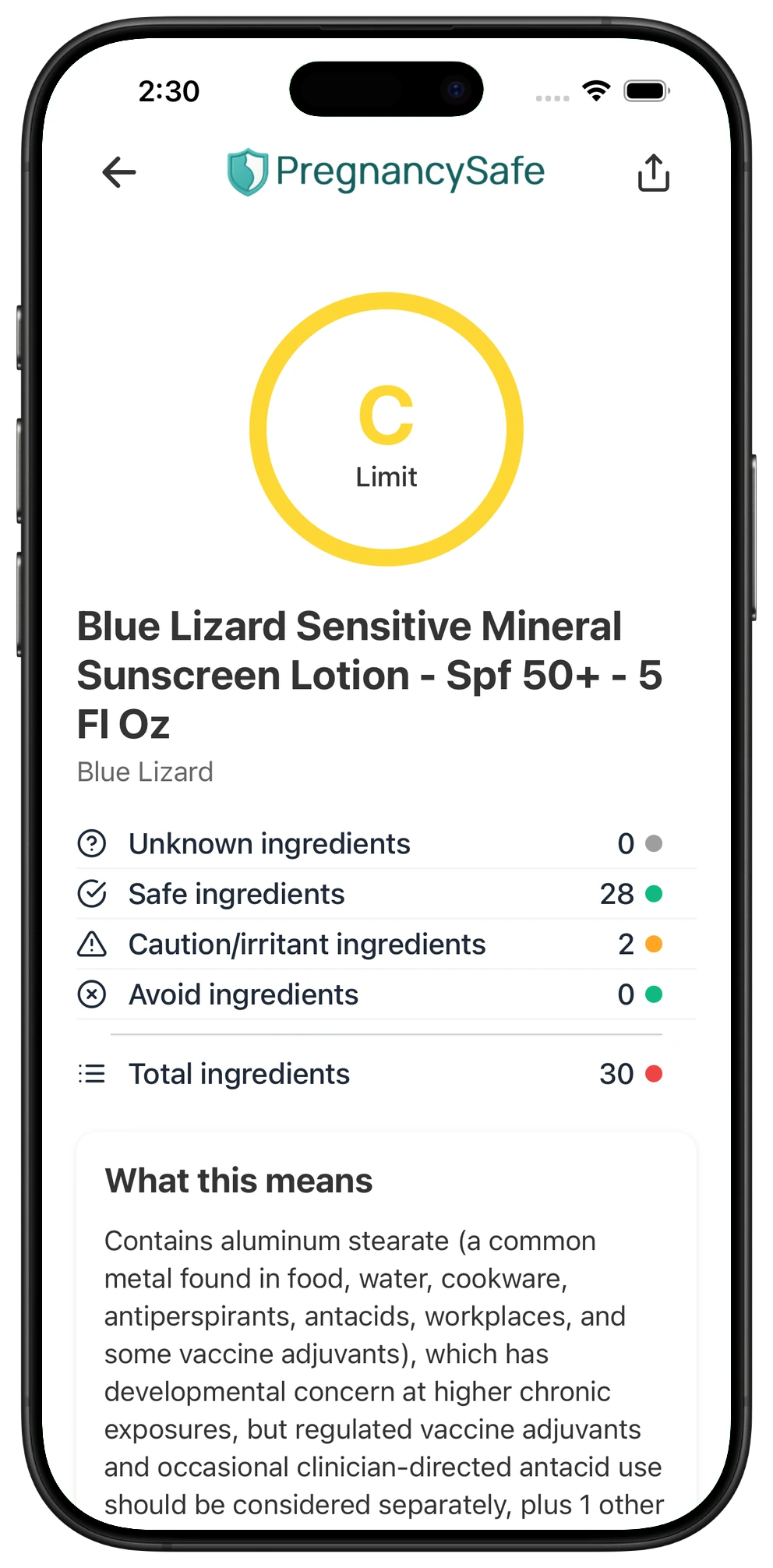
Check your exact product with zinc oxide in the app

What Is Zinc Oxide?
You may also see it listed as: CI 77947, ZnO, zinc white, zinci oxidum
Zinc oxide is a white, powdery mineral compound used for sun protection and its protective, soothing properties on skin. You may find it in sunscreen lotions, diaper rash creams, ointments, makeup, calamine type skin protectants, and some topical medications.
What Other Ingredients Should You Look Out for in Products With Zinc Oxide?
A product's full ingredient list determines whether it's pregnancy-safe or not. These ingredients also appear in some of the zinc oxide products we analyzed and may deserve a closer look.
Fragrance
CautionLook for “fragrance” or “parfum” in diaper creams and ointments: these terms can conceal individual scent ingredients and may matter if your skin or airways are sensitive. A fragrance free option can reduce exposure, without implying that every fragrance contains phthalates or that occasional use is proven harmful.
Flagged in 6 products (31.6%) in this analysis.
Butyloctyl Salicylate
CautionLook for “butyloctyl salicylate,” an emollient and solvent in sunscreen formulas with limited direct pregnancy data, although routine cosmetic use appears low concern. Check whether use involves large areas, broken skin, or an occlusive covering, since these contexts warrant extra caution.
Flagged in 5 products (26.3%) in this analysis.
Calendula
CautionLook for “calendula” or “calendula officinalis flower extract” in sunscreen and diaper cream. Normal use on intact skin is lower concern than concentrated oral preparations, but check for a known Asteraceae allergy because calendula can trigger reactions.
Flagged in 2 products (10.5%) in this analysis.
Chamomile
Caution“Chamomilla recutita flower extract” identifies chamomile in these sunscreens and diaper creams; pregnancy specific topical evidence is inadequate, and irritation or allergy is the clearest known concern. Check your sensitivity to ragweed or other daisy family plants rather than treating a cosmetic extract as equivalent to oral or concentrated essential oil exposure.
Flagged in 2 products (10.5%) in this analysis.
Methylparaben
CautionLook for “methylparaben,” a preservative in skin cream: pregnancy biomonitoring findings are mixed, while regulated cosmetic levels are generally considered low concern. If you prefer to reduce avoidable endocrine active ingredients, check the preservative list when comparing formulas rather than treating this ingredient as a proven pregnancy toxin.
Flagged in 1 product (5.3%) in this analysis.
Does Zinc Oxide Strength or Product Type Matter During Pregnancy?
The reassuring assessment applies to conventional use on intact skin, not every exposure to zinc oxide. Powders and sprays introduce an inhalation concern. Oral exposure and high dose nanoparticle animal experiments should not be treated as evidence of harm from normal lotion use, or used to extend the topical assessment to swallowed zinc oxide.
What Products Contain Zinc Oxide?
Pregnancy Safe has looked at 5,770 products that have zinc oxide as an ingredient. The category and grade breakdowns below use 19 products whose names mention Zinc Oxide or another name for it.
What Types of Products Contain Zinc Oxide?
Products You May Have That Contain Zinc Oxide
| Grade | Product | Brand | Type |
|---|---|---|---|
| D+ | La Roche Posay Anthelios Ultra-Light Fluid Mineral Face Sunscreen With Zinc Oxide – Spf 50 - 1.7 Fl Oz | La Roche Posay | Sunscreen |
| C+ | Aveeno Baby Continuous Protection Sensitive - Zinc Oxide With Broad Spectrum Skin Lotion Sunscreen - Spf 50 - 3 Fl Oz | Aveeno | Sunscreen |
| B+ | Cerave Hydrating Mineral Body Sunscreen Lotion Spf 30 With Zinc Oxide | Cerave | Sunscreen |
| C | Coppertone® Pure And Simple Zinc Oxide Mineral Sunscreen Spray Spf 50 | Coppertone | Sunscreen |
| B+ | Native Mineral Sunscreen With Zinc Oxide Spf 30 | Native | Sunscreen |
| C+ | Aveeno Baby Continuous Protection Sensitive Skin Lotion Zinc Oxide Sunscreen, Broad Spectrum Spf 50 - 3 Fl Oz | Aveeno | Sunscreen |
| C- | Babo Botanicals Sensitive Baby Mineral Sunscreen Spray Spf30 - Natural Zinc Oxide - Non-Aerosol – Face & Body - Fragrance-Free - Water Resistant - For | Babo Botanicals | Sunscreen |
| B+ | Balmex Complete Protection Diaper Rash Cream With Zinc Oxide Unscented | Balmex | Diaper Rash Cream |
How Do Products Containing Zinc Oxide Score?
It can be helpful to see how products containing zinc oxide generally score during pregnancy. This does not tell you whether your exact product is safe, but it gives you a general idea of what we found. In this breakdown of 19 products, 68% receive a C grade. A C grade means the complete formula has some pregnancy considerations, so use it sparingly and consider a higher scoring alternative when one is available.
Frequently Asked Questions About Zinc Oxide During Pregnancy
Can I use zinc oxide ointment for a rash while pregnant?
Conventional zinc oxide ointment use on intact skin is considered low concern during pregnancy. That assessment does not establish its suitability for a particular rash or extend to broken skin.
Can I use Desitin cream while pregnant?
Zinc oxide itself is likely safe for conventional topical use on intact skin, but that does not establish the safety of every Desitin formula. Check the exact product’s complete ingredient list rather than relying on the brand or zinc oxide alone.
Are zinc oxide sunscreen sprays assessed the same way as lotions?
No. Sprays can create an inhalation exposure, and the guidance is to avoid breathing in zinc oxide spray mist or powder. Conventional lotion use on intact skin is the low concern context.
Do I need non nano zinc oxide during pregnancy?
The available evidence does not establish a requirement to choose non nano zinc oxide. High dose nanoparticle animal findings should not be generalized to normal lotion use, and inhalation remains a separate concern.
Does the answer change between the first and third trimester?
The available guidance does not provide a trimester specific distinction for zinc oxide. Its low concern assessment is bounded by conventional topical use on intact skin, rather than a stated trimester cutoff.
Does a mineral sunscreen label mean the whole formula is pregnancy safe?
No. The zinc oxide assessment addresses that ingredient and its exposure context, not the complete formula. Review the other ingredients and whether the product is a lotion, powder, or spray; a product grade reflects the whole formula.
How Do We Score Products for Pregnancy Safety?
We analyze each product's ingredients and category to flag known risks and provide cautionary notices for general category safety concerns.
A - Safe
Excellent choice! All ingredients are considered safe during pregnancy.
What to do: Use with confidence.
B - Likely Safe
Pretty much safe with very minimal risk. Some ingredients may have limited pregnancy studies, but no significant safety concerns have been identified.
What to do: Use with confidence.
C - Limit
Contains ingredients with some pregnancy considerations. Research shows these ingredients may have limited safety data, potential for minor hormonal effects, or require caution based on animal studies.
What to do: Use sparingly and consider safer alternatives when available.
D - Caution
Similar to C grade but contains multiple cautionary ingredients. The combination increases overall concern.
What to do: Try to avoid if that makes you feel better. If you've already used it, no need to panic.
F - Avoid
Contains an ingredient Pregnancy Safe recommends avoiding during pregnancy. This may reflect an established risk or a precaution based on limited evidence; check the ingredient guidance and exposure context.
What to do: Do not use during pregnancy. If you've already used it, don't worry - contact your OBGYN if concerned.
Sources
- https://mothertobaby.org/baby-blog/screening-your-sunscreen-during-pregnancy/
- https://pmc.ncbi.nlm.nih.gov/articles/PMC11984416/
- https://pmc.ncbi.nlm.nih.gov/articles/PMC4279755/
- https://pmc.ncbi.nlm.nih.gov/articles/PMC7607677/
- https://www.fda.gov/drugs/understanding-over-counter-medicines/questions-and-answers-fda-posts-deemed-final-order-and-proposed-order-over-counter-sunscreen
- https://www.fda.gov/cosmetics/cosmetic-ingredients/fragrances-cosmetics
- https://www.fda.gov/cosmetics/cosmetic-ingredients/phthalates-cosmetics
- https://www.fda.gov/cosmetics/cosmetic-ingredients/allergens-cosmetics
- https://pmc.ncbi.nlm.nih.gov/articles/PMC3110684/
- https://pmc.ncbi.nlm.nih.gov/articles/PMC4016195/
- https://pmc.ncbi.nlm.nih.gov/articles/PMC4097177/
- https://pmc.ncbi.nlm.nih.gov/articles/PMC8453372/
- https://pmc.ncbi.nlm.nih.gov/articles/PMC10999525/
- https://www.epa.gov/indoor-air-quality-iaq/volatile-organic-compounds-impact-indoor-air-quality
- https://www.cir-safety.org/sites/default/files/salicy042019FAR.pdf
- https://pubmed.ncbi.nlm.nih.gov/41243163/
- https://pubmed.ncbi.nlm.nih.gov/38539266/
- https://health.ec.europa.eu/system/files/2023-06/sccs_o_268.pdf
- https://www.ncbi.nlm.nih.gov/books/NBK582985/
- https://www.fda.gov/drugs/drug-safety-and-availability/fda-recommends-avoiding-use-nsaids-pregnancy-20-weeks-or-later-because-they-can-result-low-amniotic
- https://webprod.hc-sc.gc.ca/nhpid-bdipsn/ingredReq?id=11175
- https://www.ema.europa.eu/en/documents/herbal-monograph/final-european-union-herbal-monograph-calendula-officinalis-l-flos-revision-1_en.pdf
- https://www.ema.europa.eu/en/documents/herbal-report/final-assessment-report-calendula-officinalis-l-flos-revision-1_en.pdf
- https://www.ema.europa.eu/en/documents/herbal-report/addendum-assessment-report-calendula-officinalis-l-flos-revision-1_en.pdf
- https://pubmed.ncbi.nlm.nih.gov/19288530/
- https://pubmed.ncbi.nlm.nih.gov/11558637/
- https://www.ncbi.nlm.nih.gov/books/NBK501857/
- https://www.mskcc.org/cancer-care/integrative-medicine/herbs/calendula
- https://www.nccih.nih.gov/health/chamomile
- https://www.ema.europa.eu/en/documents/herbal-monograph/final-european-union-herbal-monograph-matricaria-recutita-l-flos-first-version_en.pdf
- https://www.ema.europa.eu/en/documents/herbal-monograph/final-community-herbal-monograph-chamaemelum-nobile-l-all-flos_en.pdf
- https://journals.sagepub.com/doi/10.1177/1091581818801814
- https://journals.sagepub.com/doi/10.1177/1091581817705620
- https://pubmed.ncbi.nlm.nih.gov/40314057/
- https://pubmed.ncbi.nlm.nih.gov/40374153/
- https://www.fda.gov/cosmetics/cosmetic-ingredients/parabens-cosmetics
- https://health.ec.europa.eu/system/files/2023-12/sccs_o_276_final.pdf
- https://pubmed.ncbi.nlm.nih.gov/19101832/
- https://pubmed.ncbi.nlm.nih.gov/32283359/
- https://pubmed.ncbi.nlm.nih.gov/33477047/
- https://pubmed.ncbi.nlm.nih.gov/36709902/
- https://pubmed.ncbi.nlm.nih.gov/40117576/
- https://pubmed.ncbi.nlm.nih.gov/27156397/