Best Pregnancy Safe Moisturizer (Updated 2026 Guide)
Updated September 9, 2026
The Answer
You can continue a simple moisturizing routine during pregnancy: choose a plain formula without retinol or other topical retinoids, and maintain broad spectrum SPF 30+ protection. Our catalog contains 1,342 moisturizers with ingredient grades ranging from A to F, but those scores are not clinical pregnancy safety verdicts.
The key distinction is between plain moisturizers, retinol or retinoid anti aging formulas, and products with added sunscreen; avoid topical retinoids as a precaution during pregnancy. Fragrance can irritate sensitive skin, while preservatives such as phenoxyethanol and methylparaben are not proof that a cream harms pregnancy at regulated cosmetic levels. For SPF moisturizers, mineral filters offer a practical lower uncertainty option, but absorption findings for other filters are not a reason to stop sun protection.
Pregnancy Safe is 100% independent and research driven. No companies pay to promote or sponsor products.
Stress Less This Pregnancy
Check your exact moisturizer in the app

✓ What's Safe
- • Choose a plain moisturizing formula rather than an anti aging combination, and check the ingredient list for retinol or other retinoids.
- • Look for fragrance free labeling and check for fragrance or parfum if scents irritate your skin.
- • For daytime protection, choose a broad spectrum SPF 30+ moisturizer or use a separate sunscreen alongside your plain moisturizer.
- • Consider zinc oxide or titanium dioxide in an SPF cream or lotion if you prefer mineral sunscreen filters.
- • Match the exact formula, region and version on your package; a cream, fluid, night product and SPF version can have different ingredients.
- • Read ingredient qualifications alongside grades rather than treating an A score or a product’s popularity as a pregnancy safety guarantee.
✗ What to Avoid
- • Avoid moisturizers containing retinol or other topical retinoids during pregnancy as a precaution.
- • Avoid fragrance or parfum when it triggers irritation or scent sensitivity; these are overlapping label terms, not separate categories of pregnancy toxins.
- • Avoid choosing solely by claims such as natural or preservative free; phenoxyethanol or methylparaben alone does not establish that a moisturizer is harmful.
- • Avoid abandoning SPF because a moisturizer contains homosalate, octocrylene, octisalate or avobenzone; switch to a mineral broad spectrum option if you want to reduce uncertainty.
- • Avoid assuming your usual face or body cream is suitable for nipple use during nursing, particularly with phenoxyethanol; infant ingestion is a different exposure from moisturizing skin during pregnancy.
Most Common Ingredients in Moisturizer Products
We analyzed 1,342 moisturizer products. Here are the most common ingredients, ranked by how often they appear:
Ingredients to Watch Out For in Moisturizer
These are the most common flagged ingredients across 1,342 moisturizer products we analyzed.
Caution
Phenoxyethanol is a preservative commonly used in cosmetics and skincare products to prevent microbial growth and extend shelf life.
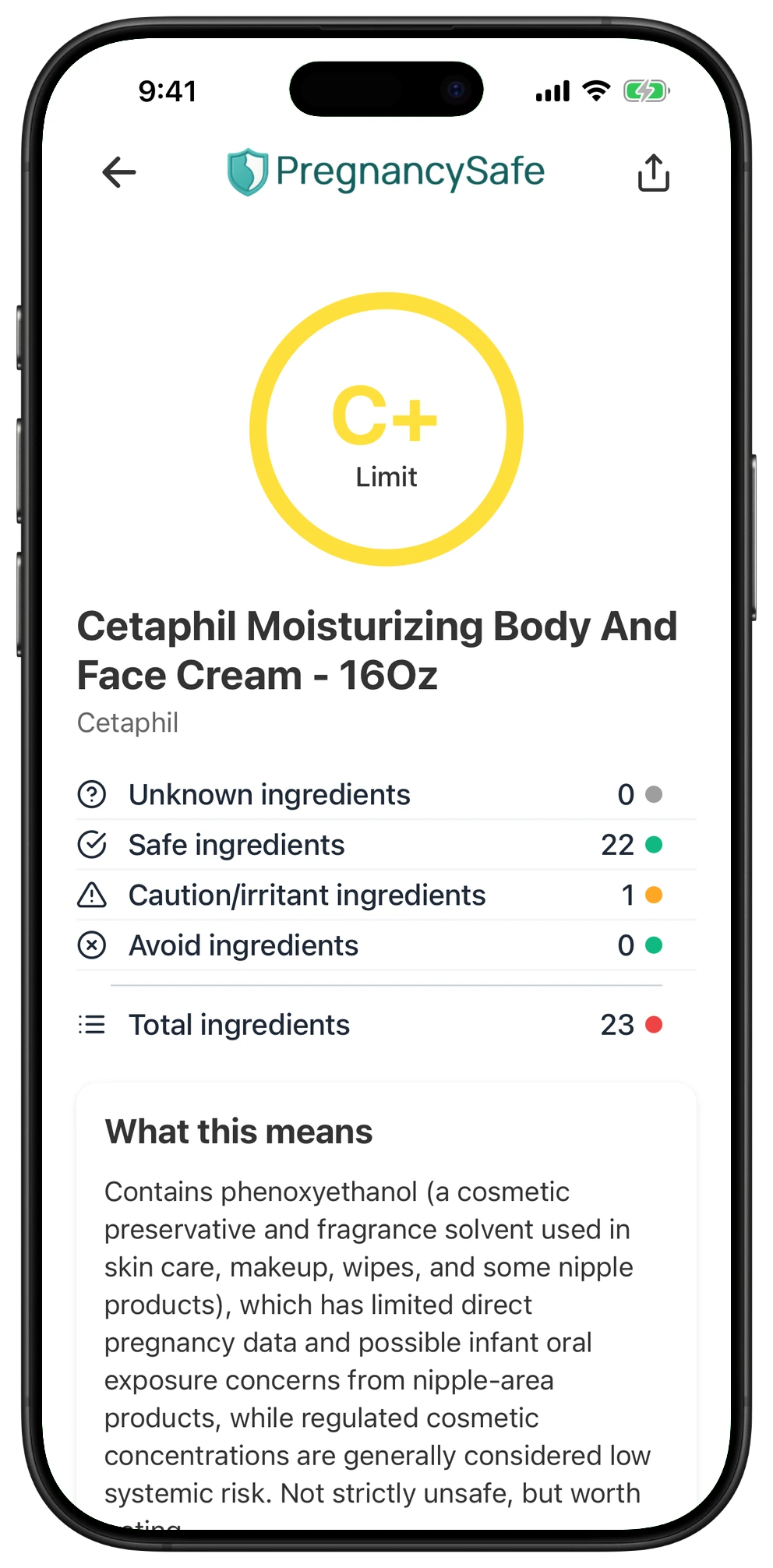
Has limited direct pregnancy data and possible infant oral exposure concerns from nipple area products, while regulated cosmetic concentrations are generally considered low systemic risk.
This preservative helps prevent microbial growth in moisturizers. Direct pregnancy outcome data are limited, but cosmetic reviews consider regulated concentrations acceptable; high dose animal findings do not establish harm from ordinary skin application. Infant ingestion from nipple area products during nursing is a separate concern.
Flagged in 731 of 1,342 products (54%)
fragrance
Caution
A fragrant substance used to add a pleasant aroma to products or environments.
Can hide product specific mixtures and has been associated with higher DEP metabolite exposure in some pregnancy studies; fragrance allergens and VOCs may also irritate sensitive skin or airways.
In a moisturizer, fragrance represents a scent mixture that may not disclose its individual components. It can trigger irritation or allergy, making fragrance free formulas a reasonable option. Exposure associations in pregnancy studies do not show that every scented cream contains phthalates or causes harm.
Flagged in 230 of 1,342 products (17%)
parfum
Caution
Parfum is a fragrant mixture of essential oils, aroma compounds, and solvents used to impart a pleasant scent.
Can hide product specific mixtures and has been associated with higher DEP metabolite exposure in some pregnancy studies; fragrance allergens and VOCs may also irritate sensitive skin or airways.
Parfum is another label term for fragrance, not a separate ingredient with a different pregnancy risk. In leave on moisturizers, the practical concerns are scent sensitivity, allergy and uncertainty about the mixture's components. Choosing a formula without parfum can reduce fragrance exposure without implying that previous use harmed pregnancy.
Flagged in 113 of 1,342 products (8%)
bht
Caution
BHT (butylated hydroxytoluene) is a synthetic antioxidant commonly used as a preservative to prevent the oxidation of fats and oils in food products.
Has limited human pregnancy data, with low concern at reviewed cosmetic levels but reproductive and thyroid related findings in high dose oral animal studies.
BHT, or butylated hydroxytoluene, is an antioxidant that helps stabilize a moisturizer's oils. Pregnancy concerns largely come from high dose oral animal studies, not ordinary topical moisturizer use. Human pregnancy data are limited, while reviewed cosmetic concentrations are considered low concern.
Flagged in 109 of 1,342 products (8%)
methylparaben
Caution
Methylparaben is a synthetic preservative commonly used in cosmetics and personal care products to inhibit microbial growth and extend shelf life.
Has mixed human pregnancy biomonitoring signals and weak endocrine activity, while regulated cosmetic levels are generally considered low concern.
Methylparaben is a short chain preservative that prevents microbial growth in moisturizers. Pregnancy biomonitoring findings are mixed and do not establish that a cream containing it causes harm. Regulated cosmetic levels are generally considered low concern; choosing a formula without it is an optional exposure reduction preference.
Flagged in 102 of 1,342 products (8%)
homosalate
Caution
Homosalate is a chemical compound commonly used in sunscreens to help absorb and block ultraviolet (UV) rays from the sun.
Has limited pregnancy specific data, measurable systemic absorption after topical use, and equivocal endocrine/reproductive concerns that regulators address with concentration limits.
Homosalate is a UVB filter found in some SPF moisturizers. It can be absorbed through skin, and pregnancy specific outcome evidence is limited; concentration, application area and frequency matter. A mineral broad spectrum alternative can reduce uncertainty, particularly for frequent large area use, without sacrificing sun protection.
Flagged in 86 of 1,342 products (6%)
octocrylene
Caution
Octocrylene is a chemical compound commonly used in sunscreens to absorb UVB rays and stabilize other UV filters.
Has limited pregnancy specific outcome data despite measurable systemic absorption, inconclusive endocrine signals, and benzophenone impurity or degradation concerns.
Octocrylene filters UV and helps stabilize some SPF moisturizers. High use studies show systemic absorption, but do not establish pregnancy harm; limited pregnancy data and benzophenone impurity or degradation concerns support caution. A mineral broad spectrum formula is an option if you prefer to avoid it.
Flagged in 85 of 1,342 products (6%)
triethanolamine
Caution
Triethanolamine is an organic compound commonly used as a pH balancer and emulsifier in cosmetics and personal care products.
Has limited direct pregnancy data and should only be considered low concern in well formulated cosmetics that avoid nitrosating systems and excess nitrosamine impurities.
Triethanolamine adjusts pH and helps emulsify moisturizers. Direct pregnancy data are lacking, and the main concern is formulation quality, including preventing nitrosamine formation and irritation. It should not inherit the toxicity claims of diethanolamine or monoethanolamine, which are different ingredients.
Flagged in 78 of 1,342 products (6%)
Types of Moisturizer
How Do Moisturizer Products Stack Up?
Our catalog contains ratings for 1,342 moisturizer products. These are database grades, not independent safety certifications.
These are ingredient scores, not clinical safety verdicts or independent verification of every product. Follow the preparation, handling or exact-formula guidance above.
Best Pregnancy Safe Moisturizer
Popular options from our catalog, prioritizing A and B ingredient grades, with C grade options used to fill remaining places. Within each group, products are ordered by searches in Pregnancy Safe, not retail sales. Read the cautions and guidance above; grades do not verify a complete current label or guarantee pregnancy safety.
| Grade | Product | Brand |
|---|---|---|
| B+ | La Roche-Posay Toleriane Double Repair Face Moisturizer | La Roche-Posay |
| B+ | Cetaphil Moisturizing Lotion | Cetaphil |
| A | Byoma Gel Cream Moisturizer | Byoma |
| B+ | Lightweight Daily Moisturizer | Good Molecules |
| B+ | La Roche-Posay Toleriane Sensitive Face Moisturizer | La Roche-Posay |
Your Questions Answered
Is moisturizer safe to use during pregnancy?
A simple moisturizing routine can continue during pregnancy. Check whether your product is a plain moisturizer or also contains anti aging ingredients or sunscreen. Avoid topical retinoids, including retinol, as a precaution rather than treating all moisturizers as risky.
How do I choose a pregnancy safe SPF moisturizer?
Look for broad spectrum SPF 30+ and check the sunscreen active ingredients. Zinc oxide or titanium dioxide can be practical lower uncertainty options during pregnancy. Other filters have limited pregnancy specific evidence, but measurable absorption does not establish harm. If you prefer a plain moisturizer, pair it with a separate sunscreen rather than dropping sun protection.
Should I stop using a moisturizer that contains phenoxyethanol or methylparaben?
Neither preservative alone is a reason to conclude that your moisturizer harms pregnancy. Cosmetic safety reviews consider them acceptable at allowed or typical cosmetic concentrations, although direct pregnancy evidence is limited or mixed. Choosing an alternative is an option if you prefer to reduce these exposures, not a necessary response to proven harm from ordinary topical use. Nipple area products during nursing require separate consideration because a baby may ingest them.
Are fragrance free moisturizers better during pregnancy?
Fragrance free formulas are a reasonable choice if you want to reduce scent exposure or avoid irritation. Fragrance and parfum both describe scent mixtures whose individual components may not be disclosed. Some studies associate fragranced product use with higher markers of certain phthalate exposures, but this does not mean every scented moisturizer contains phthalates or causes pregnancy harm.
Can I use an anti aging moisturizer with retinol?
Avoid retinol and other topical retinoids during pregnancy as a precaution. Choose a plain moisturizer instead, and ask your clinician about any treatment ingredient you are unsure of. This advice does not mean ordinary emollients carry the risks associated with oral vitamin A exposure.
Does an A grade mean a moisturizer is verified safe for pregnancy?
No. Our catalog contains 34 A grade moisturizers, but grades are ingredient scores rather than clinical safety verdicts or independent verification of every formula. The product list prioritizes A/B ingredient grades, with C grades filling remaining slots, and uses searches in Pregnancy Safe to rank products within each group; it does not establish clinical superiority or verify every formula. Likewise, a low grade or incomplete record does not by itself prove that a moisturizer is harmful.
How Do We Score Products for Pregnancy Safety?
We analyze each product's ingredients and category to flag known risks and provide cautionary notices for general category safety concerns.
Grades reflect the ingredient and category information available to us. They don’t verify a complete, current label or account for dose, preparation, or contamination. Read them alongside the guidance above, not as a guarantee of pregnancy safety or proof that every use is harmful.
A - Safe
Excellent choice! All ingredients are considered safe during pregnancy.
What to do: Use with confidence.
B - Likely Safe
Pretty much safe with very minimal risk. Some ingredients may have limited pregnancy studies, but no significant safety concerns have been identified.
What to do: Use with confidence.
C - Limit
Contains ingredients with some pregnancy considerations. Research shows these ingredients may have limited safety data, potential for minor hormonal effects, or require caution based on animal studies.
What to do: Use sparingly and consider safer alternatives when available.
D - Caution
Similar to C grade but contains multiple cautionary ingredients. The combination increases overall concern.
What to do: Try to avoid if that makes you feel better. If you've already used it, no need to panic.
F - Avoid
Contains an ingredient Pregnancy Safe recommends avoiding during pregnancy. This may reflect an established risk or a precaution based on limited evidence; check the ingredient guidance and exposure context.
What to do: Do not use during pregnancy. If you've already used it, don't worry - contact your OBGYN if concerned.
People Also Checked
References
- https://www.aad.org/public/everyday-care/skin-care-secrets/routine/pregnancy-skin-care
- https://www.fda.gov/cosmetics/resources-consumers-cosmetics/cosmetics-pregnancy
- https://www.aad.org/public/everyday-care/skin-care-secrets/anti-aging/retinoid-retinol
- https://health.ec.europa.eu/system/files/2021-08/sccs_o_195_0.pdf
- https://ec.europa.eu/growth/tools-databases/cosing/details/28157
- https://journals.sagepub.com/doi/10.3109/10915819009078737
- https://link.springer.com/article/10.1007/s00204-024-03938-5
- https://www.sfda.gov.sa/en/warnings/1156
- https://www.industrialchemicals.gov.au/sites/default/files/Ethanol%2C%202-phenoxy-_Human%20health%20tier%20II%20assessment.pdf
- https://hero.epa.gov/reference/2857875
- https://books.publisso.de/sites/default/files/documents/series/mak/dam/Vol2019/Iss1/Alt006/mb12299kske6319_w.pdf
- https://www.fda.gov/cosmetics/cosmetic-ingredients/fragrances-cosmetics
- https://www.fda.gov/cosmetics/cosmetic-ingredients/phthalates-cosmetics
- https://www.fda.gov/cosmetics/cosmetic-ingredients/allergens-cosmetics
- https://pmc.ncbi.nlm.nih.gov/articles/PMC3110684/
- https://pmc.ncbi.nlm.nih.gov/articles/PMC4016195/
- https://pmc.ncbi.nlm.nih.gov/articles/PMC4097177/
- https://pmc.ncbi.nlm.nih.gov/articles/PMC8453372/
- https://pmc.ncbi.nlm.nih.gov/articles/PMC10999525/
- https://www.epa.gov/indoor-air-quality-iaq/volatile-organic-compounds-impact-indoor-air-quality
- https://health.ec.europa.eu/system/files/2022-08/sccs_o_257.pdf
- https://pubmed.ncbi.nlm.nih.gov/37751543/
- https://pubmed.ncbi.nlm.nih.gov/12396675/
- https://pmc.ncbi.nlm.nih.gov/articles/PMC13151845/
- https://www.ecfr.gov/current/title-21/chapter-I/subchapter-B/part-172/subpart-B/section-172.115
- https://www.ecfr.gov/current/title-21/chapter-I/subchapter-B/part-182/subpart-D/section-182.3173
- https://www.fda.gov/news-events/press-announcements/fda-finalizes-food-chemical-safety-post-market-assessment-program-launches-reassessment-bht-ada
- https://www.fda.gov/cosmetics/cosmetic-ingredients/parabens-cosmetics
- https://health.ec.europa.eu/system/files/2023-12/sccs_o_276_final.pdf
- https://pubmed.ncbi.nlm.nih.gov/19101832/
- https://pubmed.ncbi.nlm.nih.gov/32283359/
- https://pubmed.ncbi.nlm.nih.gov/33477047/
- https://pubmed.ncbi.nlm.nih.gov/36709902/
- https://pubmed.ncbi.nlm.nih.gov/40117576/
- https://pubmed.ncbi.nlm.nih.gov/27156397/
- https://health.ec.europa.eu/publications/homosalate_en
- https://health.ec.europa.eu/system/files/2022-08/sccs_o_260.pdf
- https://eur-lex.europa.eu/legal-content/EN/TXT/HTML/?uri=CELEX%3A32022R2195
- https://www.fda.gov/drugs/understanding-over-counter-medicines/questions-and-answers-fda-posts-deemed-final-order-and-proposed-order-over-counter-sunscreen
- https://jamanetwork.com/journals/jama/fullarticle/2759002
- https://www.tga.gov.au/resources/explore-topic/sunscreens/sunscreen-ingredients
- https://www.tga.gov.au/sites/default/files/2025-04/safety-review-seven-active-sunscreen-ingredients.pdf
- https://mothertobaby.org/baby-blog/screening-your-sunscreen-during-pregnancy/
- https://link.springer.com/article/10.1007/s00204-024-03935-8
- https://health.ec.europa.eu/document/download/2928185b-f8b7-474e-937a-052a90a90970_en
- https://www.fda.gov/drugs/understanding-over-counter-medicines/sunscreen-how-help-protect-your-skin-sun
- https://pubmed.ncbi.nlm.nih.gov/31058986/
- https://pubmed.ncbi.nlm.nih.gov/31961417/
- https://www.tga.gov.au/resources/publication/corporate-reports/safety-review-benzophenone
- https://pubmed.ncbi.nlm.nih.gov/33682414/
- https://pubmed.ncbi.nlm.nih.gov/21030064/
- https://www.frontiersin.org/journals/medicine/articles/10.3389/fmed.2025.1563369/full
- https://pubmed.ncbi.nlm.nih.gov/23696578/
- https://health.ec.europa.eu/document/download/ac80d106-eb65-4248-a2f8-dde5d9d9996f_en
- https://www.industrialchemicals.gov.au/sites/default/files/Ethanol%2C%202%2C2%27%2C2%27%27-nitrilotris-_Human%20health%20tier%20II%20assessment.pdf
- https://www.ncbi.nlm.nih.gov/books/NBK390891/
- https://www.govinfo.gov/content/pkg/FR-2009-08-05/html/E9-18698.htm
- https://pubmed.ncbi.nlm.nih.gov/15213765/
- https://pubmed.ncbi.nlm.nih.gov/21673209/
- https://ec.europa.eu/health/scientific_committees/consumer_safety/opinions/sccnfp_opinions_97_04/sccp_out26_en.htm
- https://www.cir-safety.org/sites/default/files/salicy042019FAR.pdf
- https://pmc.ncbi.nlm.nih.gov/articles/PMC6990686/
- https://pmc.ncbi.nlm.nih.gov/articles/PMC11402844/
- https://pmc.ncbi.nlm.nih.gov/articles/PMC5744631/
- https://mothertobaby.org/baby-blog/national-safety-month-can-beauty-products-in-my-bathroom-be-bad-for-baby/
- https://www.aad.org/media/stats-sunscreen
- https://pubmed.ncbi.nlm.nih.gov/40910486/
- https://pmc.ncbi.nlm.nih.gov/articles/PMC11984416/
- https://pmc.ncbi.nlm.nih.gov/articles/PMC12317922/