Best Pregnancy Safe Body Oil (Updated 2026 Guide)
Updated September 9, 2026
The Answer
For pregnancy, choose a simple moisturizing body oil without retinoids, preferably fragrance free, and use it externally as directed. Our catalog contains mostly C range ingredient scores, but these grades are not clinical pregnancy safety verdicts.
For body oil applied to intact skin in label directed amounts, distinguish irritation and fragrance allergy from evidence of reproductive harm. Concerns from concentrated oral botanicals or high dose animal studies do not establish harm from ordinary topical use, and cosmetic preservatives are not automatically fetal toxins. Avoid retinoids, discuss medicated formulas with your pregnancy clinician, and remember that oils can moisturize but are not proven to prevent stretch marks.
Pregnancy Safe is 100% independent and research driven. No companies pay to promote or sponsor products.
Stress Less This Pregnancy
Check your exact body oil in the app

✓ What's Safe
- • Choose a moisturizing formula with a complete ingredient list rather than relying on pregnancy, clean or natural claims.
- • Prefer fragrance free formulations if you want to reduce scent exposure or have sensitive skin.
- • Check the exact bottle and version for retinoids; ask your clinician about prescription or medicated ingredients.
- • Choose a finished body oil intended for direct skin application rather than concentrated essential oils for mixing yourself.
- • Follow the labeled amount and application instructions, and test a small area first if your skin is sensitive.
✗ What to Avoid
- • Avoid retinoid containing body oils during pregnancy, even when marketed for scars, firming or stretch marks.
- • Skip fragrance, parfum or parfum fragrance if scents irritate you or you prefer less undisclosed scent exposure; these are related label terms, not three distinct hazards.
- • Avoid benzyl salicylate if you have a known allergy to it; its presence alone does not establish pregnancy harm at cosmetic concentrations.
- • Avoid applying concentrated lavandula angustifolia oil directly as body oil, and do not drink essential oils.
- • Avoid calendula officinalis flower extract if you have a known calendula or Asteraceae allergy; oral herbal concerns are not proof of harm from ordinary skin use.
- • Avoid choosing solely by an A grade or a stretch mark prevention promise; neither establishes clinical pregnancy suitability.
Most Common Ingredients in Body Oil Products
We analyzed 263 body oil products. Here are the most common ingredients, ranked by how often they appear:
Ingredients to Watch Out For in Body Oil
These are the most common flagged ingredients across 263 body oil products we analyzed.
fragrance
Caution
A fragrant substance used to add a pleasant aroma to products or environments.
Can hide product specific mixtures and has been associated with higher DEP metabolite exposure in some pregnancy studies; fragrance allergens and VOCs may also irritate sensitive skin or airways.
In body oil, fragrance identifies a scent mixture whose individual components may not be disclosed. Fragranced product use has been associated with higher DEP metabolite exposure, but this does not establish that every mixture contains phthalates or that ordinary topical use harms pregnancy. Fragrance free is an optional exposure reduction choice and can help you avoid scent related irritation.
Flagged in 86 of 263 products (33%)
parfum
Caution
Parfum is a fragrant mixture of essential oils, aroma compounds, and solvents used to impart a pleasant scent.
Can hide product specific mixtures and has been associated with higher DEP metabolite exposure in some pregnancy studies; fragrance allergens and VOCs may also irritate sensitive skin or airways.
Parfum is another label term for fragrance, not a separate pregnancy hazard. In a leave on body oil, the practical concerns are mixture uncertainty and possible skin or airway sensitivity. Its presence does not by itself show harmful fetal exposure.
Flagged in 46 of 263 products (17%)
benzyl salicylate
Caution
Benzyl salicylate is a fragrant compound commonly used as a UV filter and scent ingredient in perfumes and cosmetics.
Has limited pregnancy specific human data and weak endocrine mode signals, but regulated low dose cosmetic use has wide safety margins compared with high dose oral salicylates.
Benzyl salicylate is a fragrance allergen and light stabilizing ingredient in body oils. Direct human pregnancy evidence is limited, but assessments support specified cosmetic concentrations; normal topical exposure is not equivalent to medication like oral salicylate dosing. Avoid it if you have a known allergy.
Flagged in 33 of 263 products (13%)
parfum fragrance
Caution
A parfum fragrance is a concentrated aromatic blend designed to impart a pleasing and lasting scent when applied to the skin or clothing.
Can hide product specific mixtures and has been associated with higher DEP metabolite exposure in some pregnancy studies; fragrance allergens and VOCs may also irritate sensitive skin or airways.
Parfum fragrance is combined label wording for a scent mixture, not evidence of a distinct chemical or a more concentrated product. For body oil, it carries the same mixture disclosure and sensitivity considerations as fragrance or parfum. Choose fragrance free if you want to reduce this exposure.
Flagged in 23 of 263 products (9%)
lavandula angustifolia oil
Caution
Lavandula angustifolia oil is a soothing essential oil derived from lavender flowers, known for its calming, antiseptic, and aromatic properties.
Has limited pregnancy safety data for oral supplement use and should be separated from lower exposure aroma or diluted topical use because toxicity sedation allergy and uncertain endocrine concerns remain.
Lavandula angustifolia oil is lavender essential oil used to scent body oil. Small studies of diluted topical use or inhalation in later pregnancy have not reported clear harms, but evidence remains limited and does not cover every dose or trimester. A finished diluted body oil is different from swallowing lavender oil or applying the concentrated essential oil.
Flagged in 18 of 263 products (7%)
Caution
Phenoxyethanol is a preservative commonly used in cosmetics and skincare products to prevent microbial growth and extend shelf life.
Has limited direct pregnancy data and possible infant oral exposure concerns from nipple area products, while regulated cosmetic concentrations are generally considered low systemic risk.
Phenoxyethanol preserves body oil formulations against microbial growth. Direct pregnancy data are limited, but cosmetic safety assessments support typical regulated concentrations, including up to 1% as a preservative in the EU. Warnings involving infant ingestion from nipple creams are not evidence of harm from ordinary pregnancy skin use.
Flagged in 17 of 263 products (6%)
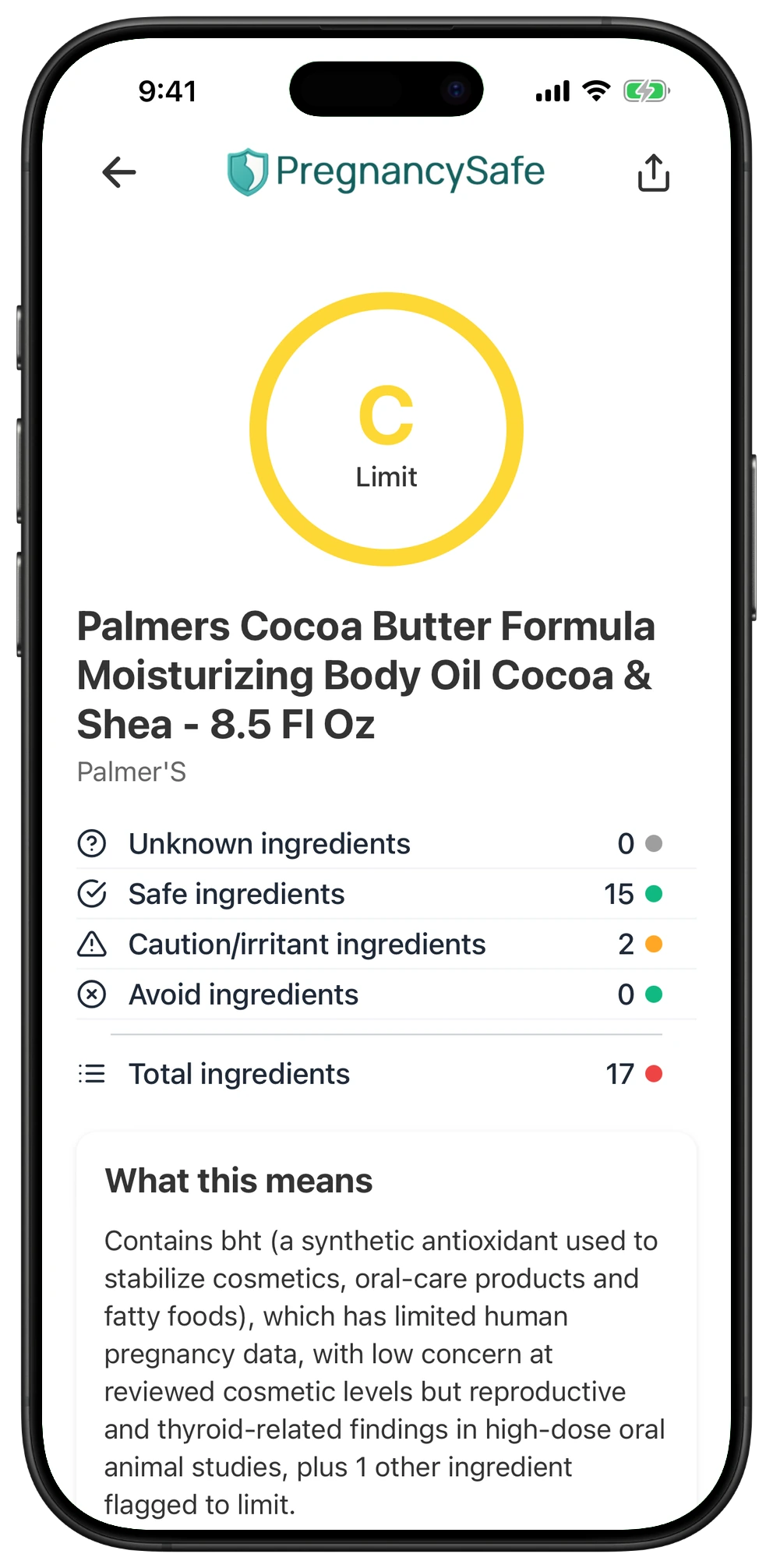
bht
Caution
BHT (butylated hydroxytoluene) is a synthetic antioxidant commonly used as a preservative to prevent the oxidation of fats and oils in food products.
Has limited human pregnancy data, with low concern at reviewed cosmetic levels but reproductive and thyroid related findings in high dose oral animal studies.
BHT is an antioxidant that helps keep oils from becoming rancid. Pregnancy related concerns largely come from high dose oral animal studies, not ordinary body oil application. Reviewed cosmetic concentrations are considered low concern, although direct human pregnancy evidence is limited.
Flagged in 15 of 263 products (6%)
calendula officinalis flower extract
Caution
Calendula officinalis flower extract is a soothing botanical ingredient known for its anti inflammatory, healing, and skin calming properties.
Has limited human pregnancy data and possible uterine stimulating concerns with concentrated oral use; topical skincare is lower concern but allergy is possible.
Calendula officinalis flower extract is a botanical ingredient in moisturizing body oils. Ordinary use on intact skin is lower concern than concentrated oral calendula preparations; high dose animal and oral medicinal concerns do not establish harm from topical body oil. Pregnancy specific evidence remains limited, and calendula can trigger Asteraceae allergy.
Flagged in 10 of 263 products (4%)
How Do Body Oil Products Stack Up?
Our catalog contains ratings for 263 body oil products. These are database grades, not independent safety certifications.
Grades are catalog ingredient scores, not measurements of current labels, preparation, pathogens, dose or clinical pregnancy suitability. Unreviewed products remain in the aggregate counts.
Best Pregnancy Safe Body Oil
Popular options from our catalog, prioritizing A and B ingredient grades, with C grade options used to fill remaining places. Within each group, products are ordered by searches in Pregnancy Safe, not retail sales. Read the cautions and guidance above; grades do not verify a complete current label or guarantee pregnancy safety.
| Grade | Product | Brand |
|---|---|---|
| A | Lemongrass Coconut Body Oil | Trader Joe'S |
| A | La Roche Posay Lipikar Oil | La Roche Posay |
| A | Plastic-Free Pregnancy Stretch Mark Prevention Oil | Attitude |
| A | Nemah Aceite De Vientre Para Mujeres Embarazadas | Nemah |
| B+ | Vitamin E Body Oil | Palmer'S |
Your Questions Answered
Which body oil is pregnancy safe?
Start with a simple, retinoid free moisturizing formula intended for external use. Fragrance free is a practical preference if you have sensitive skin or want to reduce scent exposure. Check the current ingredient list and use the labeled amount rather than treating a pregnancy or natural label as certification. Ask your pregnancy clinician about medicated formulas.
What body oils are not safe for pregnancy?
Avoid body oils containing retinoids during pregnancy. Concentrated essential oils are not interchangeable with finished body oils, and body oil should not be swallowed. Fragrance, preservatives or a low catalog grade alone do not prove a product is unsafe for pregnancy. Prescription and medicated products need a clinician guided assessment.
Can body oil prevent pregnancy stretch marks?
Body oils can moisturize your skin, but they are not proven to prevent stretch marks. Choose one for skin comfort rather than a prevention guarantee. More frequent or heavier application is not an established way to prevent stretch marks, so follow the label instead.
Should I worry if I already used a fragranced body oil?
Ordinary occasional use is not an emergency simply because fragrance appears on the label. Some pregnancy studies associate fragranced product use with higher levels of a phthalate metabolite, but this does not mean every fragrance contains phthalates or that typical use causes fetal harm. Fragrance can also cause skin or airway symptoms in sensitive people, which is a separate concern. You can switch to fragrance free if you prefer lower scent exposure.
Are lavender and other botanical body oils safer because they are natural?
Natural ingredients are not pregnancy safety certification. Limited studies of diluted topical lavender or inhaled aromatherapy later in pregnancy have not reported clear pregnancy harms, but they do not establish safety for every concentration or trimester. Evidence about concentrated oral botanical supplements should not be applied directly to a diluted body oil. Choose a finished topical formulation and stop using it if it irritates your skin.
What do the body oil grades tell me?
Our catalog contains 263 body oils, including 16 with an A ingredient score. Those are not 16 independently verified pregnancy safe products: grades do not measure the current label, application amount or individual clinical suitability. A lower grade likewise does not establish that a product causes pregnancy harm. Any listed product is specific to its version and qualifications, not a safety guarantee or clinical endorsement.
How Do We Score Products for Pregnancy Safety?
We analyze each product's ingredients and category to flag known risks and provide cautionary notices for general category safety concerns.
Grades reflect the ingredient and category information available to us. They don’t verify a complete, current label or account for dose, preparation, or contamination. Read them alongside the guidance above, not as a guarantee of pregnancy safety or proof that every use is harmful.
A - Safe
Excellent choice! All ingredients are considered safe during pregnancy.
What to do: Use with confidence.
B - Likely Safe
Pretty much safe with very minimal risk. Some ingredients may have limited pregnancy studies, but no significant safety concerns have been identified.
What to do: Use with confidence.
C - Limit
Contains ingredients with some pregnancy considerations. Research shows these ingredients may have limited safety data, potential for minor hormonal effects, or require caution based on animal studies.
What to do: Use sparingly and consider safer alternatives when available.
D - Caution
Similar to C grade but contains multiple cautionary ingredients. The combination increases overall concern.
What to do: Try to avoid if that makes you feel better. If you've already used it, no need to panic.
F - Avoid
Contains an ingredient Pregnancy Safe recommends avoiding during pregnancy. This may reflect an established risk or a precaution based on limited evidence; check the ingredient guidance and exposure context.
What to do: Do not use during pregnancy. If you've already used it, don't worry - contact your OBGYN if concerned.
References
- https://www.aad.org/public/everyday-care/skin-care-secrets/routine/pregnancy-skin-care
- https://www.fda.gov/cosmetics/cosmetic-ingredients/fragrances-cosmetics
- https://www.fda.gov/cosmetics/cosmetic-ingredients/phthalates-cosmetics
- https://www.fda.gov/cosmetics/cosmetic-ingredients/allergens-cosmetics
- https://pmc.ncbi.nlm.nih.gov/articles/PMC3110684/
- https://pmc.ncbi.nlm.nih.gov/articles/PMC4016195/
- https://pmc.ncbi.nlm.nih.gov/articles/PMC4097177/
- https://pmc.ncbi.nlm.nih.gov/articles/PMC8453372/
- https://pmc.ncbi.nlm.nih.gov/articles/PMC10999525/
- https://www.epa.gov/indoor-air-quality-iaq/volatile-organic-compounds-impact-indoor-air-quality
- https://health.ec.europa.eu/system/files/2023-11/sccs_o_277.pdf
- https://eur-lex.europa.eu/legal-content/EN/TXT/HTML/?uri=OJ%3AL_202600909
- https://pmc.ncbi.nlm.nih.gov/articles/PMC10955127/
- https://pubmed.ncbi.nlm.nih.gov/29410076/
- https://www.cir-safety.org/sites/default/files/bensal042019FR.pdf
- https://health.ec.europa.eu/system/files/2023-06/sccs_o_268.pdf
- https://www.nccih.nih.gov/health/lavender
- https://www.mayoclinichealthsystem.org/hometown-health/speaking-of-health/essential-oils-and-pregnancy
- https://pubmed.ncbi.nlm.nih.gov/39685078/
- https://pubmed.ncbi.nlm.nih.gov/41192533/
- https://pubmed.ncbi.nlm.nih.gov/33673548/
- https://pubmed.ncbi.nlm.nih.gov/32147050/
- https://pubmed.ncbi.nlm.nih.gov/31393563/
- https://pubmed.ncbi.nlm.nih.gov/35663791/
- https://health.ec.europa.eu/system/files/2021-08/sccs_o_195_0.pdf
- https://ec.europa.eu/growth/tools-databases/cosing/details/28157
- https://journals.sagepub.com/doi/10.3109/10915819009078737
- https://link.springer.com/article/10.1007/s00204-024-03938-5
- https://www.sfda.gov.sa/en/warnings/1156
- https://www.industrialchemicals.gov.au/sites/default/files/Ethanol%2C%202-phenoxy-_Human%20health%20tier%20II%20assessment.pdf
- https://hero.epa.gov/reference/2857875
- https://books.publisso.de/sites/default/files/documents/series/mak/dam/Vol2019/Iss1/Alt006/mb12299kske6319_w.pdf
- https://health.ec.europa.eu/system/files/2022-08/sccs_o_257.pdf
- https://pubmed.ncbi.nlm.nih.gov/37751543/
- https://pubmed.ncbi.nlm.nih.gov/12396675/
- https://pmc.ncbi.nlm.nih.gov/articles/PMC13151845/
- https://www.ecfr.gov/current/title-21/chapter-I/subchapter-B/part-172/subpart-B/section-172.115
- https://www.ecfr.gov/current/title-21/chapter-I/subchapter-B/part-182/subpart-D/section-182.3173
- https://www.fda.gov/news-events/press-announcements/fda-finalizes-food-chemical-safety-post-market-assessment-program-launches-reassessment-bht-ada
- https://www.ema.europa.eu/en/documents/herbal-monograph/final-european-union-herbal-monograph-calendula-officinalis-l-flos-revision-1_en.pdf
- https://www.ema.europa.eu/en/documents/herbal-report/final-assessment-report-calendula-officinalis-l-flos-revision-1_en.pdf
- https://www.ema.europa.eu/en/documents/herbal-report/addendum-assessment-report-calendula-officinalis-l-flos-revision-1_en.pdf
- https://pubmed.ncbi.nlm.nih.gov/19288530/
- https://pubmed.ncbi.nlm.nih.gov/11558637/
- https://www.ncbi.nlm.nih.gov/books/NBK501857/
- https://www.mskcc.org/cancer-care/integrative-medicine/herbs/calendula