Is Retinyl Palmitate Safe During Pregnancy?
Updated September 14, 2026
The Answer
Avoid retinyl palmitate in routine cosmetic skincare during pregnancy. This follows guidance to avoid topical retinoids, despite usually low absorption and more reassuring human evidence than for oral retinoid medicines.
Topical exposure is not equivalent to taking oral retinoid medicines: inadvertent low level skin exposure is generally more reassuring, while oral medicines such as isotretinoin are established causes of fetal harm.
EMA and teratology guidance recommend avoiding topical retinoids despite usually low absorption and a meta analysis and Nordic cohort showing no clear increase in major congenital malformations after first trimester topical exposure.
Pregnancy Safe is 100% independent and research driven. No companies pay to promote or sponsor products.
Stressless Pregnancy
Check your exact product with retinyl palmitate in the app

What Is Retinyl Palmitate?
Retinyl palmitate is a form of vitamin A used in skincare for anti aging and skin renewing purposes. You may find it in face creams, serums, body lotions, skincare oils, makeup, and cleansers. It also appears in some vitamins, foods, and drinks, which require a separate assessment from cosmetic skin use.
What Other Ingredients Should You Look Out for in Products With Retinyl Palmitate?
A product's full ingredient list determines whether it's pregnancy-safe or not. These ingredients also appear in some of the retinyl palmitate products we analyzed and may deserve a closer look.
Retinol
AvoidLook for retinol as a separate vitamin A ingredient in creams, serums, and makeup. Guidance generally recommends avoiding cosmetic retinol during pregnancy, so check the full ingredient list rather than looking only for retinyl palmitate.
Flagged in 47 products (3.8%) in this analysis.
Butylphenyl Methylpropional
AvoidLook for butylphenyl methylpropional or Lilial in scented skin and hair products; regulatory reproductive toxicity concerns rely largely on animal evidence, and the EU prohibits it in cosmetics. Check leave on and frequently used products in particular, and avoid formulas listing it.
Flagged in 44 products (3.6%) in this analysis.
Benzophenone-1
AvoidCheck nail polish, removers, and strengtheners for benzophenone-1, a formula light stabilizer that SCCS considered unsafe for that cosmetic use because of genotoxicity potential and endocrine activity. Confirm the number on the label: benzophenone-1 is not oxybenzone, or benzophenone-3.
Flagged in 6 products (0.5%) in this analysis.
Methylparaben
CautionMethylparaben or methyl paraben is a preservative found in creams, makeup, and other personal care products; pregnancy findings are mixed, while reviewed cosmetic levels are considered low concern. If you prefer to reduce exposure, check for this exact name rather than assuming all parabens have the same evidence.
Flagged in 145 products (11.8%) in this analysis.
Calendula
CautionCalendula or Calendula officinalis extract appears in lotions, oils, and balms; ordinary use on intact skin is lower concern than concentrated oral use, but daisy family allergy is possible. Check whether your product is ordinary skincare or a medicinal wound or mouth preparation, since those uses lack pregnancy specific safety data.
Flagged in 80 products (6.5%) in this analysis.
Does Retinyl Palmitate Strength or Product Type Matter During Pregnancy?
The recommendation here concerns routine topical cosmetic use. Human research on first trimester topical retinoid exposure has not shown a clear increase in major congenital malformations, but this does not establish retinyl palmitate specific safety. The evidence does not establish a safe cosmetic concentration or a rinse off exception. Findings about oral retinoid medicines should not be used to judge retinyl palmitate in foods or prenatal vitamins.
What Products Contain Retinyl Palmitate?
Pregnancy Safe has looked at 1,232 products that have retinyl palmitate as an ingredient. The category and grade breakdowns below use 1,232 products with an exact ingredient match.
What Types of Products Contain Retinyl Palmitate?
Products You May Have That Contain Retinyl Palmitate
| Grade | Product | Brand | Type |
|---|---|---|---|
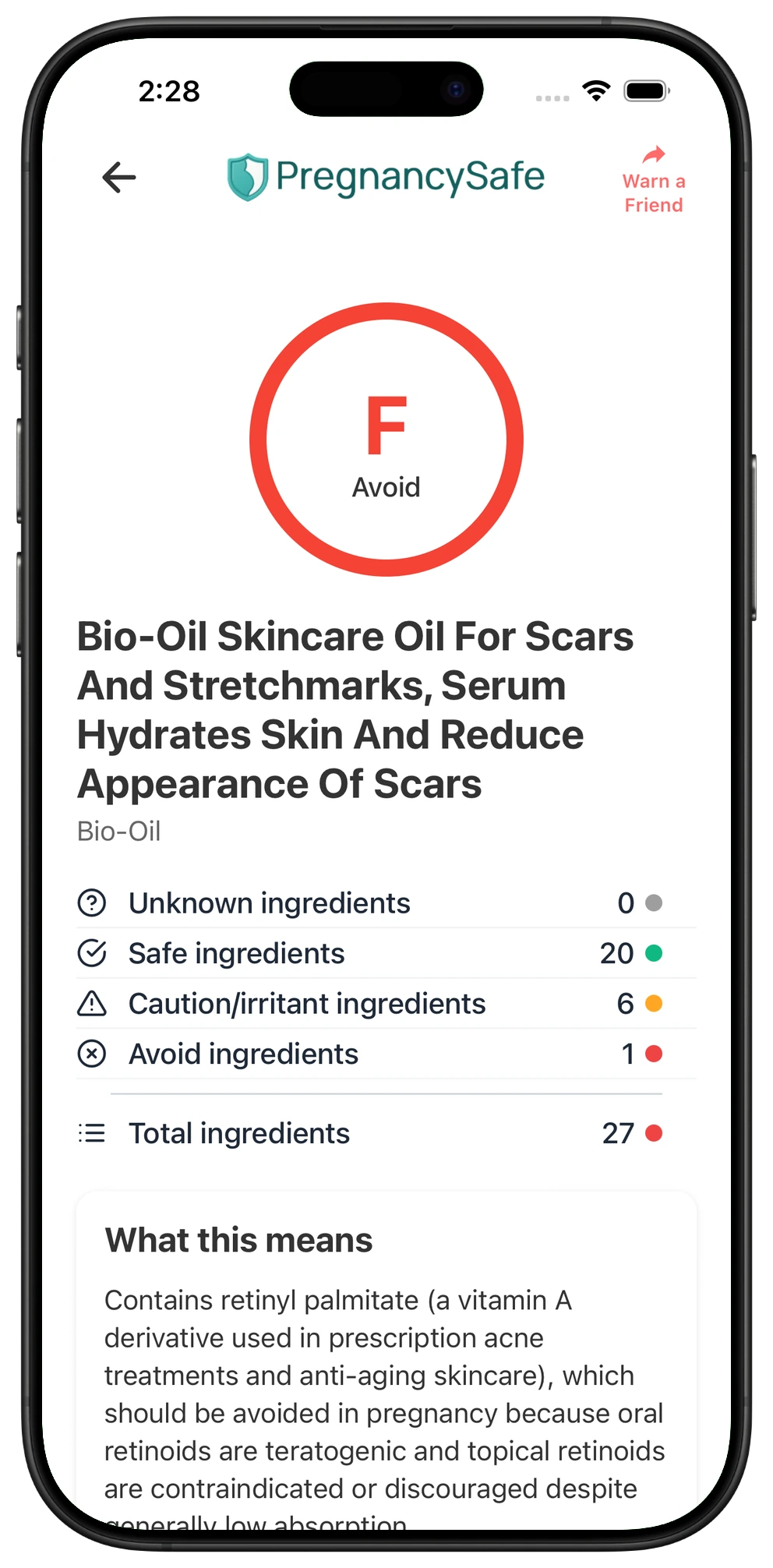
| F | Bio-Oil Skincare Oil For Scars And Stretchmarks, Serum Hydrates Skin And Reduce Appearance Of Scars | Bio-Oil | Skincare Oil |
| F | Hawaiian Tropic Lime Coolada Aftersun - 16Oz | Hawaiian Tropic | After Sun Lotion |
| F | Olly Essential Prenatal Multi Gummies Sweet Citrus | Olly | Vitamin |
| F | One A Day Women'S Prenatal 1 With Dha & Folic Acid Softgels | One A Day | Prenatal Vitamin |
| F | Tree Hut Shea Sugar Vanilla & Jasmine Body Scrub - 18Oz | Tree Hut | Body Scrub |
| F | Gold Bond Ultimate Healing Hand And Body Lotions | Gold Bond | Body Lotion |
| F | One-A-Day Womens Prenatal Advanced Vitamins With Choline, 90+ | One A Day | Vitamin |
| F | Nourish All In One Facial Cleanser | Trader Joe'S | Facial Cleanser |
How Do Products Containing Retinyl Palmitate Score?
It can be helpful to see how products containing retinyl palmitate generally score during pregnancy. This does not tell you whether your exact product is safe, but it gives you a general idea of what we found. In this breakdown of 1,232 products, 100% receive an F grade. An F grade means the complete formula contains an ingredient Pregnancy Safe recommends avoiding during pregnancy. The reason may be an established risk or a precaution based on limited evidence; check the ingredient guidance and exposure context.
Frequently Asked Questions About Retinyl Palmitate During Pregnancy
Is retinyl palmitate the same ingredient as retinol?
No. Both are vitamin A forms used in skincare, but they are distinct ingredients. Retinol is not an alternative label name for retinyl palmitate.
What if I used retinyl palmitate skincare before knowing I was pregnant?
Inadvertent low level topical exposure is generally more reassuring than oral retinoid medicine exposure. Human topical retinoid studies have not shown a clear increase in major congenital malformations, but they cannot guarantee an individual outcome or establish retinyl palmitate specific safety.
Does the advice change in the second or third trimester?
The recommendation to avoid routine cosmetic topical retinoids applies during pregnancy, not only the first trimester. The available evidence does not establish a later trimester exception for retinyl palmitate.
Does this warning mean retinyl palmitate in a prenatal vitamin is unsafe?
This skincare conclusion does not establish the safety of a prenatal vitamin. The oral medicines discussed in the evidence, such as isotretinoin, are not interchangeable with nutritional retinyl palmitate, and the evidence here does not establish a nutritional dose limit.
What about retinyl palmitate in Bio Oil?
Some listed Bio Oil skincare oils contain retinyl palmitate. Check your exact formula: when it contains this ingredient, the recommendation to avoid routine cosmetic topical retinoid use applies. A brand name alone does not establish the safety of the complete product.
Does the recommendation also apply when trying to conceive?
Yes. EMA and teratology guidance recommend avoiding topical retinoids when planning pregnancy as well as during pregnancy. The evidence here does not specify a waiting period for cosmetic retinyl palmitate.
How Do We Score Products for Pregnancy Safety?
We analyze each product's ingredients and category to flag known risks and provide cautionary notices for general category safety concerns.
A - Safe
Excellent choice! All ingredients are considered safe during pregnancy.
What to do: Use with confidence.
B - Likely Safe
Pretty much safe with very minimal risk. Some ingredients may have limited pregnancy studies, but no significant safety concerns have been identified.
What to do: Use with confidence.
C - Limit
Contains ingredients with some pregnancy considerations. Research shows these ingredients may have limited safety data, potential for minor hormonal effects, or require caution based on animal studies.
What to do: Use sparingly and consider safer alternatives when available.
D - Caution
Similar to C grade but contains multiple cautionary ingredients. The combination increases overall concern.
What to do: Try to avoid if that makes you feel better. If you've already used it, no need to panic.
F - Avoid
Contains an ingredient Pregnancy Safe recommends avoiding during pregnancy. This may reflect an established risk or a precaution based on limited evidence; check the ingredient guidance and exposure context.
What to do: Do not use during pregnancy. If you've already used it, don't worry - contact your OBGYN if concerned.
Sources
- https://dailymed.nlm.nih.gov/dailymed/drugInfo.cfm?setid=993a5325-cd10-4450-b5ea-1c0a90510df6
- https://dailymed.nlm.nih.gov/dailymed/drugInfo.cfm?setid=9f1c8971-c6dc-4708-848b-5cee50b6c32a
- https://dailymed.nlm.nih.gov/dailymed/lookup.cfm?setid=34d79c31-1568-4797-a4f5-31200c7788db
- https://pubmed.ncbi.nlm.nih.gov/26215715/
- https://pubmed.ncbi.nlm.nih.gov/36447117/
- https://pubmed.ncbi.nlm.nih.gov/41365815/
- https://www.ema.europa.eu/en/news/updated-measures-pregnancy-prevention-during-retinoid-use
- https://www.ncbi.nlm.nih.gov/books/NBK582775/
- https://www.ncbi.nlm.nih.gov/books/NBK582989/
- https://www.aad.org/public/everyday-care/skin-care-secrets/routine/pregnancy-skin-care
- https://mothertobaby.org/fact-sheets/topical-acne-treatments-pregnancy/
- https://mothertobaby.org/fact-sheets/tretinoin-retin-a-pregnancy/
- https://www.medicinesinpregnancy.org/leaflets-a-z/isotretinoin-gel/
- https://pubmed.ncbi.nlm.nih.gov/16243460/
- https://health.ec.europa.eu/publications/revision-scientific-opinion-sccs157616-vitamin-retinol-retinyl-acetate-retinyl-palmitate_en
- https://www.canada.ca/en/health-canada/services/chemicals-product-safety/lilial.html
- https://www.canada.ca/en/environment-climate-change/services/evaluating-existing-substances/draft-assessment-phenylpropanoids-aldehydes-group.html
- https://health.ec.europa.eu/publications/safety-butylphenyl-methylpropional-p-bmhca-cosmetic-products-submission-ii_en
- https://eur-lex.europa.eu/legal-content/EN/TXT/PDF/?uri=CELEX%3A32021R1902
- https://chem.echa.europa.eu/100.001.173/harmonised/113759
- https://chem.echa.europa.eu/obligation-lists/candidateList
- https://pubmed.ncbi.nlm.nih.gov/32461162/
- https://health.ec.europa.eu/publications/sccs-opinion-benzophenone-1-cas-no-131-56-6-ec-no-205-029-4_en
- https://cosmileeurope.eu/inci/detail/1572/benzophenone-1/
- https://pubmed.ncbi.nlm.nih.gov/36805158/
- https://pubmed.ncbi.nlm.nih.gov/40280095/
- https://pubmed.ncbi.nlm.nih.gov/40285926/
- https://pubmed.ncbi.nlm.nih.gov/41101572/
- https://pubmed.ncbi.nlm.nih.gov/37301947/
- https://jamanetwork.com/journals/jamanetworkopen/fullarticle/2850460
- https://www.fda.gov/cosmetics/cosmetic-ingredients/parabens-cosmetics
- https://health.ec.europa.eu/system/files/2023-12/sccs_o_276_final.pdf
- https://pubmed.ncbi.nlm.nih.gov/19101832/
- https://pubmed.ncbi.nlm.nih.gov/32283359/
- https://pubmed.ncbi.nlm.nih.gov/33477047/
- https://pubmed.ncbi.nlm.nih.gov/36709902/
- https://pubmed.ncbi.nlm.nih.gov/40117576/
- https://pubmed.ncbi.nlm.nih.gov/27156397/
- https://www.ema.europa.eu/en/documents/herbal-monograph/final-european-union-herbal-monograph-calendula-officinalis-l-flos-revision-1_en.pdf
- https://www.ema.europa.eu/en/documents/herbal-report/final-assessment-report-calendula-officinalis-l-flos-revision-1_en.pdf
- https://www.ema.europa.eu/en/documents/herbal-report/addendum-assessment-report-calendula-officinalis-l-flos-revision-1_en.pdf
- https://pubmed.ncbi.nlm.nih.gov/19288530/
- https://pubmed.ncbi.nlm.nih.gov/11558637/
- https://www.ncbi.nlm.nih.gov/books/NBK501857/
- https://www.mskcc.org/cancer-care/integrative-medicine/herbs/calendula