Is Vitamin C Safe During Pregnancy?
Updated September 14, 2026
The Answer
Yes, vitamin C is compatible with pregnancy at normal food and standard prenatal vitamin amounts. Ascorbic acid in ordinary rinse off and leave on cosmetics is also considered compatible, although direct pregnancy studies of topical formulas are limited.
The main distinction is normal nutritional intake versus high dose supplements: more vitamin C is not necessarily better, and special high dose use should be clinician directed.
ACOG and NIH guidance supports normal nutritional intake; WHO guidance and a Cochrane review of 29 trials do not support routine high dose supplementation to prevent pregnancy complications.
Already used it? If you have taken extra vitamin C, check the amount per serving and your total intake from food, your prenatal, and other supplements. If your intake exceeded the pregnancy upper limit or involved a high dose regimen, discuss the amount and frequency with your clinician.
Pregnancy Safe is 100% independent and research driven. No companies pay to promote or sponsor products.
Stressless Pregnancy
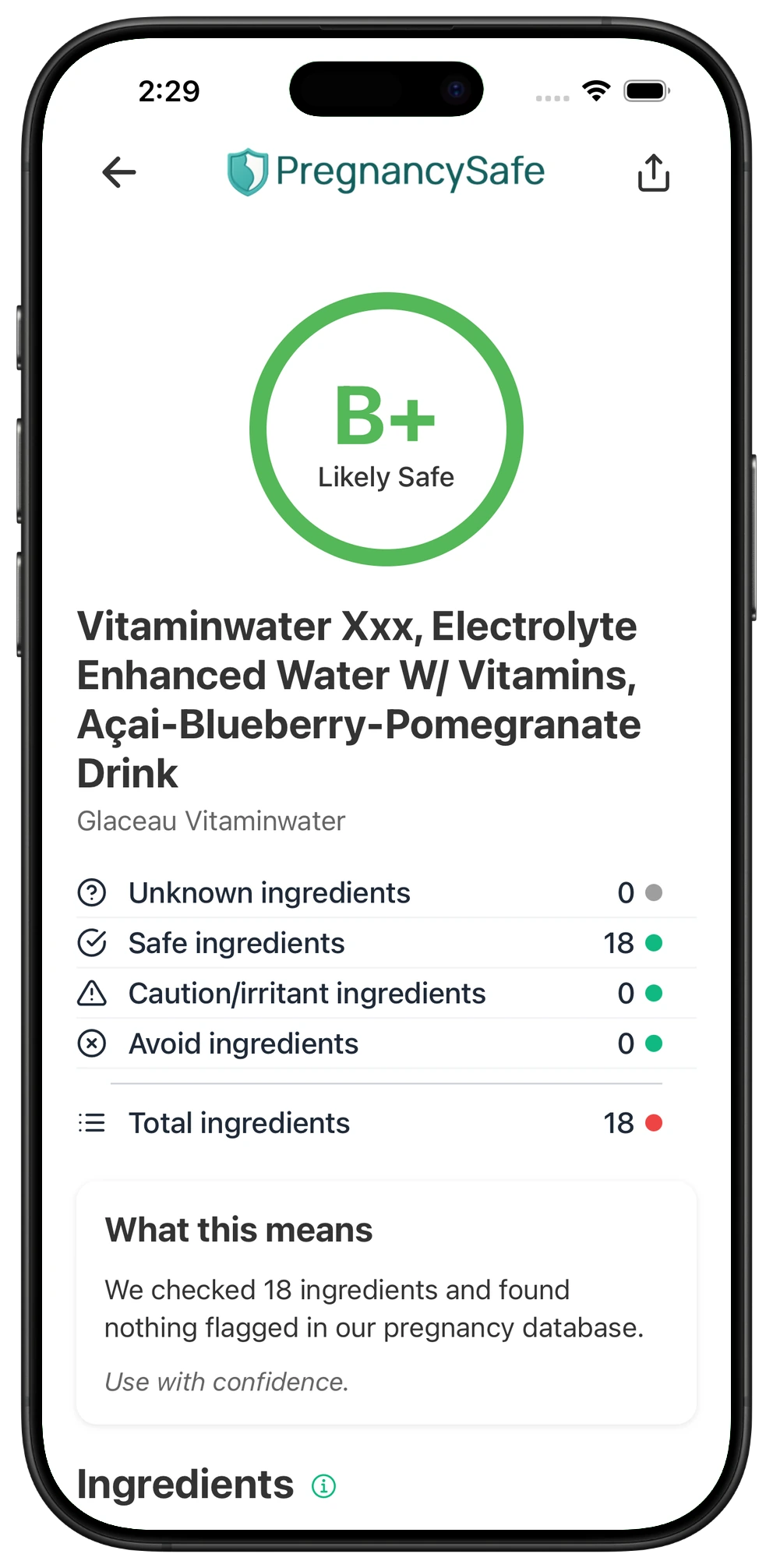
Check your exact product with vitamin C in the app
What Is Vitamin C?
You may also see it listed as: ascorbic acid, L-ascorbic acid, E300
Vitamin C, or ascorbic acid, is an essential water soluble nutrient and antioxidant found in fruits and vegetables. It is added to fortified foods and used to help preserve food freshness. You may encounter it in prenatal vitamins, tablets, gummies, drink mixes, and lozenges. In skin, scalp, and hair products, it serves as an antioxidant and pH adjuster.
What Other Ingredients Should You Look Out for in Products With Vitamin C?
A product's full ingredient list determines whether it's pregnancy-safe or not. These ingredients also appear in some of the vitamin c products we analyzed and may deserve a closer look.
Alcohol
AvoidLook for alcohol, ethanol, or ethyl alcohol in swallowed liquid vitamins and supplements: pregnancy guidance recommends avoiding supplements that retain ethanol. Check whether alcohol remains in the finished product, since an extraction solvent mention alone does not establish exposure.
Flagged in 11 products (0.7%) in this analysis.
Retinol
AvoidCheck vitamin C skincare labels for retinol, a vitamin A ingredient generally avoided during pregnancy despite low topical absorption and reassuring inadvertent exposure findings. If it appears, ask your clinician to review the formula rather than judging it by vitamin C alone.
Flagged in 6 products (0.4%) in this analysis.
Animal Liver
AvoidLook for beef liver or desiccated liver in vitamin supplements: liver can deliver high amounts of preformed vitamin A, and several public health authorities advise avoiding liver products during pregnancy. Check the vitamin A content and review the supplement with your clinician.
Flagged in 3 products (0.2%) in this analysis.
Licorice Root
AvoidLook for licorice root extract, including organic licorice root extract, in vitamin supplements: medicinal oral use is discouraged during pregnancy because glycyrrhizin can raise blood pressure and lower potassium. Have your clinician review the extract and intended frequency; small incidental food flavoring is a different exposure.
Flagged in 2 products (0.1%) in this analysis.
Rutin
CautionRutin, rutin concentrate, and rutin powder appear in vitamin C supplements, but isolated supplemental rutin has insufficient pregnancy safety evidence. Check the amount per serving and discuss added rutin with your clinician; normal food exposure is a different context.
Flagged in 93 products (6.1%) in this analysis.
Elderberry
CautionLook for elderberry extract, concentrate, or powder in vitamin and gummy formulas: pregnancy safety information for health purpose use is limited. Check the preparation and dose with your clinician rather than assuming an added botanical has the same safety profile as vitamin C.
Flagged in 39 products (2.6%) in this analysis.
Does the Form or Amount of Vitamin C Matter During Pregnancy?
For oral intake, pregnancy guidance recommends about 80 mg daily for ages 14–18 and 85 mg daily for adults. Total intake above the pregnancy upper limit of 1,800–2,000 mg daily can cause side effects; that upper limit is not an intake target. Topical use is a separate exposure: ordinary rinse off and leave on ascorbic acid cosmetics are considered compatible, but pregnancy specific trials and systemic absorption studies of topical formulas are lacking. Skin penetration depends on concentration, pH, vehicle, and skin condition, and acidic leave on formulas may sting or irritate.
What Products Contain Vitamin C?
Pregnancy Safe has looked at 19,763 products that have vitamin c as an ingredient. The category and grade breakdowns below use 1,514 products whose names mention Vitamin C or another name for it.
What Types of Products Contain Vitamin C?
Products You May Have That Contain Vitamin C
| Grade | Product | Brand | Type |
|---|---|---|---|
| C- | Naturium Vitamin C Complex Serum- 1 Fl Oz | Naturium | Serum |
| C | C-Firma™ Vitamin C Day Serum | Drunk Elephant | Serum |
| B+ | L'Oreal Paris Revitalift Derm Intensives Vitamin C Face Serum | L'Oreal Paris Revitalift | Face Serum |
| B+ | Cocokind Vitamin C Glow Serum - 1 Fl Oz | Cocokind | Serum |
| B+ | Prequel Lucent-C Vitamin C Serum - 1 Fl Oz | Prequel | Serum |
| C+ | Propolis + Vitamin C Liposomal | Beekeeper'S Naturals | Dietary Supplement |
| C+ | Cerave Skin Renewing Vitamin C Serum | Cerave | Serum |
| C+ | Cerave Skin Renewing Vitamin C Serum - 1 Fl Oz | Cerave | Serum |
How Do Products Containing Vitamin C Score?
It can be helpful to see how products containing vitamin c generally score during pregnancy. This does not tell you whether your exact product is safe, but it gives you a general idea of what we found. In this breakdown of 1,514 products, 41% receive a B grade. A B grade means the complete formula is likely safe, with minimal identified risk.
Frequently Asked Questions About Vitamin C During Pregnancy
How much vitamin C do I need each day while pregnant?
Pregnancy guidance recommends about 80 mg daily for ages 14–18 and 85 mg daily for adults. These are nutritional intake recommendations, not amounts to add on top of food and your prenatal vitamin.
Can I take 500 mg or 1,000 mg of vitamin C, including Emergen C?
Both amounts exceed the daily nutritional recommendation. Being below the pregnancy upper limit does not establish a need for extra supplementation or make a whole formula pregnancy safe. Check your combined intake and all added ingredients, and discuss high dose use with your clinician.
Can I use a vitamin C serum during pregnancy?
Ascorbic acid in ordinary leave on cosmetics is considered compatible with pregnancy, although direct pregnancy studies of topical formulas are limited. Acidic serums may cause stinging, dryness, or irritation. The other ingredients still need a separate check.
What happens if I take too much vitamin C?
Total intake above the pregnancy upper limit of 1,800–2,000 mg daily may cause diarrhea, nausea, and abdominal cramps, with possible kidney stone concerns. The upper limit is not a recommended daily dose.
Does extra vitamin C prevent pregnancy complications?
A Cochrane review of 29 trials and WHO guidance do not support routine high dose vitamin C supplementation to prevent preeclampsia, preterm birth, poor fetal growth, or fetal/neonatal death.
Is ascorbic acid or E300 the same as vitamin C?
Yes. Ascorbic acid is vitamin C, and E300 is a food additive name for it. You may also see L ascorbic acid on a label; the name alone does not tell you the amount or assess the complete formula.
How Do We Score Products for Pregnancy Safety?
We analyze each product's ingredients and category to flag known risks and provide cautionary notices for general category safety concerns.
A - Safe
Excellent choice! All ingredients are considered safe during pregnancy.
What to do: Use with confidence.
B - Likely Safe
Pretty much safe with very minimal risk. Some ingredients may have limited pregnancy studies, but no significant safety concerns have been identified.
What to do: Use with confidence.
C - Limit
Contains ingredients with some pregnancy considerations. Research shows these ingredients may have limited safety data, potential for minor hormonal effects, or require caution based on animal studies.
What to do: Use sparingly and consider safer alternatives when available.
D - Caution
Similar to C grade but contains multiple cautionary ingredients. The combination increases overall concern.
What to do: Try to avoid if that makes you feel better. If you've already used it, no need to panic.
F - Avoid
Contains an ingredient Pregnancy Safe recommends avoiding during pregnancy. This may reflect an established risk or a precaution based on limited evidence; check the ingredient guidance and exposure context.
What to do: Do not use during pregnancy. If you've already used it, don't worry - contact your OBGYN if concerned.
Sources
- https://mothertobaby.org/fact-sheets/vitamin-c/
- https://ods.od.nih.gov/factsheets/Pregnancy-HealthProfessional/
- https://ods.od.nih.gov/factsheets/VitaminC-HealthProfessional/
- https://onlinelibrary.wiley.com/doi/10.1111/ijd.70620
- https://pmc.ncbi.nlm.nih.gov/articles/PMC5605218/
- https://pubmed.ncbi.nlm.nih.gov/11207686/
- https://pubmed.ncbi.nlm.nih.gov/16154915/
- https://pubmed.ncbi.nlm.nih.gov/26415762/
- https://www.aad.org/public/everyday-care/skin-care-secrets/routine/pregnancy-skin-care
- https://www.acog.org/womens-health/faqs/healthy-eating-during-pregnancy
- https://www.cir-safety.org/sites/default/files/RRSum_AscorbicAcid_062025.pdf
- https://www.who.int/tools/elena/review-summaries/vitaminsec-pregnancy--vitamin-c-supplementation-in-pregnancy
- https://www.ncbi.nlm.nih.gov/books/NBK582563/
- https://www.ncbi.nlm.nih.gov/books/NBK582743/
- https://www.cdc.gov/alcohol-pregnancy/about/index.html
- https://www.fda.gov/food/dietary-supplements-guidance-documents-regulatory-information/dietary-supplement-labeling-guide-chapter-iv-nutrition-labeling
- https://pubmed.ncbi.nlm.nih.gov/28775124/
- https://www.iberogast.com/healthcare-professionals/instructions-resources
- https://www.herbalist-alchemist.com/shop-products-cyp-cyperus-extract
- https://mothertobaby.org/fact-sheets/topical-acne-treatments-pregnancy/
- https://mothertobaby.org/fact-sheets/tretinoin-retin-a-pregnancy/
- https://www.medicinesinpregnancy.org/leaflets-a-z/isotretinoin-gel/
- https://www.ema.europa.eu/en/news/updated-measures-pregnancy-prevention-during-retinoid-use
- https://dailymed.nlm.nih.gov/dailymed/lookup.cfm?setid=34d79c31-1568-4797-a4f5-31200c7788db
- https://pubmed.ncbi.nlm.nih.gov/26215715/
- https://pubmed.ncbi.nlm.nih.gov/41365815/
- https://pubmed.ncbi.nlm.nih.gov/16243460/
- https://health.ec.europa.eu/publications/revision-scientific-opinion-sccs157616-vitamin-retinol-retinyl-acetate-retinyl-palmitate_en
- https://www.nhs.uk/pregnancy/keeping-well/foods-to-avoid/
- https://www.nhs.uk/conditions/vitamins-and-minerals/vitamin-a/
- https://cot.food.gov.uk/Lay%20Summary%20of%20the%20Statement%20on%20the%20effects%20of%20excess%20Vitamin%20A%20on%20maternal%20health
- https://pubmed.ncbi.nlm.nih.gov/38846679/
- https://ods.od.nih.gov/factsheets/VitaminA-HealthProfessional/
- https://www.canada.ca/en/public-health/services/publications/healthy-living/maternity-newborn-care-guidelines-chapter-3.html
- https://www.pregnancybirthbaby.org.au/foods-to-avoid-when-pregnant
- https://www.thewomens.org.au/images/uploads/fact-sheets/Food_safety_in_pregnancy_260316.pdf
- https://www.nccih.nih.gov/health/licorice-root
- https://webprod.hc-sc.gc.ca/nhpid-bdipsn/dbImages/mono_licorice_english.pdf
- https://www.ema.europa.eu/en/medicines/herbal/liquiritiae-radix
- https://www.medsafe.govt.nz/profs/PUArticles/December2019/Liquorice-side-effects-interactions.htm
- https://www.bfr.bund.de/cm/349/does-the-consumption-of-liquorice-by-pregnant-women-impair-the-mental-and-physical-development-of-children.pdf
- https://pubmed.ncbi.nlm.nih.gov/28158597/
- https://pubmed.ncbi.nlm.nih.gov/11390327/
- https://pmc.ncbi.nlm.nih.gov/articles/PMC7050615/
- https://pubmed.ncbi.nlm.nih.gov/17253454/
- https://pubmed.ncbi.nlm.nih.gov/26240050/
- https://pmc.ncbi.nlm.nih.gov/articles/PMC5598508/
- https://vkm.no/english/riskassessments/allpublications/rutinandquercetinhealthrisksofintakeoffoodsupplements.4.7cc8817a18c33cc0df9bd9bb.html
- https://www.nccih.nih.gov/health/elderberry
- https://pmc.ncbi.nlm.nih.gov/articles/PMC3941201/
- https://pmc.ncbi.nlm.nih.gov/articles/PMC8026097/
- https://pmc.ncbi.nlm.nih.gov/articles/PMC7961730/
- https://www.cdc.gov/mmwr/preview/mmwrhtml/00000311.htm
- https://www.fda.gov/food/information-consumers-using-dietary-supplements/questions-and-answers-dietary-supplements
- https://pubmed.ncbi.nlm.nih.gov/11518905/
- https://infantrisk.com/content/management-cold-and-flu-during-pregnancy