Is Grapefruit Safe During Pregnancy? (Updated 2026 Guide)
Updated September 9, 2026
The Answer
Yes, grapefruit can be an ordinary part of your pregnancy diet, provided you wash it before peeling or cutting and check for interactions with any medicines you take. The main concerns are unwashed produce and drug interactions not a blanket pregnancy restriction on grapefruit.
Rinse grapefruit under running water without soap or detergent, and refrigerate cut fruit promptly. Grapefruit and its juice can interact with some medicines, including certain formulations of nifedipine, so ask your pharmacist about your exact medication rather than stopping treatment. Some processed grapefruit drinks contain red 40; occasional regulated food exposure is unlikely to be a major pregnancy hazard, but frequent high dye intake is reasonable to limit.
Pregnancy Safe is 100% independent and research driven. No companies pay to promote or sponsor products.
Stress Less This Pregnancy
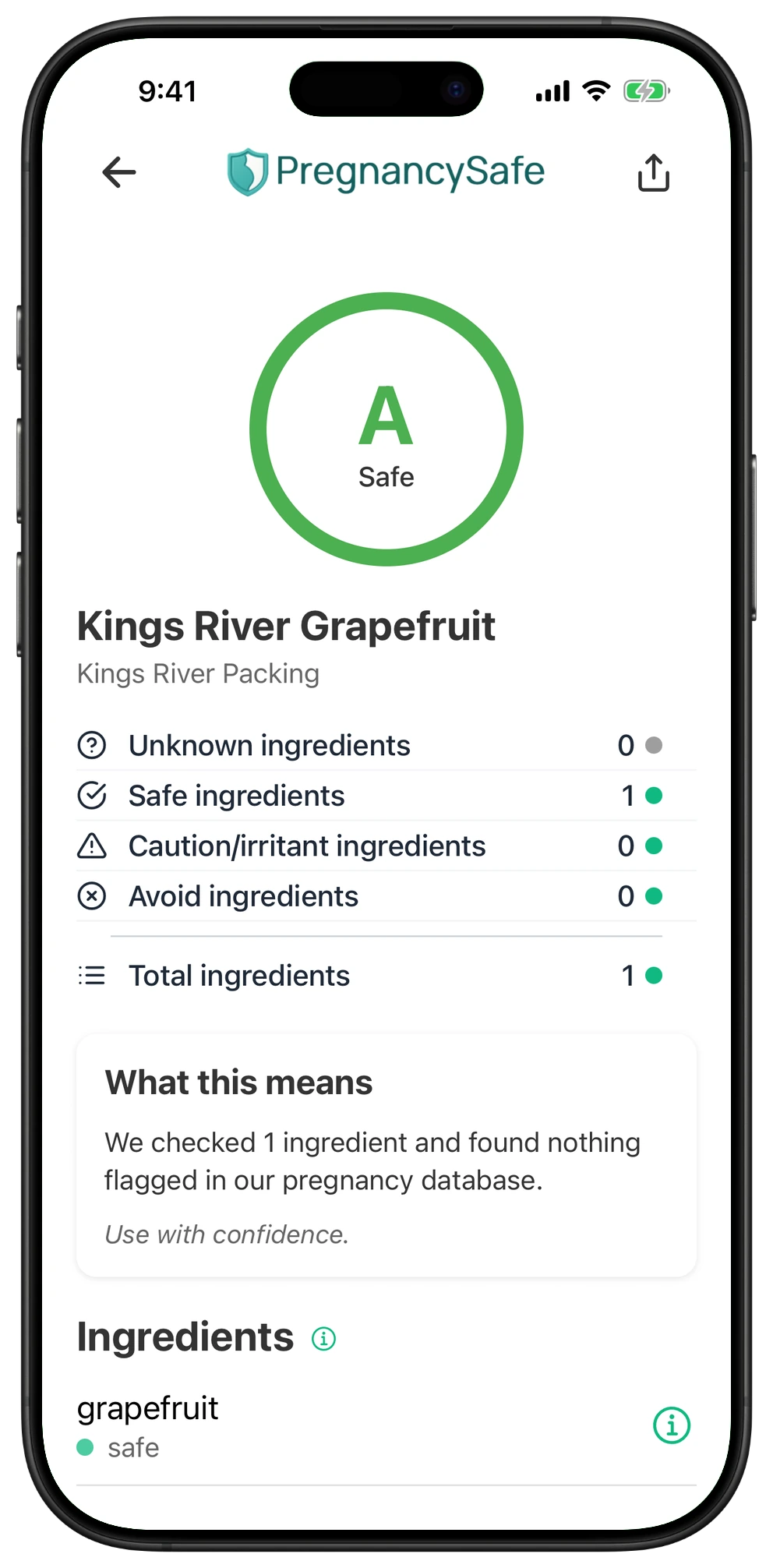
Check your exact grapefruit in the app

✓ What's Safe
- • Whole grapefruit that you can rinse under running water before peeling or cutting.
- • Freshly cut grapefruit that is refrigerated promptly and kept chilled.
- • Juice labeled pasteurized or otherwise treated to reduce harmful microbes.
- • A medication specific answer from your pharmacist about whether you need to avoid grapefruit fruit, juice, or both.
- • Plain fruit or processed options without added dyes if you want to limit frequent red 40 exposure.
✗ What to Avoid
- • Peeling or cutting unwashed grapefruit, even when you do not plan to eat the rind.
- • Using soap or detergent to wash fruit.
- • Untreated grapefruit juice or juice whose treatment status you cannot confirm.
- • Leaving cut grapefruit unrefrigerated rather than chilling it promptly.
- • Assuming a small portion or a gap of a few hours makes grapefruit compatible with an interacting medicine.
- • Stopping or changing a prescribed medicine so that you can eat grapefruit; ask your pharmacist or prescriber instead.
Most Common Ingredients in Grapefruit Products
We analyzed 8 grapefruit products. Here are the most common ingredients, ranked by how often they appear:
Ingredients to Watch Out For in Grapefruit
These are the most common flagged ingredients across 8 grapefruit products we analyzed.
Caution
Red 40 is a synthetic food dye commonly used to add vibrant red color to candies, beverages, and processed foods.
Has limited human pregnancy data and is allowed at regulated food additive levels, but child neurobehavior concerns and high dose animal findings make frequent high dye intake worth limiting.
Flagged in 1 of 8 products (13%)
Grapefruit Products We've Analyzed
Our catalog contains ratings for 8 grapefruit products. These are database grades, not independent safety certifications.
Grades are ingredient scores, not clinical verdicts or measurements of pathogens, dose, preparation or current package contents. Cohorts include unreviewed catalog records and counts are not independently verified safe-product totals.
Pregnancy Safe Grapefruit Products
Popular options from our catalog, prioritizing A and B ingredient grades, with C grade options used to fill remaining places. Within each group, products are ordered by searches in Pregnancy Safe, not retail sales. Read the cautions and guidance above; grades do not verify a complete current label or guarantee pregnancy safety.
| Grade | Product | Brand |
|---|---|---|
| A | Kings River Grapefruit | Kings River Packing |
| A | Star Ruby Red Grapefruit | Wegmans |
| B+ | Ruby Red Grapefruit | — |
| A | Texas Red Grapefruit | Wonderful |
| A | Texax Red Grapefruit | Wonderful Sweet Scarletts |
Your Questions Answered
Which fruit is best to avoid during pregnancy?
Focus on avoiding unwashed fruit and untreated juice rather than excluding fruit simply by name. Grapefruit needs an additional check because it interacts with some medicines. If your medication has a grapefruit warning, follow that specific restriction rather than assuming all fruit is off limits.
Can you eat raw grapefruit while pregnant?
Yes, raw grapefruit can fit a pregnancy diet if it does not conflict with your medicines. Wash the outside under running water before peeling or cutting, even though you discard the rind. Do not use soap or detergent, and refrigerate cut fruit promptly.
Is grapefruit juice safe during pregnancy?
Choose grapefruit juice that is pasteurized or otherwise treated to reduce harmful microbes. Treatment addresses the food handling concern, but it does not remove the need to check medication interactions. Ask your pharmacist about your exact medicine before drinking grapefruit juice if you are unsure.
Can I eat grapefruit if I take nifedipine?
Grapefruit can interact with certain formulations of nifedipine, so ask your pharmacist to check your exact prescription. Do not assume that a different formulation, a small portion, or separating grapefruit and your dose by a few hours avoids the interaction. Keep taking your medicine as prescribed unless your clinician tells you otherwise.
How much grapefruit is safe to eat during pregnancy?
There is no single amount that can be promised to be free of medication interactions. If you take an interacting medicine, a smaller serving is not a reliable workaround. If no medication restriction applies, grapefruit can be an ordinary fruit in your diet; there is no need to treat a particular portion as a pregnancy safety threshold.
Is red 40 in a grapefruit drink a pregnancy concern?
Red 40 is an added synthetic dye, not the same thing as grapefruit's natural color. Human pregnancy specific evidence is limited, and high dose animal findings do not establish fetal harm from ordinary food exposure. Occasional regulated food exposure is unlikely to be a major pregnancy hazard, though choosing drinks without it is a reasonable way to limit frequent high dye intake.
Does an A grade mean grapefruit is guaranteed safe during pregnancy?
No. Our catalog contains eight grapefruit entries, including six with an A ingredient grade, but those counts are not independently verified safe product totals. Ingredient grades do not measure contamination, preparation, portion size, medication interactions, or current package contents. Use handling guidance and medication checks regardless of the grade.
How Do We Score Products for Pregnancy Safety?
We analyze each product's ingredients and category to flag known risks and provide cautionary notices for general category safety concerns.
Grades reflect the ingredient and category information available to us. They don’t verify a complete, current label or account for dose, preparation, or contamination. Read them alongside the guidance above, not as a guarantee of pregnancy safety or proof that every use is harmful.
A - Safe
Excellent choice! All ingredients are considered safe during pregnancy.
What to do: Use with confidence.
B - Likely Safe
Pretty much safe with very minimal risk. Some ingredients may have limited pregnancy studies, but no significant safety concerns have been identified.
What to do: Use with confidence.
C - Limit
Contains ingredients with some pregnancy considerations. Research shows these ingredients may have limited safety data, potential for minor hormonal effects, or require caution based on animal studies.
What to do: Use sparingly and consider safer alternatives when available.
D - Caution
Similar to C grade but contains multiple cautionary ingredients. The combination increases overall concern.
What to do: Try to avoid if that makes you feel better. If you've already used it, no need to panic.
F - Avoid
Contains an ingredient Pregnancy Safe recommends avoiding during pregnancy. This may reflect an established risk or a precaution based on limited evidence; check the ingredient guidance and exposure context.
What to do: Do not use during pregnancy. If you've already used it, don't worry - contact your OBGYN if concerned.
People Also Checked
References
- https://www.fda.gov/food/buy-store-serve-safe-food/selecting-and-serving-produce-safely
- https://www.fda.gov/media/77178/download
- https://www.fda.gov/consumers/consumer-updates/grapefruit-juice-and-some-drugs-dont-mix
- https://www.hfpappexternal.fda.gov/scripts/fdcc/index.cfm?id=FDCRed40&set=ColorAdditives
- https://www.ecfr.gov/current/title-21/chapter-I/subchapter-A/part-74/subpart-A/section-74.340
- https://www.fda.gov/food/color-additives-information-consumers/tracking-food-industry-pledges-remove-petroleum-based-food-dyes
- https://www.efsa.europa.eu/en/efsajournal/pub/1327
- https://www.efsa.europa.eu/en/efsajournal/pub/4007
- https://apps.who.int/food-additives-contaminants-jecfa-database/Home/Chemical/2361
- https://oehha.ca.gov/risk-assessment/report/health-effects-assessment-potential-neurobehavioral-effects-synthetic-food-dyes-children
- https://pubmed.ncbi.nlm.nih.gov/6636206/
- https://pubmed.ncbi.nlm.nih.gov/2613118/
- https://pubmed.ncbi.nlm.nih.gov/7940558/