Is Orange Juice Safe During Pregnancy? (Updated 2026 Guide)
Updated October 1, 2026
The Answer
Orange juice can fit into your pregnancy diet when pasteurized or otherwise treated to kill harmful bacteria, then stored as directed.
The main pregnancy consideration is avoiding harmful germs in untreated juice, so prioritize treatment and cold storage over claims such as fresh or natural. Frequent high intake of added sugars, including high fructose corn syrup in some orange drinks, is a nutritional concern rather than proof that occasional consumption harms pregnancy. Fortified juice can contribute calcium and vitamin D, but it does not replace prenatal nutrients, and its vitamin C is not an infection treatment.
Pregnancy Safe is 100% independent and research driven. No companies pay to promote or sponsor products.
Stress Less This Pregnancy
Check your exact orange juice in the app

Is orange juice good for pregnancy?
Orange juice can contribute vitamin C, which helps your body absorb iron from plant foods. Calcium- or vitamin D fortified versions can contribute those nutrients too, but check the actual label: not every orange juice has the same fortification. These are nutritional contributions, not a reason to replace prenatal care or recommended supplements with juice.
Juice has less fiber than whole fruit. USDA advises getting at least half of your fruit intake from whole fruit rather than juice. Compare 100% orange juice with sweetened orange drinks, and consider the carbohydrate amount in the portion you pour. A nutritious label still does not replace the treatment and storage checks above.
Freshly squeezed versus treated orange juice
The key distinction is treatment, not whether juice is fresh or bottled. Home squeezed or juice bar orange juice may be untreated, so do not assume it is the safer choice. Choose pasteurized or juice otherwise treated to kill harmful bacteria, and ask the seller if the treatment is unclear.
How much orange juice can you drink?
There is no single portion that suits every pregnancy or meal plan. Check the carbohydrate amount for your actual serving and avoid frequent large portions, particularly of sweetened orange drinks. If you have gestational diabetes, ask your care team how juice fits your individualized carbohydrate guidance rather than treating an ingredient grade as permission for unlimited servings.
Calcium- and vitamin D-fortified juice
Fortification is not itself a reason to avoid orange juice during pregnancy. Check the exact label for calcium and vitamin D amounts, along with treatment and storage instructions. Food use acidifiers and calcium hydroxide are not equivalent to consuming industrial chemicals. Fortified juice can contribute nutrients, but it does not replace your recommended prenatal nutrition.
✓ What's Safe
- • Choose juice labeled pasteurized or confirmed to have received an appropriate treatment to reduce harmful germs.
- • At juice bars or markets, ask how the juice was treated before buying it; freshly squeezed does not establish safety.
- • Follow the package's refrigeration and after opening storage instructions.
- • Compare 100% orange juice with orange drinks, checking the added sugars line and ingredient list.
- • Check the carbohydrate amount for the portion you actually pour, especially if you have a gestational diabetes meal plan.
- • If choosing calcium- or vitamin D fortified juice, check the amounts per serving rather than assuming every version contains them.
✗ What to Avoid
- • Avoid unpasteurized or untreated orange juice during pregnancy, including untreated home squeezed juice.
- • Skip juice when the seller cannot confirm treatment; organic, fresh and cold pressed claims are not substitutes.
- • Avoid drinking juice that has not been stored according to its refrigeration instructions.
- • Limit frequent large portions of orange drinks sweetened with high fructose corn syrup or other added sugars.
- • Do not use an A grade as a substitute for checking the current package, treatment and storage.
- • Avoid using orange juice or its vitamin C as an infection remedy or a replacement for recommended prenatal nutrition.
Most Common Ingredients in Orange Juice Products
We analyzed 926 orange juice products. Here are the most common ingredients, ranked by how often they appear:
Ingredients to Watch Out For in Orange Juice
These are the most common flagged ingredients across 926 orange juice products we analyzed.
high fructose corn syrup
Caution
High fructose corn syrup is a sweet, liquid sweetener made from corn starch, commonly used in processed foods and beverages.
Is not a known teratogen at occasional food amounts, but high added sugar intake can displace nutrients and raise gestational diabetes and metabolic concerns.
Flagged in 5 of 926 products (1%)
probiotic bacillus coagulans gbi 30 6086
Caution
Bacillus coagulans GBI-30, 6086 is a specific bacterial strain added to some foods as a probiotic.
Pregnancy specific evidence for this strain is limited. Findings about other probiotic strains, or disease causing species in the broader Bacillus genus, do not establish this strain’s benefits or risks. The ingredient name alone is not a pregnancy safety assessment.
Flagged in 3 of 926 products (0%)
yellow 5
Caution
Yellow 5 is a synthetic food dye used to impart a bright yellow color to various processed foods and beverages.
Has limited human pregnancy data, rare hypersensitivity labeling concerns, and animal/children's neurobehavior signals despite regulated dietary use under ADI based limits.
Flagged in 2 of 926 products (0%)
bha
Caution
BHA (butylated hydroxyanisole) is an antioxidant food preservative used to slow rancidity in fats and oils.
Has limited pregnancy specific human data and normal regulated food use appears lower concern than high dose animal exposures that drove carcinogenicity classifications.
Flagged in 1 of 926 products (0%)
combined congener orange fragrance
Caution
A vibrant, citrusy scent derived from combined congener orange fragrance, offering a fresh and uplifting aroma.
Can hide product specific mixtures and has been associated with higher DEP metabolite exposure in some pregnancy studies; fragrance allergens and VOCs may also irritate sensitive skin or airways.
Flagged in 1 of 926 products (0%)
tangerine fragrance
Caution
A bright, citrusy aroma reminiscent of fresh tangerines, evoking a cheerful and invigorating scent.
Can hide product specific mixtures and has been associated with higher DEP metabolite exposure in some pregnancy studies; fragrance allergens and VOCs may also irritate sensitive skin or airways.
Flagged in 1 of 926 products (0%)
Orange Juice Products We've Analyzed
Our catalog contains ratings for 926 orange juice products. These are database grades, not independent safety certifications.
Grades are catalog ingredient scores, not measurements of current labels, preparation, pathogens, dose or clinical pregnancy suitability. Unreviewed products remain in the aggregate counts.
Pregnancy Safe Orange Juice Products
Popular options from our catalog, prioritizing A and B ingredient grades, with C grade options used to fill remaining places. Within each group, products are ordered by searches in Pregnancy Safe, not retail sales. Read the cautions and guidance above; grades do not verify a complete current label or guarantee pregnancy safety.
| Grade | Product | Brand |
|---|---|---|
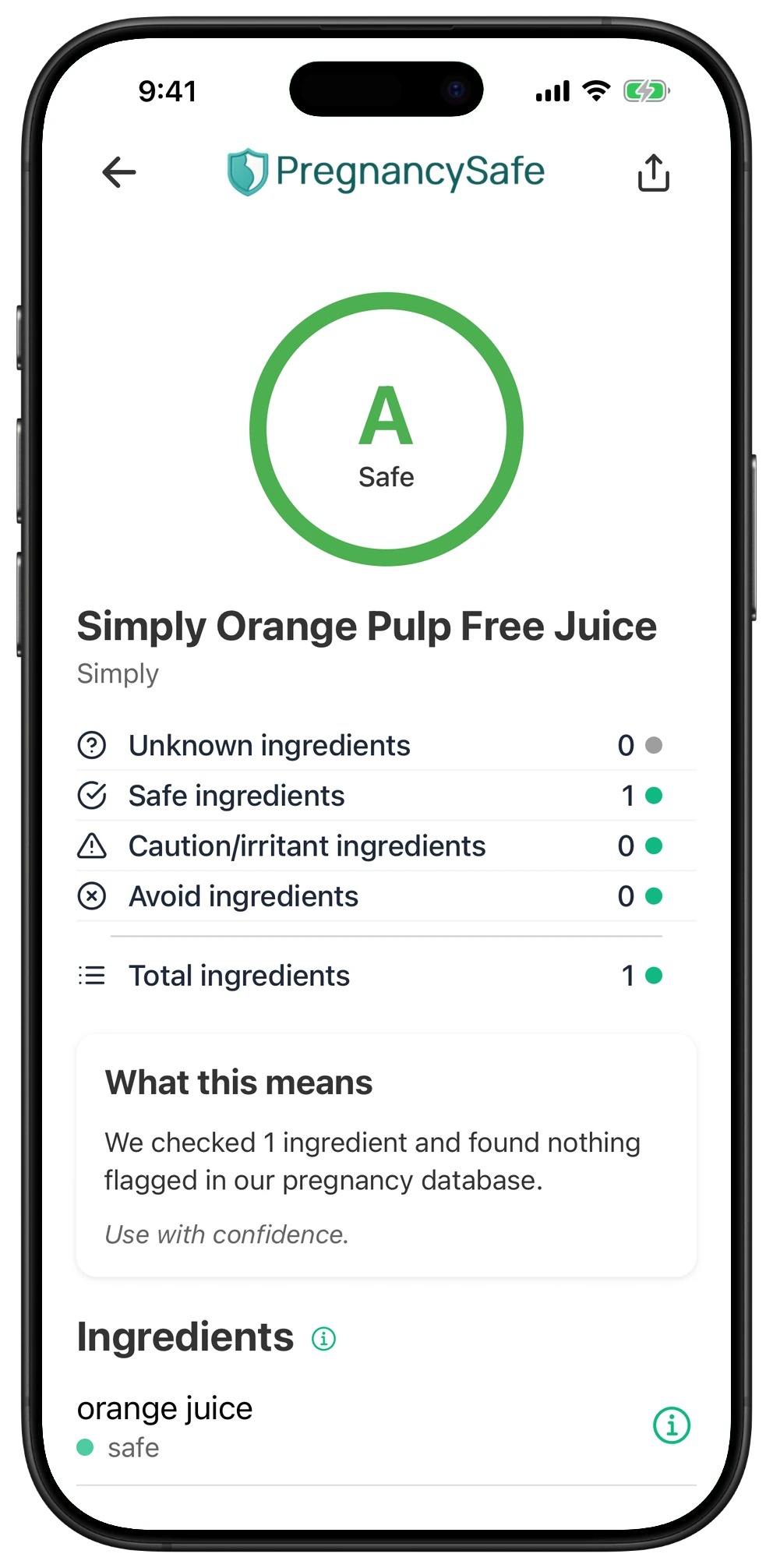
| A | Simply Orange Pulp Free Juice | Simply |
| A | 100% Orange Juice | Tropicana |
| A | 100% Orange Juice | Minute Maid |
| A | 7 Select Farmer'S Grove Orange Juice | 7-Select |
| A | Simply Orange High Pulp | Simply Orange |
Your Questions Answered
Which orange juice is safe for pregnancy?
Choose pasteurized or appropriately treated orange juice and follow its storage instructions. Check the exact package rather than relying on a brand name, ingredient grade or fresh squeezed claim. A 100% juice option without added sugar can help you avoid extra sweeteners, but it still requires attention to portion size.
Should I avoid orange juice with added probiotics?
Added probiotics do not automatically make juice better suited to pregnancy. Pregnancy specific evidence for Bacillus coagulans GBI-30, 6086 is limited, and reassuring findings about other probiotic strains cannot establish this strain's safety. It is also not the same organism as the food poisoning species Bacillus cereus. You can choose juice without added probiotics, particularly if you do not need that feature, and seek individualized advice if you are immunocompromised.
Do orange juice grades tell me whether a bottle is pregnancy safe?
No grades are ingredient scores, not checks for pathogens, pasteurization, storage or your portion size. Our catalog contains 926 products, including 721 graded A and 195 graded B+, but these are not counts of independently verified pregnancy safe bottles. Lower grades or incomplete records do not by themselves prove harm. Read the current package and any qualifications attached to a listed product.
How Do We Score Products for Pregnancy Safety?
We analyze each product's ingredients and category to flag known risks and provide cautionary notices for general category safety concerns.
Grades reflect the ingredient and category information available to us. They don’t verify a complete, current label or account for dose, preparation, or contamination. Read them alongside the guidance above, not as a guarantee of pregnancy safety or proof that every use is harmful.
A - Safe
Excellent choice! All ingredients are considered safe during pregnancy.
What to do: Use with confidence.
B - Likely Safe
Pretty much safe with very minimal risk. Some ingredients may have limited pregnancy studies, but no significant safety concerns have been identified.
What to do: Use with confidence.
C - Limit
Contains ingredients with some pregnancy considerations. Research shows these ingredients may have limited safety data, potential for minor hormonal effects, or require caution based on animal studies.
What to do: Use sparingly and consider safer alternatives when available.
D - Caution
Similar to C grade but contains multiple cautionary ingredients. The combination increases overall concern.
What to do: Try to avoid if that makes you feel better. If you've already used it, no need to panic.
F - Avoid
Contains an ingredient Pregnancy Safe recommends avoiding during pregnancy. This may reflect an established risk or a precaution based on limited evidence; check the ingredient guidance and exposure context.
What to do: Do not use during pregnancy. If you've already used it, don't worry - contact your OBGYN if concerned.
People Also Checked
Aloe Vera Juice
25 products
Cold Pressed Juice
30 products
Sparkling Juice
244 products
Juice
7,912 products
Grapefruit
8 products
See our full guide to juice during pregnancy.
References
- https://ods.od.nih.gov/factsheets/VitaminC-HealthProfessional/
- https://foodbuyingguide.fns.usda.gov/FoodComponents/ResourceFruits
- https://ods.od.nih.gov/factsheets/Calcium-HealthProfessional/
- https://ods.od.nih.gov/factsheets/VitaminD-Consumer/
- https://www.fda.gov/food/buy-store-serve-safe-food/what-you-need-know-about-juice-safety
- https://www.nhs.uk/pregnancy/keeping-well/foods-to-avoid/
- https://cdn.realfood.gov/DGA.pdf
- https://www.dietaryguidelines.gov/sites/default/files/2021-12/DGA_Pregnancy_FactSheet-508c.pdf
- https://www.acog.org/womens-health/faqs/healthy-eating-during-pregnancy
- https://www.cdc.gov/nutrition/php/data-research/added-sugars.html
- https://www.cdc.gov/diabetes/about/gestational-diabetes.html
- https://www.who.int/publications/i/item/9789241549028
- https://nesr.usda.gov/2025-dietary-guidelines-advisory-committee-systematic-reviews/dietary-patterns_gestational-diabetes
- https://pmc.ncbi.nlm.nih.gov/articles/PMC8308823/
- https://pmc.ncbi.nlm.nih.gov/articles/PMC5759212/
- https://pmc.ncbi.nlm.nih.gov/articles/PMC6811671/
- https://www.efsa.europa.eu/en/topics/topic/qualified-presumption-safety-qps
- https://www.fda.gov/files/food/published/GRAS-Notice-000660---Bacillus-coagulans-GBI-30--6086.pdf
- https://www.bccdc.ca/health-info/diseases-conditions/bacillus-cereus
- https://www.fda.gov/food/people-risk-foodborne-illness/food-safety-booklet-pregnant-women-their-unborn-babies-and-children-under-five
- https://hfpappexternal.fda.gov/scripts/fdcc/index.cfm?id=FDCYellow5&set=ColorAdditives
- https://www.ecfr.gov/current/title-21/chapter-I/subchapter-A/part-74#74.705
- https://www.fda.gov/food/color-additives-information-consumers/tracking-food-industry-pledges-remove-petroleum-based-food-dyes
- https://www.fda.gov/food/nutrition-food-labeling-and-critical-foods/food-allergies
- https://apps.who.int/food-additives-contaminants-jecfa-database/Home/Chemical/3885
- https://efsa.onlinelibrary.wiley.com/doi/10.2903/j.efsa.2009.1331
- https://oehha.ca.gov/risk-assessment/report/health-effects-assessment-potential-neurobehavioral-effects-synthetic-food-dyes-children
- https://pubmed.ncbi.nlm.nih.gov/1628860/
- https://pmc.ncbi.nlm.nih.gov/articles/PMC7023231/
- https://pmc.ncbi.nlm.nih.gov/articles/PMC6354951/
- https://www.fda.gov/food/food-chemical-safety/list-select-chemicals-food-supply-under-fda-review
- https://www.federalregister.gov/documents/2026/02/11/2026-02761/butylated-hydroxyanisole-bha-request-for-information
- https://www.ecfr.gov/current/title-21/chapter-I/subchapter-B/part-182/subpart-D/section-182.3169
- https://www.ecfr.gov/current/title-21/chapter-I/subchapter-B/part-172/subpart-B/section-172.110
- https://www.efsa.europa.eu/en/efsajournal/pub/2392
- https://pmc.ncbi.nlm.nih.gov/articles/PMC13092903/
- https://www.ncbi.nlm.nih.gov/books/NBK590883/
- https://www.inchem.org/documents/iarc/vol40/butylatedhydroxyanisole.html
- https://pubmed.ncbi.nlm.nih.gov/7290287/
- https://pubmed.ncbi.nlm.nih.gov/3804125/
- https://www.fda.gov/cosmetics/cosmetic-ingredients/fragrances-cosmetics
- https://www.fda.gov/cosmetics/cosmetic-ingredients/phthalates-cosmetics
- https://www.fda.gov/cosmetics/cosmetic-ingredients/allergens-cosmetics
- https://pmc.ncbi.nlm.nih.gov/articles/PMC3110684/
- https://pmc.ncbi.nlm.nih.gov/articles/PMC4016195/
- https://pmc.ncbi.nlm.nih.gov/articles/PMC4097177/
- https://pmc.ncbi.nlm.nih.gov/articles/PMC8453372/
- https://pmc.ncbi.nlm.nih.gov/articles/PMC10999525/
- https://www.epa.gov/indoor-air-quality-iaq/volatile-organic-compounds-impact-indoor-air-quality