Is Cold Pressed Juice Safe During Pregnancy? (Updated 2026 Guide)
Updated September 9, 2026
The Answer
Cold pressed juice can be a suitable choice during pregnancy if it is pasteurized or otherwise appropriately treated to kill harmful bacteria and stored as directed. Our catalog contains 26 A graded records out of 30, but ingredient grades do not verify treatment or establish pregnancy safety.
Cold pressed describes juice extraction, not a pathogen killing step, so confirm the exact bottle’s treatment rather than relying on organic, raw or refrigerated claims. Non heat treatments can be appropriate, but their effectiveness depends on the specific process. Added oral aloe warrants caution, blue green algae raises contamination concerns, and probiotic safety evidence depends on the strain and amount consumed.
Pregnancy Safe is 100% independent and research driven. No companies pay to promote or sponsor products.
Stress Less This Pregnancy
Check your exact cold pressed juice in the app

✓ What's Safe
- • Choose juice labeled pasteurized or confirmed to have an appropriate pathogen reduction treatment.
- • For HPP treated juice, ask whether the exact product’s pressure treatment is validated to control harmful bacteria.
- • Follow the bottle’s refrigeration, use by and after opening instructions.
- • At juice bars, ask about treatment before ordering, even when no warning label is displayed.
- • Read the full ingredient list for aloe, algae or added probiotics rather than relying on wellness claims.
✗ What to Avoid
- • Untreated juice, including freshly pressed juice with no confirmed pathogen killing step.
- • Assuming raw, organic, cold pressed or refrigerated means pregnancy safe.
- • Relying on washed produce alone to make homemade juice safe from harmful bacteria.
- • Juice stored contrary to its label instructions or kept beyond its stated use period.
- • Aloe vera juice blends without clinician guidance, particularly when the aloe form and amount are unclear.
- • Blue green algae additions without documented contaminant testing, or juice cleanses used in place of meals.
Most Common Ingredients in Cold Pressed Juice Products
We analyzed 30 cold pressed juice products. Here are the most common ingredients, ranked by how often they appear:
Ingredients to Watch Out For in Cold Pressed Juice
These are the most common flagged ingredients across 30 cold pressed juice products we analyzed.
a nutrient dense aqua botanical blue green algae
Caution
Has limited human pregnancy data and can be contaminated with microcystins, other cyanotoxins, heavy metals, or microbes unless carefully cultivated and tested.
Flagged in 1 of 30 products (3%)
aloe vera juice
Caution
Aloe vera juice is a soothing, hydrating beverage made from the gel of the aloe vera plant, known for its potential health and skin benefits.
Is low concern on skin but oral latex, whole leaf, laxative, supplement, or juice forms may stimulate uterine contractions and cause laxative related fluid or electrolyte imbalance.
Flagged in 1 of 30 products (3%)
bacillus coagulans gbi 30 6086
Caution
Has strain specific safety with limited pregnancy specific data and includes species that can cause foodborne illness or carry toxin genes.
Flagged in 1 of 30 products (3%)
e3live aphanizomenon flos aquae
Caution
Has limited human pregnancy data and can be contaminated with microcystins, other cyanotoxins, heavy metals, or microbes unless carefully cultivated and tested.
Flagged in 1 of 30 products (3%)
Cold Pressed Juice Products We've Analyzed
Our catalog contains ratings for 30 cold pressed juice products. These are database grades, not independent safety certifications.
Ingredient grades cannot establish dose, preparation, label completeness, efficacy or pregnancy suitability. An A score is not an endorsement, and counts include unreviewed catalog records.
Pregnancy Safe Cold Pressed Juice Products
Popular options from our catalog, prioritizing A and B ingredient grades, with C grade options used to fill remaining places. Within each group, products are ordered by searches in Pregnancy Safe, not retail sales. Read the cautions and guidance above; grades do not verify a complete current label or guarantee pregnancy safety.
| Grade | Product | Brand |
|---|---|---|
| A | Morning Glory Cold Pressed | Loop Mission |
| A | Evolution Fresh Protein Power Greens Cold-Pressed Juice | Evolution Fresh |
| A | Green With Envy Apple Romaine, Cucumber, Celery, Kale, Lemon, Parsley Cold Pressed Juice, Green With Envy | Midwest Juicery |
| A | Pineapple Turmeric Basil Cold Pressed Juice | Factor |
| A | Vanilla Almond Flavored Cold Pressed Beverage, Vanilla Almond | — |
Your Questions Answered
Is cold pressed juice the same as unpasteurized juice?
No. Cold pressed describes how juice is extracted, while pasteurization describes a treatment to control harmful bacteria. A cold pressed juice may receive heat treatment or an appropriate non heat treatment afterward. Check the exact bottle rather than assuming its extraction method tells you whether it has been treated.
Is HPP cold pressed juice safe during pregnancy?
High pressure processing, or HPP, is a non heat treatment, so HPP juice should not automatically be treated as untreated juice. Confirm that the exact product uses a validated process to control harmful bacteria. Follow its storage and after opening instructions, and check any added ingredients separately. If the manufacturer cannot clarify treatment, choose a clearly pasteurized option.
Can I drink freshly squeezed juice from a juice bar?
Choose it only when the seller can confirm pasteurization or another appropriate pathogen reduction treatment. Juice sold by the glass may lack a warning label even when it is untreated. Fresh preparation, organic produce and refrigeration do not replace treatment. If the seller cannot confirm the process, choose a treated alternative.
Does washing fruit make homemade cold pressed juice safe?
Washing produce is important, but it does not sterilize the produce or the resulting juice. Home pressing alone does not provide a pathogen killing step. For pregnancy, choose pasteurized or otherwise appropriately treated juice rather than relying on washing and immediate consumption.
Which added ingredients need extra attention?
Oral aloe vera juice warrants caution; latex and whole leaf forms have laxative related concerns, and evidence about skin applied aloe does not establish drinking safety. Blue green algae, including Aphanizomenon flos aquae, needs documented contaminant testing, and direct human pregnancy evidence is limited. Bacillus coagulans GBI 30 6086 is a named probiotic strain, not the same organism as food poisoning species such as Bacillus cereus. Its pregnancy evidence remains limited, so consider the strain, amount and product quality rather than assuming all probiotics share the same evidence.
Does an A grade mean a cold pressed juice is safe during pregnancy?
No. Our catalog contains 30 records: 26 graded A, two B+ and two C. These ingredient grades do not establish treatment, dose, label completeness or pregnancy suitability, and the counts include unreviewed records. An ingredient list alone cannot verify the current bottle’s pathogen reduction process, so check treatment and storage regardless of grade.
Can I use cold pressed juice for a pregnancy detox cleanse?
Do not use a juice cleanse as a substitute for meals or prenatal nutrition. Appropriate treatment addresses harmful bacteria, but it does not make a juice a complete diet. If you drink juice, check its treatment and ingredients and keep it alongside meals rather than replacing them.
How Do We Score Products for Pregnancy Safety?
We analyze each product's ingredients and category to flag known risks and provide cautionary notices for general category safety concerns.
Grades reflect the ingredient and category information available to us. They don’t verify a complete, current label or account for dose, preparation, or contamination. Read them alongside the guidance above, not as a guarantee of pregnancy safety or proof that every use is harmful.
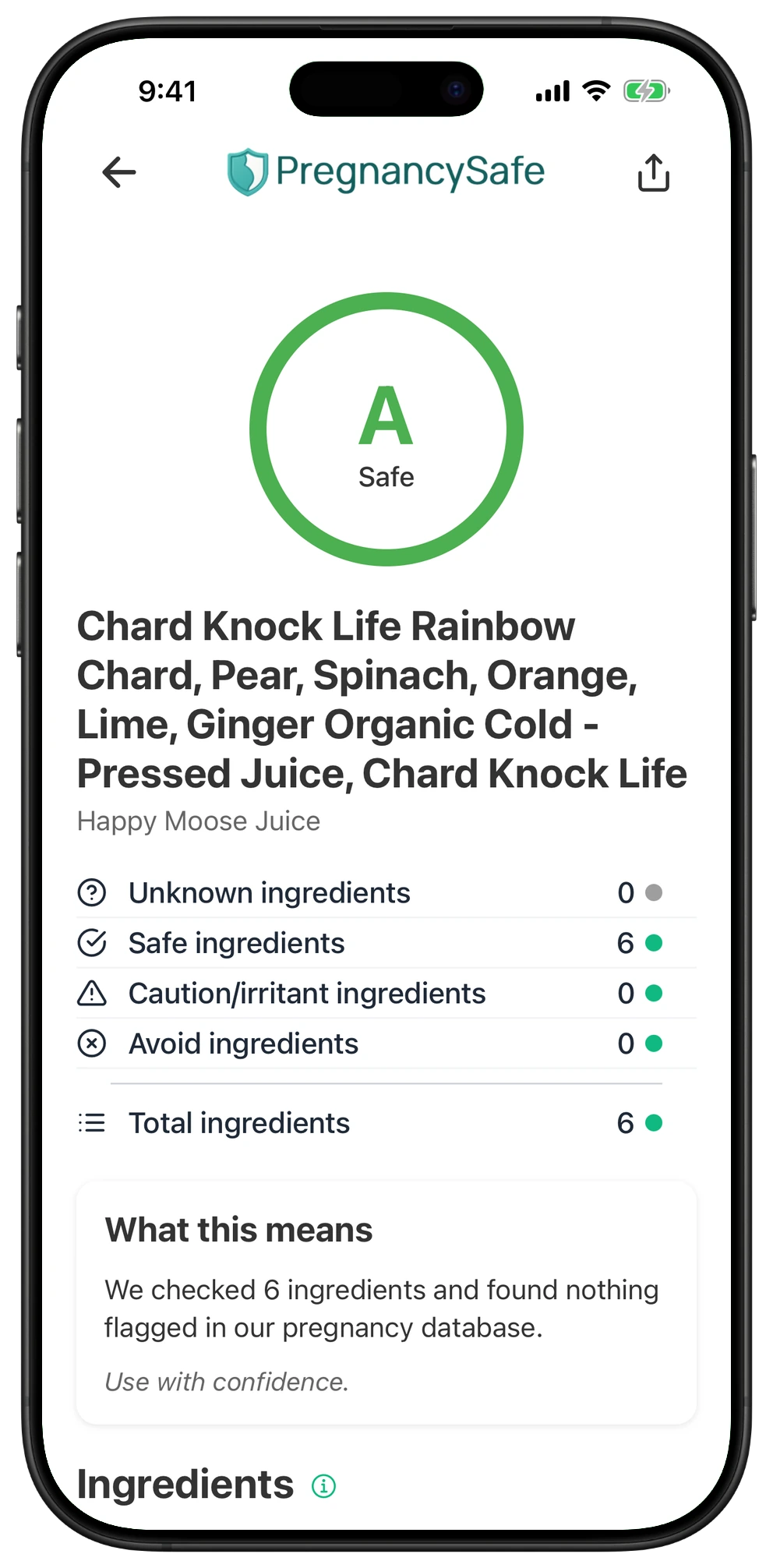
A - Safe
Excellent choice! All ingredients are considered safe during pregnancy.
What to do: Use with confidence.
B - Likely Safe
Pretty much safe with very minimal risk. Some ingredients may have limited pregnancy studies, but no significant safety concerns have been identified.
What to do: Use with confidence.
C - Limit
Contains ingredients with some pregnancy considerations. Research shows these ingredients may have limited safety data, potential for minor hormonal effects, or require caution based on animal studies.
What to do: Use sparingly and consider safer alternatives when available.
D - Caution
Similar to C grade but contains multiple cautionary ingredients. The combination increases overall concern.
What to do: Try to avoid if that makes you feel better. If you've already used it, no need to panic.
F - Avoid
Contains an ingredient Pregnancy Safe recommends avoiding during pregnancy. This may reflect an established risk or a precaution based on limited evidence; check the ingredient guidance and exposure context.
What to do: Do not use during pregnancy. If you've already used it, don't worry - contact your OBGYN if concerned.
People Also Checked
Aloe Vera Juice
25 products
Orange Juice
926 products
Sparkling Juice
244 products
Juice
7,912 products
See our full guide to juice during pregnancy.
References
- https://www.fda.gov/food/buy-store-serve-safe-food/what-you-need-know-about-juice-safety
- https://www.fda.gov/food/natural-toxins-food/blue-green-algae-products-and-microcystins
- https://www.fda.gov/food/chemical-contaminants-pesticides/natural-toxins-food
- https://www.cdc.gov/harmful-algal-blooms/hcp/clinical-signs/symptoms-freshwater-harmful-algal-blooms.html
- https://www.epa.gov/habs/what-are-effects-habs
- https://www.ncbi.nlm.nih.gov/sites/books/NBK501849/
- https://pmc.ncbi.nlm.nih.gov/articles/PMC9960112/
- https://pmc.ncbi.nlm.nih.gov/articles/PMC5371831/
- https://pubmed.ncbi.nlm.nih.gov/10330729/
- https://pubmed.ncbi.nlm.nih.gov/31672369/
- https://pubmed.ncbi.nlm.nih.gov/21793723/
- https://www.nccih.nih.gov/health/aloe-vera
- https://webprod.hc-sc.gc.ca/nhpid-bdipsn/dbImages/mono_aloe--oral_english.pdf
- https://www.ema.europa.eu/en/documents/herbal-monograph/final-european-union-herbal-monograph-aloe-barbadensis-mill-and-aloe-various-species-mainly-aloe-ferox-mill-and-its-hybrids-folii-succus-siccatus_en.pdf
- https://www.utep.edu/herbal-safety/populations/herbs-to-avoid-during-pregnancy.html
- https://www.federalregister.gov/documents/2002/05/09/02-11510/status-of-certain-additional-over-the-counter-drug-category-ii-and-iii-active-ingredients
- https://pubmed.ncbi.nlm.nih.gov/33164294/
- https://pubmed.ncbi.nlm.nih.gov/28139161/
- https://journals.sagepub.com/doi/10.1080/10915810701351186
- https://pmc.ncbi.nlm.nih.gov/articles/PMC8308823/
- https://pmc.ncbi.nlm.nih.gov/articles/PMC5759212/
- https://pmc.ncbi.nlm.nih.gov/articles/PMC6811671/
- https://www.efsa.europa.eu/en/topics/topic/qualified-presumption-safety-qps
- https://www.fda.gov/files/food/published/GRAS-Notice-000660---Bacillus-coagulans-GBI-30--6086.pdf
- https://www.bccdc.ca/health-info/diseases-conditions/bacillus-cereus
- https://www.fda.gov/food/people-risk-foodborne-illness/food-safety-booklet-pregnant-women-their-unborn-babies-and-children-under-five