Is The Ordinary Hyaluronic Acid 2% + B5 with Ceramides Safe During Pregnancy? (Updated 2026 Guide)
Updated September 9, 2026
The Ordinary Hyaluronic Acid 2% + B5 with Ceramides
The Ordinary
The Ordinary Hyaluronic Acid 2% + B5 with Ceramides receives a C+ pregnancy grade, meaning caution rather than a blanket safety endorsement. Phenoxyethanol carries a caution flag because direct pregnancy evidence is limited, while propanediol and tocopherol are rated likely safe for ordinary topical use. This ingredient based grade does not establish that normal facial application harms pregnancy.
You can use this, but maybe don't make it your everyday go to. Not the end of the world if you've used it. Consult your OBGYN or midwife if you have concerns.
Pregnancy Safe is 100% independent and research driven. No companies pay to promote or sponsor products.
Stress Less This Pregnancy
Check your serum in the app

What Ingredients Are in The Ordinary Hyaluronic Acid 2% + B5 with Ceramides?
The Ordinary Hyaluronic Acid 2% + B5 with Ceramides has 23 ingredients. We flagged 1 ingredient to use with caution.
CAUTION
Phenoxyethanol is a preservative commonly used in cosmetics and skincare products to prevent microbial growth and extend shelf life. Phenoxyethanol warrants caution because direct pregnancy data are limited, although regulated cosmetic concentrations are generally considered low systemic risk in ordinary topical use.
propanediol
LIKELY SAFE
Propanediol is a versatile, plant derived humectant and solvent commonly used in skincare and cosmetic formulations to retain moisture and improve product texture. Propanediol is rated likely safe for ordinary topical use, but the supporting propylene glycol evidence is indirect and high dose medication concerns do not establish risk from this serum.
tocopherol
LIKELY SAFE
Tocopherol is a form of vitamin E commonly used as an antioxidant in skincare and cosmetic products. Tocopherol is considered low concern during pregnancy at ordinary topical amounts, and high dose oral vitamin E concerns should not be extrapolated to facial serum use.
citric acid
SAFE
Citric acid is a natural organic acid commonly used as a preservative and flavor enhancer in food and beverages. Citric acid is generally compatible with pregnancy in ordinary topical cosmetics, although direct pregnancy studies are lacking and stronger or lower pH formulas may irritate.
SAFE
Glycerin is a colorless, odorless, and sweet tasting humectant commonly used in skincare products to attract and retain moisture in the skin. Glycerin is generally compatible with pregnancy in ordinary topical skincare, where systemic exposure is expected to be low.
hydrolyzed hyaluronic acid
SAFE
Hydrolyzed hyaluronic acid is a smaller, more easily absorbed form of hyaluronic acid that helps hydrate and plump the skin. Hydrolyzed hyaluronic acid is generally considered compatible with pregnancy in ordinary topical skincare, though direct pregnancy outcome studies are limited.
sodium citrate
SAFE
Sodium citrate is a salt commonly used as a food additive and buffering agent to regulate acidity and stabilize emulsions. The topical citrate assessment considers sodium citrate generally compatible with pregnancy in ordinary cosmetics, while noting limited direct pregnancy evidence.
sodium hyaluronate
SAFE
Sodium hyaluronate is a powerful hydrating agent that helps retain moisture in the skin, promoting plumpness and elasticity. Sodium hyaluronate is generally compatible with pregnancy in ordinary topical skincare because systemic exposure is expected to be low.
sodium hyaluronate crosspolymer
SAFE
Sodium hyaluronate crosspolymer is a stabilized, gel like form of hyaluronic acid used in skincare products to enhance hydration and improve skin texture. The topical hyaluronate assessment considers sodium hyaluronate crosspolymer generally compatible with pregnancy, although direct pregnancy studies are limited.
ahnfeltiopsis concinna extract
SAFE
This extract is unflagged, but pregnancy specific evidence for its ordinary topical use is not established here.
aqua
SAFE
Aqua is the scientific term for water, commonly used as a solvent and base ingredient in various cosmetic and skincare products. Water is unflagged in this topical serum, but its presence does not establish the pregnancy safety of the complete formula.
caprylyl glycol
SAFE
Caprylyl glycol is a versatile moisturizing agent and skin conditioner commonly used in skincare products for its humectant and antimicrobial properties. Caprylyl glycol is unflagged, which does not establish a pregnancy specific safety assessment for topical exposure.
chlorphenesin
SAFE
Chlorphenesin is a synthetic preservative and muscle relaxant commonly used in cosmetics and topical products to inhibit microbial growth. Chlorphenesin is unflagged here, but a nursing warning involving a nipple cream with phenoxyethanol concerned infant ingestion rather than ordinary facial use during pregnancy.
ethoxydiglycol
SAFE
Ethoxydiglycol is a clear, colorless, and odorless solvent commonly used in cosmetics and skincare products to enhance ingredient delivery and improve texture. Ethoxydiglycol is unflagged, but pregnancy specific safety for its topical use is not established by this assessment.
ethylhexylglycerin
SAFE
Ethylhexylglycerin is a skin conditioning agent and preservative booster commonly used in cosmetics to enhance product stability and provide mild antimicrobial benefits. Ethylhexylglycerin is unflagged rather than specifically confirmed safe for topical use during pregnancy.
hexylene glycol
SAFE
Hexylene glycol is a clear, colorless, and odorless solvent commonly used in cosmetics and skincare products as a humectant, solvent, and viscosity stabilizer. Hexylene glycol is unflagged, but this does not confirm pregnancy specific safety at the serum’s topical exposure.
p anisic acid
SAFE
P anisic acid is unflagged, but pregnancy specific evidence for its topical use is not established here.
panthenol
SAFE
Panthenol is a moisturizing and soothing ingredient commonly used in skincare and haircare products to improve hydration and promote healthy skin and hair. Panthenol is unflagged in this topical serum, but its moisturizing role does not itself establish pregnancy safety.
pentylene glycol
SAFE
Pentylene glycol is a versatile, water soluble humectant and solvent commonly used in skincare and cosmetic formulations to hydrate the skin and enhance product stability. Pentylene glycol is unflagged rather than specifically reviewed as safe for topical exposure during pregnancy.
phospholipids
SAFE
Phospholipids are essential lipid molecules composed of two fatty acid chains, a glycerol backbone, and a phosphate group, playing a key role in cell membrane structure and function. Phospholipids are unflagged, but their presence does not establish pregnancy specific safety for this topical formula.
polysorbate 20
SAFE
Polysorbate 20 is a gentle, water soluble emulsifier commonly used in cosmetics and skincare products to blend oil and water based ingredients. Polysorbate 20 is unflagged, which is not confirmation of pregnancy specific safety for ordinary topical use.
sphingolipids
SAFE
Sphingolipids are a class of complex lipids that play essential roles in cell membrane structure and signaling processes. Sphingolipids are unflagged, but this does not provide a separate pregnancy safety assessment of topical ceramides.
trisodium ethylenediamine disuccinate
SAFE
Trisodium ethylenediamine disuccinate is a chelating agent used in skincare and cosmetic products to bind and neutralize metal ions, enhancing stability and efficacy. Trisodium ethylenediamine disuccinate is unflagged, but pregnancy specific safety evidence for its topical use is not established here.
Answering Your Questions
How much The Ordinary Hyaluronic Acid 2% + B5 with Ceramides is safe during pregnancy?
If you choose to use it, apply a few drops to your face on unbroken skin, following the manufacturer’s directions. Patch test first; this cosmetic amount is not a pregnancy specific safety threshold.
Can you use The Ordinary Hyaluronic Acid 2% + B5 with Ceramides daily while pregnant?
The manufacturer directs morning and evening application, but that schedule is not a pregnancy specific safety guarantee. If irritation develops, rinse it off, stop using it, and consult a clinician, as the manufacturer advises.
Why did this serum receive a C+ pregnancy grade?
The C+ comes from ingredient based scoring: phenoxyethanol is rated caution, while propanediol and tocopherol are rated likely safe. Phenoxyethanol has limited direct pregnancy data, although cosmetic safety reviews consider regulated concentrations acceptable. The propanediol evidence is indirect and concerns propylene glycol; it does not establish that the label lists propylene glycol. Ingredients without a flag are not necessarily individually reviewed for pregnancy safety.
Can I use this serum while breastfeeding?
Ordinary facial application is different from applying a product where your baby could swallow it during nursing. Avoid using this serum on your nipples or breast areas that contact your baby’s mouth: the phenoxyethanol related nursing warning concerned infant ingestion of a nipple cream containing phenoxyethanol and chlorphenesin, not ordinary facial skincare. This pregnancy grade does not certify breastfeeding safety.
What alternatives should I consider during pregnancy?
Look for a moisturizer or hydrating serum with a reviewed full ingredient list and fewer pregnancy related caution flags. Glycerin and topical hyaluronic acid are generally compatible with pregnancy at ordinary cosmetic exposure, but their presence alone does not establish the safety of the whole formula.
Are hyaluronic acid and ceramides pregnancy safe?
Topical hyaluronic acid is generally considered compatible with pregnancy because systemic exposure from ordinary skincare is expected to be low, although direct pregnancy studies are limited. The “with Ceramides” name identifies this second generation formula; it is not a standalone pregnancy safety guarantee or a separate ceramide assessment. The whole serum retains its C+ grade.
What is this serum used for?
It is a facial hydration serum intended to help dehydrated skin feel smoother and support the skin’s moisture barrier. The manufacturer recommends applying it after cleansing and before heavier creams or oils; these skincare benefits do not establish pregnancy safety. The Ordinary
Can I use vitamin B5 on my skin while pregnant?
This formula lists panthenol, a moisturizing ingredient associated with its B5 claim. Panthenol is unflagged here, but that is not the same as a pregnancy specific safety review. Judge this leave on serum by its complete formula rather than its B5 name alone.
Does this grade also apply to the original formula?
No. This assessment covers the second generation with Ceramides formula identified in the 60 ml version, not the original serum. Compare your package’s ingredient list, since the manufacturer notes that formulas can vary with purchase date and region. The Ordinary
What Are Pregnancy Safe Alternatives to The Ordinary Hyaluronic Acid 2% + B5 with Ceramides?
Here are some solid alternatives. Everything below has an A or B grade, meaning no flagged ingredients in our database.
| Grade | Product | Brand | Type |
|---|---|---|---|
| B+ | True Belly Serum | 8 Sheep Organics | serum |
| B+ | Byoma Hydrating Serum | Byoma | serum |
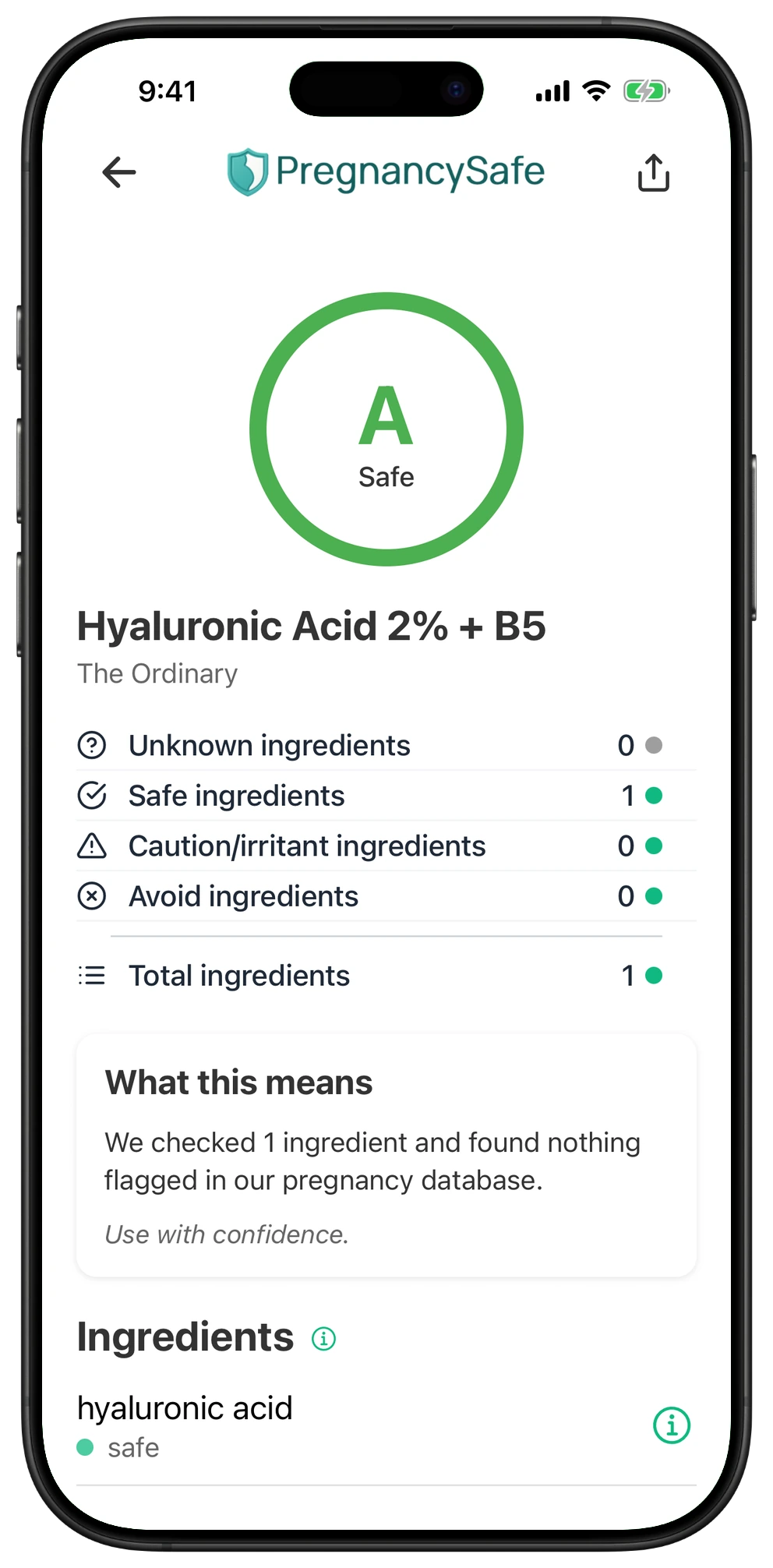
| A | Hyaluronic Acid 2% + B5 | The Ordinary | serum |
| A | E.L.F. Skin Holy Hydration Thirst Burst Drops Serum | E.L.F. Skin | serum |
Are Other The Ordinary Products Safe During Pregnancy?
We looked at 12 other The Ordinary products. 5 are pregnancy safe (A or B grade), while 7 need a closer look.
| Grade | Product | Type |
|---|---|---|
| C | The Ordinary Natural Moisturizing Factors + Hyaluronic Acid Daily Moisturizer | moisturizer |
| C+ | The Ordinary Niacinamide 10% + Zinc 1% | serum |
| A | 100% Plant-Derived Squalane | face oil |
| A | Ascorbyl Tetraisopalmitate Solution 20% In Vitamin F | serum |
How Does The Ordinary Hyaluronic Acid 2% + B5 with Ceramides Compare to Other Serums?
We graded 1,128 Serums for pregnancy safety. Here's how they stack up:
The Ordinary Hyaluronic Acid 2% + B5 with Ceramides earns a C+ grade, placing it among the majority of Serums. Only 3% of products in this category get an A grade, so it pays to choose carefully.
How Do We Score Products for Pregnancy Safety?
We analyze each product's ingredients and category to flag known risks and provide cautionary notices for general category safety concerns.
A - Safe
Excellent choice! All ingredients are considered safe during pregnancy.
What to do: Use with confidence.
B - Likely Safe
Pretty much safe with very minimal risk. Some ingredients may have limited pregnancy studies, but no significant safety concerns have been identified.
What to do: Use with confidence.
C - Limit
Contains ingredients with some pregnancy considerations. Research shows these ingredients may have limited safety data, potential for minor hormonal effects, or require caution based on animal studies.
What to do: Use sparingly and consider safer alternatives when available.
D - Caution
Similar to C grade but contains multiple cautionary ingredients. The combination increases overall concern.
What to do: Try to avoid if that makes you feel better. If you've already used it, no need to panic.
F - Avoid
Contains an ingredient Pregnancy Safe recommends avoiding during pregnancy. This may reflect an established risk or a precaution based on limited evidence; check the ingredient guidance and exposure context.
What to do: Do not use during pregnancy. If you've already used it, don't worry - contact your OBGYN if concerned.
People Also Checked
Byoma Hydrating Serum
Byoma
Caudalie Vinoperfect Brightening Dark Spot Serum Vitamin C Alternative 30Ml
Caudalie
Mad Hippie Vitamin C Serum
Mad Hippie
The Ordinary Natural Moisturizing Factors + Hyaluronic Acid Daily Moisturizer
The Ordinary
Supergoop! Mineral Mattescreen Spf 40
Supergoop!
References
- https://health.ec.europa.eu/system/files/2021-08/sccs_o_195_0.pdf
- https://ec.europa.eu/growth/tools-databases/cosing/details/28157
- https://journals.sagepub.com/doi/10.3109/10915819009078737
- https://link.springer.com/article/10.1007/s00204-024-03938-5
- https://www.sfda.gov.sa/en/warnings/1156
- https://www.industrialchemicals.gov.au/sites/default/files/Ethanol%2C%202-phenoxy-_Human%20health%20tier%20II%20assessment.pdf
- https://hero.epa.gov/reference/2857875
- https://books.publisso.de/sites/default/files/documents/series/mak/dam/Vol2019/Iss1/Alt006/mb12299kske6319_w.pdf
- https://www.ecfr.gov/current/title-21/part-184/section-184.1666
- https://pmc.ncbi.nlm.nih.gov/articles/PMC7009459/
- https://pubmed.ncbi.nlm.nih.gov/15995735/
- https://pubmed.ncbi.nlm.nih.gov/23064775/
- https://www.ema.europa.eu/en/documents/scientific-guideline/questions-and-answers-propylene-glycol-used-excipient-medicinal-products-human-use_en.pdf
- https://pmc.ncbi.nlm.nih.gov/articles/PMC11867916/
- https://pubmed.ncbi.nlm.nih.gov/29281181/
- https://pubmed.ncbi.nlm.nih.gov/40234020/
- https://cdnservices.industrialchemicals.gov.au/statements/EVA00103%20-%20Evaluation%20Statement%20-%2026%20June%202023.pdf
- https://journals.sagepub.com/doi/10.1177/1091581818794455
- https://pmc.ncbi.nlm.nih.gov/articles/PMC4154592/
- https://pubmed.ncbi.nlm.nih.gov/15868062/
- https://mothertobaby.org/fact-sheets/vitamin-e/
- https://www.cir-safety.org/sites/default/files/citric032012FR.pdf
- https://www.canada.ca/en/health-canada/services/consumer-product-safety/cosmetics/cosmetic-ingredient-hotlist-prohibited-restricted-ingredients/hotlist.html
- https://www.fda.gov/cosmetics/cosmetic-ingredients/alpha-hydroxy-acids
- https://pubmed.ncbi.nlm.nih.gov/35309882/
- https://pubmed.ncbi.nlm.nih.gov/16040403/
- https://pubmed.ncbi.nlm.nih.gov/9256916/
- https://www.hfpappexternal.fda.gov/scripts/fdcc/index.cfm?id=GLYCERIN&set=FoodSubstances
- https://pubmed.ncbi.nlm.nih.gov/31840548/
- https://pmc.ncbi.nlm.nih.gov/articles/PMC7009851/
- https://www.medicinesinpregnancy.org/leaflets-a-z/glycerin-suppositories/
- https://mothertobaby.org/pregnancy-breastfeeding-exposures/cosmetics/
- https://www.cir-safety.org/sites/default/files/TR_Hyaluronates_032023_1.pdf
- https://pubmed.ncbi.nlm.nih.gov/19636067/
- https://www.aad.org/public/everyday-care/skin-care-secrets/routine/pregnancy-skin-care
- https://www.fda.gov/medical-devices/aesthetic-cosmetic-devices/dermal-fillers-soft-tissue-fillers
- https://pubmed.ncbi.nlm.nih.gov/28492048/