Is Neutrogena Hydro Boost Fragrance Free Water Gel Safe During Pregnancy? (Updated 2026 Guide)
Updated September 9, 2026
Neutrogena Hydro Boost Fragrance Free Water Gel
Neutrogena
Neutrogena Hydro Boost Fragrance Free Water Gel is generally compatible with pregnancy for ordinary use as a leave on facial moisturizer, with a B+ ingredient based grade. Glutamic acid and lysine HCl are rated likely safe and account for the scoring deductions; neither is flagged for caution or avoidance. Their supporting evidence mainly concerns oral exposure, so it does not establish a risk from normal facial application.
Go ahead and use it. Nothing to worry about here.
Pregnancy Safe is 100% independent and research driven. No companies pay to promote or sponsor products.
Stress Less This Pregnancy
Check your face moisturizer in the app

What Ingredients Are in Neutrogena Hydro Boost Fragrance Free Water Gel?
Neutrogena Hydro Boost Fragrance Free Water Gel has 34 ingredients. All 34 ingredients are considered safe or likely safe for pregnancy.
glutamic acid
LIKELY SAFE
Glutamic acid is a naturally occurring amino acid that serves as a key building block of proteins and functions as a flavor enhancer in food. Glutamic acid is rated likely safe here, but its mainly dietary evidence neither directly establishes topical pregnancy safety nor shows harm from ordinary facial use.
lysine hcl
LIKELY SAFE
Lysine HCl is a purified amino acid supplement commonly used to support immune function and promote healthy collagen production. Lysine HCl is rated likely safe here, and pregnancy cautions for high dose oral lysine supplements should not be transferred to ordinary topical moisturizer use.
alanine
SAFE
Alanine is a non essential amino acid that plays a key role in energy production and muscle metabolism. Alanine is considered compatible with pregnancy at typical topical cosmetic levels, although direct studies in pregnant users are lacking.
arginine
SAFE
Arginine is a semi essential amino acid that plays a key role in nitric oxide production, supporting blood flow and immune function. Arginine is considered compatible with pregnancy in ordinary leave on cosmetics, based on cosmetic safety reviews rather than pregnancy specific topical studies.
betaine
SAFE
Betaine is a naturally occurring compound known for its role in supporting liver function, cellular health, and acting as an effective methyl donor in the body. Betaine is considered compatible with pregnancy at normal cosmetic concentrations based partly on low dermal penetration, not on evidence about oral supplements.
citric acid
SAFE
Citric acid is a natural organic acid commonly used as a preservative and flavor enhancer in food and beverages. Citric acid is generally compatible with pregnancy in ordinary topical cosmetics, although stronger or lower pH formulations can irritate skin.
SAFE
Dimethicone is a silicone based polymer commonly used in skincare and cosmetic products to provide a smooth, silky feel and create a protective barrier on the skin. Dimethicone has very low expected systemic absorption with normal topical use, supporting low pregnancy concern despite limited direct pregnancy studies.
dimethicone crosspolymer
SAFE
Dimethicone crosspolymer is a silicone based polymer used in cosmetics to improve texture, provide a smooth feel, and create a lightweight, long lasting finish. Dimethicone crosspolymer's pregnancy assessment relies on related dimethicone evidence about low topical absorption rather than direct pregnancy studies of this crosspolymer.
fructose
SAFE
Fructose is a natural sugar found in fruits, honey, and some vegetables, known for its sweet taste and rapid absorption in the body. Fructose is considered compatible with pregnancy in ordinary topical cosmetics because dermal systemic exposure is expected to be limited, although direct pregnancy studies are lacking.
glucose
SAFE
Glucose is a simple sugar that serves as a primary source of energy for the body's cells. Glucose in normal skincare use on intact skin is not expected to meaningfully affect maternal blood glucose and is not equivalent to consuming sugar.
SAFE
Glycerin is a colorless, odorless, and sweet tasting humectant commonly used in skincare products to attract and retain moisture in the skin. Glycerin is generally compatible with pregnancy in ordinary topical moisturizers, where pregnancy exposure is expected to be low.
glycine
SAFE
Glycine is a simple, non essential amino acid that plays a key role in protein synthesis and acts as an inhibitory neurotransmitter in the central nervous system. Glycine is considered compatible with pregnancy in normal topical cosmetics because intact skin limits absorption, although direct pregnancy studies are lacking.
maltose
SAFE
Maltose is a disaccharide composed of two glucose molecules, commonly used as a sweetener in brewing and confectionery. Maltose is considered compatible with pregnancy in ordinary topical cosmetics, and dietary sugar cautions do not apply to normal facial use.
proline
SAFE
Proline is a non essential amino acid characterized by its unique cyclic structure, playing a key role in protein stability and collagen synthesis. Proline is considered low concern during pregnancy at normal topical cosmetic levels, while animal intravenous evidence is indirect and does not prove human pregnancy safety.
serine
SAFE
Serine is a non essential amino acid involved in protein synthesis and metabolic processes, playing a key role in cell function and neurotransmitter production. Serine is considered compatible with pregnancy in normal topical cosmetics, although pregnancy specific studies are lacking.
sodium chloride
SAFE
Sodium chloride is a common mineral known as table salt, used to enhance the flavor of food and as a preservative. Sodium chloride's pregnancy evidence here concerns dietary intake, so it does not directly assess this moisturizer or justify applying dietary salt restrictions to facial use.
sodium hyaluronate
SAFE
Sodium hyaluronate is a powerful hydrating agent that helps retain moisture in the skin, promoting plumpness and elasticity. Sodium hyaluronate is generally compatible with pregnancy in topical moisturizers because systemic exposure is expected to be low, unlike unassessed injectable uses.
threonine
SAFE
Threonine is an essential amino acid vital for protein synthesis, immune function, and maintaining proper gut health. Threonine is considered compatible with pregnancy at customary topical cosmetic levels, although pregnancy specific studies are limited.
urea
SAFE
Urea is a nitrogen rich compound commonly used in fertilizers, skincare products, and industrial applications. Urea is generally compatible with pregnancy in normal topical cosmetics, while higher strength or damaged skin use requires separate consideration because of irritation and enhanced ingredient penetration.
water
SAFE
Water is a clear, tasteless, and essential liquid that sustains all known forms of life. Water used as a topical cosmetic base is not a pregnancy concern, although proper preservation and the other finished product ingredients still matter.
allantoin
SAFE
Allantoin is a soothing compound known for its skin calming, moisturizing, and healing properties. Allantoin is unflagged in this facial moisturizer, but its soothing properties alone do not establish pregnancy specific topical safety.
caprylyl glycol
SAFE
Caprylyl glycol is a versatile moisturizing agent and skin conditioner commonly used in skincare products for its humectant and antimicrobial properties. Caprylyl glycol is unflagged in this topical formula, but pregnancy specific evidence is not established in its ingredient assessment.
cetearyl olivate
SAFE
Cetearyl olivate is a natural emulsifier derived from olive oil that helps blend and stabilize skincare formulations. Cetearyl olivate is unflagged in this moisturizer, but its olive oil origin does not by itself establish safety during pregnancy.
dimethiconol
SAFE
Dimethiconol is a silicone based polymer used in skincare and haircare products to provide smoothness, shine, and a protective, conditioning barrier. Dimethiconol is unflagged in this facial moisturizer, but its ingredient assessment does not establish pregnancy specific topical safety.
ethylhexylglycerin
SAFE
Ethylhexylglycerin is a skin conditioning agent and preservative booster commonly used in cosmetics to enhance product stability and provide mild antimicrobial benefits. Ethylhexylglycerin is unflagged in this topical formula, which is not the same as a completed pregnancy specific safety review.
pca
SAFE
PCA (Principal Component Analysis) is a skincare ingredient known for its ability to regulate oil production, improve skin clarity, and reduce the appearance of pores. PCA is unflagged in this formula, but its ingredient assessment does not establish pregnancy specific safety for topical use.
pentylene glycol
SAFE
Pentylene glycol is a versatile, water soluble humectant and solvent commonly used in skincare and cosmetic formulations to hydrate the skin and enhance product stability. Pentylene glycol is unflagged in this moisturizer, but its humectant role does not establish pregnancy specific topical safety.
polyacrylate crosspolymer 6
SAFE
Polyacrylate crosspolymer 6 is unflagged, but no ingredient specific pregnancy evidence is available in its assessment.
sodium hydroxide
SAFE
Sodium hydroxide is a highly caustic, white, solid compound commonly used as a strong base in cleaning, manufacturing, and chemical processes. Sodium hydroxide is unflagged here, and its concentrated chemical hazard description alone does not establish pregnancy risk from this finished topical moisturizer.
sodium lactate
SAFE
Sodium lactate is a salt derived from lactic acid that acts as a humectant, preservative, and pH stabilizer in various cosmetic and food products. Sodium lactate is unflagged in this moisturizer, but its ingredient assessment does not establish pregnancy specific topical safety.
sodium pca
SAFE
Sodium PCA is a natural humectant that attracts and retains moisture in the skin, helping to keep it hydrated and supple. Sodium PCA is unflagged in this formula, but its moisturizing function is not evidence of pregnancy specific topical safety.
sorbitan olivate
SAFE
Sorbitan olivate is a gentle emulsifier derived from sorbitol and olive oil, commonly used in skincare products to stabilize emulsions and moisturize the skin. Sorbitan olivate is unflagged in this moisturizer, but its ingredient assessment does not provide pregnancy specific topical evidence.
synthetic beeswax
SAFE
Synthetic beeswax is a man made alternative to natural beeswax, often used in cosmetics and skincare products for its emollient and sealing properties. Synthetic beeswax is unflagged in this topical formula, rather than established safe by a pregnancy specific ingredient review.
trehalose
SAFE
Trehalose is a natural disaccharide sugar known for its ability to protect cells and stabilize proteins by preventing dehydration and oxidative damage. Trehalose is unflagged in this moisturizer, but its described cellular effects do not establish pregnancy specific safety or benefits from topical use.
Answering Your Questions
How much Neutrogena Hydro Boost Fragrance Free Water Gel is safe during pregnancy?
Apply a small amount sufficient to spread a thin layer over your face, following the package directions. Use on intact skin rather than broken or significantly irritated areas, and avoid your eyes.
Can you use Neutrogena Hydro Boost Fragrance Free Water Gel daily while pregnant?
Use according to the label as part of your daily moisturizing routine, adjusting to your skin's needs. Try a small area first when introducing it, and stop if persistent stinging, redness, or a rash develops.
Why did this moisturizer receive a B+ grade?
The B+ comes from ingredient based scoring, with glutamic acid and lysine HCl rated likely safe rather than safe. Neither is a caution or avoid ingredient, and their evidence primarily addresses food or supplements rather than facial skincare. The grade is not a clinical test of the finished product, and unflagged ingredients are not necessarily individually reviewed for pregnancy safety.
Can I use it while breastfeeding?
Ordinary facial use appears low concern, but direct breastfeeding studies of this finished moisturizer are not established here. Keep it off the nipple and areas your baby may lick, and avoid direct contact between your baby's mouth and freshly applied product. Oral lysine supplement cautions should not be treated as evidence of harm from this facial moisturizer.
What alternatives should I consider during pregnancy?
Look for a simple, fragrance free facial moisturizer with familiar moisturizing ingredients such as glycerin or hyaluronic acid. Choose a gel or cream according to your skin's needs, and check the exact formula's pregnancy assessment rather than assuming every product from a brand has the same rating.
Can I use Neutrogena Hydro Boost Fragrance Free Water Gel every day?
Daily use as directed is consistent with its assessment for ordinary topical moisturizing. You do not need a special pregnancy specific application limit based on this grade; follow the label and reduce or stop use if your skin becomes irritated.
Is this Hydro Boost Water Gel fragrance free?
Yes, this assessment is for the Fragrance Free Water Gel variant, and fragrance is not listed in its analyzed ingredients. Check the name and ingredient list on your package, since other Hydro Boost versions can differ. Fragrance free does not guarantee that a product cannot irritate your skin.
Does this rating also apply to Hydro Boost Water Cream?
No the B+ rating applies specifically to Neutrogena Hydro Boost Fragrance Free Water Gel. Water Cream, Gel Cream, and fragranced versions should be checked separately because similar names do not establish identical formulas.
Is the hyaluronic acid ingredient safe during pregnancy?
Sodium hyaluronate, a form of hyaluronic acid, is generally considered compatible with pregnancy at ordinary topical cosmetic use levels because systemic exposure is expected to be low. Direct pregnancy outcome studies are limited, and this assessment does not extend to injectable fillers or other medical injections.
What Are Pregnancy Safe Alternatives to Neutrogena Hydro Boost Fragrance Free Water Gel?
Here are some solid alternatives. Everything below has an A or B grade, meaning no flagged ingredients in our database.
| Grade | Product | Brand | Type |
|---|---|---|---|
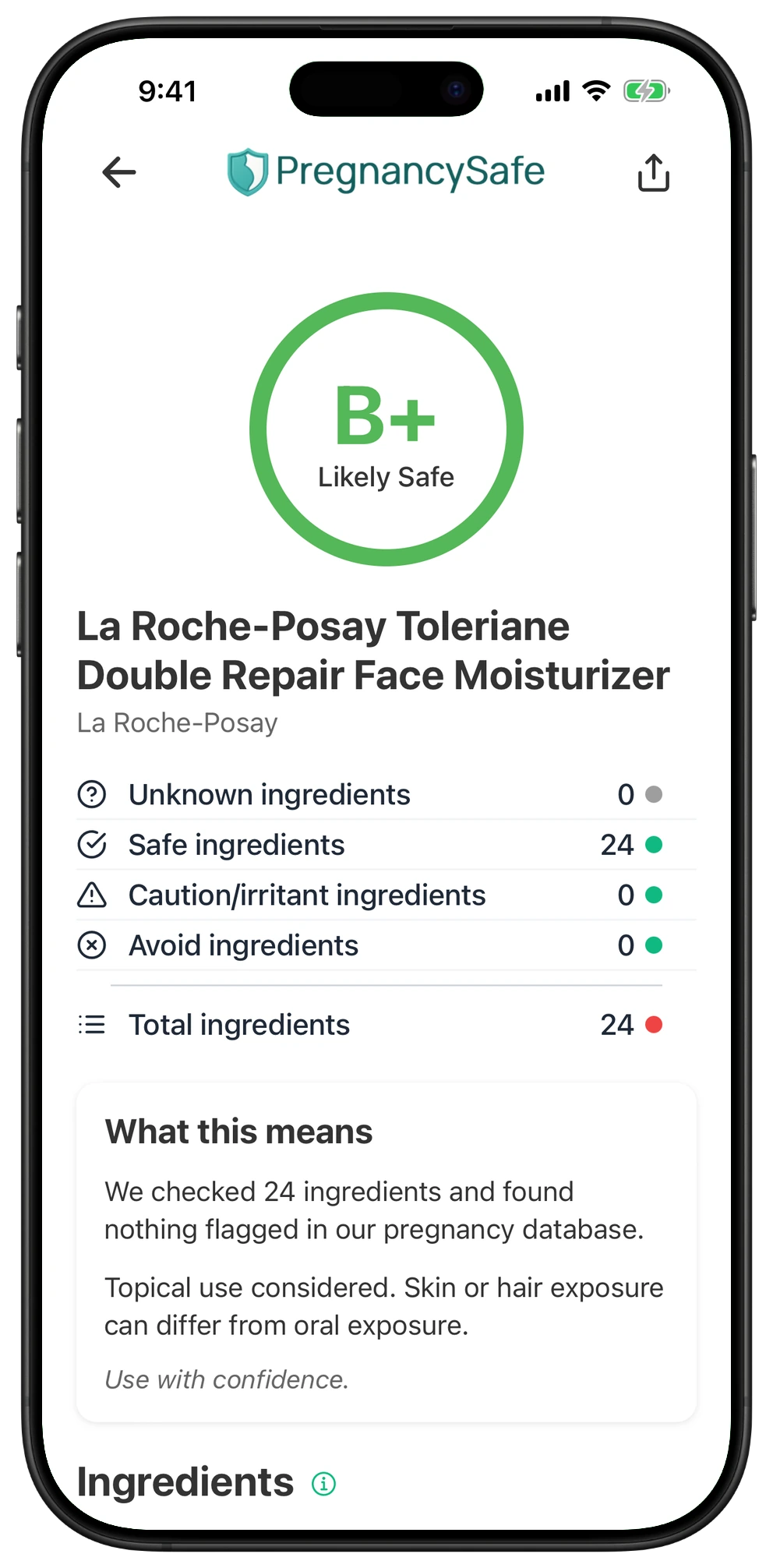
| B+ | La Roche-Posay Toleriane Double Repair Face Moisturizer | La Roche Posay | face moisturizer |
| A | La Roche-Posay Toleriane Dermallegro Soothing Face Moisturizer For Sensitive Skin | La Roche-Posay | face moisturizer |
| A | Vichy Liftactiv Supreme Spf30 50Ml | Vichy | face moisturizer |
| A | Avène Hydrance Light Hydrating Emulsion Spf30 For Dehydrated Skin 40Ml | Avène | face moisturizer |
Are Other Neutrogena Products Safe During Pregnancy?
We looked at 10 other Neutrogena products. 2 are pregnancy safe (A or B grade), while 8 need a closer look.
| Grade | Product | Type |
|---|---|---|
| B+ | Alcohol-Free Daily Facial Toner | facial toner |
| B+ | Hand Cream | hand cream |
| C | Deep Moisture Body Lotion | body lotion |
| C+ | All-In-One Make-Up Removing Cleansing Wipes | makeup remover |
How Does Neutrogena Hydro Boost Fragrance Free Water Gel Compare to Other Face Moisturizers?
We graded 279 Face Moisturizers for pregnancy safety. Here's how they stack up:
Neutrogena Hydro Boost Fragrance Free Water Gel earns a B+ grade, placing it among the top of Face Moisturizers. Only 1% of products in this category get an A grade, so it pays to choose carefully.
How Do We Score Products for Pregnancy Safety?
We analyze each product's ingredients and category to flag known risks and provide cautionary notices for general category safety concerns.
A - Safe
Excellent choice! All ingredients are considered safe during pregnancy.
What to do: Use with confidence.
B - Likely Safe
Pretty much safe with very minimal risk. Some ingredients may have limited pregnancy studies, but no significant safety concerns have been identified.
What to do: Use with confidence.
C - Limit
Contains ingredients with some pregnancy considerations. Research shows these ingredients may have limited safety data, potential for minor hormonal effects, or require caution based on animal studies.
What to do: Use sparingly and consider safer alternatives when available.
D - Caution
Similar to C grade but contains multiple cautionary ingredients. The combination increases overall concern.
What to do: Try to avoid if that makes you feel better. If you've already used it, no need to panic.
F - Avoid
Contains an ingredient Pregnancy Safe recommends avoiding during pregnancy. This may reflect an established risk or a precaution based on limited evidence; check the ingredient guidance and exposure context.
What to do: Do not use during pregnancy. If you've already used it, don't worry - contact your OBGYN if concerned.
People Also Checked
Cerave Face Moisturizer With Sunscreen, Am Facial Moisturizing Lotion For Normal To Dry Skin - Spf 30
Cerave
La Roche Posay Toleriane Face Moisturizer Sunscreen With Ceramide And Niacinamide - Spf 30
La Roche Posay
Medicube Zero Pore Pad 2.0
Medicube
Mad Hippie Vitamin C Serum
Mad Hippie
Skin Renewing Night Cream
Cerave
References
- https://www.fda.gov/food/food-additives-petitions/questions-and-answers-monosodium-glutamate-msg
- https://www.hfpappexternal.fda.gov/scripts/fdcc/index.cfm?id=GLUTAMICACID&set=FoodSubstances
- https://pmc.ncbi.nlm.nih.gov/articles/PMC7009848/
- https://apps.who.int/food-additives-contaminants-jecfa-database/Home/Chemical/2257
- https://www.canada.ca/en/health-canada/services/food-nutrition/food-safety/food-additives/monosodium-glutamate-questions-answers.html
- https://www.ncbi.nlm.nih.gov/sites/books/NBK562630/
- https://pubmed.ncbi.nlm.nih.gov/1168996/
- https://pubmed.ncbi.nlm.nih.gov/10597625/
- https://pubmed.ncbi.nlm.nih.gov/29378056/
- https://www.ncbi.nlm.nih.gov/books/NBK614625/table/ch3.tab28/?report=objectonly
- https://www.ncbi.nlm.nih.gov/books/NBK614631/
- https://www.ncbi.nlm.nih.gov/books/NBK221371/
- https://webprod.hc-sc.gc.ca/nhpid-bdipsn/dbImages/mono_lysine_english.pdf
- https://www.hfpappexternal.fda.gov/scripts/fdcc/index.cfm?id=LYSINE&set=FoodSubstances
- https://www.cir-safety.org/sites/default/files/amacid092012rep.pdf
- https://journals.sagepub.com/doi/10.1177/1091581813507090
- https://www2.mst.dk/Udgiv/publications/2025/05/978-87-7038-999-0a.pdf
- https://pubchem.ncbi.nlm.nih.gov/compound/5950
- https://pubmed.ncbi.nlm.nih.gov/14749863/
- https://onlinelibrary.wiley.com/doi/10.1111/ics.70076
- https://pubmed.ncbi.nlm.nih.gov/37258415/
- https://pubmed.ncbi.nlm.nih.gov/23435582/
- https://journals.sagepub.com/doi/10.1177/1091581818773354
- https://cir-safety.org/sites/default/files/QRT-Update-Dec2025.pdf
- https://pubmed.ncbi.nlm.nih.gov/12535285/
- https://cosmileeurope.eu/inci/detail/1648/betaine/
- https://dailymed.nlm.nih.gov/dailymed/lookup.cfm?setid=31a684d0-cd98-4e46-b43a-ccbd17c41559
- https://www.cir-safety.org/sites/default/files/citric032012FR.pdf
- https://www.canada.ca/en/health-canada/services/consumer-product-safety/cosmetics/cosmetic-ingredient-hotlist-prohibited-restricted-ingredients/hotlist.html
- https://www.fda.gov/cosmetics/cosmetic-ingredients/alpha-hydroxy-acids
- https://pubmed.ncbi.nlm.nih.gov/35309882/
- https://pubmed.ncbi.nlm.nih.gov/16040403/
- https://pubmed.ncbi.nlm.nih.gov/9256916/
- https://www.medicinesinpregnancy.org/leaflets-a-z/dimethicone/
- https://uktis.org/monographs/use-of-head-lice-treatments-in-pregnancy/
- https://www.cir-safety.org/sites/default/files/FAR_Methicones_032022.pdf
- https://www.medicines.org.uk/emc/product/4860/smpc
- https://www.sps.nhs.uk/articles/treating-lice-during-breastfeeding/
- https://mothertobaby.org/fact-sheets/lice-scabies-pregnancy/
- https://www.ecfr.gov/current/title-21/chapter-I/subchapter-D/part-347/subpart-B/section-347.10
- https://journals.sagepub.com/doi/10.1177/1091581818814189
- https://pubmed.ncbi.nlm.nih.gov/30847563/
- https://onlinelibrary.wiley.com/doi/full/10.1111/j.1600-0625.2011.01329.x
- https://www.fda.gov/cosmetics/resources-consumers-cosmetics/cosmetics-pregnancy
- https://health.ec.europa.eu/system/files/2016-11/sccs_s_002_0.pdf
- https://pubmed.ncbi.nlm.nih.gov/10581419/
- https://pubmed.ncbi.nlm.nih.gov/16715366/
- https://pubmed.ncbi.nlm.nih.gov/27391632/
- https://www.ecfr.gov/current/title-21/chapter-I/subchapter-B/part-184/subpart-B/section-184.1857
- https://www.fao.org/fao-who-codexalimentarius/sh-proxy/en/?lnk=1&url=https%3A%2F%2Fworkspace.fao.org%2Fsites%2Fcodex%2FStandards%2FCXS+212-1999%2FCXS_212e.pdf
- https://www.hfpappexternal.fda.gov/scripts/fdcc/index.cfm?id=GLYCERIN&set=FoodSubstances
- https://pubmed.ncbi.nlm.nih.gov/31840548/
- https://pmc.ncbi.nlm.nih.gov/articles/PMC7009851/
- https://www.medicinesinpregnancy.org/leaflets-a-z/glycerin-suppositories/
- https://mothertobaby.org/pregnancy-breastfeeding-exposures/cosmetics/
- https://www.jstage.jst.go.jp/article/sccj1979/30/1/30_1_55/_article
- https://pubmed.ncbi.nlm.nih.gov/19054053/
- https://pmc.ncbi.nlm.nih.gov/articles/PMC7850138/
- https://pubmed.ncbi.nlm.nih.gov/40561639/
- https://www.cir-safety.org/sites/default/files/saccharides_0.pdf
- https://pubchem.ncbi.nlm.nih.gov/compound/Maltose
- https://www.hfpappexternal.fda.gov/scripts/fdcc/index.cfm?id=MALTOSE&set=FoodSubstances
- https://cir-safety.org/sites/default/files/amacid092012rep.pdf
- https://www.jstage.jst.go.jp/article/sccj1979/30/1/30_1_55/_pdf
- https://www.ema.europa.eu/en/documents/scientific-guideline/information-package-leaflet-regarding-proline-used-excipient-medicinal-products-human-use_en.pdf
- https://www.canada.ca/en/health-canada/services/food-nutrition/supplemented-foods/list-permitted-food-ingredients.html
- https://pmc.ncbi.nlm.nih.gov/articles/PMC6467405/
- https://pubmed.ncbi.nlm.nih.gov/32548941/
- https://pubmed.ncbi.nlm.nih.gov/12488240/
- https://hfpappexternal.fda.gov/scripts/fdcc/index.cfm?id=SERINE&set=FoodSubstances
- https://www.acog.org/womens-health/faqs/healthy-eating-during-pregnancy
- https://pmc.ncbi.nlm.nih.gov/articles/PMC11270530/
- https://pmc.ncbi.nlm.nih.gov/articles/PMC6946899/
- https://www.who.int/publications/i/item/9789241504836
- https://www.ncbi.nlm.nih.gov/books/NBK610895/
- https://www.cir-safety.org/sites/default/files/TR_Hyaluronates_032023_1.pdf
- https://pubmed.ncbi.nlm.nih.gov/19636067/
- https://www.aad.org/public/everyday-care/skin-care-secrets/routine/pregnancy-skin-care
- https://www.fda.gov/medical-devices/aesthetic-cosmetic-devices/dermal-fillers-soft-tissue-fillers
- https://pubmed.ncbi.nlm.nih.gov/28492048/
- https://doi.org/10.1177/1091581813507090
- https://doi.org/10.5107/sccj.30.55
- https://cir-safety.org/sites/default/files/qrt-fix_0.pdf
- https://www.ecfr.gov/current/title-21/chapter-I/subchapter-B/part-172/subpart-D/section-172.320
- https://journals.sagepub.com/doi/pdf/10.1080/10915810500257097
- https://pubmed.ncbi.nlm.nih.gov/16422263/
- https://assets.hpra.ie/products/Human/25239/Licence_PA1106-002-001_14052019112418.pdf
- https://assets.hpra.ie/products/Human/27046/Licence_PA2261-008-001_15112024123028.pdf
- https://dailymed.nlm.nih.gov/dailymed/drugInfo.cfm?setid=ef2db58d-e760-417d-8574-45a411c49b47
- https://iris.epa.gov/static/pdfs/1022tr.pdf
- https://www.personalcarecouncil.org/wp-content/uploads/2022/03/INCINomenclatureConventionsReferenceInformation2022_v1.pdf
- https://www.seslhd.health.nsw.gov.au/sites/default/files/groups/Royal_Hospital_for_Women/Mothersafe/documents/skinhaircareandcosmetictreatmentsapril2021.pdf
- https://www.nhs.uk/pregnancy/complications/itching-and-intrahepatic-cholestasis/
- https://www.fda.gov/cosmetics/cosmetics-guidance-documents/good-manufacturing-practice-gmp-guidelinesinspection-checklist-cosmetics
- https://www.fda.gov/cosmetics/potential-contaminants-cosmetics/microbiological-safety-and-cosmetics
- https://pubmed.ncbi.nlm.nih.gov/25153208/