Is Honey Safe During Pregnancy? (Updated 2026 Guide)
Updated September 9, 2026
The Answer
Yes honey is generally compatible with pregnancy in normal food amounts; the no honey under one warning applies to feeding infants, not routinely to pregnant adults. Our catalog contains mostly A grade records, but ingredient grades do not verify individual products’ pregnancy safety.
Treat honey as a sweetener, not a pregnancy supplement or treatment for gestational diabetes. Plain honey differs from concentrated blends containing ginseng, propolis or other supplemental ingredients, whose pregnancy evidence and doses need separate consideration. Follow the package’s storage and preparation instructions, and account for any known allergy or individualized blood sugar advice.
Pregnancy Safe is 100% independent and research driven. No companies pay to promote or sponsor products.
Stress Less This Pregnancy
Check your exact honey in the app

✓ What's Safe
- • Choose plain food honey when you want a sweetener rather than an herbal supplement.
- • Read the full current label to distinguish ordinary honey from tonics, extracts and concentrated blends.
- • Use modest food amounts and account for honey within your overall sugar intake.
- • Follow the exact package’s storage and preparation instructions.
- • If you have gestational diabetes, ask your care team how honey fits your carbohydrate plan.
✗ What to Avoid
- • Avoid self prescribing honey supplements containing korean ginseng or american ginseng during pregnancy; supplement dose safety data are limited.
- • Avoid starting concentrated oral propolis blends without clinical advice; labels may say propolis extract or bee propolis extract.
- • Avoid treating honey blends with spirulina, chlorella or elderberry juice concentrate as proven pregnancy remedies.
- • Avoid large or frequent servings on the assumption that honey does not count as sugar.
- • Avoid paying for manuka claims as though they establish better pregnancy outcomes.
- • Never feed honey to a baby younger than one year, even though eating honey during pregnancy is a different exposure.
Most Common Ingredients in Honey Products
We analyzed 1,763 honey products. Here are the most common ingredients, ranked by how often they appear:
Ingredients to Watch Out For in Honey
These are the most common flagged ingredients across 1,763 honey products we analyzed.
korean ginseng
Avoid
Korean ginseng is a potent adaptogenic root traditionally used to boost energy, enhance mental clarity, and support overall vitality.
Is not recommended as an oral supplement in pregnancy because human data are limited and animal or embryo culture ginsenoside studies raise developmental concerns.
Flagged in 7 of 1,763 products (0%)
bee propolis extract
Caution
Bee propolis extract is a natural resinous substance collected by bees, known for its antimicrobial, anti inflammatory, and antioxidant properties.
Has limited human pregnancy safety data and high dose animal findings, so oral supplements are best treated cautiously while small throat spray amounts may be lower concern.
Flagged in 6 of 1,763 products (0%)
bacillus coagulans gbi 30 6086
Caution
Has strain specific safety with limited pregnancy specific data and includes species that can cause foodborne illness or carry toxin genes.
Flagged in 5 of 1,763 products (0%)
propolis
Caution
Propolis is a natural resinous substance produced by bees, known for its antimicrobial and healing properties.
Has limited human pregnancy safety data and high dose animal findings, so oral supplements are best treated cautiously while small throat spray amounts may be lower concern.
Flagged in 5 of 1,763 products (0%)
propolis extract
Caution
Propolis extract is a natural resinous substance produced by bees, known for its antimicrobial, anti inflammatory, and healing properties.
Has limited human pregnancy safety data and high dose animal findings, so oral supplements are best treated cautiously while small throat spray amounts may be lower concern.
Flagged in 5 of 1,763 products (0%)
spirulina
Caution
Spirulina is a nutrient rich blue green algae known for its high protein, vitamin, and antioxidant content, often used as a dietary supplement.
Has limited pregnancy safety data and product quality concerns because contaminated blue green algae supplements can contain microcystins, heavy metals, or pathogenic bacteria.
Flagged in 3 of 1,763 products (0%)
american ginseng
Avoid
American ginseng is a medicinal root known for its adaptogenic properties, traditionally used to boost energy, reduce stress, and support overall wellness.
Is not recommended as an oral supplement in pregnancy because human safety data are limited and Panax ginsenosides have animal or embryo culture developmental concerns.
Flagged in 2 of 1,763 products (0%)
bacillus coagulans
Caution
Bacillus coagulans is a probiotic bacterium known for supporting digestive health and enhancing immune function.
Has strain specific safety with limited pregnancy specific data and includes species that can cause foodborne illness or carry toxin genes.
Flagged in 2 of 1,763 products (0%)
Honey Products We've Analyzed
Our catalog contains ratings for 1,763 honey products. These are database grades, not independent safety certifications.
Catalog ingredient grades do not measure current-label completeness, pathogens, preparation, caffeine or clinical pregnancy suitability. These counts include unreviewed records and are not a percentage of independently verified safe products.
Pregnancy Safe Honey Products
Popular options from our catalog, prioritizing A and B ingredient grades, with C grade options used to fill remaining places. Within each group, products are ordered by searches in Pregnancy Safe, not retail sales. Read the cautions and guidance above; grades do not verify a complete current label or guarantee pregnancy safety.
| Grade | Product | Brand |
|---|---|---|
| A | Nature Nate'S 100% Pure Raw & Unfiltered Honey Bear | Nature Nate'S |
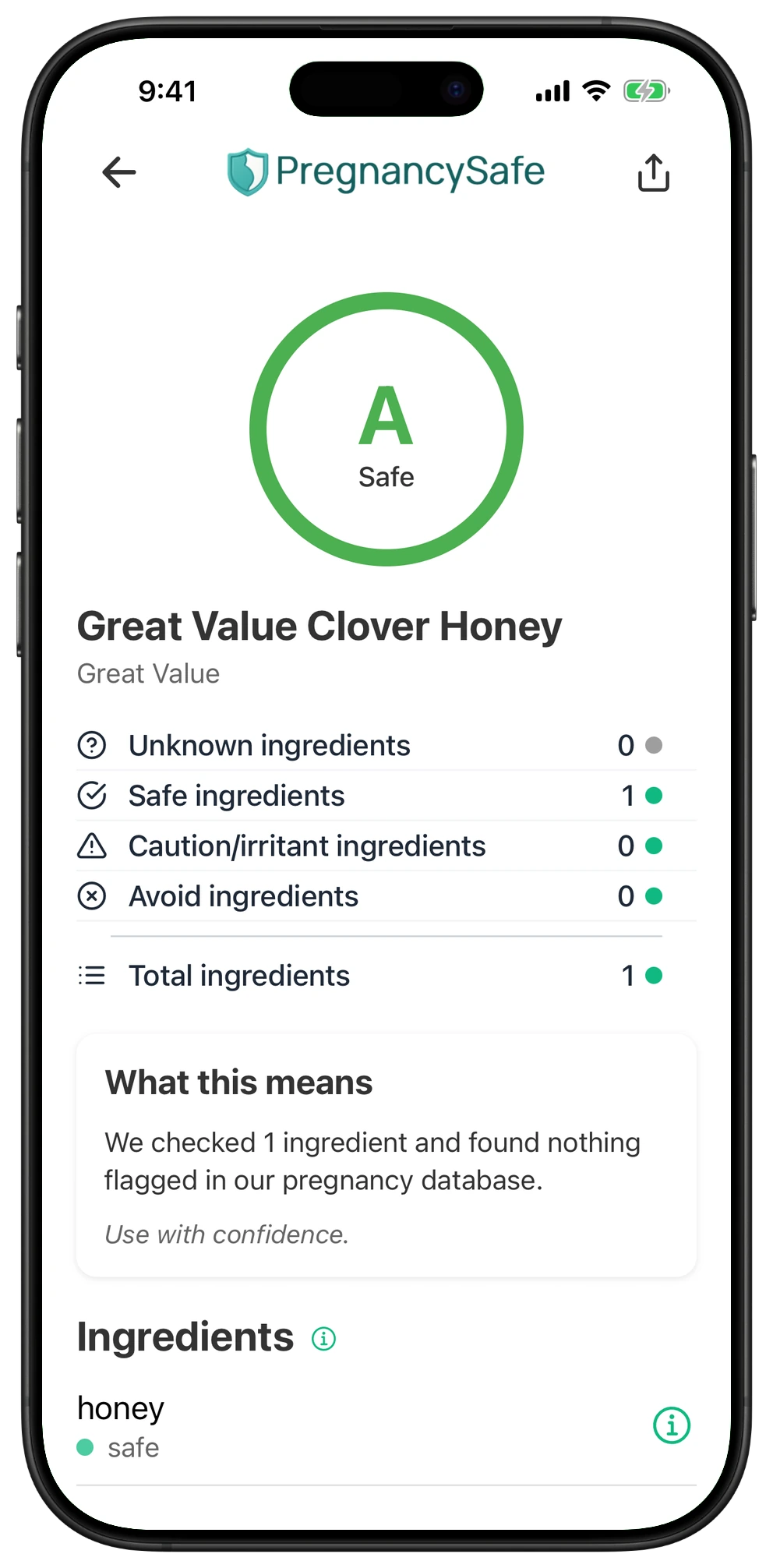
| A | Great Value Clover Honey | Great Value |
| A | Clover Honey | Good & Gather |
| A | Member'S Mark Wildflower Pure Premium Honey . | Member'S Mark |
| A | Comvita Manuka Honey Umf 12+ | Comvita |
Your Questions Answered
Can pregnant women have raw honey?
Ordinary food honey, including raw forms, is generally compatible with pregnancy. The infant botulism warning is not a routine instruction for pregnant adults to avoid honey. Check that the product is food honey rather than a concentrated supplement blend, and follow its storage instructions.
How much honey can I have while pregnant?
Use honey in modest amounts as a sweetener rather than taking large daily doses for health benefits. There is no single pregnancy specific serving limit established here. Your overall sugar intake and any individualized diabetes advice matter more than whether the honey is raw, organic or manuka.
Can I eat honey if I have gestational diabetes?
Honey is still a sugar source, so do not assume it is an unrestricted substitute for table sugar. Ask your diabetes care team how any portion fits your carbohydrate plan and glucose targets. Honey should not be used to treat gestational diabetes.
Is manuka honey better during pregnancy?
Manuka honey can be considered a food sweetener, but its marketing claims do not establish improved pregnancy outcomes. It still contributes sugar. Choose based on your preferences and the actual label, not a promise that it protects your pregnancy.
Are honey blends with herbs or propolis safe?
Do not assume a blend has the same pregnancy considerations as plain honey. Oral ginseng supplements are not recommended because human pregnancy evidence is limited; experimental findings do not establish harm from every food level exposure. Propolis also has limited human pregnancy data, and high dose animal findings cannot be treated as proof of harm from a small serving. Have your clinician or pharmacist check the exact ingredients and doses before using a concentrated blend.
When can my baby have honey?
Do not feed honey to a baby younger than one year because of the infant botulism risk. This warning concerns the baby swallowing honey, rather than you eating normal food amounts while pregnant. Keep that distinction in mind when preparing food for your baby after birth.
Does an A grade mean a honey product is verified safe?
No. Our catalog contains 1,763 records in this category, including 1,699 graded A, but those are ingredient grades rather than independently verified safe product counts. They do not establish current label completeness or measure pathogens, contaminants or clinical suitability. Read your actual package; an incomplete record or lower grade is not by itself proof that a product is harmful.
How Do We Score Products for Pregnancy Safety?
We analyze each product's ingredients and category to flag known risks and provide cautionary notices for general category safety concerns.
Grades reflect the ingredient and category information available to us. They don’t verify a complete, current label or account for dose, preparation, or contamination. Read them alongside the guidance above, not as a guarantee of pregnancy safety or proof that every use is harmful.
A - Safe
Excellent choice! All ingredients are considered safe during pregnancy.
What to do: Use with confidence.
B - Likely Safe
Pretty much safe with very minimal risk. Some ingredients may have limited pregnancy studies, but no significant safety concerns have been identified.
What to do: Use with confidence.
C - Limit
Contains ingredients with some pregnancy considerations. Research shows these ingredients may have limited safety data, potential for minor hormonal effects, or require caution based on animal studies.
What to do: Use sparingly and consider safer alternatives when available.
D - Caution
Similar to C grade but contains multiple cautionary ingredients. The combination increases overall concern.
What to do: Try to avoid if that makes you feel better. If you've already used it, no need to panic.
F - Avoid
Contains an ingredient Pregnancy Safe recommends avoiding during pregnancy. This may reflect an established risk or a precaution based on limited evidence; check the ingredient guidance and exposure context.
What to do: Do not use during pregnancy. If you've already used it, don't worry - contact your OBGYN if concerned.
References
- https://www.nhs.uk/pregnancy/keeping-well/foods-to-avoid/
- https://www.fda.gov/food/people-risk-foodborne-illness/cooking-food-safety-moms-be
- https://journals.sagepub.com/doi/10.1177/10915818251340381
- https://www.fda.gov/cosmetics/resources-consumers-cosmetics/cosmetics-pregnancy
- https://pmc.ncbi.nlm.nih.gov/articles/PMC10820177/
- https://pubmed.ncbi.nlm.nih.gov/25170405/
- https://www.oxfordhealth.nhs.uk/wp-content/uploads/sites/51/2024/08/Oxfordshire-Wound-Management-Advice-and-Prescribing-Guidance-2023-Version-3.0-07Aug2024.pdf
- https://pmc.ncbi.nlm.nih.gov/articles/PMC11796271/
- https://www.accessdata.fda.gov/cdrh_docs/pdf8/K080315.pdf
- https://pubmed.ncbi.nlm.nih.gov/26289766/
- https://www.nccih.nih.gov/health/asian-ginseng
- https://www.ema.europa.eu/en/documents/herbal-report/draft-assessment-report-panax-ginseng-camey-radix-revision-1_en.pdf
- https://pubmed.ncbi.nlm.nih.gov/18204104/
- https://pubmed.ncbi.nlm.nih.gov/14507839/
- https://pubmed.ncbi.nlm.nih.gov/15834894/
- https://pubmed.ncbi.nlm.nih.gov/15336721/
- https://pubmed.ncbi.nlm.nih.gov/20091796/
- https://webprod.hc-sc.gc.ca/nhpid-bdipsn/dbImages/mono_propolis--oral_english.pdf
- https://webprod.hc-sc.gc.ca/nhpid-bdipsn/atReq?atid=propolis_buc&lang=eng
- https://infantrisk.com/content/management-cold-and-flu-during-pregnancy
- https://www.drugs.com/npp/propolis.html
- https://pmc.ncbi.nlm.nih.gov/articles/PMC6820270/
- https://pubmed.ncbi.nlm.nih.gov/20872924/
- https://pubmed.ncbi.nlm.nih.gov/9651052/
- https://www.ema.europa.eu/en/human-regulatory-overview/herbal-medicinal-products/herbal-medicinal-products-questions-answers
- https://pmc.ncbi.nlm.nih.gov/articles/PMC8308823/
- https://pmc.ncbi.nlm.nih.gov/articles/PMC5759212/
- https://pmc.ncbi.nlm.nih.gov/articles/PMC6811671/
- https://www.efsa.europa.eu/en/topics/topic/qualified-presumption-safety-qps
- https://www.fda.gov/files/food/published/GRAS-Notice-000660---Bacillus-coagulans-GBI-30--6086.pdf
- https://www.bccdc.ca/health-info/diseases-conditions/bacillus-cereus
- https://www.fda.gov/food/people-risk-foodborne-illness/food-safety-booklet-pregnant-women-their-unborn-babies-and-children-under-five
- https://www.fda.gov/food/natural-toxins-food/blue-green-algae-products-and-microcystins
- https://www.ncbi.nlm.nih.gov/books/NBK548312/
- https://www.ncbi.nlm.nih.gov/books/NBK501849/
- https://pubmed.ncbi.nlm.nih.gov/21793723/
- https://journal.ugm.ac.id/v3/InaJBCS/article/view/23573
- https://doi.org/10.4236/ojog.2017.71016
- https://pubmed.ncbi.nlm.nih.gov/37317149/
- https://pubmed.ncbi.nlm.nih.gov/37368655/
- https://pubmed.ncbi.nlm.nih.gov/23036452/
- https://pubmed.ncbi.nlm.nih.gov/21842336/
- https://www.ncbi.nlm.nih.gov/books/NBK501814/
- https://www.mskcc.org/cancer-care/integrative-medicine/herbs/ginseng-asian
- https://www.mskcc.org/cancer-care/integrative-medicine/herbs/ginseng-american
- https://www.ncbi.nlm.nih.gov/books/NBK501822/
- https://pmc.ncbi.nlm.nih.gov/articles/PMC10804112/
- https://pubmed.ncbi.nlm.nih.gov/20013055/
- https://pubmed.ncbi.nlm.nih.gov/17472477/
- https://pubmed.ncbi.nlm.nih.gov/15985279/
- https://pubmed.ncbi.nlm.nih.gov/24635025/
- https://www.fda.gov/food/information-consumers-using-dietary-supplements/questions-and-answers-dietary-supplements
- https://ods.od.nih.gov/factsheets/Pregnancy-HealthProfessional/
- https://pmc.ncbi.nlm.nih.gov/articles/PMC7551278/
- https://www.nccih.nih.gov/health/elderberry
- https://pmc.ncbi.nlm.nih.gov/articles/PMC3941201/
- https://pmc.ncbi.nlm.nih.gov/articles/PMC8026097/
- https://pmc.ncbi.nlm.nih.gov/articles/PMC7961730/
- https://www.cdc.gov/mmwr/preview/mmwrhtml/00000311.htm
- https://pubmed.ncbi.nlm.nih.gov/11518905/