Best Pregnancy Safe Makeup Remover (Updated 2026 Guide)
Updated September 9, 2026
The Answer
Choose a makeup remover intended for your face or eye area, check the exact formula, and use it as directed; fragrance free options can help reduce irritation concerns. Our catalog contains 120 products with grades from A to F, mostly in the C range, but those ingredient scores are not clinical pregnancy safety verdicts.
For ordinary topical makeup removal, the main practical considerations are the exact formulation, skin irritation or allergy, and following directions for facial or eye area use. Phenoxyethanol and methylparaben have limited direct pregnancy evidence but are considered acceptable at reviewed cosmetic levels; fragrance and formaldehyde releasing preservatives can raise sensitivity concerns. High dose oral animal findings and occupational inhalation evidence do not establish fetal harm from routine makeup remover use.
Pregnancy Safe is 100% independent and research driven. No companies pay to promote or sponsor products.
Stress Less This Pregnancy
Check your exact makeup remover in the app

✓ What's Safe
- • Choose a fragrance free formula, checking the ingredient list for fragrance, parfum or parfum fragrance rather than relying only on front label claims.
- • Match the ingredient list to the exact version and country of sale; similarly named micellar waters can have different preservatives or added ingredients.
- • Look for directions that specifically permit use on the face or eye area where you plan to remove makeup.
- • Distinguish a plain makeup remover from a formula with added exfoliating or acne treatment ingredients that need separate consideration.
- • Choose a formulation your skin tolerates and follow its rinse off or leave on directions without harsh rubbing.
✗ What to Avoid
- • Avoid fragrance, parfum and parfum fragrance if scent mixtures trigger skin or airway symptoms; these are related label terms, not three distinct pregnancy hazards.
- • Avoid diazolidinyl urea and dmdm hydantoin if you have a formaldehyde allergy; the practical concern is sensitization, not established fetal harm from regulated topical use.
- • Avoid chamomilla recutita flower extract if you have reacted to chamomile, and take extra care with ragweed or daisy family allergies.
- • Avoid using household disinfectant wipes containing benzalkonium chloride as makeup removers; use only a product intended for the relevant facial area.
- • Avoid treating phenoxyethanol, methylparaben or bht as automatic reasons to discard a tolerated remover; concentration and topical exposure matter.
- • Avoid choosing solely by an A grade, a short ingredient list or a natural claim; none guarantees pregnancy safety or a complete current label.
Most Common Ingredients in Makeup Remover Products
We analyzed 120 makeup remover products. Here are the most common ingredients, ranked by how often they appear:
Ingredients to Watch Out For in Makeup Remover
These are the most common flagged ingredients across 120 makeup remover products we analyzed.
Caution
Phenoxyethanol is a preservative commonly used in cosmetics and skincare products to prevent microbial growth and extend shelf life.
Has limited direct pregnancy data and possible infant oral exposure concerns from nipple area products, while regulated cosmetic concentrations are generally considered low systemic risk.
This preservative helps protect makeup remover from microbial growth. Direct pregnancy data are limited, but reviewed cosmetic concentrations are considered acceptable; ordinary facial use is not equivalent to high dose animal exposure or infant ingestion from nipple products.
Flagged in 64 of 120 products (53%)
fragrance
Caution
A fragrant substance used to add a pleasant aroma to products or environments.
Can hide product specific mixtures and has been associated with higher DEP metabolite exposure in some pregnancy studies; fragrance allergens and VOCs may also irritate sensitive skin or airways.
Fragrance identifies a scent mixture whose individual components may not be disclosed. In makeup remover, irritation or allergy is a practical concern; pregnancy exposure associations do not prove that every mixture contains phthalates or that normal use harms pregnancy. Fragrance free is a reasonable exposure reduction option.
Flagged in 23 of 120 products (19%)
methylparaben
Caution
Methylparaben is a synthetic preservative commonly used in cosmetics and personal care products to inhibit microbial growth and extend shelf life.
Has mixed human pregnancy biomonitoring signals and weak endocrine activity, while regulated cosmetic levels are generally considered low concern.
Methylparaben preserves makeup remover against microbial growth. Human pregnancy biomonitoring findings are mixed, and its weak endocrine activity does not establish harm from low dose facial application. Reviewed cosmetic levels are considered acceptable; choosing an alternative is an optional precaution, not a proven pregnancy requirement.
Flagged in 9 of 120 products (8%)
chamomilla recutita flower extract
Caution
Chamomilla recutita flower extract is a soothing botanical ingredient known for its calming and anti inflammatory properties.
Warrants caution because pregnancy specific topical evidence is inadequate; assessed cosmetic concentrations appear to pose low systemic concern, but irritation or allergy is possible and concentrated or medicinal preparations are not well studied.
This is German chamomile flower extract, a botanical used in makeup remover formulas. Direct topical pregnancy evidence is inadequate, while irritation or allergy is the clearest concern, especially with daisy family sensitivity. Cosmetic extract use is distinct from oral chamomile or concentrated essential oil exposure.
Flagged in 8 of 120 products (7%)
parfum
Caution
Parfum is a fragrant mixture of essential oils, aroma compounds, and solvents used to impart a pleasant scent.
Can hide product specific mixtures and has been associated with higher DEP metabolite exposure in some pregnancy studies; fragrance allergens and VOCs may also irritate sensitive skin or airways.
Parfum is a label term for fragrance, not a separate pregnancy hazard. In makeup remover, the mixture may be incompletely disclosed and can trigger sensitivity. Its presence does not establish phthalate content or fetal harm from ordinary topical use.
Flagged in 8 of 120 products (7%)
parfum fragrance
Caution
A parfum fragrance is a concentrated aromatic blend designed to impart a pleasing and lasting scent when applied to the skin or clothing.
Can hide product specific mixtures and has been associated with higher DEP metabolite exposure in some pregnancy studies; fragrance allergens and VOCs may also irritate sensitive skin or airways.
Parfum fragrance is combined label wording for a scent mixture, not evidence of two separate ingredients or a higher concentration. For makeup removal, consider fragrance sensitivity and uncertainty about mixture components. This wording alone does not establish reproductive harm.
Flagged in 8 of 120 products (7%)
benzalkonium chloride
Caution
Benzalkonium chloride is a disinfectant and antiseptic agent commonly used for sanitizing surfaces and skin.
Has limited human pregnancy data and route specific concerns from disinfectant inhalation, mucosal irritation, asthma, and mixed animal reproductive findings.
Benzalkonium chloride is an antimicrobial that may serve as a preservative in makeup remover. Irritation depends on concentration and contact with skin or eyes; follow the product's intended use directions. Occupational disinfectant inhalation and mixed animal findings do not establish pregnancy harm from low dose cosmetic use.
Flagged in 7 of 120 products (6%)
bht
Caution
BHT (butylated hydroxytoluene) is a synthetic antioxidant commonly used as a preservative to prevent the oxidation of fats and oils in food products.
Has limited human pregnancy data, with low concern at reviewed cosmetic levels but reproductive and thyroid related findings in high dose oral animal studies.
BHT, or butylated hydroxytoluene, is an antioxidant that helps stabilize makeup remover formulas. Direct pregnancy data are limited, but reviewed cosmetic levels are considered low concern. Reproductive findings from high dose oral animal studies should not be treated as evidence of harm from ordinary topical removal.
Flagged in 5 of 120 products (4%)
How Do Makeup Remover Products Stack Up?
Our catalog contains ratings for 120 makeup remover products. These are database grades, not independent safety certifications.
Catalog ingredient scores are not clinical pregnancy verdicts or independent current-label/contaminant checks. Unreviewed, mixed-route or incompletely sourced records can affect counts. Follow exact product form, active ingredients, exposure and directions rather than choosing solely by grade.
Best Pregnancy Safe Makeup Remover
Popular options from our catalog, prioritizing A and B ingredient grades, with C grade options used to fill remaining places. Within each group, products are ordered by searches in Pregnancy Safe, not retail sales. Read the cautions and guidance above; grades do not verify a complete current label or guarantee pregnancy safety.
| Grade | Product | Brand |
|---|---|---|
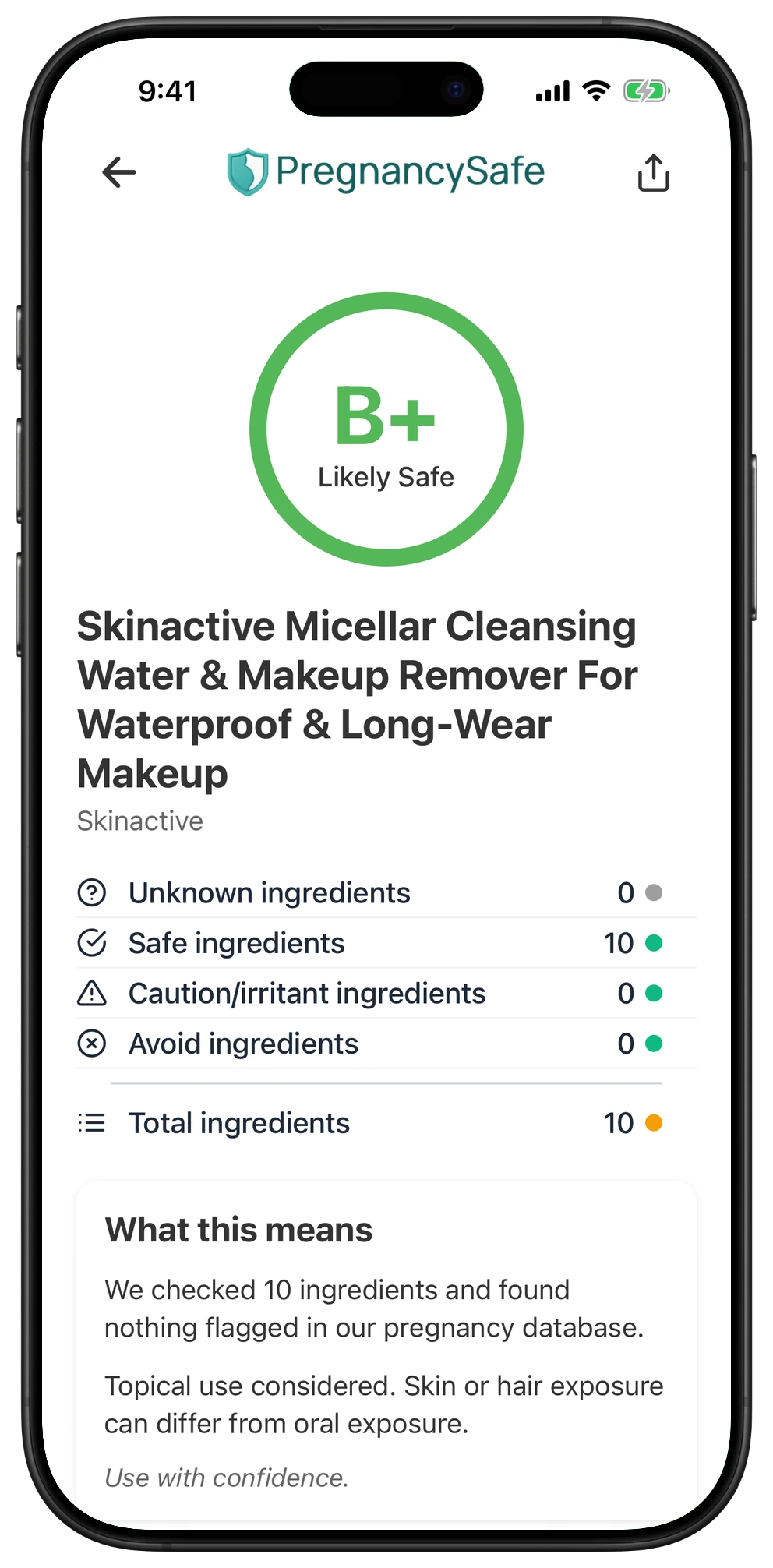
| B+ | Skinactive Micellar Cleansing Water & Makeup Remover For Waterproof & Long-Wear Makeup | Skinactive |
| A | Garnier Skin Active Micellar Makeup Cleansing Water | Garnier |
| A | 365 Everyday Value Makeup Remover Cleansing Towelettes | 365 Everyday Value |
| A | Make-Up Remover Cleansing Bar - Bag | Swiss Toniq Geneva |
| B+ | Up&Up Face Makeup Remover | Up&Up |
Your Questions Answered
Can I use micellar water while pregnant?
A micellar water can be an option for makeup removal during pregnancy, but check its exact formula and intended use. Plain cleansing water is not necessarily an exfoliating acid product, and similarly named versions can differ across countries. Follow the bottle's directions and avoid harsh rubbing. A listed product is not a guarantee for every regional version or future reformulation.
What cosmetics should be avoided during pregnancy?
For makeup removers, do not treat every preservative, fragrance ingredient or low catalog grade as evidence of fetal harm. Avoid ingredients that cause you an allergic reaction, and use only products intended for the face or eye area. A remover with added acne treatment or exfoliating ingredients needs consideration beyond its cleansing function. Ask your clinician about those active ingredients rather than assuming a makeup remover label settles their suitability.
Are makeup remover wipes safer than cleansing balms or oils?
The format alone does not establish pregnancy safety. Compare the exact ingredients, intended application area and directions rather than assuming a wipe, balm or oil is inherently safer. For wipes, avoid repeated harsh rubbing; for balms and oils, follow any rinse off instructions. Stop using a product that causes irritation.
Should I avoid phenoxyethanol in makeup remover?
Phenoxyethanol is a preservative, and its presence alone is not a reason to avoid a makeup remover during pregnancy. Direct pregnancy outcome data are limited, but cosmetic safety reviews consider it acceptable at typical permitted concentrations. High dose animal evidence does not represent ordinary facial application. Concerns about infant ingestion from nipple area products during nursing are a different exposure from removing makeup.
Does an A grade mean a makeup remover is verified pregnancy safe?
No. Our catalog contains 8 A grade makeup removers, but those are ingredient scores, not 8 independently verified pregnancy safe products. Grades do not establish current label completeness or provide independent contaminant testing. A lower grade also does not automatically mean a product is harmful; check the exact formula, exposure and qualifications.
Is natural or botanical makeup remover a better choice?
Natural labeling does not certify pregnancy safety or prevent allergic reactions. For example, chamomilla recutita flower extract is a chamomile ingredient with inadequate direct pregnancy evidence for topical cosmetic use and a known potential for allergy. A diluted cosmetic extract should not be equated with an oral herbal preparation or concentrated essential oil. Choose based on the actual formula and your skin's tolerance, not the natural claim.
How Do We Score Products for Pregnancy Safety?
We analyze each product's ingredients and category to flag known risks and provide cautionary notices for general category safety concerns.
Grades reflect the ingredient and category information available to us. They don’t verify a complete, current label or account for dose, preparation, or contamination. Read them alongside the guidance above, not as a guarantee of pregnancy safety or proof that every use is harmful.
A - Safe
Excellent choice! All ingredients are considered safe during pregnancy.
What to do: Use with confidence.
B - Likely Safe
Pretty much safe with very minimal risk. Some ingredients may have limited pregnancy studies, but no significant safety concerns have been identified.
What to do: Use with confidence.
C - Limit
Contains ingredients with some pregnancy considerations. Research shows these ingredients may have limited safety data, potential for minor hormonal effects, or require caution based on animal studies.
What to do: Use sparingly and consider safer alternatives when available.
D - Caution
Similar to C grade but contains multiple cautionary ingredients. The combination increases overall concern.
What to do: Try to avoid if that makes you feel better. If you've already used it, no need to panic.
F - Avoid
Contains an ingredient Pregnancy Safe recommends avoiding during pregnancy. This may reflect an established risk or a precaution based on limited evidence; check the ingredient guidance and exposure context.
What to do: Do not use during pregnancy. If you've already used it, don't worry - contact your OBGYN if concerned.
People Also Checked
References
- https://www.fda.gov/cosmetics/resources-consumers-cosmetics/cosmetics-pregnancy
- https://www.aad.org/public/everyday-care/skin-care-secrets/routine/pregnancy-skin-care
- https://health.ec.europa.eu/system/files/2021-08/sccs_o_195_0.pdf
- https://ec.europa.eu/growth/tools-databases/cosing/details/28157
- https://journals.sagepub.com/doi/10.3109/10915819009078737
- https://link.springer.com/article/10.1007/s00204-024-03938-5
- https://www.sfda.gov.sa/en/warnings/1156
- https://www.industrialchemicals.gov.au/sites/default/files/Ethanol%2C%202-phenoxy-_Human%20health%20tier%20II%20assessment.pdf
- https://hero.epa.gov/reference/2857875
- https://books.publisso.de/sites/default/files/documents/series/mak/dam/Vol2019/Iss1/Alt006/mb12299kske6319_w.pdf
- https://www.fda.gov/cosmetics/cosmetic-ingredients/fragrances-cosmetics
- https://www.fda.gov/cosmetics/cosmetic-ingredients/phthalates-cosmetics
- https://www.fda.gov/cosmetics/cosmetic-ingredients/allergens-cosmetics
- https://pmc.ncbi.nlm.nih.gov/articles/PMC3110684/
- https://pmc.ncbi.nlm.nih.gov/articles/PMC4016195/
- https://pmc.ncbi.nlm.nih.gov/articles/PMC4097177/
- https://pmc.ncbi.nlm.nih.gov/articles/PMC8453372/
- https://pmc.ncbi.nlm.nih.gov/articles/PMC10999525/
- https://www.epa.gov/indoor-air-quality-iaq/volatile-organic-compounds-impact-indoor-air-quality
- https://www.fda.gov/cosmetics/cosmetic-ingredients/parabens-cosmetics
- https://health.ec.europa.eu/system/files/2023-12/sccs_o_276_final.pdf
- https://pubmed.ncbi.nlm.nih.gov/19101832/
- https://pubmed.ncbi.nlm.nih.gov/32283359/
- https://pubmed.ncbi.nlm.nih.gov/33477047/
- https://pubmed.ncbi.nlm.nih.gov/36709902/
- https://pubmed.ncbi.nlm.nih.gov/40117576/
- https://pubmed.ncbi.nlm.nih.gov/27156397/
- https://www.nccih.nih.gov/health/chamomile
- https://www.ema.europa.eu/en/documents/herbal-monograph/final-european-union-herbal-monograph-matricaria-recutita-l-flos-first-version_en.pdf
- https://www.ema.europa.eu/en/documents/herbal-monograph/final-community-herbal-monograph-chamaemelum-nobile-l-all-flos_en.pdf
- https://journals.sagepub.com/doi/10.1177/1091581818801814
- https://journals.sagepub.com/doi/10.1177/1091581817705620
- https://pubmed.ncbi.nlm.nih.gov/40314057/
- https://pubmed.ncbi.nlm.nih.gov/40374153/
- https://npic.orst.edu/factsheets/quats.html
- https://www.ema.europa.eu/en/documents/scientific-guideline/questions-and-answers-benzalkonium-chloride-context-revision-guideline-excipients-label-and-package-leaflet-medicinal-products-human-use_en.pdf
- https://www.mountsinai.org/files/MSHealth/Assets/HS/Patient-Care/Service-Areas/Occupational-Medicine/QACsInfoforPhysicians_18.pdf
- https://pubmed.ncbi.nlm.nih.gov/33749149/
- https://pubmed.ncbi.nlm.nih.gov/28618200/
- https://pubmed.ncbi.nlm.nih.gov/25483128/
- https://rwandafda.gov.rw/wp-content/uploads/2024/08/Pharmatex_18%209_mg%20pessaries_Benzalkonium%20Chloride_SmPC.pdf
- https://health.ec.europa.eu/system/files/2022-08/sccs_o_257.pdf
- https://pubmed.ncbi.nlm.nih.gov/37751543/
- https://pubmed.ncbi.nlm.nih.gov/12396675/
- https://pmc.ncbi.nlm.nih.gov/articles/PMC13151845/
- https://www.ecfr.gov/current/title-21/chapter-I/subchapter-B/part-172/subpart-B/section-172.115
- https://www.ecfr.gov/current/title-21/chapter-I/subchapter-B/part-182/subpart-D/section-182.3173
- https://www.fda.gov/news-events/press-announcements/fda-finalizes-food-chemical-safety-post-market-assessment-program-launches-reassessment-bht-ada
- https://journals.sagepub.com/doi/pdf/10.3109/10915819009078735?download=true
- https://ec.europa.eu/health/archive/ph_risk/committees/sccp/documents/out188_en.pdf
- https://www.industrialchemicals.gov.au/sites/default/files/Formaldehyde%20donors_Human%20health%20tier%20II%20assessment.pdf
- https://pubmed.ncbi.nlm.nih.gov/21309789/
- https://www.cdc.gov/niosh/reproductive-health/prevention/formaldehyde.html
- https://uktis.org/monographs/exposure-to-formaldehyde-in-pregnancy/
- https://pmc.ncbi.nlm.nih.gov/articles/PMC3203331/
- https://www.atsdr.cdc.gov/toxprofiles/tp111.pdf
- https://eur-lex.europa.eu/legal-content/EN/TXT/PDF/?uri=CELEX%3A32022R1181
- https://journals.sagepub.com/doi/pdf/10.3109/10915818809023133
- https://pubmed.ncbi.nlm.nih.gov/37177794/
- https://ec.europa.eu/growth/tools-databases/cosing/reference/annexes/list/V
- https://eur-lex.europa.eu/eli/reg/2022/1181/oj/eng
- https://health.ec.europa.eu/system/files/2022-08/sccs_o_254.pdf