Is Sodium Benzoate Safe During Pregnancy?
Updated September 14, 2026
The Answer
Sodium benzoate is likely safe during pregnancy at regulated preservative levels in foods, drinks, and cosmetics used on your skin. Normal food and topical exposure is generally low concern, although direct human pregnancy data are limited.
Some beverages containing benzoate salts plus vitamin C or erythorbic acid can form benzene, especially with heat or light exposure; this is a product specific concern, not a warning about every use of sodium benzoate.
FDA food rules, JECFA and EFSA dietary assessments, and cosmetic safety reviews support low level preservative use, but direct human pregnancy data remain limited.
Pregnancy Safe is 100% independent and research driven. No companies pay to promote or sponsor products.
Stressless Pregnancy
Check your exact product with sodium benzoate in the app

What Is Sodium Benzoate?
You may also see it listed as: E211, INS 211, benzoic acid sodium salt
Sodium benzoate is the sodium salt of benzoic acid, used as a preservative to inhibit bacteria, yeast, and molds. You may encounter it in acidic foods and drinks, including sodas, sauces, and pickles, as well as shampoos, body washes, cleansers, and moisturizers.
What Other Ingredients Should You Look Out for in Products With Sodium Benzoate?
A product's full ingredient list determines whether it's pregnancy-safe or not. These ingredients also appear in some of the sodium benzoate products we analyzed and may deserve a closer look.
Butylphenyl Methylpropional
AvoidLook for butylphenyl methylpropional, also called Lilial, in scented hair and skin products: regulatory reproductive toxicity concerns are based largely on animal evidence, and the EU prohibits it in cosmetics. Check leave on and frequently used products in particular, and choose products without this listed fragrance during pregnancy.
Flagged in 231 products (0.9%) in this analysis.
High Fructose Corn Syrup
CautionHigh fructose corn syrup or HFCS identifies added sugar in drinks, sauces, baked goods, and some supplements. Check added sugars per serving and how often you consume them; the concern is frequent high intake and overall nutrition, not occasional exposure causing birth defects.
Flagged in 4,080 products (16.6%) in this analysis.
Does the Form or Amount of Sodium Benzoate Matter During Pregnancy?
The low concern conclusion applies to normal food exposure and cosmetic use at assessed preservative concentrations, not high dose experimental exposure. FDA food rules permit use under good manufacturing practice, with a typical maximum of 0.1%; that is a food formulation level, not a personal daily intake target. High dose animal or experimental findings should not be extrapolated to usual consumer exposure.
What Products Contain Sodium Benzoate?
Pregnancy Safe has looked at 24,631 products that have sodium benzoate as an ingredient. The category and grade breakdowns below use 24,631 products with an exact ingredient match.
What Types of Products Contain Sodium Benzoate?
Products You May Have That Contain Sodium Benzoate
| Grade | Product | Brand | Type |
|---|---|---|---|
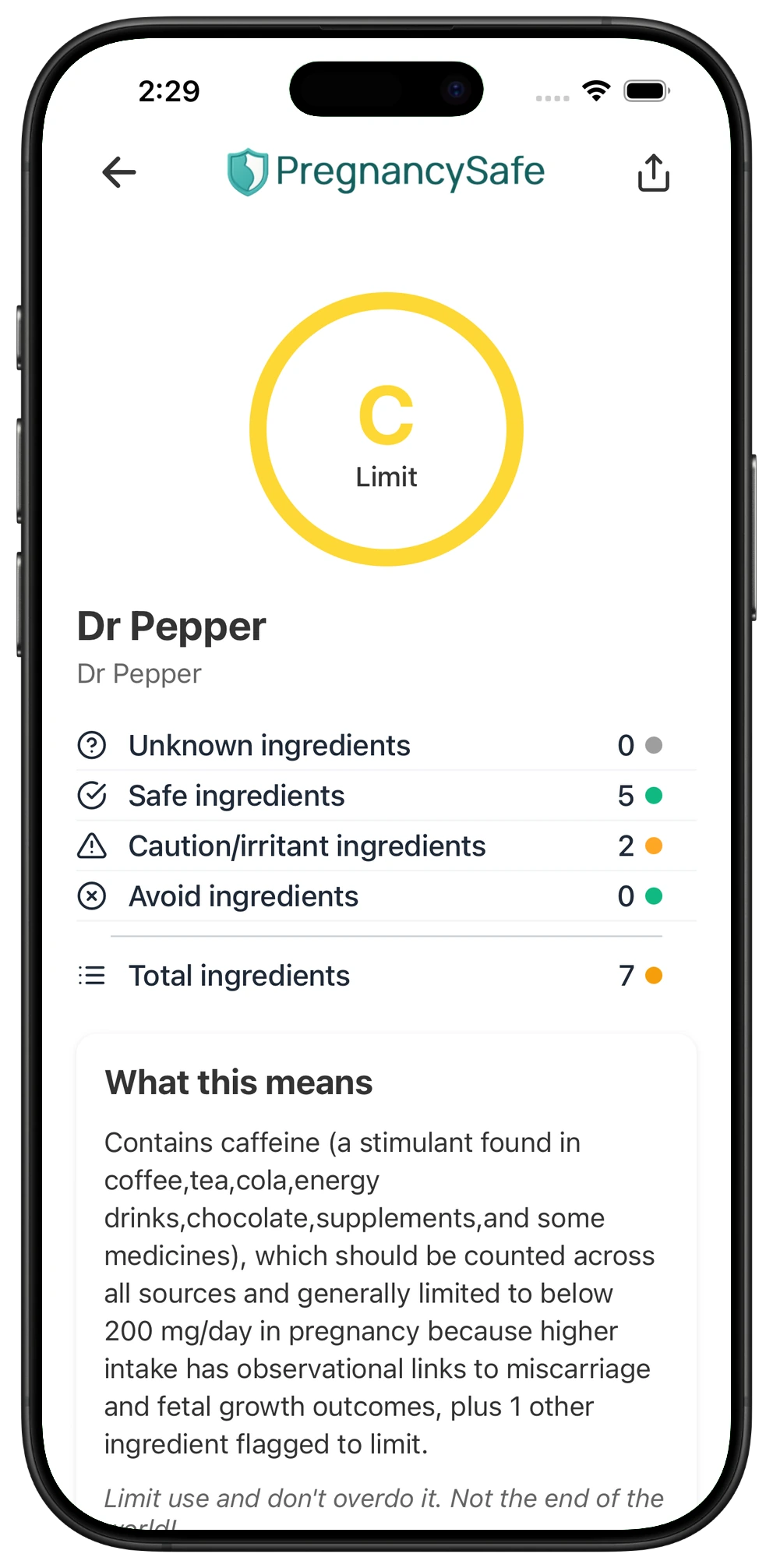
| C | Dr Pepper | Dr Pepper | Soft Drink |
| C+ | Ginger Ale | Canada Dry | Soft Drink |
| B+ | Cetaphil Gentle Skin Cleanser | Cetaphil | Skin Cleanser |
| B+ | Cetaphil Moisturizing Lotion | Cetaphil | Moisturizer |
| C+ | Palmers Cocoa Butter Formula Massage Lotion For Stretch Marks - 8.5 Fl Oz | Palmer'S | Body Lotion |
| C | Revealer Concealer | Kosas | Concealer |
| C | Dove Beauty Sensitive Skin Body Wash Pump 24Hr Lotion-Soft Skin | — | Body Wash |
| C | Dove Sensitive Skin Body Wash Gentle Hypoallergenic Formula 24Hr Lotion-Soft Skin - 20 Fl Oz | Dove Beauty | Unknown |
How Do Products Containing Sodium Benzoate Score?
It can be helpful to see how products containing sodium benzoate generally score during pregnancy. This does not tell you whether your exact product is safe, but it gives you a general idea of what we found. In this breakdown of 24,631 products, 60% receive a C grade. A C grade means the complete formula has some pregnancy considerations, so use it sparingly and consider a higher scoring alternative when one is available.
Frequently Asked Questions About Sodium Benzoate During Pregnancy
Can I use skin care containing sodium benzoate?
Sodium benzoate itself is generally low concern at assessed cosmetic preservative concentrations during pregnancy. That does not establish the safety of the whole formula, so check the other ingredients too.
What should I check on a drink containing sodium benzoate?
Check whether it also contains vitamin C or erythorbic acid. Some beverages with this combination can form benzene, especially with heat or light exposure; the ingredient list alone does not establish that benzene has formed.
Does sodium benzoate cause pregnancy complications or side effects?
Direct human pregnancy data are limited, so the available evidence cannot reliably identify pregnancy specific side effects. High dose animal or experimental findings should not be treated as proof of harm from normal food or cosmetic exposure.
Does the advice change in the second or third trimester?
The available evidence does not establish a different sodium benzoate recommendation by trimester. The relevant distinction remains normal regulated preservative exposure versus higher dose exposure or a beverage specific benzene concern.
Are E211 and INS 211 the same as sodium benzoate?
Yes. E211 and INS 211 are label names for sodium benzoate, not different preservatives.
Why do products containing sodium benzoate have different grades?
A product grade reflects its complete formula, not sodium benzoate alone. Two products containing this preservative can have different grades because their other ingredients differ.
How Do We Score Products for Pregnancy Safety?
We analyze each product's ingredients and category to flag known risks and provide cautionary notices for general category safety concerns.
A - Safe
Excellent choice! All ingredients are considered safe during pregnancy.
What to do: Use with confidence.
B - Likely Safe
Pretty much safe with very minimal risk. Some ingredients may have limited pregnancy studies, but no significant safety concerns have been identified.
What to do: Use with confidence.
C - Limit
Contains ingredients with some pregnancy considerations. Research shows these ingredients may have limited safety data, potential for minor hormonal effects, or require caution based on animal studies.
What to do: Use sparingly and consider safer alternatives when available.
D - Caution
Similar to C grade but contains multiple cautionary ingredients. The combination increases overall concern.
What to do: Try to avoid if that makes you feel better. If you've already used it, no need to panic.
F - Avoid
Contains an ingredient Pregnancy Safe recommends avoiding during pregnancy. This may reflect an established risk or a precaution based on limited evidence; check the ingredient guidance and exposure context.
What to do: Do not use during pregnancy. If you've already used it, don't worry - contact your OBGYN if concerned.
Sources
- https://apps.who.int/food-additives-contaminants-jecfa-database/Home/Chemical/1098
- https://ec.europa.eu/health/ph_risk/committees/04_sccp/docs/sccp_o_015.pdf
- https://efsa.onlinelibrary.wiley.com/doi/10.2903/j.efsa.2016.4433
- https://pubmed.ncbi.nlm.nih.gov/29243541/
- https://www.ecfr.gov/current/title-21/chapter-I/subchapter-B/part-184/subpart-B/section-184.1733
- https://www.fda.gov/food/environmental-contaminants-food/questions-and-answers-occurrence-benzene-soft-drinks-and-other-beverages
- https://www.inchem.org/documents/jecfa/jecmono/v83je01.pdf
- https://www.canada.ca/en/health-canada/services/chemicals-product-safety/lilial.html
- https://www.canada.ca/en/environment-climate-change/services/evaluating-existing-substances/draft-assessment-phenylpropanoids-aldehydes-group.html
- https://health.ec.europa.eu/publications/safety-butylphenyl-methylpropional-p-bmhca-cosmetic-products-submission-ii_en
- https://eur-lex.europa.eu/legal-content/EN/TXT/PDF/?uri=CELEX%3A32021R1902
- https://chem.echa.europa.eu/100.001.173/harmonised/113759
- https://chem.echa.europa.eu/obligation-lists/candidateList
- https://pubmed.ncbi.nlm.nih.gov/32461162/
- https://cdn.realfood.gov/DGA.pdf
- https://www.dietaryguidelines.gov/sites/default/files/2021-12/DGA_Pregnancy_FactSheet-508c.pdf
- https://www.acog.org/womens-health/faqs/healthy-eating-during-pregnancy
- https://www.cdc.gov/nutrition/php/data-research/added-sugars.html
- https://www.cdc.gov/diabetes/about/gestational-diabetes.html
- https://www.who.int/publications/i/item/9789241549028
- https://nesr.usda.gov/2025-dietary-guidelines-advisory-committee-systematic-reviews/dietary-patterns_gestational-diabetes