Is Philadelphia Original Cream Cheese Spread Safe During Pregnancy? (Updated 2026 Guide)
Updated September 9, 2026
Philadelphia Original Cream Cheese Spread
Philadelphia
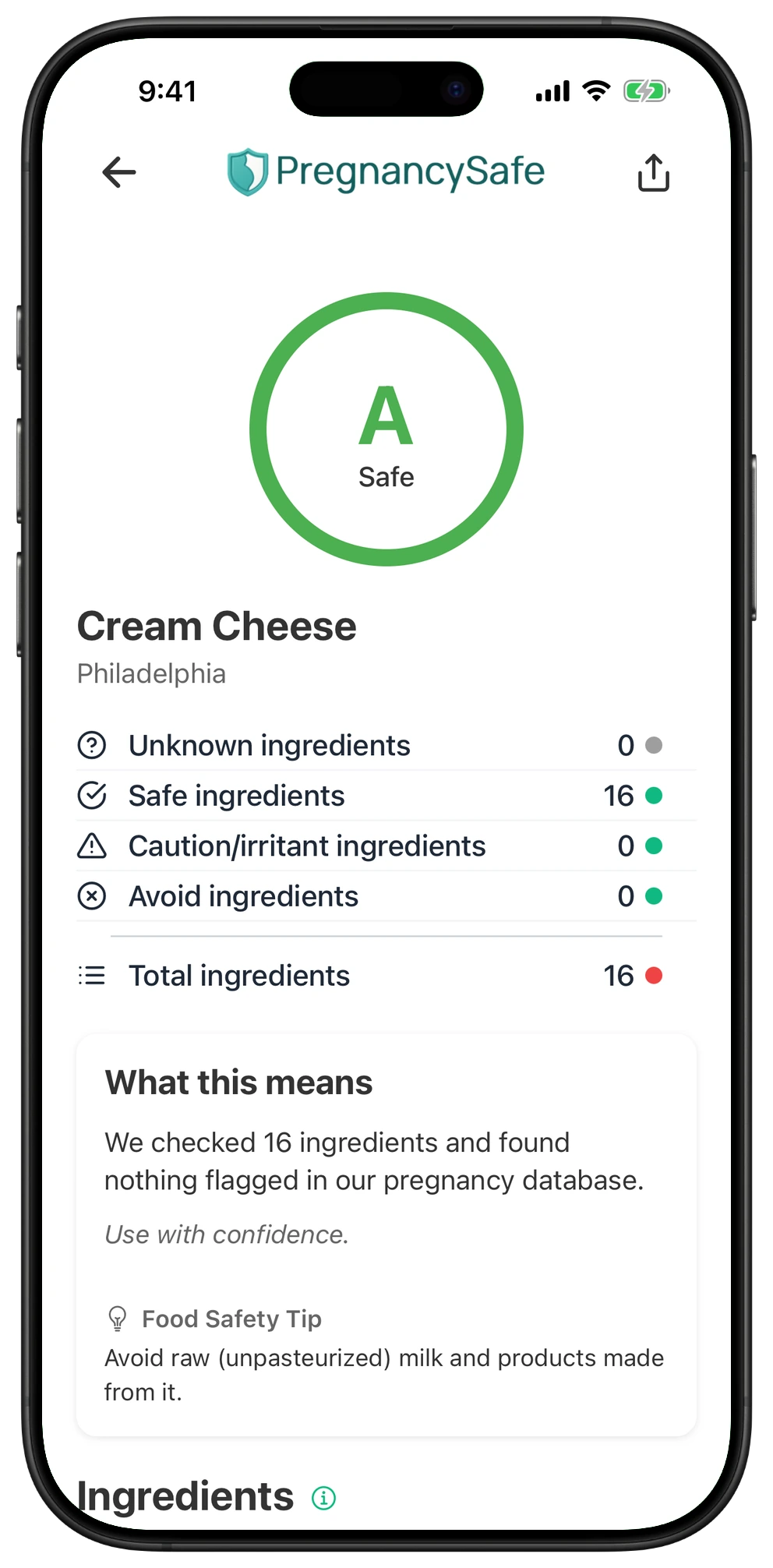
Yes Philadelphia Original Cream Cheese Spread is generally safe to eat during pregnancy in normal food portions when refrigerated and properly handled. It receives an A grade under ingredient based scoring, with pasteurized milk and cream and no flagged ingredients; this does not guarantee protection against contamination or recalls.
Go ahead and use it. Nothing to worry about here.
Pregnancy Safe is 100% independent and research driven. No companies pay to promote or sponsor products.
Stress Less This Pregnancy
Check your cream cheese in the app

What Ingredients Are in Philadelphia Original Cream Cheese Spread?
Philadelphia Original Cream Cheese Spread has 4 ingredients. All 4 ingredients are considered safe for pregnancy.
cheese culture
SAFE
Cheese culture is a collection of beneficial bacteria used to ferment milk and develop the flavor, texture, and characteristic qualities of cheese. Cheese culture in this pasteurized dairy spread is compatible with pregnancy in normal food portions, provided the product is properly handled.
pasteurized milk and cream
SAFE
A rich, smooth blend of pasteurized milk and cream, offering a creamy dairy flavor perfect for cooking and baking. Pasteurized milk and cream are generally compatible with pregnancy in normal food portions, though pasteurization does not remove the need for safe storage and handling.
salt
SAFE
Salt is a mineral essential for flavor enhancement and preserving food. Salt is compatible with pregnancy in normal dietary amounts, but your overall sodium intake may need individualized guidance if you have hypertension or kidney disease.
guar gum
SAFE
Guar gum is a natural thickening and stabilizing agent derived from the guar bean, commonly used in food and industrial applications. Guar gum is an unflagged food thickener in this spread, but no pregnancy specific evidence is available here to establish its safety independently.
Answering Your Questions
How much Philadelphia Original Cream Cheese Spread is safe during pregnancy?
Use the serving size on your tub as a practical starting point, rather than a pregnancy specific limit. Spread a modest amount on bread or crackers, and consider the sodium listed on the label alongside the rest of your meal.
Can you use Philadelphia Original Cream Cheese Spread daily while pregnant?
You can include it regularly as part of a varied diet; there is no specific pregnancy frequency limit established here. Keep it refrigerated and follow the package's use by and after opening instructions.
Why does Philadelphia Original Cream Cheese Spread receive an A grade?
Its A grade comes from ingredient based scoring with no flagged ingredients. The pasteurized dairy ingredients and normal dietary amounts of salt are compatible with pregnancy; guar gum is unflagged, which is not the same as having pregnancy specific safety evidence. The grade does not assess the storage history or contamination status of your tub.
Is Philadelphia Original Cream Cheese Spread pasteurized?
Yes, this Original Cream Cheese Spread lists pasteurized milk and cream. Check your own package when buying a different variant or a product from another country rather than assuming every Philadelphia product has the same formulation.
Can I eat it cold, or does it need cooking during pregnancy?
You can eat properly refrigerated pasteurized cream cheese cold; it does not need cooking simply because you are pregnant. NHS guidance specifically includes pasteurized cream cheese among cheeses you can eat during pregnancy. NHS
How should I store it during pregnancy?
Keep the tub refrigerated, use clean utensils, and follow its storage and after opening instructions. Do not eat recalled cream cheese or a tub that has been improperly stored, even if it was made with pasteurized milk.
Can I eat Philadelphia cream cheese while breastfeeding?
Generally, yes cream cheese can fit into a varied breastfeeding diet, and breastfeeding alone is not a reason to avoid dairy. Follow any individualized advice you have been given about dairy avoidance. NHS breastfeeding diet
What alternatives can I choose during pregnancy?
You do not need to switch solely because of pregnancy. If you prefer another option, look for a clearly labeled pasteurized cream cheese or pasteurized cottage cheese, and follow its storage instructions. Both types are included in NHS pregnancy guidance. NHS
What Are Pregnancy Safe Alternatives to Philadelphia Original Cream Cheese Spread?
Here are some solid alternatives. Everything below has an A or B grade, meaning no flagged ingredients in our database.
| Grade | Product | Brand | Type |
|---|---|---|---|
| A | Cream Cheese | Philadelphia | cream cheese |
| A | Philadelphia Original Cream Cheese Spread- 8Oz | Philadelphia | cream cheese |
| A | Happy Farms Whipped Cream Cheese Spread 8 Oz | Happy Farms | cream cheese |
| A | Whipped Cream Cheese Spread | Kroger | cream cheese |
Are Other Philadelphia Products Safe During Pregnancy?
Yep! All 10 other Philadelphia products we looked at are safe (A or B grades).
| Grade | Product | Type |
|---|---|---|
| A | Cheesecake | cheesecake |
| A | Chive & Onion Mashed Potatoes, Chive & Onion | mashed potatoes |
| B+ | Cheesecake Cup | dessert |
| B+ | Cracked Pepper & Olive Oil Cream Cheese Spread, Cracked Pepper & Olive Oil | cream cheese |
How Does Philadelphia Original Cream Cheese Spread Compare to Other Cream Cheeses?
We graded 872 Cream Cheeses for pregnancy safety. Here's how they stack up:
Philadelphia Original Cream Cheese Spread earns a A grade, placing it among the majority of Cream Cheeses. About 94% of products in this category get an A or B grade.
How Do We Score Products for Pregnancy Safety?
We analyze each product's ingredients and category to flag known risks and provide cautionary notices for general category safety concerns.
A - Safe
Excellent choice! All ingredients are considered safe during pregnancy.
What to do: Use with confidence.
B - Likely Safe
Pretty much safe with very minimal risk. Some ingredients may have limited pregnancy studies, but no significant safety concerns have been identified.
What to do: Use with confidence.
C - Limit
Contains ingredients with some pregnancy considerations. Research shows these ingredients may have limited safety data, potential for minor hormonal effects, or require caution based on animal studies.
What to do: Use sparingly and consider safer alternatives when available.
D - Caution
Similar to C grade but contains multiple cautionary ingredients. The combination increases overall concern.
What to do: Try to avoid if that makes you feel better. If you've already used it, no need to panic.
F - Avoid
Contains an ingredient Pregnancy Safe recommends avoiding during pregnancy. This may reflect an established risk or a precaution based on limited evidence; check the ingredient guidance and exposure context.
What to do: Do not use during pregnancy. If you've already used it, don't worry - contact your OBGYN if concerned.
People Also Checked
Cheetos Crunchy Flamin' Hot Cheese Flavored Snacks
Cheetos
Tropicana Pure Premium No Pulp Orange Juice with Calcium and Vitamin D
Tropicana
Cetaphil Gentle Skin Cleanser - Travel Size
Cetaphil
Miralax Polyethylene Glycol 3350 Laxative Powder Unflavored
Miralax
Premier Protein High Protein Shake, Chocolate
Premier Protein
References
- https://www.acog.org/womens-health/faqs/healthy-eating-during-pregnancy
- https://www.cdc.gov/food-safety/foods/pregnant-women.html
- https://www.fda.gov/food/people-risk-foodborne-illness/food-safety-moms-be
- https://www.fda.gov/food/health-educators/listeria-food-safety-moms-be
- https://www.foodsafety.gov/people-at-risk/pregnant-women
- https://www.acog.org/womens-health/faqs/listeria-and-pregnancy
- https://www.fda.gov/food/people-risk-foodborne-illness/dietary-advice-and-during-pregnancy
- https://www.fda.gov/food/buy-store-serve-safe-food/dangers-raw-milk-unpasteurized-milk-can-pose-serious-health-risk
- https://www.fda.gov/food/buy-store-serve-safe-food/raw-milk-misconceptions-and-danger-raw-milk-consumption
- https://pmc.ncbi.nlm.nih.gov/articles/PMC11270530/
- https://pmc.ncbi.nlm.nih.gov/articles/PMC6946899/
- https://www.who.int/publications/i/item/9789241504836
- https://www.ncbi.nlm.nih.gov/books/NBK610895/