Is Greek Yogurt Safe During Pregnancy? (Updated 2026 Guide)
Updated September 9, 2026
The Answer
Yes Greek yogurt made with pasteurized milk and kept properly refrigerated is suitable during pregnancy. Avoid yogurt made with raw milk; pasteurization and safe handling matter more than a catalog grade.
The main pregnancy consideration is foodborne illness from unpasteurized dairy or unsafe storage, not ordinary live yogurt cultures. Choose pasteurized milk yogurt, check that packaging is intact, and keep it at 40°F/4°C or colder. Rare specialty ingredients need dose specific interpretation: concerns about concentrated herbal supplements or high dose animal exposures do not establish harm from ordinary yogurt servings.
Pregnancy Safe is 100% independent and research driven. No companies pay to promote or sponsor products.
Stress Less This Pregnancy
Check your exact greek yogurt in the app

✓ What's Safe
- • Check the label for pasteurized milk; ask the manufacturer if the wording is unclear.
- • Choose refrigerated yogurt with intact packaging and an undamaged seal.
- • Keep yogurt at 40°F/4°C or colder, including during transport when needed.
- • Follow the package’s storage and after opening instructions.
- • Check the actual formulation for your milk allergy or any clinician directed dietary restrictions, rather than relying on a grade.
✗ What to Avoid
- • Avoid Greek yogurt made with raw or unpasteurized milk.
- • Do not eat yogurt left unrefrigerated for more than two hours, or more than one hour above 90°F.
- • Avoid containers with broken seals or damaged packaging.
- • Do not eat recalled yogurt, even if its catalog grade is high.
- • Do not add medicinal dose fenugreek or concentrated fennel preparations to yogurt without clinician guidance; ordinary seasoning amounts are a different exposure.
Most Common Ingredients in Greek Yogurt Products
We analyzed 1,740 greek yogurt products. Here are the most common ingredients, ranked by how often they appear:
Ingredients to Watch Out For in Greek Yogurt
These are the most common flagged ingredients across 1,740 greek yogurt products we analyzed.
blue 1
Caution
Blue 1 is a synthetic blue dye commonly used to add vibrant color to foods, beverages, and cosmetics.
Has limited human pregnancy data; regulated food use is not shown to cause fetal harm, but high dose animal neurobehavior findings and child sensitivity concerns support minimizing frequent exposure.
Flagged in 4 of 1,740 products (0%)
elderberry juice concentrate
Caution
Elderberry juice concentrate is a potent extract rich in antioxidants and vitamins, commonly used to support immune health and boost overall wellness.
Has little pregnancy specific safety data for supplement doses and can be toxic if raw, unripe, or made with leaves, stems, bark, or roots.
Flagged in 4 of 1,740 products (0%)
bacillus coagulans gbi 30 6086
Caution
Has strain specific safety with limited pregnancy specific data and includes species that can cause foodborne illness or carry toxin genes.
Flagged in 3 of 1,740 products (0%)
artificial color
Caution
Artificial color is a synthetic dye added to foods and products to enhance or alter their visual appearance.
Has limited pregnancy specific outcome data; regulated incidental exposure is generally low concern but some dyes have child behavior allergy or regulatory caveats.
Flagged in 2 of 1,740 products (0%)
Caution
Fennel seed is a aromatic spice with a sweet, licorice like flavor commonly used to enhance savory dishes and digestive remedies.
Is generally low concern at normal culinary amounts but should be avoided as concentrated medicinal tea, essential oil, or supplement during pregnancy because safety data are limited and estrogenic or uterine concerns exist.
Flagged in 2 of 1,740 products (0%)
fenugreek
Caution
Fenugreek is a versatile herb and spice known for its slightly bitter, nutty flavor and its use in both culinary dishes and traditional medicine.
Is generally lower concern in normal food amounts but medicinal doses are not recommended in pregnancy due to limited data plus uterine stimulant and reproductive toxicity signals.
Flagged in 2 of 1,740 products (0%)
hibiscus carrot juice concentrate
Caution
Has limited human pregnancy safety data; medicinal teas or supplements may lower blood pressure and uterine or menstrual effects are uncertain.
Flagged in 2 of 1,740 products (0%)
organic elderberry juice
Caution
Organic elderberry juice is a natural, antioxidant rich beverage made from concentrated, sustainably grown elderberries.
Has little pregnancy specific safety data for supplement doses and can be toxic if raw, unripe, or made with leaves, stems, bark, or roots.
Flagged in 2 of 1,740 products (0%)
Greek Yogurt Products We've Analyzed
Our catalog contains ratings for 1,740 greek yogurt products. These are database grades, not independent safety certifications.
These scores do not verify pasteurization, cold storage or microbiological safety. The main practical checks are pasteurized milk and safe handling, not the letter grade. Rare specialty products do not describe all Greek yogurt. 5 source-confirmed supplement powders were excluded from this food category.
Pregnancy Safe Greek Yogurt Products
Popular options from our catalog, prioritizing A and B ingredient grades, with C grade options used to fill remaining places. Within each group, products are ordered by searches in Pregnancy Safe, not retail sales. Read the cautions and guidance above; grades do not verify a complete current label or guarantee pregnancy safety.
| Grade | Product | Brand |
|---|---|---|
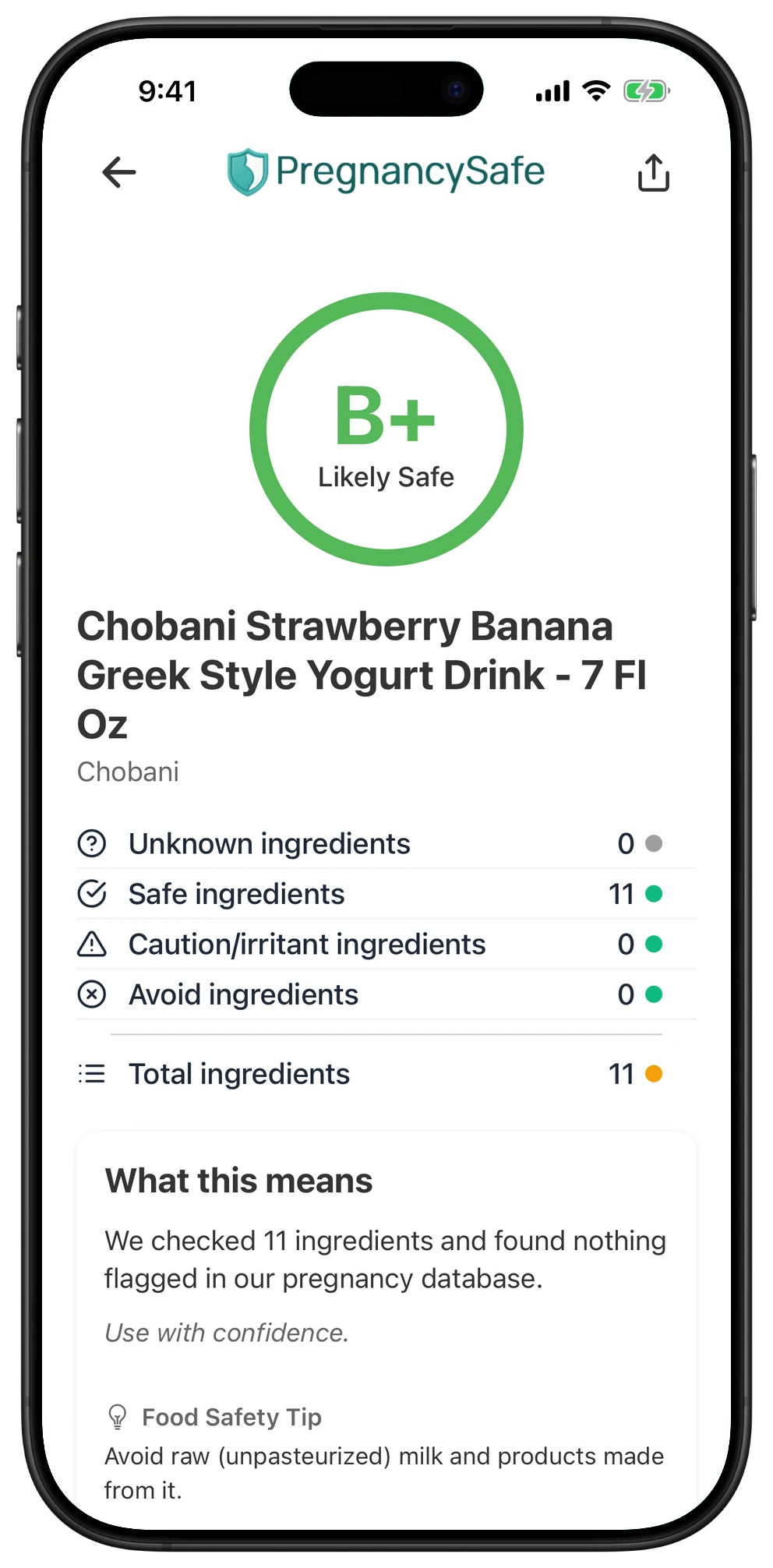
| B+ | Chobani Strawberry Banana Greek Style Yogurt Drink | Chobani |
| A | Greek Yogurt Protein Drink | Chobani |
| A | Oikos Triple Zero Vanilla Nonfat Greek Yogurt | Danone |
| B+ | Kirkland Signature Organic Greek Yogurt | Kirkland Signature |
| B+ | Chobani ""Flip"" S'More S'Mores Low-Fat Greek Yogurt | Chobani |
Your Questions Answered
Is Greek yogurt usually pasteurized?
Greek yogurt manufacturing commonly includes pasteurizing the milk before adding cultures. Still, check the specific label rather than assuming every product is pasteurized. If it only says cultured milk and you cannot confirm pasteurization, ask the manufacturer or choose one that states it clearly.
What food to avoid in the early weeks of pregnancy?
For yogurt and other dairy foods, avoid raw milk and products made from it from the start of pregnancy. Also avoid yogurt that has exceeded safe unrefrigerated storage times or is subject to a recall. Pasteurized Greek yogurt that has been handled safely does not need to be excluded simply because you are in the first trimester.
Are live cultures in Greek yogurt safe during pregnancy?
Ordinary live yogurt cultures are not a reason to avoid pasteurized Greek yogurt during pregnancy. Cultures can be added after milk is pasteurized, so live cultures do not mean the milk was raw. This does not establish that yogurt probiotics prevent pregnancy complications, and findings about ordinary cultures should not be extended to every high dose probiotic supplement.
How long can Greek yogurt stay out of the fridge?
Keep Greek yogurt refrigerated at 40°F/4°C or colder. Discard it if it has been unrefrigerated for more than two hours, or more than one hour when the temperature is above 90°F. These limits apply even when the yogurt was made with pasteurized milk.
Can I eat flavored or fruit Greek yogurt while pregnant?
Yes fruit or flavoring alone is not a reason to avoid Greek yogurt made with pasteurized milk and handled safely. If you prefer fewer nonessential dyes, choose versions without blue 1 or red 40; ordinary regulated food exposure has not been shown to cause fetal harm. Specialty herbal additions need separate consideration because evidence about medicinal or concentrated doses does not establish harm at yogurt serving amounts.
Does an A grade mean Greek yogurt is guaranteed safe during pregnancy?
No. Our catalog contains 1,740 products, including 871 with an A grade, but these are catalog scores rather than counts of independently verified pregnancy safe foods. A grade does not confirm pasteurization, refrigeration, recall status or absence of pathogens. A lower grade or incomplete record likewise does not prove that a yogurt is harmful.
How Do We Score Products for Pregnancy Safety?
We analyze each product's ingredients and category to flag known risks and provide cautionary notices for general category safety concerns.
Grades reflect the ingredient and category information available to us. They don’t verify a complete, current label or account for dose, preparation, or contamination. Read them alongside the guidance above, not as a guarantee of pregnancy safety or proof that every use is harmful.
A - Safe
Excellent choice! All ingredients are considered safe during pregnancy.
What to do: Use with confidence.
B - Likely Safe
Pretty much safe with very minimal risk. Some ingredients may have limited pregnancy studies, but no significant safety concerns have been identified.
What to do: Use with confidence.
C - Limit
Contains ingredients with some pregnancy considerations. Research shows these ingredients may have limited safety data, potential for minor hormonal effects, or require caution based on animal studies.
What to do: Use sparingly and consider safer alternatives when available.
D - Caution
Similar to C grade but contains multiple cautionary ingredients. The combination increases overall concern.
What to do: Try to avoid if that makes you feel better. If you've already used it, no need to panic.
F - Avoid
Contains an ingredient Pregnancy Safe recommends avoiding during pregnancy. This may reflect an established risk or a precaution based on limited evidence; check the ingredient guidance and exposure context.
What to do: Do not use during pregnancy. If you've already used it, don't worry - contact your OBGYN if concerned.
People Also Checked
Yogurt
6,185 products
Kefir
312 products
Cottage Cheese
1,036 products
Sour Cream
589 products
Feta Cheese
4 products
See our full guide to yogurt during pregnancy.
References
- https://www.cdc.gov/foodsafety/rawmilk/index.html
- https://www.nhs.uk/pregnancy/keeping-well/foods-to-avoid/
- https://www.cdc.gov/food-safety/foods/raw-milk.html
- https://www.fda.gov/food/food-additives-petitions/trans-fat
- https://www.hfpappexternal.fda.gov/scripts/fdcc/index.cfm?id=FDCBlue1&set=ColorAdditives
- https://www.ecfr.gov/current/title-21/chapter-I/subchapter-A/part-74
- https://www.fda.gov/food/color-additives-information-consumers/tracking-food-industry-pledges-remove-petroleum-based-food-dyes
- https://efsa.onlinelibrary.wiley.com/doi/10.2903/j.efsa.2010.1853
- https://apps.who.int/food-additives-contaminants-jecfa-database/Home/Chemical/3309
- https://pubmed.ncbi.nlm.nih.gov/23208798/
- https://pubmed.ncbi.nlm.nih.gov/24257113/
- https://oehha.ca.gov/risk-assessment/report/health-effects-assessment-potential-neurobehavioral-effects-synthetic-food-dyes-children
- https://www.nccih.nih.gov/health/elderberry
- https://pmc.ncbi.nlm.nih.gov/articles/PMC3941201/
- https://pmc.ncbi.nlm.nih.gov/articles/PMC8026097/
- https://pmc.ncbi.nlm.nih.gov/articles/PMC7961730/
- https://www.cdc.gov/mmwr/preview/mmwrhtml/00000311.htm
- https://www.fda.gov/food/information-consumers-using-dietary-supplements/questions-and-answers-dietary-supplements
- https://pubmed.ncbi.nlm.nih.gov/11518905/
- https://infantrisk.com/content/management-cold-and-flu-during-pregnancy
- https://pmc.ncbi.nlm.nih.gov/articles/PMC8308823/
- https://pmc.ncbi.nlm.nih.gov/articles/PMC5759212/
- https://pmc.ncbi.nlm.nih.gov/articles/PMC6811671/
- https://www.efsa.europa.eu/en/topics/topic/qualified-presumption-safety-qps
- https://www.fda.gov/files/food/published/GRAS-Notice-000660---Bacillus-coagulans-GBI-30--6086.pdf
- https://www.bccdc.ca/health-info/diseases-conditions/bacillus-cereus
- https://www.fda.gov/food/people-risk-foodborne-illness/food-safety-booklet-pregnant-women-their-unborn-babies-and-children-under-five
- https://www.fda.gov/food/color-additives-information-consumers/color-additives-questions-and-answers-consumers
- https://www.fda.gov/food/food-ingredients-packaging/color-additives-information-consumers
- https://www.fda.gov/cosmetics/cosmetic-ingredient-names/color-additives-permitted-use-cosmetics
- https://www.fda.gov/industry/color-additives/fdc-red-no-3
- https://pubmed.ncbi.nlm.nih.gov/35233072/
- https://pubmed.ncbi.nlm.nih.gov/35484553/
- https://pubmed.ncbi.nlm.nih.gov/35106984/
- https://hfpappexternal.fda.gov/scripts/fdcc/index.cfm?id=FENNELCOMMON&set=FoodSubstances
- https://www.ema.europa.eu/en/documents/herbal-monograph/final-european-union-herbal-monograph-foeniculum-vulgare-miller-subsp-vulgare-var-dulce-mill-batt-trab-fructus-revision-1_en.pdf
- https://webprod.hc-sc.gc.ca/nhpid-bdipsn/dbImages/mono_fennel-sweet_english.pdf
- https://www.swissmedic.ch/swissmedic/en/home/news/mitteilungen/fencheltee-fuer-schwangere-kinder-unter-4-jahren.html
- https://www.efsa.europa.eu/en/news/have-your-say-estragole-fennel-seed-preparations
- https://www.ncbi.nlm.nih.gov/books/NBK501793/
- https://pubmed.ncbi.nlm.nih.gov/30969204/
- https://pubmed.ncbi.nlm.nih.gov/32733750/
- https://pubmed.ncbi.nlm.nih.gov/23275017/
- https://www.utep.edu/herbal-safety/populations/herbs-to-avoid-during-pregnancy.html
- https://www.nccih.nih.gov/health/fenugreek
- https://www.ncbi.nlm.nih.gov/books/NBK501779/
- https://www.ema.europa.eu/en/documents/herbal-report/assessment-report-trigonella-foenum-graecum-l-semen-revision-1_en.pdf
- https://www.ema.europa.eu/en/documents/herbal-monograph/european-union-herbal-monograph-trigonella-foenum-graecum-l-semen-revision-1_en.pdf
- https://webprod.hc-sc.gc.ca/nhpid-bdipsn/dbImages/mono_fenugreek--oral_english.pdf
- https://pubmed.ncbi.nlm.nih.gov/32421208/
- https://pubmed.ncbi.nlm.nih.gov/27498339/
- https://pubmed.ncbi.nlm.nih.gov/33722213/
- https://mothertobaby.org/fact-sheets/herbal-products-pregnancy/
- https://www.ncbi.nlm.nih.gov/books/NBK501882/
- https://pubmed.ncbi.nlm.nih.gov/19434218/
- https://pubmed.ncbi.nlm.nih.gov/18066103/
- https://pmc.ncbi.nlm.nih.gov/articles/PMC9086798/
- https://www.nccih.nih.gov/health/hypertension-high-blood-pressure
- https://www.ffhdj.com/index.php/ffhd/article/view/1768
- https://www.hfpappexternal.fda.gov/scripts/fdcc/index.cfm?id=FDCRed40&set=ColorAdditives
- https://www.ecfr.gov/current/title-21/chapter-I/subchapter-A/part-74/subpart-A/section-74.340
- https://www.efsa.europa.eu/en/efsajournal/pub/1327
- https://www.efsa.europa.eu/en/efsajournal/pub/4007
- https://apps.who.int/food-additives-contaminants-jecfa-database/Home/Chemical/2361
- https://pubmed.ncbi.nlm.nih.gov/6636206/
- https://pubmed.ncbi.nlm.nih.gov/2613118/
- https://pubmed.ncbi.nlm.nih.gov/7940558/