Is Sour Cream Safe During Pregnancy? (Updated 2026 Guide)
Updated September 9, 2026
The Answer
Yes sour cream made with pasteurized dairy can be eaten during pregnancy when kept refrigerated and used according to label instructions. Avoid sour cream made with raw, unpasteurized milk or cream.
The main pregnancy consideration is pasteurization and safe storage, not whether sour cream contains live cultures or has a short ingredient list. Pasteurized sour cream is not sterile, and ingredient grades do not measure Listeria or handling risks. Ordinary food level vitamins and additives should not be equated with high dose supplements; the listed additive cautions do not establish that a normal serving causes pregnancy harm.
Pregnancy Safe is 100% independent and research driven. No companies pay to promote or sponsor products.
Stress Less This Pregnancy
Check your exact sour cream in the app

✓ What's Safe
- • Check the actual tub for confirmation that the milk or cream is pasteurized.
- • Choose sour cream that has been kept refrigerated, and maintain refrigeration at home.
- • Read the package's date and instructions for storage and use after opening.
- • Check the exact version's full label rather than relying on a brand name, ingredient grade or archived label.
- • When eating out, ask whether the sour cream uses pasteurized dairy and has been kept refrigerated.
✗ What to Avoid
- • Sour cream made from raw or unpasteurized milk or cream.
- • Eating sour cream when you cannot confirm its pasteurization or refrigerated storage.
- • Leaving the tub unrefrigerated between uses or disregarding its storage instructions.
- • Assuming that cultured, organic or a short ingredient list means pasteurized.
- • Using an A ingredient grade as proof that a tub is free from pathogens.
Most Common Ingredients in Sour Cream Products
We analyzed 589 sour cream products. Here are the most common ingredients, ranked by how often they appear:
Ingredients to Watch Out For in Sour Cream
These are the most common flagged ingredients across 589 sour cream products we analyzed.
artificial color
Caution
Artificial color is a synthetic dye added to foods and products to enhance or alter their visual appearance.
Has limited pregnancy specific outcome data; regulated incidental exposure is generally low concern but some dyes have child behavior allergy or regulatory caveats.
Flagged in 28 of 589 products (5%)
Caution
Red 40 is a synthetic food dye commonly used to add vibrant red color to candies, beverages, and processed foods.
Has limited human pregnancy data and is allowed at regulated food additive levels, but child neurobehavior concerns and high dose animal findings make frequent high dye intake worth limiting.
Flagged in 3 of 589 products (1%)
bht
Caution
BHT (butylated hydroxytoluene) is a synthetic antioxidant commonly used as a preservative to prevent the oxidation of fats and oils in food products.
Has limited human pregnancy data, with low concern at reviewed cosmetic levels but reproductive and thyroid related findings in high dose oral animal studies.
Flagged in 2 of 589 products (0%)
partially hydrogenated soybean oil
Caution
Partially hydrogenated soybean oil is a processed fat commonly used in foods to improve texture and shelf life, but it contains trans fats linked to health risks.
Mainly raise concern when partially hydrogenated and high in artificial trans fat; fully hydrogenated oils are mostly a saturated fat limit rather than the same trans fat issue.
Flagged in 2 of 589 products (0%)
Sour Cream Products We've Analyzed
Our catalog contains ratings for 589 sour cream products. These are database grades, not independent safety certifications.
Catalog ingredient grades do not measure current-label completeness, pathogens, preparation, caffeine or clinical pregnancy suitability. These counts include unreviewed records and are not a percentage of independently verified safe products.
Pregnancy Safe Sour Cream Products
Popular options from our catalog, prioritizing A and B ingredient grades, with C grade options used to fill remaining places. Within each group, products are ordered by searches in Pregnancy Safe, not retail sales. Read the cautions and guidance above; grades do not verify a complete current label or guarantee pregnancy safety.
| Grade | Product | Brand |
|---|---|---|
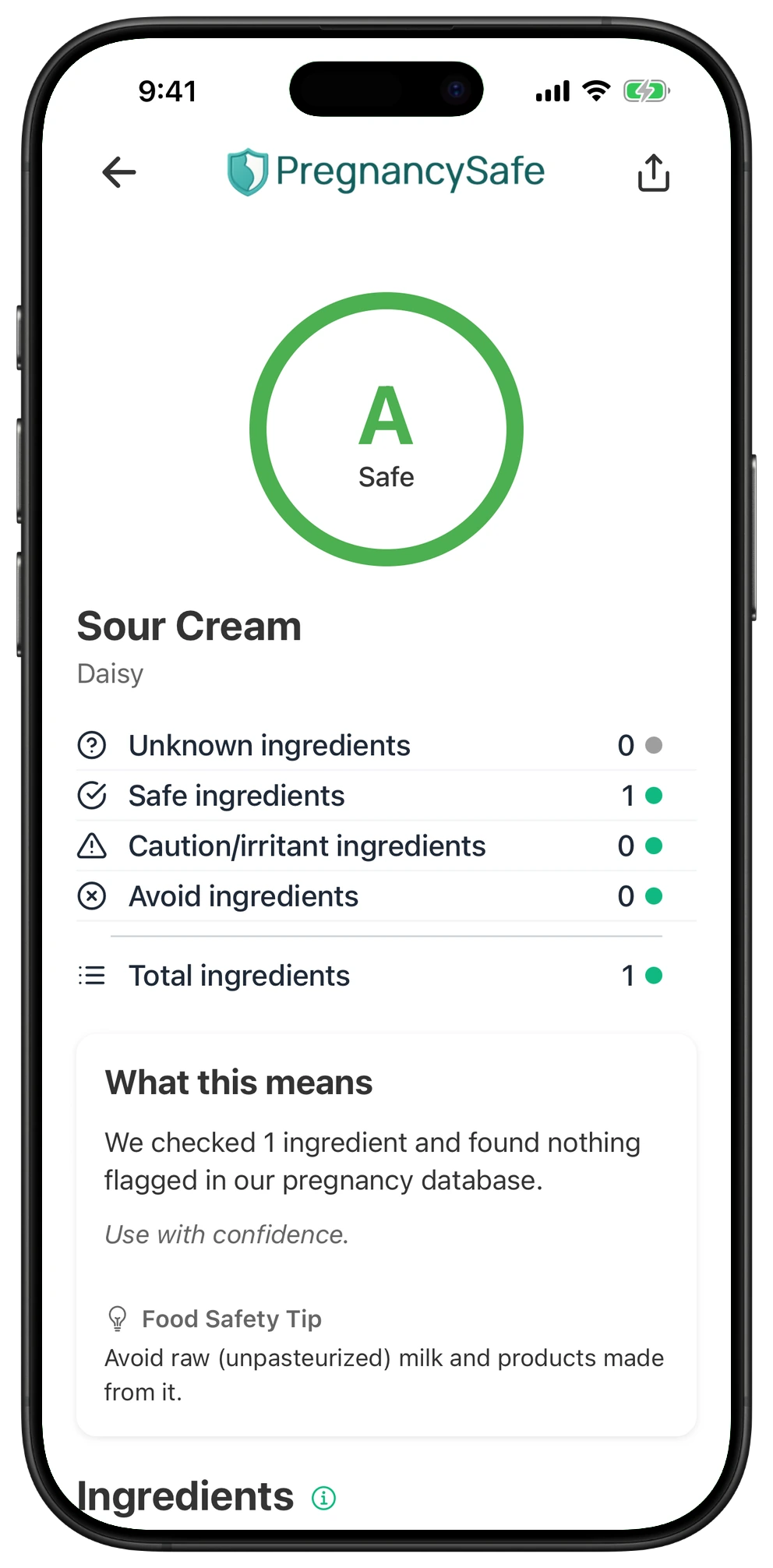
| A | Sour Cream | Daisy |
| A | Daisy Light Sour Cream | Daisy Brand |
| A | Daisy Pure & Natural Sour Cream | Daisy Brand |
| B+ | Cacique Crema Mexicana Agria Sour Cream | Unknown |
| A | Bulla Light Sour Cream | Bulla |
Your Questions Answered
Is sour cream safe when pregnant?
Yes, if it is made with pasteurized dairy, kept refrigerated and used according to its label instructions. Avoid versions made with raw milk or cream. Check the actual package rather than assuming all versions of a familiar brand are the same.
Does cultured sour cream mean it is unpasteurized?
No cultured and unpasteurized are not interchangeable terms. A cultured cream ingredient listing alone does not confirm whether the dairy was pasteurized, so check the package for that information. Live cultures also do not establish pregnancy specific probiotic benefits or make sour cream equivalent to an oral probiotic supplement.
How should I store sour cream during pregnancy?
Keep it refrigerated and follow the package's storage and use after opening instructions. Return the tub to the refrigerator after serving rather than leaving it out. Pasteurization does not make sour cream sterile or remove the need for careful handling.
Can I eat restaurant or homemade sour cream?
The same checks apply: confirm pasteurized dairy and proper refrigerated storage. At a restaurant, ask staff if you are unsure; for homemade sour cream, check the milk or cream used to make it. If you cannot establish those basics, choose another topping rather than assuming fermentation makes it safe.
Should I worry about additives or vitamin A in sour cream?
Ordinary food level vitamins and additives are not equivalent to high dose retinol supplements or liver. Artificial color and red 40 have limited pregnancy specific evidence, but occasional regulated food exposure is not established fetal harm. BHT concerns rely largely on high dose oral animal findings, not proof of harm from a normal serving. If the current label lists partially hydrogenated soybean oil, choose an alternative to minimize industrial trans fat; fully hydrogenated oil is different.
Does an A grade mean sour cream is guaranteed safe during pregnancy?
No ingredient grades do not verify pasteurization, storage, pathogens or current label completeness. Our catalog contains 589 sour cream products, including 297 graded A, but those are not counts of independently verified safe products. Use grades as ingredient information, then check the actual tub and follow the food handling precautions.
How Do We Score Products for Pregnancy Safety?
We analyze each product's ingredients and category to flag known risks and provide cautionary notices for general category safety concerns.
Grades reflect the ingredient and category information available to us. They don’t verify a complete, current label or account for dose, preparation, or contamination. Read them alongside the guidance above, not as a guarantee of pregnancy safety or proof that every use is harmful.
A - Safe
Excellent choice! All ingredients are considered safe during pregnancy.
What to do: Use with confidence.
B - Likely Safe
Pretty much safe with very minimal risk. Some ingredients may have limited pregnancy studies, but no significant safety concerns have been identified.
What to do: Use with confidence.
C - Limit
Contains ingredients with some pregnancy considerations. Research shows these ingredients may have limited safety data, potential for minor hormonal effects, or require caution based on animal studies.
What to do: Use sparingly and consider safer alternatives when available.
D - Caution
Similar to C grade but contains multiple cautionary ingredients. The combination increases overall concern.
What to do: Try to avoid if that makes you feel better. If you've already used it, no need to panic.
F - Avoid
Contains an ingredient Pregnancy Safe recommends avoiding during pregnancy. This may reflect an established risk or a precaution based on limited evidence; check the ingredient guidance and exposure context.
What to do: Do not use during pregnancy. If you've already used it, don't worry - contact your OBGYN if concerned.
People Also Checked
References
- https://www.cdc.gov/foodsafety/rawmilk/index.html
- https://www.cdc.gov/listeria/prevention/index.html
- https://www.nhs.uk/pregnancy/keeping-well/foods-to-avoid/
- https://www.fda.gov/food/color-additives-information-consumers/color-additives-questions-and-answers-consumers
- https://www.fda.gov/food/food-ingredients-packaging/color-additives-information-consumers
- https://www.fda.gov/cosmetics/cosmetic-ingredient-names/color-additives-permitted-use-cosmetics
- https://www.fda.gov/industry/color-additives/fdc-red-no-3
- https://pubmed.ncbi.nlm.nih.gov/35233072/
- https://pubmed.ncbi.nlm.nih.gov/35484553/
- https://pubmed.ncbi.nlm.nih.gov/35106984/
- https://www.hfpappexternal.fda.gov/scripts/fdcc/index.cfm?id=FDCRed40&set=ColorAdditives
- https://www.ecfr.gov/current/title-21/chapter-I/subchapter-A/part-74/subpart-A/section-74.340
- https://www.fda.gov/food/color-additives-information-consumers/tracking-food-industry-pledges-remove-petroleum-based-food-dyes
- https://www.efsa.europa.eu/en/efsajournal/pub/1327
- https://www.efsa.europa.eu/en/efsajournal/pub/4007
- https://apps.who.int/food-additives-contaminants-jecfa-database/Home/Chemical/2361
- https://oehha.ca.gov/risk-assessment/report/health-effects-assessment-potential-neurobehavioral-effects-synthetic-food-dyes-children
- https://pubmed.ncbi.nlm.nih.gov/6636206/
- https://pubmed.ncbi.nlm.nih.gov/2613118/
- https://pubmed.ncbi.nlm.nih.gov/7940558/
- https://health.ec.europa.eu/system/files/2022-08/sccs_o_257.pdf
- https://pubmed.ncbi.nlm.nih.gov/37751543/
- https://pubmed.ncbi.nlm.nih.gov/12396675/
- https://pmc.ncbi.nlm.nih.gov/articles/PMC13151845/
- https://www.ecfr.gov/current/title-21/chapter-I/subchapter-B/part-172/subpart-B/section-172.115
- https://www.ecfr.gov/current/title-21/chapter-I/subchapter-B/part-182/subpart-D/section-182.3173
- https://www.fda.gov/news-events/press-announcements/fda-finalizes-food-chemical-safety-post-market-assessment-program-launches-reassessment-bht-ada
- https://www.fda.gov/food/food-additives-petitions/trans-fat
- https://www.fda.gov/food/hfp-constituent-updates/fda-completes-final-administrative-actions-partially-hydrogenated-oils-foods
- https://www.federalregister.gov/documents/2013/11/08/2013-26854/tentative-determination-regarding-partially-hydrogenated-oils-request-for-comments-and-for
- https://www.who.int/news-room/fact-sheets/detail/trans-fat
- https://cdn.realfood.gov/DGA.pdf
- https://www.fda.gov/food/people-risk-foodborne-illness/dietary-advice-and-during-pregnancy
- https://www.rcpi.ie/Portals/0/Document%20Repository/Institute%20of%20Obstetricians%20and%20Gynaecologists/National%20Clinical%20Guidelines/IOG_National%20Clinical%20Guidelines_Nutrition%20in%20pregnancy%20Guideline_2019.pdf
- https://pmc.ncbi.nlm.nih.gov/articles/PMC8027310/
- https://pmc.ncbi.nlm.nih.gov/articles/PMC3192475/