Is Ricotta Cheese Safe During Pregnancy? (Updated 2026 Guide)
Updated October 1, 2026
The Answer
NHS pregnancy guidance lists pasteurized ricotta as an option. Keep it refrigerated and follow the package’s use by and after opening instructions.
For ricotta, the main pregnancy consideration is foodborne contamination, including Listeria, rather than an ingredient score. Choose the exact pasteurized version, keep it refrigerated and follow both use by and after opening instructions. Pasteurization does not prevent all later contamination, and ordinary food additives alone do not establish fetal harm.
Pregnancy Safe is 100% independent and research driven. No companies pay to promote or sponsor products.
Stress Less This Pregnancy
Check your exact ricotta cheese in the app

How to check whether ricotta is pasteurized
Look for pasteurization information on the current package, including the dairy ingredients. A listing that simply says milk or whey does not by itself confirm whether it was pasteurized or unpasteurized. If the label is unclear, ask the manufacturer; at a restaurant, ask staff to check the cheese they actually use.
For Galbani or another brand, check the exact variety and package you are buying. Look for an explicit pasteurization statement, then check refrigeration and after opening directions. If you cannot find that information, ask the manufacturer with the full product name. A brand name or an older online listing is not confirmation of today’s tub.
Can you eat ricotta cold, or must it be cooked?
NHS pregnancy guidance lists pasteurized ricotta among cheeses you can eat without an additional cooking requirement. You can eat it cold when it has been kept refrigerated and is within its use by and after opening limits. This does not extend to every soft cheese: queso fresco type cheeses need heating even if pasteurized.
Storing ricotta after opening
Follow the after opening instructions on your exact tub and stay within its use by date. Keep it refrigerated, and note when you opened it so you can follow that limit. Do not assume the unopened use by date means an opened tub will remain suitable until then.
✓ What's Safe
- • Check the current package for confirmation that the dairy ingredients are pasteurized.
- • Choose ricotta sold refrigerated and keep it refrigerated at home.
- • Read the use by date and after opening instructions before buying a tub you may not finish promptly.
- • Check the exact variety and size rather than assuming every version from one brand has the same label.
- • For restaurant or homemade ricotta, ask whether pasteurized dairy was used and how the cheese has been stored.
- • Confirm the cheese type: ordinary ricotta and queso fresco type cheeses do not have identical pregnancy guidance.
✗ What to Avoid
- • Avoid ricotta made with unpasteurized dairy.
- • Skip ricotta when you cannot confirm its pasteurization or refrigerated storage; uncertainty does not prove harm, but another option is easier to assess.
- • Do not eat ricotta beyond its use by date or the package's after opening limit.
- • Avoid treating an A grade, a short ingredient list or an organic label as protection against Listeria.
- • Do not assume a similarly named cheese has the same guidance: queso fresco type cheeses need heating even when pasteurized.
- • Avoid using an older online label as a substitute for checking the tub you are buying.
Most Common Ingredients in Ricotta Cheese Products
We analyzed 194 ricotta cheese products. Here are the most common ingredients, ranked by how often they appear:
Ricotta Cheese Products We've Analyzed
Our catalog contains ratings for 194 ricotta cheese products. These are database grades, not independent safety certifications.
Catalog ingredient grades are not pregnancy safety certifications, a check of current labels, or measurements of caffeine, pathogens or handling. Not all candidates were independently reviewed.
Pregnancy Safe Ricotta Cheese Products
Popular options from our catalog, prioritizing A and B ingredient grades, with C grade options used to fill remaining places. Within each group, products are ordered by searches in Pregnancy Safe, not retail sales. Read the cautions and guidance above; grades do not verify a complete current label or guarantee pregnancy safety.
| Grade | Product | Brand |
|---|---|---|
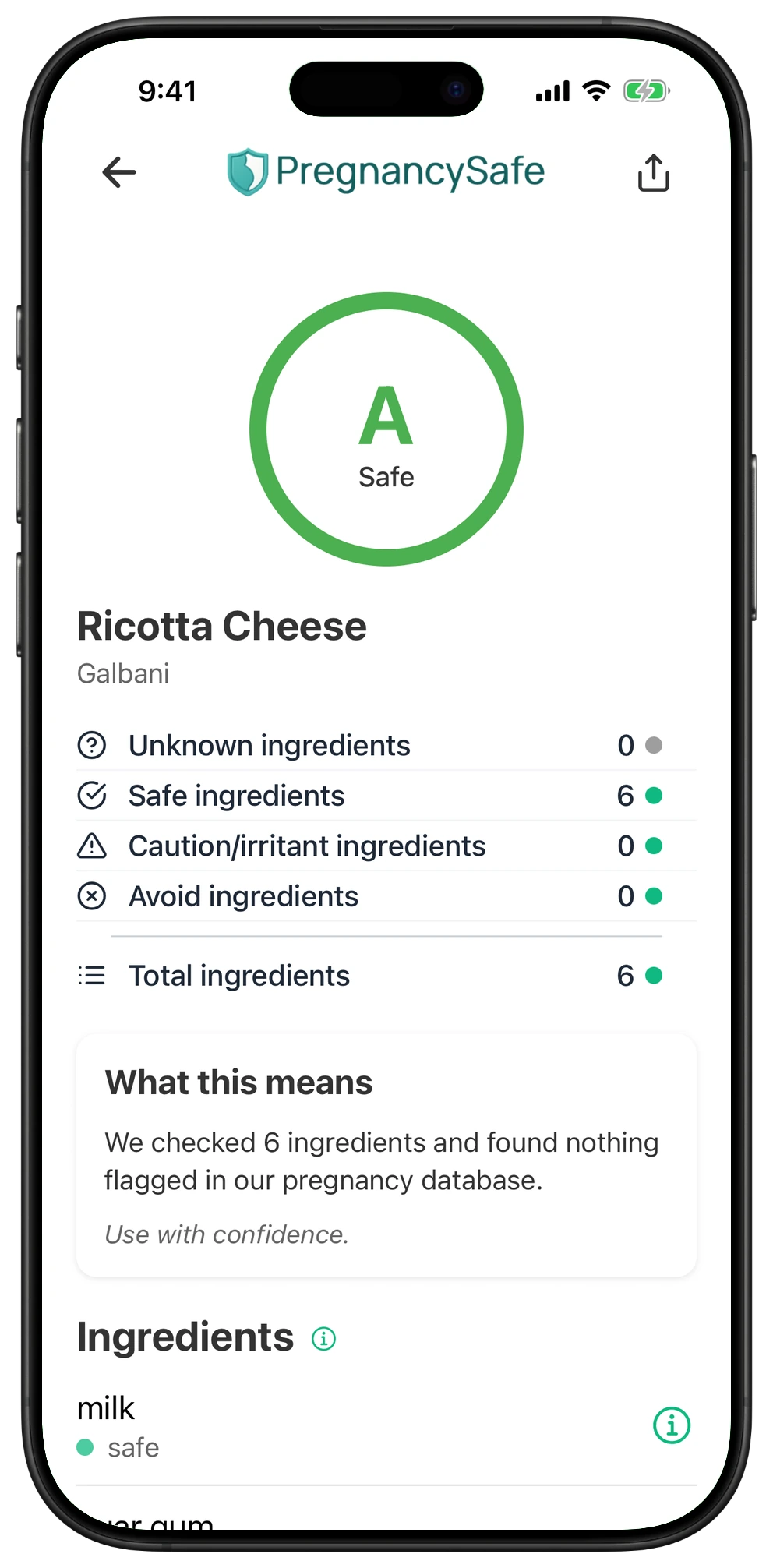
| A | Ricotta Cheese | Galbani |
| A | Low Fat Ricotta Cheese | Galbani |
| A | Polly O Original Ricotta Cheese | Polly-O |
| A | Perfect Italiano Ricotta Light | Perfect Italiano |
| B+ | Part Skim Ricotta Cheese | Polly-O |
Your Questions Answered
Is it safe to eat ricotta cheese while pregnant?
Yes, ordinary ricotta made with pasteurized dairy is an option during pregnancy when properly refrigerated and used within the package instructions. Check the exact tub rather than relying on its brand or ingredient grade. Pasteurization is important, but storage and handling still matter because contamination can happen afterward.
Do A and B+ grades mean ricotta is pregnancy safe?
No ingredient grades are not pregnancy safety certifications. Our catalog contains 194 ricotta entries: 121 graded A and 73 graded B+. Those counts do not mean every current label was independently checked, and the grades cannot detect Listeria or assess storage. You still need to confirm pasteurization and follow the package's handling instructions.
Should I avoid ricotta with carrageenan or gums during pregnancy?
The presence of carrageenan, guar gum or xanthan gum in ricotta does not by itself establish fetal harm from eating the cheese. Choosing a simpler recipe is a preference, not a substitute for food safety checks. Prioritize pasteurized dairy, refrigeration and use by instructions over the number of ingredients.
How Do We Score Products for Pregnancy Safety?
We analyze each product's ingredients and category to flag known risks and provide cautionary notices for general category safety concerns.
Grades reflect the ingredient and category information available to us. They don’t verify a complete, current label or account for dose, preparation, or contamination. Read them alongside the guidance above, not as a guarantee of pregnancy safety or proof that every use is harmful.
A - Safe
Excellent choice! All ingredients are considered safe during pregnancy.
What to do: Use with confidence.
B - Likely Safe
Pretty much safe with very minimal risk. Some ingredients may have limited pregnancy studies, but no significant safety concerns have been identified.
What to do: Use with confidence.
C - Limit
Contains ingredients with some pregnancy considerations. Research shows these ingredients may have limited safety data, potential for minor hormonal effects, or require caution based on animal studies.
What to do: Use sparingly and consider safer alternatives when available.
D - Caution
Similar to C grade but contains multiple cautionary ingredients. The combination increases overall concern.
What to do: Try to avoid if that makes you feel better. If you've already used it, no need to panic.
F - Avoid
Contains an ingredient Pregnancy Safe recommends avoiding during pregnancy. This may reflect an established risk or a precaution based on limited evidence; check the ingredient guidance and exposure context.
What to do: Do not use during pregnancy. If you've already used it, don't worry - contact your OBGYN if concerned.
People Also Checked
Feta Cheese
4 products
Goat Cheese
191 products
Mascarpone Cheese
14 products
String Cheese
340 products
Mozzarella Cheese
10 products
Cottage Cheese
1,036 products
Cheddar Cheese
184 products
Cheese
13,379 products
See our full guide to cheese during pregnancy.