Is Non Alcoholic Wine Safe During Pregnancy? (Updated 2026 Guide)
Updated September 9, 2026
The Answer
Do not assume non alcoholic wine is safe during pregnancy: dealcoholized wine can still contain alcohol, and pregnancy guidance is to avoid alcohol. Choose a clearly alcohol free alternative after checking the exact label; an ingredient grade cannot confirm zero alcohol.
The main consideration is the alcohol you would drink, not the wine's ingredient score: non alcoholic or dealcoholized does not necessarily mean zero alcohol, and no safe amount or timing of alcohol use in pregnancy is established. Under FDA guidance, dealcoholized wine may contain less than 0.5% ABV, while alcohol free means no detectable alcohol. Herbal flavorings need dose specific consideration, and ingredient concerns based on cosmetic exposure do not establish harm from drinking a beverage.
Pregnancy Safe is 100% independent and research driven. No companies pay to promote or sponsor products.
Stress Less This Pregnancy
Check your exact non alcoholic wine in the app
✓ What's Safe
- • Check the exact bottle for an alcohol free statement and its alcohol by volume, or ABV, rather than relying on the product name.
- • Ask the manufacturer to clarify residual alcohol if the label says only non alcoholic, dealcoholized, or alcohol removed.
- • Choose a clearly alcohol free alternative when the wine's alcohol content cannot be confirmed.
- • Read the full ingredient list for herbal additions; distinguish small food flavor amounts from concentrated extracts or medicinal preparations.
- • Match the exact version and bottle size when checking manufacturer information, and follow the bottle's storage instructions.
✗ What to Avoid
- • Avoid wine with declared residual alcohol, including labels stating less than 0.5% ABV, rather than treating that threshold as a pregnancy safe allowance.
- • Do not choose a bottle solely because its name says zero, non alcoholic, or alcohol removed without checking the complete label.
- • Avoid using a small serving or occasional drinking schedule as a proven safe alcohol limit during pregnancy.
- • Avoid adding alcoholic wine, spirits, or alcohol based herbal tinctures to an otherwise alcohol free drink.
- • Avoid medicinal elderflower teas or concentrated extracts as wine substitutes during pregnancy; their limited safety evidence differs from small food flavor amounts.
- • Do not use an A ingredient grade as proof of zero alcohol, or an incomplete record as proof that a beverage is harmful.
Most Common Ingredients in Non Alcoholic Wine Products
We analyzed 32 non alcoholic wine products. Here are the most common ingredients, ranked by how often they appear:
Ingredients to Watch Out For in Non Alcoholic Wine
These are the most common flagged ingredients across 32 non alcoholic wine products we analyzed.
butylparaben
Caution
Butylparaben is a synthetic preservative commonly used in cosmetics and personal care products to inhibit microbial growth and extend shelf life.
Has endocrine disrupting signals and limited mixed pregnancy data, so frequent stacked leave on exposure deserves caution.
Flagged in 1 of 32 products (3%)
ethylparaben
Caution
Ethylparaben is a preservative commonly used in cosmetics and personal care products to inhibit microbial growth and extend shelf life.
Has weak endocrine activity and limited, mixed pregnancy biomonitoring findings, while regulated cosmetic levels are generally considered low concern.
Flagged in 1 of 32 products (3%)
fd c red 40
Caution
FD&C Red 40 is a synthetic red dye commonly used to add vibrant color to foods, beverages, and cosmetics.
Has limited human pregnancy data and is allowed at regulated food additive levels, but child neurobehavior concerns and high dose animal findings make frequent high dye intake worth limiting.
Flagged in 1 of 32 products (3%)
isobutylparaben
Caution
Has weak endocrine activity and mixed human pregnancy signals, especially for longer chain propyl, butyl, isopropyl and isobutyl forms, while regulated cosmetic levels are generally considered low concern.
Flagged in 1 of 32 products (3%)
methylparaben
Caution
Methylparaben is a synthetic preservative commonly used in cosmetics and personal care products to inhibit microbial growth and extend shelf life.
Has mixed human pregnancy biomonitoring signals and weak endocrine activity, while regulated cosmetic levels are generally considered low concern.
Flagged in 1 of 32 products (3%)
organic elderflower
Caution
Organic elderflower is a fragrant, delicate flower known for its floral aroma and subtle sweetness, often used to make syrups, teas, and flavorings.
Has limited pregnancy safety data; medicinal teas and extracts are not recommended in pregnancy, while pasteurized food flavor amounts are a different lower exposure context.
Flagged in 1 of 32 products (3%)
Caution
Phenoxyethanol is a preservative commonly used in cosmetics and skincare products to prevent microbial growth and extend shelf life.
Has limited direct pregnancy data and possible infant oral exposure concerns from nipple area products, while regulated cosmetic concentrations are generally considered low systemic risk.
Flagged in 1 of 32 products (3%)
propylparaben
Caution
Propylparaben is a synthetic preservative commonly used in cosmetics and personal care products to inhibit microbial growth and extend shelf life.
Has mixed pregnancy biomonitoring signals and weak endocrine activity, but regulated cosmetic concentrations are considered low concern by FDA, SCCS and CIR.
Flagged in 1 of 32 products (3%)
Non Alcoholic Wine Products We've Analyzed
Our catalog contains ratings for 32 non alcoholic wine products. These are database grades, not independent safety certifications.
Ingredient grades cannot establish dose, preparation, label completeness, efficacy or pregnancy suitability. An A score is not an endorsement, and counts include unreviewed catalog records.
Your Questions Answered
Can a pregnant person drink alcohol free wine?
A clearly alcohol free beverage is a more suitable choice than wine that retains alcohol, but check the exact label and other ingredients. Under FDA guidance for these beverages, alcohol free means no detectable alcohol. Non alcoholic and dealcoholized are not equivalent terms, so do not rely on them alone.
Is alcohol free wine the same as non alcoholic wine?
Not necessarily: the distinction matters when you are avoiding alcohol during pregnancy. FDA guidance permits non alcoholic dealcoholized wine to contain less than 0.5% alcohol by volume, while alcohol free means no detectable alcohol. Check the complete bottle label and ask the manufacturer if the wording is unclear.
Is wine with less than 0.5% ABV safe during pregnancy?
Less than 0.5% ABV is a labeling threshold, not an established pregnancy safe dose. Alcohol exposure depends on both concentration and how much you drink, and pregnancy guidance is to avoid alcohol because no safe amount or timing is known. Choose a clearly alcohol free alternative rather than using this threshold as permission to drink.
What if I already drank non alcoholic wine while pregnant?
An incidental past exposure does not prove that harm occurred. Check the bottle's ABV and note approximately how much you drank and when. If it contained alcohol or you cannot confirm the content, discuss those details with your prenatal clinician and choose a clearly alcohol free drink going forward.
Does an A grade mean a non alcoholic wine is pregnancy safe?
No. Our catalog contains 32 products, including 20 with an A ingredient grade, but those counts include records that have not been independently label reviewed. Ingredient grades do not establish residual alcohol, serving amount, label completeness, or pregnancy suitability. No specific zero alcohol example is established here, so use the actual label rather than the grade to check alcohol content.
Should I worry about herbal flavorings, dyes, or preservatives?
Check alcohol content first, then consider the exact ingredient and amount. Organic elderflower used in small pasteurized food flavor amounts is a different exposure from medicinal teas or concentrated extracts, which lack adequate pregnancy safety data. FD&C Red 40 has limited human pregnancy data; high dose animal findings do not establish fetal harm from occasional regulated food exposure. Paraben and phenoxyethanol concerns based largely on cosmetics or nursing related exposure cannot establish either safety or harm from drinking a particular wine.
How Do We Score Products for Pregnancy Safety?
We analyze each product's ingredients and category to flag known risks and provide cautionary notices for general category safety concerns.
Grades reflect the ingredient and category information available to us. They don’t verify a complete, current label or account for dose, preparation, or contamination. Read them alongside the guidance above, not as a guarantee of pregnancy safety or proof that every use is harmful.
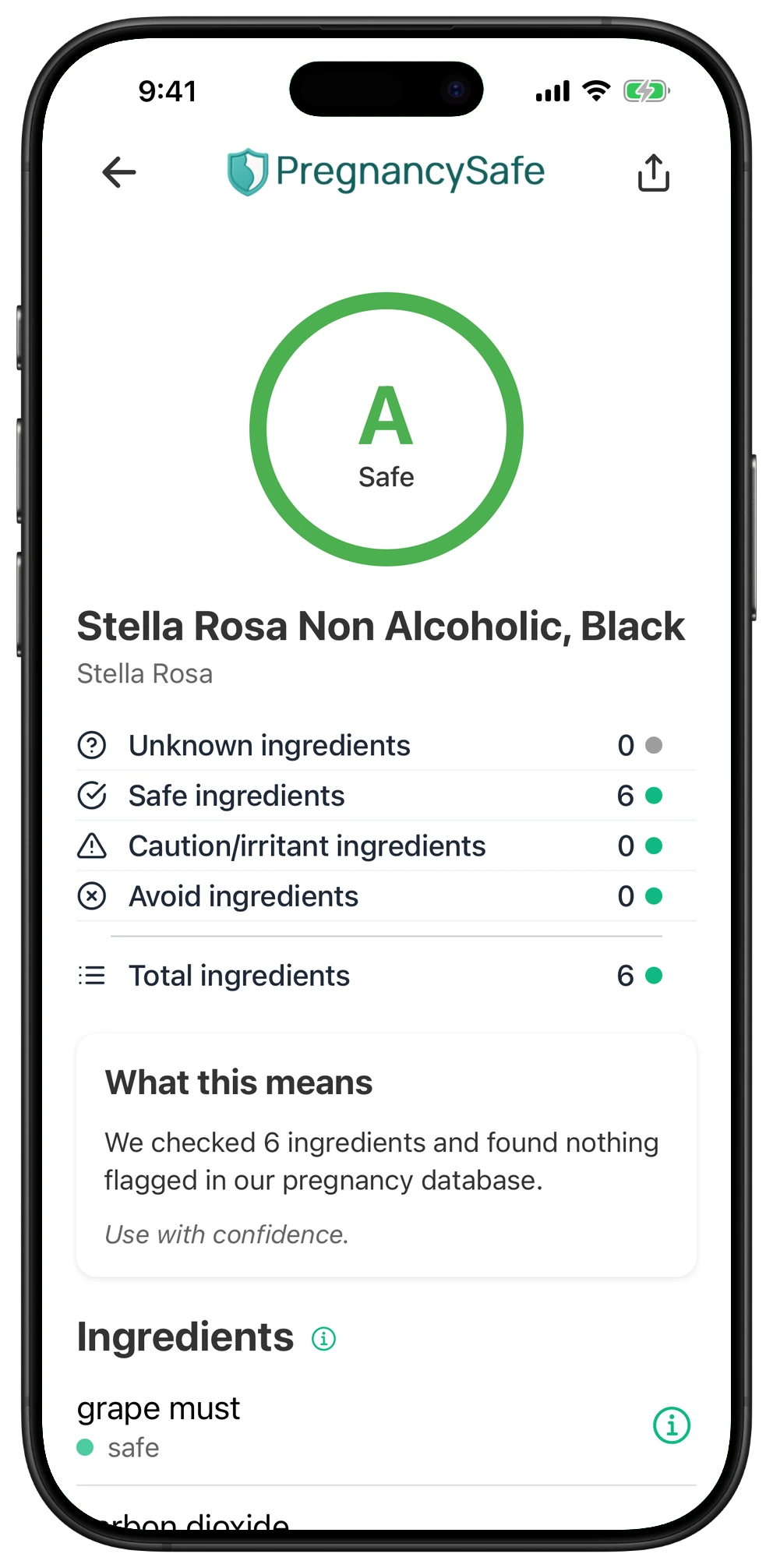
A - Safe
Excellent choice! All ingredients are considered safe during pregnancy.
What to do: Use with confidence.
B - Likely Safe
Pretty much safe with very minimal risk. Some ingredients may have limited pregnancy studies, but no significant safety concerns have been identified.
What to do: Use with confidence.
C - Limit
Contains ingredients with some pregnancy considerations. Research shows these ingredients may have limited safety data, potential for minor hormonal effects, or require caution based on animal studies.
What to do: Use sparingly and consider safer alternatives when available.
D - Caution
Similar to C grade but contains multiple cautionary ingredients. The combination increases overall concern.
What to do: Try to avoid if that makes you feel better. If you've already used it, no need to panic.
F - Avoid
Contains an ingredient Pregnancy Safe recommends avoiding during pregnancy. This may reflect an established risk or a precaution based on limited evidence; check the ingredient guidance and exposure context.
What to do: Do not use during pregnancy. If you've already used it, don't worry - contact your OBGYN if concerned.
People Also Checked
See our full guide to wine during pregnancy.
References
- https://www.fda.gov/regulatory-information/search-fda-guidance-documents/cpg-sec-510400-dealcoholized-wine-and-malt-beverages-labeling
- https://www.cdc.gov/fasd/about/index.html
- https://www.fda.gov/cosmetics/cosmetic-ingredients/parabens-cosmetics
- https://health.ec.europa.eu/publications/butylparaben-cas-no-94-26-8-ec-no-202-318-7_en
- https://health.ec.europa.eu/publications/sccs-opinion-butylparaben-cas-no-94-26-8-ec-no-202-318-7-childrens-exposure_en
- https://eur-lex.europa.eu/legal-content/EN/TXT/PDF/?uri=CELEX%3A32014R1004
- https://www.cir-safety.org/sites/default/files/Parabens.pdf
- https://chem.echa.europa.eu/obligation-lists/candidateList
- https://pubmed.ncbi.nlm.nih.gov/32279061/
- https://pubmed.ncbi.nlm.nih.gov/27156397/
- https://pubmed.ncbi.nlm.nih.gov/38968838/
- https://pubmed.ncbi.nlm.nih.gov/32771829/
- https://ec.europa.eu/health/scientific_committees/consumer_safety/docs/sccs_o_132.pdf
- https://journals.sagepub.com/doi/10.1177/1091581820925001
- https://pubmed.ncbi.nlm.nih.gov/32521303/
- https://pubmed.ncbi.nlm.nih.gov/36709902/
- https://pubmed.ncbi.nlm.nih.gov/34474324/
- https://pubmed.ncbi.nlm.nih.gov/29596967/
- https://www.hfpappexternal.fda.gov/scripts/fdcc/index.cfm?id=FDCRed40&set=ColorAdditives
- https://www.ecfr.gov/current/title-21/chapter-I/subchapter-A/part-74/subpart-A/section-74.340
- https://www.fda.gov/food/color-additives-information-consumers/tracking-food-industry-pledges-remove-petroleum-based-food-dyes
- https://www.efsa.europa.eu/en/efsajournal/pub/1327
- https://www.efsa.europa.eu/en/efsajournal/pub/4007
- https://apps.who.int/food-additives-contaminants-jecfa-database/Home/Chemical/2361
- https://oehha.ca.gov/risk-assessment/report/health-effects-assessment-potential-neurobehavioral-effects-synthetic-food-dyes-children
- https://pubmed.ncbi.nlm.nih.gov/6636206/
- https://pubmed.ncbi.nlm.nih.gov/2613118/
- https://pubmed.ncbi.nlm.nih.gov/7940558/
- https://ec.europa.eu/health/scientific_committees/consumer_safety/docs/sccs_o_041.pdf
- https://pubmed.ncbi.nlm.nih.gov/32723119/
- https://pubmed.ncbi.nlm.nih.gov/31731171/
- https://pubmed.ncbi.nlm.nih.gov/34991249/
- https://pubmed.ncbi.nlm.nih.gov/30844582/
- https://pubmed.ncbi.nlm.nih.gov/28925944/
- https://health.ec.europa.eu/system/files/2023-12/sccs_o_276_final.pdf
- https://pubmed.ncbi.nlm.nih.gov/19101832/
- https://pubmed.ncbi.nlm.nih.gov/32283359/
- https://pubmed.ncbi.nlm.nih.gov/33477047/
- https://pubmed.ncbi.nlm.nih.gov/40117576/
- https://www.ema.europa.eu/en/documents/herbal-monograph/final-european-union-herbal-monograph-sambucus-nigra-l-flos-revision-1_en.pdf
- https://www.ema.europa.eu/en/documents/herbal-report/final-assessment-report-sambucus-nigra-l-flos-revision-1_en.pdf
- https://www.ema.europa.eu/en/documents/herbal-report/addendum-assessment-report-sambucus-nigra-l-flos_en.pdf
- https://webprod.hc-sc.gc.ca/nhpid-bdipsn/atReq?atid=elder.sureau&lang=eng
- https://pmc.ncbi.nlm.nih.gov/articles/PMC3941201/
- https://www.nccih.nih.gov/health/elderberry
- https://pubmed.ncbi.nlm.nih.gov/33806603/
- https://health.ec.europa.eu/system/files/2021-08/sccs_o_195_0.pdf
- https://ec.europa.eu/growth/tools-databases/cosing/details/28157
- https://journals.sagepub.com/doi/10.3109/10915819009078737
- https://link.springer.com/article/10.1007/s00204-024-03938-5
- https://www.sfda.gov.sa/en/warnings/1156
- https://www.industrialchemicals.gov.au/sites/default/files/Ethanol%2C%202-phenoxy-_Human%20health%20tier%20II%20assessment.pdf
- https://hero.epa.gov/reference/2857875
- https://books.publisso.de/sites/default/files/documents/series/mak/dam/Vol2019/Iss1/Alt006/mb12299kske6319_w.pdf
- https://health.ec.europa.eu/publications/propylparaben_en
- https://pubmed.ncbi.nlm.nih.gov/30412856/
- https://pubmed.ncbi.nlm.nih.gov/35487354/
- https://pubmed.ncbi.nlm.nih.gov/16097138/