Is Cooking Wine Safe During Pregnancy? (Updated 2026 Guide)
Updated September 9, 2026
The Answer
Avoid drinking cooking wine during pregnancy, and use a nonalcoholic substitute in recipes when avoiding alcohol. Cooking can reduce alcohol but does not guarantee its removal; a small amount in a cooked dish is not the same exposure as drinking wine.
The main concern is alcohol you consume in the finished dish, which depends on the amount added, recipe, cooking method, cooking time and portion eaten. No safe amount of drinking alcohol has been established during pregnancy, but that does not mean one inadvertent serving of food cooked with wine guarantees harm. Salt and added sugars are separate nutritional considerations, not measures of how much alcohol remains.
Pregnancy Safe is 100% independent and research driven. No companies pay to promote or sponsor products.
Stress Less This Pregnancy
Check your exact cooking wine in the app

✓ What's Safe
- • Choose recipes that use broth or water instead of cooking wine.
- • Use a suitable juice when its sweetness and flavor fit the recipe.
- • Read ingredient lists for wine, rice wine or neutral spirits rather than assuming a cooking label means alcohol free.
- • When eating out, ask whether wine is used in the sauce and whether your dish can be prepared without it.
- • Compare sodium and added sugars in replacement ingredients separately from checking for alcohol.
✗ What to Avoid
- • Do not drink cooking wine during pregnancy.
- • Avoid relying on boiling, baking or simmering to guarantee that all alcohol disappears.
- • Skip uncooked wine based sauces or wine added at the end of cooking when you want to avoid alcohol.
- • Do not assume switching from white wine to red wine, sherry wine or rice wine removes the alcohol concern.
- • Avoid using a fixed cooking time or a product grade as proof that a finished dish is alcohol free.
Most Common Ingredients in Cooking Wine Products
We analyzed 82 cooking wine products. Here are the most common ingredients, ranked by how often they appear:
Ingredients to Watch Out For in Cooking Wine
These are the most common flagged ingredients across 82 cooking wine products we analyzed.
wine
Caution
Wine is a fermented beverage made from crushed grapes or other fruits, often enjoyed for its rich flavors and cultural significance.
Avoid wine beverages entirely. Be extremely careful when using in cooking or even with small percentages.
Flagged in 30 of 82 products (37%)
neutral spirits
Avoid
Neutral spirits are high proof, flavorless distilled alcohol used as a base for cocktails and infusions.
Has no established safe amount in pregnancy and is linked to fetal alcohol spectrum disorders and other adverse pregnancy outcomes.
Flagged in 11 of 82 products (13%)
white wine
Avoid
White wine is a crisp, pale yellow alcoholic beverage made from fermented white grapes, often used to enhance the flavor of dishes or enjoyed on its own.
Has no established safe amount in pregnancy and is linked to fetal alcohol spectrum disorders and other adverse pregnancy outcomes.
Flagged in 7 of 82 products (9%)
marsala wine
Avoid
Marsala wine is a rich, fortified Italian wine with a sweet or dry flavor profile, often used in cooking and desserts.
Has no established safe amount in pregnancy and is linked to fetal alcohol spectrum disorders and other adverse pregnancy outcomes.
Flagged in 6 of 82 products (7%)
alcohol
Caution
Alcohol is a volatile, colorless liquid commonly used as a solvent, disinfectant, or intoxicating beverage.
No amount of Alcohol is considered safe. Avoid alcohol beverages entirely. Be extremely careful when using in cooking or even with small percentages.
Flagged in 5 of 82 products (6%)
red wine
Avoid
Red wine is a rich, fermented beverage made from dark colored grape varieties, often enjoyed for its complex flavors and cultural significance.
Has no established safe amount in pregnancy and is linked to fetal alcohol spectrum disorders and other adverse pregnancy outcomes.
Flagged in 5 of 82 products (6%)
sherry wine
Avoid
Sherry wine is a fortified Spanish wine known for its rich, nutty flavor and versatility in cooking and sipping.
Has no established safe amount in pregnancy and is linked to fetal alcohol spectrum disorders and other adverse pregnancy outcomes.
Flagged in 5 of 82 products (6%)
high fructose corn syrup
Caution
High fructose corn syrup is a sweet, liquid sweetener made from corn starch, commonly used in processed foods and beverages.
Is not a known teratogen at occasional food amounts, but high added sugar intake can displace nutrients and raise gestational diabetes and metabolic concerns.
Flagged in 2 of 82 products (2%)
Cooking Wine Products We've Analyzed
Our catalog contains ratings for 82 cooking wine products. These are database grades, not independent safety certifications.
A grade cannot quantify alcohol retained in a finished recipe. Cooking-wine sodium and alcohol are separate considerations.
Your Questions Answered
Can I eat food cooked with wine during pregnancy?
Food cooked with wine can retain alcohol, so using a nonalcoholic substitute is the simplest way to avoid that exposure. The amount you consume depends on the recipe, preparation and portion, not just whether wine appears in the ingredients. A small amount in a cooked dish is not equivalent to drinking a glass of wine.
How long does it take for alcohol to cook out of food?
There is no universal cooking time that guarantees an alcohol free dish. Heat can reduce alcohol, but retention varies with the recipe, method and cooking time. Rather than treating a particular simmering or baking time as a pregnancy safety threshold, replace the wine before cooking.
What can I use instead of cooking wine?
Use broth, water or a suitable juice, depending on the flavor and sweetness your recipe needs. Choose a recipe designed for that substitute if you are unsure how the change will affect the dish. Check the replacement's ingredients, sodium and added sugars rather than assuming every substitute has the same nutritional profile.
What if I already ate a dish made with cooking wine?
One inadvertent serving does not establish that harm occurred. The amount of wine added to the whole recipe is not necessarily the amount of alcohol you consumed, because cooking and portion size affect exposure. If you are concerned, tell your prenatal care professional what you ate, approximately how much and how it was prepared.
Are rice wine, sherry and Marsala different from other cooking wines?
These names describe different types of wine, not an exemption from the alcohol concern. Their alcohol in a finished dish still depends on the amount used and how the dish is prepared. Check the exact label and use a recipe appropriate nonalcoholic substitute rather than switching between wine types to avoid alcohol.
Do F grades mean every dish made with cooking wine is unsafe?
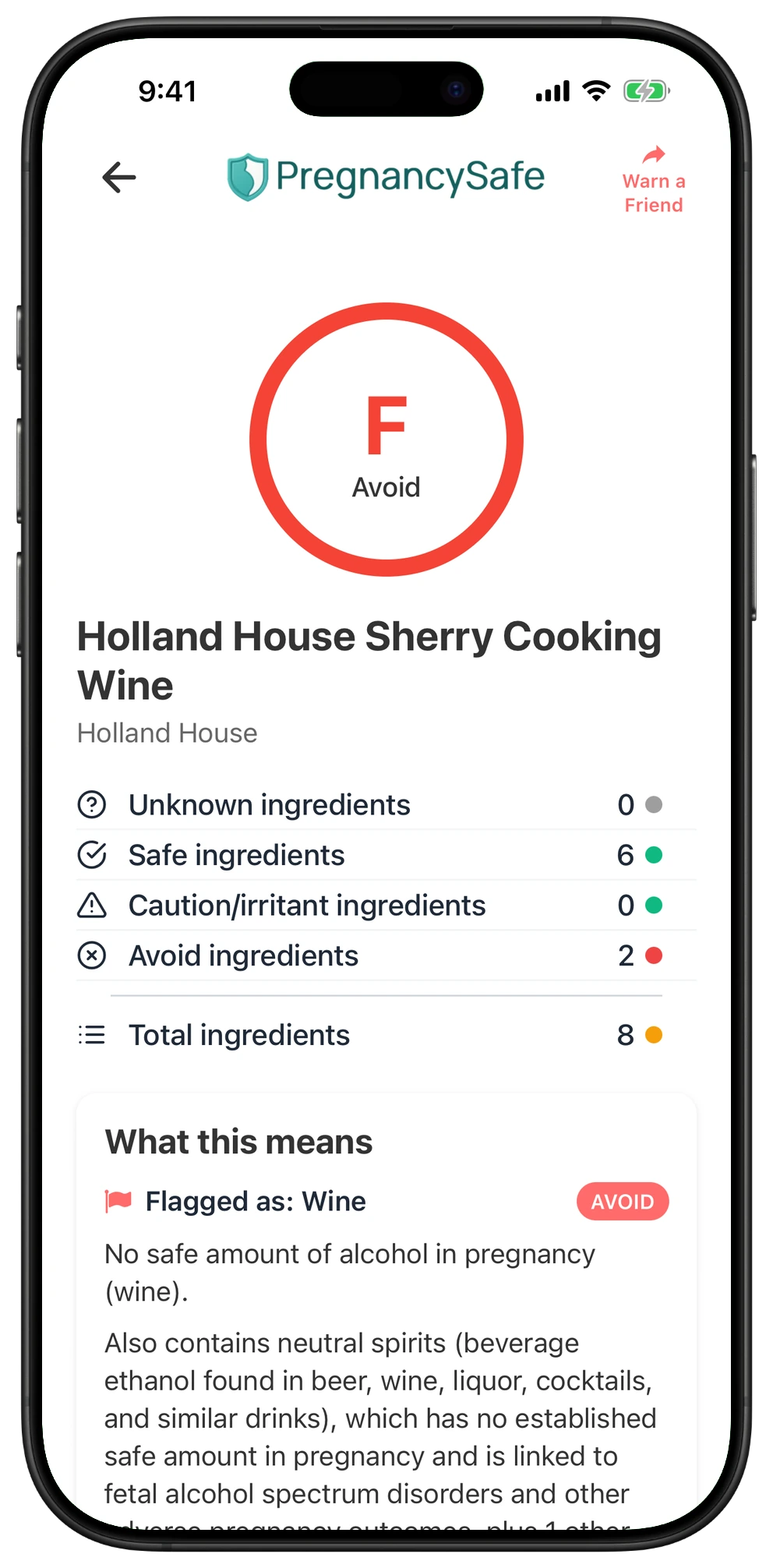
No. Our catalog contains 82 cooking wine products, all graded F, but a bottle's grade cannot quantify alcohol retained in your meal. It also cannot establish that an individual serving caused harm. For practical decisions, focus on recipe substitution and preparation rather than treating the grade as a verdict on a finished dish.
How Do We Score Products for Pregnancy Safety?
We analyze each product's ingredients and category to flag known risks and provide cautionary notices for general category safety concerns.
Grades reflect the ingredient and category information available to us. They don’t verify a complete, current label or account for dose, preparation, or contamination. Read them alongside the guidance above, not as a guarantee of pregnancy safety or proof that every use is harmful.
A - Safe
Excellent choice! All ingredients are considered safe during pregnancy.
What to do: Use with confidence.
B - Likely Safe
Pretty much safe with very minimal risk. Some ingredients may have limited pregnancy studies, but no significant safety concerns have been identified.
What to do: Use with confidence.
C - Limit
Contains ingredients with some pregnancy considerations. Research shows these ingredients may have limited safety data, potential for minor hormonal effects, or require caution based on animal studies.
What to do: Use sparingly and consider safer alternatives when available.
D - Caution
Similar to C grade but contains multiple cautionary ingredients. The combination increases overall concern.
What to do: Try to avoid if that makes you feel better. If you've already used it, no need to panic.
F - Avoid
Contains an ingredient Pregnancy Safe recommends avoiding during pregnancy. This may reflect an established risk or a precaution based on limited evidence; check the ingredient guidance and exposure context.
What to do: Do not use during pregnancy. If you've already used it, don't worry - contact your OBGYN if concerned.
People Also Checked
See our full guide to wine during pregnancy.
References
- https://www.cdc.gov/alcohol-pregnancy/about/index.html
- https://www.cdc.gov/fasd/about/index.html
- https://www.ars.usda.gov/northeast-area/beltsville-md-bhnrc/beltsville-human-nutrition-research-center/methods-and-application-of-food-composition-laboratory/mafcl-site-pages/nutrient-retention-factors/
- https://www.acog.org/womens-health/infographics/alcohol-and-pregnancy
- https://www.niaaa.nih.gov/publications/brochures-and-fact-sheets/alcohol-and-your-pregnancy
- https://mothertobaby.org/fact-sheets/alcohol-pregnancy/
- https://pubmed.ncbi.nlm.nih.gov/26482673/
- https://pmc.ncbi.nlm.nih.gov/articles/PMC9543418/
- https://cdn.realfood.gov/DGA.pdf
- https://www.dietaryguidelines.gov/sites/default/files/2021-12/DGA_Pregnancy_FactSheet-508c.pdf
- https://www.acog.org/womens-health/faqs/healthy-eating-during-pregnancy
- https://www.cdc.gov/nutrition/php/data-research/added-sugars.html
- https://www.cdc.gov/diabetes/about/gestational-diabetes.html
- https://www.who.int/publications/i/item/9789241549028
- https://nesr.usda.gov/2025-dietary-guidelines-advisory-committee-systematic-reviews/dietary-patterns_gestational-diabetes