Is Maruchan Ramen Noodle Soup Chicken Flavor Safe During Pregnancy? (Updated 2026 Guide)
Updated September 9, 2026
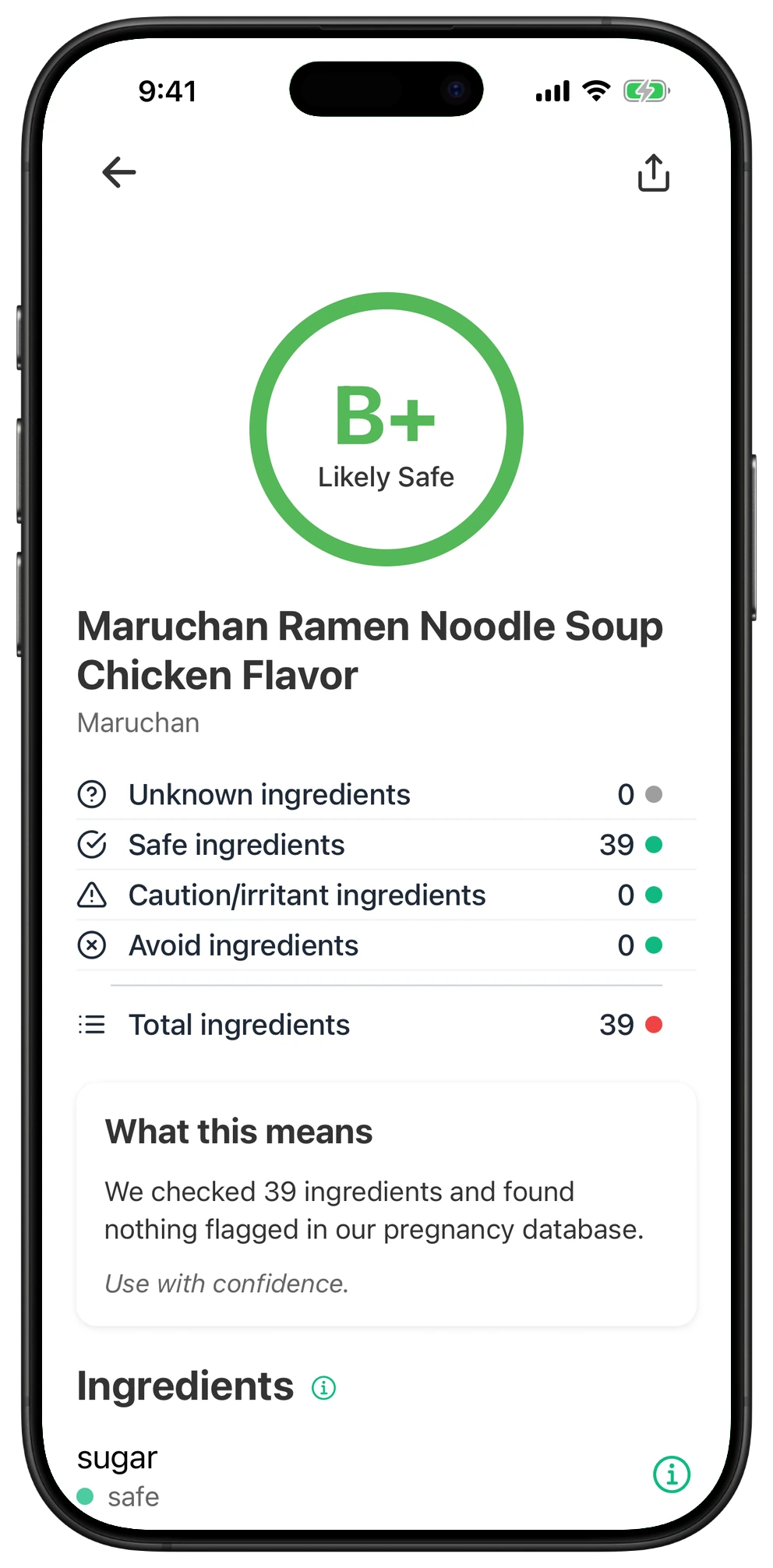
Maruchan Ramen Noodle Soup Chicken Flavor
Maruchan
Maruchan Ramen Noodle Soup Chicken Flavor is generally compatible with pregnancy in ordinary food portions, with a B+ ingredient based grade. MSG and two phosphate additives are rated likely safe at typical food levels, rather than ingredients you need to avoid; pregnancy specific human evidence for MSG remains limited.
Go ahead and use it. Nothing to worry about here.
Pregnancy Safe is 100% independent and research driven. No companies pay to promote or sponsor products.
Stress Less This Pregnancy
Check your ramen in the app

What Ingredients Are in Maruchan Ramen Noodle Soup Chicken Flavor?
Maruchan Ramen Noodle Soup Chicken Flavor has 40 ingredients. All 40 ingredients are considered safe or likely safe for pregnancy.
LIKELY SAFE
Monosodium glutamate (MSG) is a flavor enhancer commonly used to impart a savory, umami taste to various dishes. MSG is low concern at typical food additive levels during pregnancy, although human pregnancy specific data are limited and high dose exposures are not equivalent.
monosodium phosphate
LIKELY SAFE
Monosodium phosphate is a white, crystalline salt commonly used as a food additive, buffering agent, and emulsifier. Monosodium phosphate is likely safe at normal food amounts during pregnancy, while high dose phosphate products and kidney disease require separate medical guidance.
sodium tripolyphosphate
LIKELY SAFE
Sodium tripolyphosphate is a chemical compound commonly used as a food additive and water softener, known for its ability to bind with metal ions and improve cleaning efficiency. Sodium tripolyphosphate is likely safe at ordinary food exposures during pregnancy, which differ from high dose phosphate supplements or medical bowel preparations.
enriched wheat flour
SAFE
Enriched wheat flour is refined wheat flour that has been fortified with added nutrients such as iron and B vitamins to restore its nutritional value. Cooked enriched wheat flour is compatible with pregnancy and can contribute folic acid, while raw flour and dough carry separate foodborne illness risks.
folic acid
SAFE
Folic acid is a synthetic form of vitamin B9 essential for DNA synthesis and cell growth. Folic acid at normal food fortification amounts is compatible with pregnancy, but this ramen should not replace your recommended prenatal supplementation.
hydrolyzed corn protein
SAFE
Hydrolyzed corn protein is a processed plant based ingredient that provides moisturizing and conditioning benefits to hair and skin by delivering amino acids and peptides. The evidence attached to hydrolyzed corn protein mainly concerns topical corn ingredients and does not directly establish safety from eating it during pregnancy.
lactose
SAFE
Lactose is a natural sugar found in milk and dairy products. Lactose is compatible with pregnancy at normal food amounts, although it can cause digestive symptoms if you are lactose intolerant.
niacin
SAFE
Niacin, also known as vitamin B3, is a water soluble vitamin essential for energy metabolism and maintaining healthy skin and nerves. Niacin in normal fortified food amounts is compatible with pregnancy and differs from high dose supplements that can cause adverse effects.
potassium carbonate
SAFE
Potassium carbonate is a white, water soluble salt commonly used as a buffering agent, pH regulator, and in glass manufacturing. Normal dietary potassium is compatible with pregnancy, but the supporting evidence concerns potassium broadly rather than a pregnancy study of potassium carbonate in ramen.
reduced iron
SAFE
Reduced iron is a form of iron that has been processed to a fine, powdery state, commonly used as a dietary supplement or food additive to fortify products with iron. Iron at normal food fortification amounts supports pregnancy needs, while high dose supplementation and iron overload require separate medical guidance.
riboflavin
SAFE
Riboflavin is a water soluble B vitamin (vitamin B2) essential for energy production and the metabolism of fats, proteins, and carbohydrates. Riboflavin in fortified foods is compatible with pregnancy and helps meet your vitamin B2 needs.
salt
SAFE
Salt is a mineral essential for flavor enhancement and preserving food. Salt is compatible with pregnancy in normal dietary amounts, while excessive intake and conditions such as hypertension warrant individualized guidance.
sugar
SAFE
Sugar is a sweet, crystalline substance derived from plants like sugarcane or sugar beets, commonly used to sweeten and enhance the flavor of foods and beverages. Sugar is compatible with pregnancy in normal food amounts, while overall intake and carbohydrate planning matter if you have gestational diabetes.
thiamine mononitrate
SAFE
Thiamine mononitrate is a synthetic form of vitamin B1 used as a dietary supplement and food additive to support energy metabolism. Thiamine mononitrate at normal fortified food amounts is compatible with pregnancy and contributes essential vitamin B1.
SAFE
Turmeric is a vibrant yellow orange spice derived from the root of the Curcuma longa plant, known for its earthy flavor and potent anti inflammatory properties. Turmeric at ordinary seasoning or food color amounts is generally compatible with pregnancy and is distinct from concentrated supplements.
water
SAFE
Water is a clear, tasteless, and essential liquid that sustains all known forms of life. Water from a safe treated source is compatible with pregnancy and should be used to prepare your ramen.
wheat flour
SAFE
Wheat flour is a finely ground powder made from milling wheat grains, commonly used as a primary ingredient in baking and cooking. Cooked wheat flour is compatible with pregnancy, while raw flour or dough can carry foodborne pathogens.
canola oil
SAFE
Canola oil is a light, mild tasting vegetable oil derived from the seeds of the canola plant, commonly used for cooking and baking. Canola oil is unflagged in this ramen, but that does not establish ingredient specific pregnancy safety.
celery seed
SAFE
Celery seed is a small, aromatic spice derived from dried seeds of the celery plant, commonly used to add a savory, slightly bitter flavor to dishes and pickles. Celery seed appears here as a food seasoning and is unflagged, not individually established safe for pregnancy.
chive
SAFE
Chives are slender, green herbaceous plants with mild onion flavor, commonly used to add a fresh, subtle onion note to dishes. Chive is unflagged as a food ingredient here, rather than supported by a specific pregnancy safety review.
cottonseed oil
SAFE
Cottonseed oil is a vegetable oil extracted from the seeds of the cotton plant, commonly used in cooking and food processing. Cottonseed oil is unflagged in this food, which is not the same as confirmed pregnancy safety.
dehydrated vegetables
SAFE
Dehydrated vegetables are vegetables that have had most of their moisture removed to preserve their flavor and nutrients for long term storage. Dehydrated vegetables are unflagged here, but their ingredient listing alone does not establish pregnancy safety or nutritional adequacy.
disodium guanylate
SAFE
Disodium guanylate is a flavor enhancer commonly used in processed foods to enhance umami taste. This flavor enhancer is unflagged in the ramen, without an ingredient specific pregnancy safety conclusion.
disodium inosinate
SAFE
Disodium inosinate is a flavor enhancer commonly used to improve the savory taste of foods. Disodium inosinate is unflagged at this food use, not individually reviewed as safe during pregnancy.
garlic
SAFE
Garlic is a pungent, aromatic bulb commonly used to add bold flavor to a variety of culinary dishes. Garlic is unflagged as a food ingredient here, without a separate pregnancy safety assessment.
hydrolyzed soy protein
SAFE
Hydrolyzed soy protein is a processed soy derived ingredient that provides moisture, improves texture, and enhances the stability of cosmetic and skincare products. Hydrolyzed soy protein is unflagged, but cosmetic use descriptions do not establish pregnancy safety for eating it.
hydrolyzed wheat protein
SAFE
Hydrolyzed wheat protein is a processed form of wheat protein that helps strengthen and condition hair and skin by providing moisture and improving elasticity. Hydrolyzed wheat protein is unflagged, but topical conditioning information does not establish pregnancy safety for dietary exposure.
maltodextrin
SAFE
Maltodextrin is a white, powdery carbohydrate derived from starch, commonly used as a thickener, filler, or energy source in processed foods. Maltodextrin is unflagged in this ramen, not individually established safe by pregnancy specific evidence.
natural flavors
SAFE
Natural flavors are derived from plant or animal sources and used to enhance the taste of food and beverages. Natural flavors are unflagged here, but the broad ingredient name does not establish pregnancy safety for each flavoring component.
onion
SAFE
An onion is a versatile bulb vegetable with layered, pungent flesh that adds flavor and aroma to a wide variety of dishes. Onion is unflagged as a food ingredient here, rather than individually reviewed for pregnancy safety.
palm oil
SAFE
Palm oil is a versatile vegetable oil derived from the fruit of oil palm trees, commonly used in cooking, processed foods, and cosmetics. Palm oil is unflagged in this ramen, which does not amount to an ingredient specific pregnancy safety finding.
powdered cooked chicken
SAFE
Powdered cooked chicken is a dehydrated, finely ground form of cooked chicken meat used as a convenient protein source in various recipes. Powdered cooked chicken is unflagged here, but its inclusion does not replace normal pregnancy food safety precautions when preparing your meal.
sodium carbonate
SAFE
Sodium carbonate is a white, crystalline compound commonly used as a cleaning agent, water softener, and pH regulator in various industrial and household applications. Sodium carbonate is unflagged in this food, and descriptions of industrial uses do not establish a pregnancy risk from eating the ramen.
sodium hexametaphosphate
SAFE
Sodium hexametaphosphate is a water soluble compound commonly used as a food additive and water softener to prevent mineral buildup. Sodium hexametaphosphate is unflagged here, without an ingredient specific pregnancy safety review.
soy sauce
SAFE
Soy sauce is a savory, salty condiment made from fermented soybeans, wheat, salt, and water, commonly used to enhance flavor in Asian cuisine. Soy sauce is unflagged in this ramen, but this is not a separate pregnancy safety assessment.
soybeans
SAFE
Soybeans are versatile, protein rich legumes commonly used in a variety of culinary dishes and as a source of plant based protein. Soybeans are unflagged as a food ingredient here, rather than individually established safe by a pregnancy specific review.
spices
SAFE
Spices are aromatic plant derived seasonings used to enhance the flavor and aroma of dishes. Spices are unflagged here, but this general label does not establish pregnancy safety for every component or for concentrated herbal products.
tbhq
SAFE
TBHQ (tert Butylhydroquinone) is an antioxidant preservative commonly used to extend the shelf life of processed foods and fats. TBHQ is unflagged in this ramen, which should not be interpreted as a completed pregnancy safety review of the preservative.
vegetable oil
SAFE
Vegetable oil is a versatile, plant derived oil commonly used for cooking, frying, and baking. Vegetable oil is unflagged in this food, without a separate ingredient specific pregnancy safety conclusion.
yeast extract
SAFE
Yeast extract is a savory, umami rich ingredient made from the concentrated extract of yeast cells, commonly used to enhance flavor in various dishes. Yeast extract is unflagged as a flavoring here, rather than individually established safe by pregnancy specific evidence.
Answering Your Questions
How much Maruchan Ramen Noodle Soup Chicken Flavor is safe during pregnancy?
Use the package's labeled serving size as a starting point, adjusting the portion to your appetite and meal needs. Check sodium per serving and consider using less seasoning, with vegetables and fully cooked protein to round out the meal.
Can you use Maruchan Ramen Noodle Soup Chicken Flavor daily while pregnant?
Keep it as an occasional convenience meal within a varied diet rather than your everyday staple. There is no established pregnancy specific weekly limit for this product; follow individualized dietary advice if you have hypertension, kidney disease, or gestational diabetes.
Why does Maruchan Chicken Flavor Ramen receive a B+ grade?
Its B+ comes from ingredient based scoring, with monosodium glutamate, monosodium phosphate, and sodium tripolyphosphate contributing likely safe ratings. These ingredients are low concern at ordinary food exposures, not classified as caution or avoid. The grade does not mean every ingredient has been individually established safe in pregnancy, and it is not a measure of nutritional completeness.
Can I eat this ramen while breastfeeding?
The B+ grade applies to pregnancy, not a separate breastfeeding assessment. It does not establish a breastfeeding specific serving limit or a reason to avoid this product; consider your overall diet, personal allergies, and any dietary guidance from your care team.
What alternatives should I look for during pregnancy?
Look for noodles with lower sodium broth, or prepare plain noodles with broth you season yourself. Add vegetables and fully cooked protein for a more varied meal. Compare labels rather than assuming another flavor or brand has a better pregnancy rating.
Does Maruchan Chicken Flavor Ramen contain real chicken?
Yes, its ingredient list includes powdered cooked chicken, so it is not vegetarian. The ingredient name alone does not tell you how much protein a serving provides.
Can I eat chicken noodle soup during pregnancy?
Yes, properly prepared chicken noodle soup can fit into your pregnancy diet. Prepare this ramen according to the package directions using safe drinking water, and fully cook any chicken or egg you add.
Should I avoid the MSG or phosphate additives?
They are rated likely safe at typical food additive amounts, so their presence alone is not a reason to avoid an ordinary serving. MSG has limited pregnancy specific human data, and high dose animal findings should not be treated as evidence of harm from normal food use. Phosphate supplements, laxatives, and bowel preparations are different exposures; kidney disease also calls for individualized advice.
What Are Pregnancy Safe Alternatives to Maruchan Ramen Noodle Soup Chicken Flavor?
Here are some solid alternatives. Everything below has an A or B grade, meaning no flagged ingredients in our database.
| Grade | Product | Brand | Type |
|---|---|---|---|
| A | Samyang Buldak Hot Chicken Ramen Carbonara | Samyang | ramen |
| A | Buldak Artificial Spicy Chicken Flavor Ramen | Samyang | ramen |
| A | Samyang Buldak Hot Chicken Flavour Ramen - Carbonara 130G | Samyang | ramen |
| A | Paldo Kokomen Ramen Spicy Chicken 5P 21.15Z | Paldo | ramen |
Are Other Maruchan Products Safe During Pregnancy?
Yep! All 10 other Maruchan products we looked at are safe (A or B grades).
| Grade | Product | Type |
|---|---|---|
| B+ | Instant Lunch Chili Piquin & Shrimp Ramen Noodle Soup | ramen noodle soup |
| B+ | Instant Lunch Hot & Spicy Flavor With Shrimp Ramen Noodle Soup | ramen |
| B+ | Instant Lunch Lime Chili Flavor With Shrimp | instant noodles |
| B+ | Instant Lunch Shrimp Ramen Noodle Soup 3Oz | ramen noodle soup |
How Does Maruchan Ramen Noodle Soup Chicken Flavor Compare to Other Ramens?
We graded 382 Ramens for pregnancy safety. Here's how they stack up:
Maruchan Ramen Noodle Soup Chicken Flavor earns a B+ grade, placing it among the top of Ramens. About 61% of products in this category get an A or B grade.
How Do We Score Products for Pregnancy Safety?
We analyze each product's ingredients and category to flag known risks and provide cautionary notices for general category safety concerns.
A - Safe
Excellent choice! All ingredients are considered safe during pregnancy.
What to do: Use with confidence.
B - Likely Safe
Pretty much safe with very minimal risk. Some ingredients may have limited pregnancy studies, but no significant safety concerns have been identified.
What to do: Use with confidence.
C - Limit
Contains ingredients with some pregnancy considerations. Research shows these ingredients may have limited safety data, potential for minor hormonal effects, or require caution based on animal studies.
What to do: Use sparingly and consider safer alternatives when available.
D - Caution
Similar to C grade but contains multiple cautionary ingredients. The combination increases overall concern.
What to do: Try to avoid if that makes you feel better. If you've already used it, no need to panic.
F - Avoid
Contains an ingredient Pregnancy Safe recommends avoiding during pregnancy. This may reflect an established risk or a precaution based on limited evidence; check the ingredient guidance and exposure context.
What to do: Do not use during pregnancy. If you've already used it, don't worry - contact your OBGYN if concerned.
People Also Checked
References
- https://www.fda.gov/food/food-additives-petitions/questions-and-answers-monosodium-glutamate-msg
- https://efsa.onlinelibrary.wiley.com/doi/10.2903/j.efsa.2017.4910
- https://pubmed.ncbi.nlm.nih.gov/32625571/
- https://pmc.ncbi.nlm.nih.gov/articles/PMC6952072/
- https://pmc.ncbi.nlm.nih.gov/articles/PMC10104942/
- https://ods.od.nih.gov/factsheets/Phosphorus-HealthProfessional/
- https://ods.od.nih.gov/factsheets/Pregnancy-HealthProfessional/
- https://www.nationalacademies.org/read/5776/chapter/7
- https://hfpappexternal.fda.gov/scripts/fdcc/index.cfm?order=ASC&search=phosphate&set=FoodSubstances&sort=Sortterm_ID&startrow=1&type=basic
- https://pmc.ncbi.nlm.nih.gov/articles/PMC7009158/
- https://pmc.ncbi.nlm.nih.gov/articles/PMC13086773/
- https://www.kidney.org/news-stories/smart-eating-kidney-health-understanding-phosphorus-foods
- https://www.accessdata.fda.gov/drugsatfda_docs/label/2018/021892s014lbl.pdf
- https://www.fda.gov/consumers/consumer-updates/flour-raw-food-and-other-safety-facts
- https://www.cdc.gov/food-safety/foods/no-raw-dough.html
- https://www.fda.gov/food/food-additives-petitions/fortifying-corn-masa-flour-products-folic-acid
- https://www.cdc.gov/mmwr/preview/mmwrhtml/mm5931a2.htm
- https://www.uspreventiveservicestaskforce.org/uspstf/recommendation/folic-acid-for-the-prevention-of-neural-tube-defects-preventive-medication
- https://www.cdc.gov/folic-acid/about/intake-and-sources.html
- https://www.cdc.gov/folic-acid/hcp/clinical-overview/index.html
- https://ods.od.nih.gov/factsheets/Folate-HealthProfessional/
- https://www.acog.org/womens-health/faqs/healthy-eating-during-pregnancy
- https://www.who.int/tools/elena/interventions/folate-periconceptional
- https://www.who.int/tools/elena/interventions/daily-iron-pregnancy
- https://journals.sagepub.com/doi/pdf/10.1177/1091581811403832
- https://pubmed.ncbi.nlm.nih.gov/21772025/
- https://www.cir-safety.org/ingredient/zea-mays-corn-starch
- https://www.ecfr.gov/current/title-21/chapter-I/subchapter-D/part-347
- https://www.hfpappexternal.fda.gov/scripts/fdcc/index.cfm?id=CORNSTARCH&set=FoodSubstances
- https://www.fda.gov/food/people-risk-foodborne-illness/dietary-advice-and-during-pregnancy
- https://pubmed.ncbi.nlm.nih.gov/40984809/
- https://www.cdc.gov/food-safety/foods/pregnant-women.html
- https://www.fda.gov/food/buy-store-serve-safe-food/dangers-raw-milk-unpasteurized-milk-can-pose-serious-health-risk
- https://www.niddk.nih.gov/health-information/digestive-diseases/lactose-intolerance
- https://ods.od.nih.gov/factsheets/Calcium-HealthProfessional/
- https://pubmed.ncbi.nlm.nih.gov/30925689/
- https://ods.od.nih.gov/factsheets/Niacin-HealthProfessional/
- https://ods.od.nih.gov/factsheets/Niacin-Consumer/
- https://www.ncbi.nlm.nih.gov/books/NBK114304/
- https://www.ncbi.nlm.nih.gov/books/NBK548176/
- https://www.ncbi.nlm.nih.gov/books/NBK557728/
- https://ods.od.nih.gov/factsheets/Potassium-HealthProfessional/
- https://www.ncbi.nlm.nih.gov/books/NBK545428/
- https://wicworks.fns.usda.gov/resources/eye-nutrition-potassium
- https://www.fda.gov/food/nutrition-facts-label/daily-value-nutrition-and-supplement-facts-labels
- https://dailymed.nlm.nih.gov/dailymed/lookup.cfm?setid=41ff55cf-4af3-487e-bd78-09703d310780
- https://www.kidney.org/kidney-topics/hyperkalemia-high-potassium
- https://www.cdc.gov/mmwr/preview/mmwrhtml/00051880.htm
- https://ods.od.nih.gov/factsheets/Iron-HealthProfessional/
- https://www.uspreventiveservicestaskforce.org/uspstf/document/RecommendationStatementFinal/iron-deficiency-anemia-in-pregnant-women-screening-and-supplementation
- https://ods.od.nih.gov/factsheets/Riboflavin-HealthProfessional/
- https://ods.od.nih.gov/factsheets/Riboflavin-Consumer/
- https://www.ncbi.nlm.nih.gov/books/NBK114322/
- https://www.ncbi.nlm.nih.gov/books/NBK114310/
- https://pmc.ncbi.nlm.nih.gov/articles/PMC11270530/
- https://pmc.ncbi.nlm.nih.gov/articles/PMC6946899/
- https://www.who.int/publications/i/item/9789241504836
- https://www.ncbi.nlm.nih.gov/books/NBK610895/
- https://www.ecfr.gov/current/title-21/chapter-I/subchapter-B/part-184/subpart-B/section-184.1854
- https://www.fda.gov/files/food/published/Guidance-for-Industry--Ingredients-Declared-as-Evaporated-Cane-Juice-%28PDF%29.pdf
- https://cdn.realfood.gov/DGA.pdf
- https://www.cdc.gov/maternal-infant-health/pregnancy-diabetes/index.html
- https://pubmed.ncbi.nlm.nih.gov/30501650/
- https://pubmed.ncbi.nlm.nih.gov/35483873/
- https://pubmed.ncbi.nlm.nih.gov/34666569/
- https://ods.od.nih.gov/factsheets/Thiamin-HealthProfessional/
- https://www.ncbi.nlm.nih.gov/books/NBK482360/
- https://pmc.ncbi.nlm.nih.gov/articles/PMC10158844/
- https://www.nccih.nih.gov/health/turmeric
- https://www.aesan.gob.es/AECOSAN/docs/documentos/seguridad_alimentaria/evaluacion_riesgos/informes_cc_ingles/CURCUMIN_FOOD_SUPPLEMENTS.PDF
- https://apps.who.int/food-additives-contaminants-jecfa-database/Home/Chemical/1355
- https://www.acog.org/womens-health/experts-and-stories/ask-acog/how-much-water-should-i-drink-during-pregnancy
- https://www.cdc.gov/healthy-weight-growth/water-healthy-drinks/index.html
- https://www.cdc.gov/heat-health/hcp/clinical-overview/heat-and-pregnant-women.html
- https://www.cdc.gov/drinking-water/about/index.html
- https://www.cdc.gov/yellow-book/hcp/family-travel/pregnant-travelers.html
- https://www.epa.gov/privatewells/protect-your-homes-water
- https://www.fda.gov/consumers/consumer-updates/bottled-water-everywhere-keeping-it-safe
- https://www.nationalacademies.org/read/10925/chapter/6