Is Monosodium Glutamate Safe During Pregnancy?
Updated September 8, 2026
The Answer
Monosodium glutamate (MSG) is likely safe during pregnancy when consumed at typical food additive levels. Pregnancy specific human data are limited, and very high or additive heavy intake is less certain.
The key distinction is typical food additive use versus very high intake or high dose animal and supplement exposures, which should not be treated as equivalent.
The FDA considers MSG generally recognized as safe, while EFSA established a group acceptable daily intake for glutamic acid and glutamates and noted that some high consuming groups could exceed it; pregnancy specific human data remain limited.
Pregnancy Safe is 100% independent and research driven. No companies pay to promote or sponsor products.
Stressless Pregnancy
Check your exact product with monosodium glutamate in the app

What Is Monosodium Glutamate?
You may also see it listed as: MSG, E621, sodium glutamate, sodium L-glutamate
Monosodium glutamate is the sodium salt of glutamic acid. It enhances savory, umami flavor and is used as a standalone seasoning and in foods such as soups, snacks, chips, sauces, dressings, bouillon, and instant noodles.
Does the Form or Amount of Monosodium Glutamate Matter During Pregnancy?
The low concern assessment applies to MSG at typical food additive levels. EFSA noted that some high consuming groups could exceed its group acceptable daily intake for glutamic acid and glutamates, while pregnancy specific human data remain limited. High dose animal or supplement exposures should not be equated with ordinary food use.
What Products Contain Monosodium Glutamate?
Pregnancy Safe has looked at 9,961 products that have monosodium glutamate as an ingredient. The category and grade breakdowns below use 3 products whose names mention Monosodium Glutamate or another name for it.
What Types of Products Contain Monosodium Glutamate?
Products You May Have That Contain Monosodium Glutamate
| Grade | Product | Brand | Type |
|---|---|---|---|
| B+ | Msg | Aji-No-Moto | Seasoning |
| B+ | Spices Inc Msg | Badia | Seasoning |
| B+ | Extra Fancy M.S.G. Monosodium Glutamate | Bolner'S Fiesta | Seasoning |
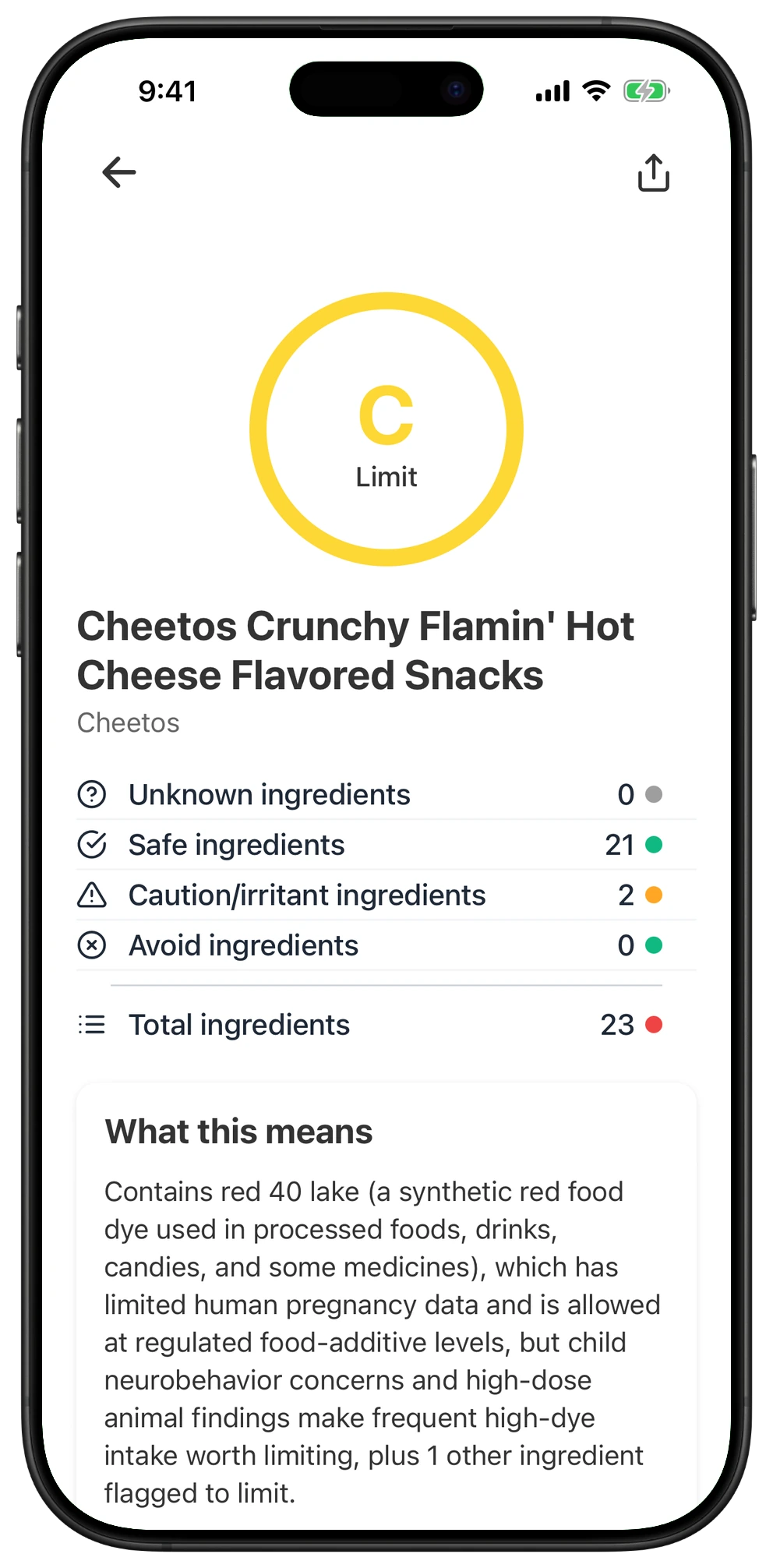
| Varies C (1), C+ (1), C- (1) | Cheetos Crunchy Flamin' Hot Cheese Flavored Snacks | Cheetos | Snack |
| C+ | Takis Fuego | Takis | Tortilla Chip |
| B+ | Buldak Carbonara | Samyang | Ramen |
| Varies C (2), C+ (2), C- (2) | Doritos Nacho Cheese Flavored Tortilla Chips | Doritos | Tortilla Chip |
| Varies C+ (1), C- (3), D+ (1) | Doritos Cool Ranch Flavored Tortilla Chips | Doritos | Tortilla Chip |
How Do Products Containing Monosodium Glutamate Score?
It can be helpful to see how products containing monosodium glutamate generally score during pregnancy. This does not tell you whether your exact product is safe, but it gives you a general idea of what we found. In this breakdown of 3 products, 100% receive a B grade. A B grade means the complete formula is likely safe, with minimal identified risk.
Frequently Asked Questions About Monosodium Glutamate During Pregnancy
Are MSG, sodium glutamate, and E621 the same ingredient?
Yes. MSG is the common abbreviation for monosodium glutamate, also called sodium glutamate and identified on some labels as E621.
Does the answer differ during the first or third trimester?
The available evidence does not provide trimester specific conclusions. The supported distinction is between typical food additive exposure and very high intake, with limited pregnancy specific human data overall.
Which foods commonly contain MSG?
MSG commonly appears in savory foods such as soups, sausages, seasoned snacks, tortilla and potato chips, salad dressings, sauces, bouillon, and instant noodles. It is also sold as a standalone seasoning.
Does MSG make ramen or seasoned snacks pregnancy safe?
No. MSG itself is low concern at typical food additive levels, but that does not establish the pregnancy safety or overall quality of a complete food product with other ingredients.
Why does the amount of MSG matter?
Typical food use is considered low concern, but EFSA noted that some high consuming groups could exceed the group acceptable daily intake for glutamic acid and glutamates. Very high additive intake is therefore less certain.
Do high dose animal studies describe ordinary dietary MSG exposure?
Not necessarily. High dose animal or supplement exposures should not be treated as equivalent to the smaller amounts generally encountered when MSG is used as a food additive.
What does “likely safe” mean for MSG?
It means the available evidence indicates low concern at typical food additive levels. It is not an unconditional conclusion for every amount or exposure, particularly because pregnancy specific human data are limited.
How Do We Score Products for Pregnancy Safety?
We analyze each product's ingredients and category to flag known risks and provide cautionary notices for general category safety concerns.
A - Safe
Excellent choice! All ingredients are considered safe during pregnancy.
What to do: Use with confidence.
B - Likely Safe
Pretty much safe with very minimal risk. Some ingredients may have limited pregnancy studies, but no significant safety concerns have been identified.
What to do: Use with confidence.
C - Limit
Contains ingredients with some pregnancy considerations. Research shows these ingredients may have limited safety data, potential for minor hormonal effects, or require caution based on animal studies.
What to do: Use sparingly and consider safer alternatives when available.
D - Caution
Similar to C grade but contains multiple cautionary ingredients. The combination increases overall concern.
What to do: Try to avoid if that makes you feel better. If you've already used it, no need to panic.
F - Avoid
Contains an ingredient Pregnancy Safe recommends avoiding during pregnancy. This may reflect an established risk or a precaution based on limited evidence; check the ingredient guidance and exposure context.
What to do: Do not use during pregnancy. If you've already used it, don't worry - contact your OBGYN if concerned.
Sources
- https://efsa.onlinelibrary.wiley.com/doi/10.2903/j.efsa.2017.4910
- https://pmc.ncbi.nlm.nih.gov/articles/PMC10104942/
- https://pmc.ncbi.nlm.nih.gov/articles/PMC6952072/
- https://pubmed.ncbi.nlm.nih.gov/32625571/
- https://www.fda.gov/food/food-additives-petitions/questions-and-answers-monosodium-glutamate-msg