Is Chicken Safe During Pregnancy? (Updated 2026 Guide)
Updated September 10, 2026
The Answer
Yes, you can eat chicken during pregnancy when it is fully cooked to 165°F and handled safely. Take care with storage and preparation: undercooked chicken, unheated deli poultry, and premade deli chicken salad need different precautions.
The main concern with chicken during pregnancy is foodborne illness from undercooking, cross contamination, or improper storage not chicken as an ingredient. Check that all poultry, including ground chicken, reaches 165°F with a food thermometer; color and clear juices are not reliable safety tests. Refrigerate promptly, reheat properly stored leftovers to 165°F, and avoid premade deli chicken salad.
Pregnancy Safe is 100% independent and research driven. No companies pay to promote or sponsor products.
Stress Less This Pregnancy
Check your exact chicken in the app

✓ What's Safe
- • Use a food thermometer to confirm chicken reaches 165°F, including ground chicken.
- • Follow package cooking directions for frozen or breaded chicken, then check its internal temperature.
- • Keep raw chicken separate from ready to eat food during storage and preparation.
- • Refrigerate chicken within 2 hours, or within 1 hour when the temperature is above 90°F.
- • Keep cooked leftovers at 40°F or below, use within 3–4 days, and reheat to 165°F.
- • Choose deli sliced chicken only when reheated to 165°F or until steaming hot before eating.
✗ What to Avoid
- • Avoid raw or undercooked chicken; do not apply beef cooking temperatures to poultry.
- • Do not rely on browned breading, clear juices, or a pink free center to establish that chicken is cooked.
- • Do not wash raw chicken, because splashing can spread germs.
- • Avoid chicken left unrefrigerated beyond 2 hours, or 1 hour above 90°F; reheating does not rescue improperly stored food.
- • Avoid cold, unheated deli sliced chicken and premade deli chicken salad.
- • Do not treat organic, free range, hormone free, or ingredient grade labels as guarantees against contamination.
Ingredients in the Reviewed Sample
Selected ingredients are counted once per product where the reviewed source label declares them. Compound label phrases are normalized. These are occurrence counts, not amounts or a complete ingredient list.
Chicken Products We've Analyzed
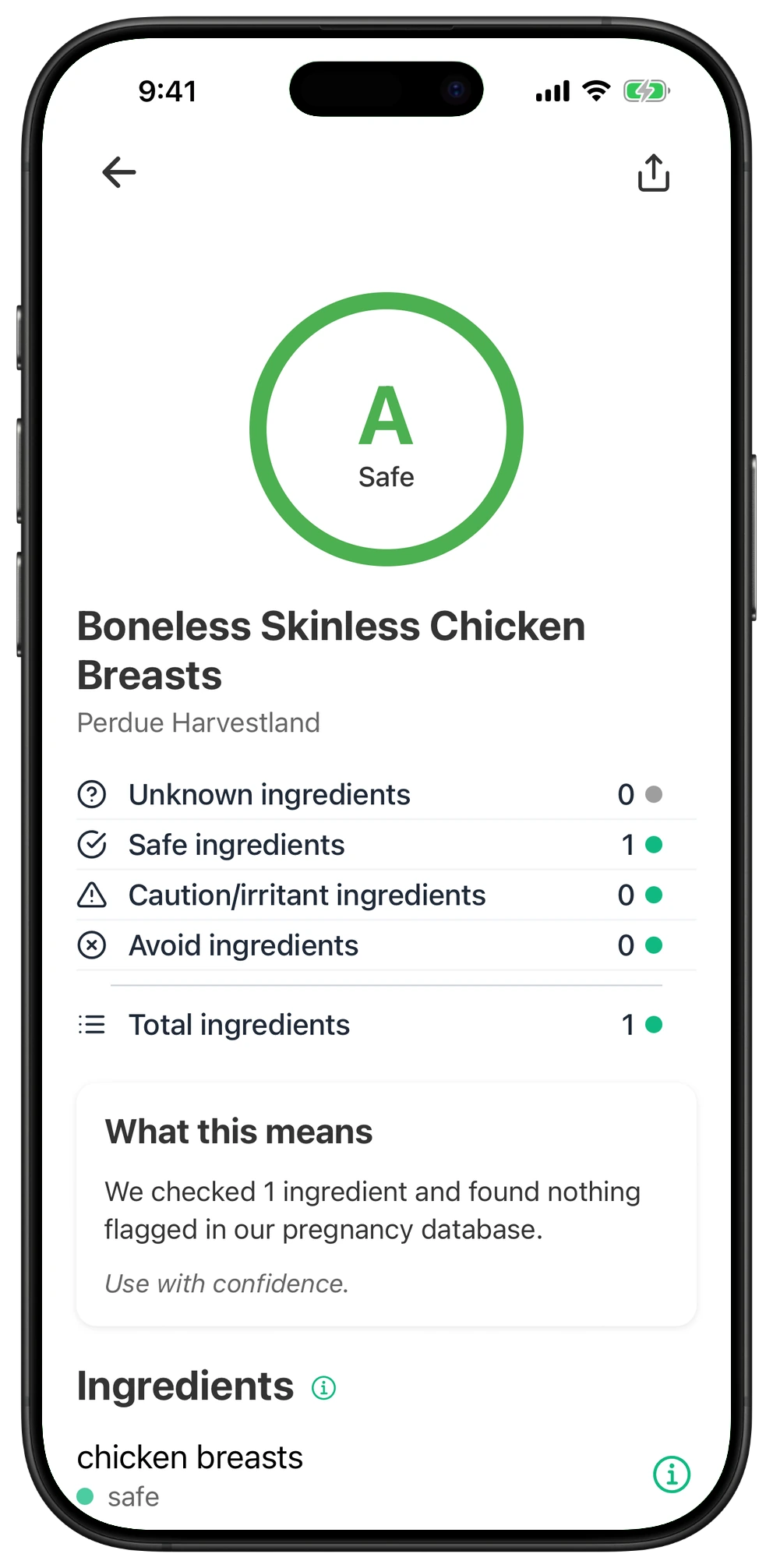
This page uses a source-reviewed sample of 1 chicken product record. It is not a comprehensive catalog count or a pregnancy-safety ranking.
This source-reviewed sample contains 1 stored label record. It is not a market-wide count, complete current-label verification, or product recommendation. Ingredient grades do not measure preparation, storage, caffeine, mercury or contamination; use the food-specific guidance above.
Your Questions Answered
Can you eat chicken when pregnant?
Yes, chicken meat can be eaten during pregnancy when fully cooked and handled safely. Use a food thermometer to confirm it reaches 165°F, including ground chicken. Safe handling and prompt refrigeration matter just as much as cooking.
How do I know chicken is fully cooked?
Check its internal temperature with a food thermometer: all poultry must reach 165°F. Clear juices, meat color, and a pink free appearance are not reliable substitutes. Use the poultry temperature even for ground chicken, rather than a temperature intended for beef.
Can I eat frozen or breaded chicken during pregnancy?
Yes, provided you follow the package cooking directions and confirm the chicken reaches 165°F. Browned breading does not prove that the center is fully cooked. Treat the thermometer reading, not the outside appearance, as your cooking check.
How should I store and reheat leftover chicken?
Refrigerate cooked chicken within 2 hours, or within 1 hour if the temperature is above 90°F. Keep it at 40°F or below and use refrigerated leftovers within 3–4 days. Reheat properly stored leftovers to 165°F. Do not try to make improperly stored chicken safe by reheating it.
Can I eat deli chicken or premade chicken salad?
Deli sliced chicken is different from freshly cooked chicken: reheat it to 165°F or until steaming hot before eating. CDC advises avoiding premade deli chicken salad during pregnancy. Do not assume a chilled, ready to eat chicken dish has the same precautions as freshly cooked meat.
Is organic or free range chicken safer during pregnancy?
Organic, free range, and hormone free labels do not guarantee protection against foodborne illness. You still need to cook chicken to 165°F, prevent cross contamination, and refrigerate it promptly. An ingredient grade also cannot establish whether chicken was cooked or stored safely.
How Do We Score Products for Pregnancy Safety?
We analyze each product's ingredients and category to flag known risks and provide cautionary notices for general category safety concerns.
Grades reflect the ingredient and category information available to us. They don’t verify a complete, current label or account for dose, preparation, or contamination. Read them alongside the guidance above, not as a guarantee of pregnancy safety or proof that every use is harmful.
A - Safe
Excellent choice! All ingredients are considered safe during pregnancy.
What to do: Use with confidence.
B - Likely Safe
Pretty much safe with very minimal risk. Some ingredients may have limited pregnancy studies, but no significant safety concerns have been identified.
What to do: Use with confidence.
C - Limit
Contains ingredients with some pregnancy considerations. Research shows these ingredients may have limited safety data, potential for minor hormonal effects, or require caution based on animal studies.
What to do: Use sparingly and consider safer alternatives when available.
D - Caution
Similar to C grade but contains multiple cautionary ingredients. The combination increases overall concern.
What to do: Try to avoid if that makes you feel better. If you've already used it, no need to panic.
F - Avoid
Contains an ingredient Pregnancy Safe recommends avoiding during pregnancy. This may reflect an established risk or a precaution based on limited evidence; check the ingredient guidance and exposure context.
What to do: Do not use during pregnancy. If you've already used it, don't worry - contact your OBGYN if concerned.