Is Hibiscus Safe During Pregnancy?
Updated September 11, 2026
The Answer
Use caution with hibiscus during pregnancy, especially medicinal teas and supplements. Human pregnancy safety data are very limited, and hibiscus can lower blood pressure; this is not a blanket instruction to avoid every food containing it.
Medicinal hibiscus teas or supplements deserve particular caution if you have low blood pressure or take blood pressure lowering medicines.
A small second trimester pilot found short term tolerability but could not establish safety; adult trials show blood pressure lowering, while animal studies raise indirect developmental concerns with continuous extract dosing.
Already used it? If you have already consumed hibiscus, discuss the preparation, amount, and frequency with your prenatal clinician, especially if you have low blood pressure or take blood pressure lowering medicines.
Pregnancy Safe is 100% independent and research driven. No companies pay to promote or sponsor products.
Stressless Pregnancy
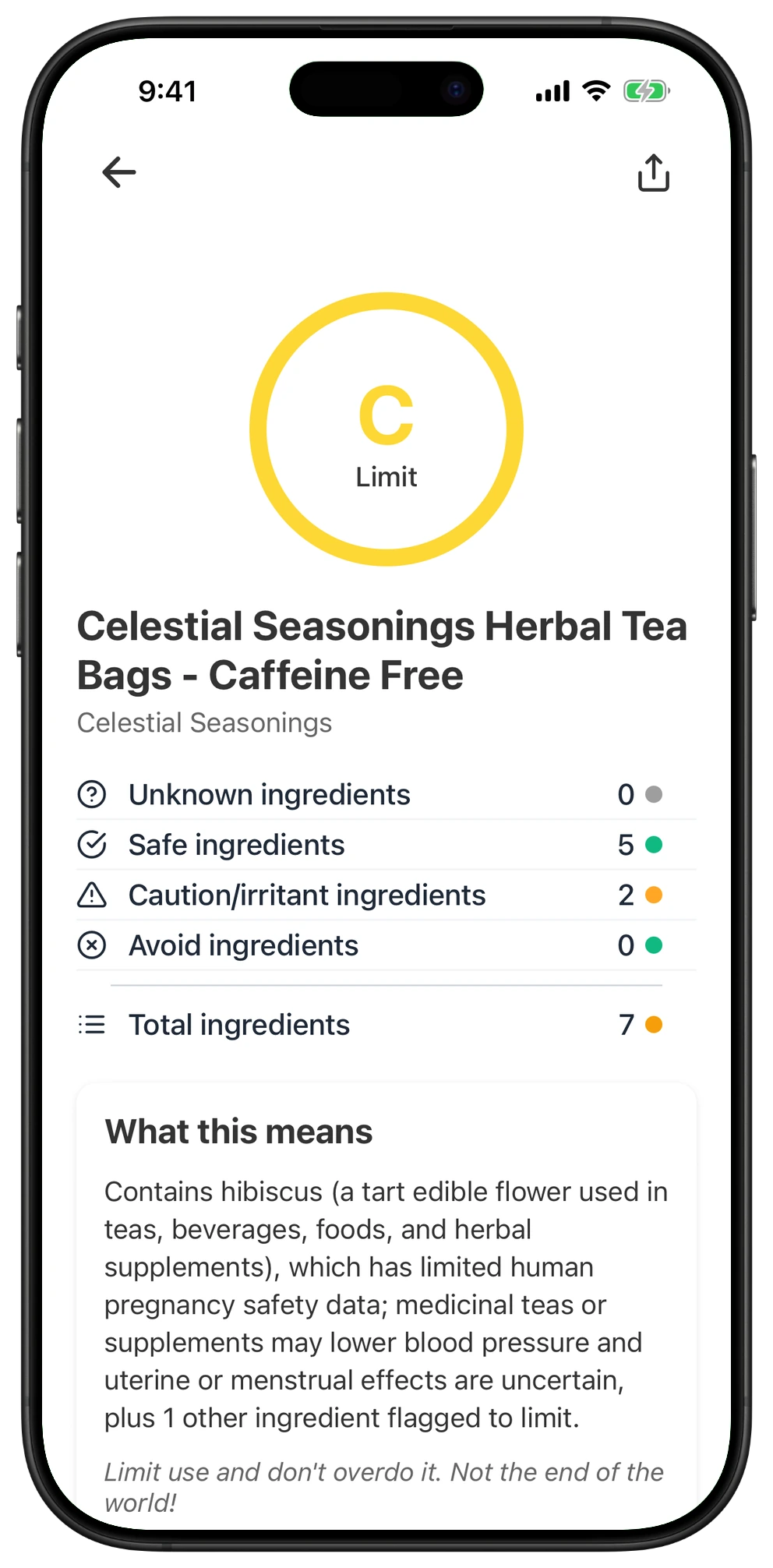
Check your exact product with hibiscus in the app
What Is Hibiscus?
You may also see it listed as: Hibiscus sabdariffa, roselle
The edible hibiscus discussed here is Hibiscus sabdariffa, also called roselle. Its tart flowers are used for flavor in teas, infusions, beverages, and foods such as jams. You may also encounter it as dried flowers, herbal powders, extracts, and supplements, or in blends such as flavored waters and kombucha.
What Other Ingredients Should You Look Out for in Products With Hibiscus?
A product's full ingredient list determines whether it's pregnancy-safe or not. These ingredients also appear in some of the hibiscus products we analyzed and may deserve a closer look.
Licorice Root
AvoidLook for “licorice root” in tea blends: regular or medicinal exposure to its glycyrrhizin can raise blood pressure and lower potassium, and medicinal licorice is discouraged during pregnancy. Check whether it is a regular herbal ingredient rather than incidental food flavoring.
Flagged in 4 products (4.1%) in this analysis.
Kombucha
Caution“Kombucha” or “live kombucha culture” in these fermented drinks calls for checking pasteurization, alcohol content, and caffeine. Raw or unpasteurized versions carry more uncertainty than pasteurized, alcohol controlled commercial versions, but neither description alone establishes pregnancy safety.
Flagged in 11 products (11.3%) in this analysis.
Black Tea
Caution“Black tea” or “organic black tea” can contribute caffeine in fermented drinks and other foods; the ingredient name alone does not tell you how much. Check the product’s caffeine per serving and your daily total against pregnancy guidance to stay below 200 mg.
Flagged in 7 products (7.2%) in this analysis.
Raspberry Leaf
CautionLook for “raspberry leaf” or “raspberry leaves” in teas and health tonics, not just raspberry flavor. Pregnancy safety and labor preparation benefits remain uncertain, so review timing and concentration with your prenatal clinician, particularly for early pregnancy or high dose use.
Flagged in 5 products (5.2%) in this analysis.
Horseradish
Caution“Horseradish” in a health tonic deserves a different check from a small amount of condiment: medicinal products or large regular doses are discouraged during pregnancy. Check the tonic’s intended use and serving instructions to distinguish medicinal dosing from culinary flavoring.
Flagged in 2 products (2.1%) in this analysis.
Valerian
CautionLook for “valerian” in supplements marketed for sleep or relaxation: EMA does not recommend pregnancy use because safety data are insufficient, and it may add to sedation. Ask your clinician or pharmacist to review the formula alongside any sedating medicines.
Flagged in 1 product (1%) in this analysis.
Does the Form or Amount of Hibiscus Matter During Pregnancy?
Hibiscus in food, brewed tea, and supplements should not be treated as equivalent exposures. The animal developmental concerns arose with continuous extract dosing and do not establish harm from an occasional food or drink. Medicinal teas and supplements warrant caution because adult trials show blood pressure lowering effects, while human pregnancy evidence does not establish a safe amount or brewing strength.
What Products Contain Hibiscus?
Pregnancy Safe has looked at 564 products that have hibiscus as an ingredient. The category and grade breakdowns below use 97 products whose names mention Hibiscus or another name for it.
What Types of Products Contain Hibiscus?
Products You May Have That Contain Hibiscus
| Grade | Product | Brand | Type |
|---|---|---|---|
| C+ | Organic Hibiscus Flower Tea | Celebration Herbals | Herbal Tea |
| C+ | Mixed Berries & Hibiscus Herbal Infusion | Ahmad Tea | Herbal Tea |
| C+ | Strawberry Hibiscus Preserves | Beau Bien Fine Foods Llc | Jam |
| C+ | Hibiscus Marmalade | Kalustyan'S | Marmalade |
| C | Organic Elderberry Hibiscus Herbal Tea | Newman'S Own Organics | Herbal Tea |
| F | Hibiscus & Rosehips Kombucha | Rise | Kombucha |
| F | Stash Wild Raspberry Hibiscus Caffeine Free Herbal Tea Bags 20 Count | The Stash Tea Company | Herbal Tea |
| F | Vmc Jamaica Hibiscus Cocktail 12Oz | Vmc | Cocktail |
How Do Products Containing Hibiscus Score?
It can be helpful to see how products containing hibiscus generally score during pregnancy. This does not tell you whether your exact product is safe, but it gives you a general idea of what we found. In this breakdown of 97 products, 81% receive a C grade. A C grade means the complete formula has some pregnancy considerations, so use it sparingly and consider a higher scoring alternative when one is available.
Frequently Asked Questions About Hibiscus During Pregnancy
What if I accidentally drank hibiscus tea while pregnant?
The available evidence cannot determine the risk from a single cup. Animal concerns involved continuous extract dosing, not an accidental drink; share the tea label and how much you drank with your prenatal clinician, especially if low blood pressure or blood pressure medicines are relevant.
Is hibiscus safer in the second or third trimester?
No trimester specific safety conclusion is established. A small second trimester pilot found short term tolerability, but that does not establish safety throughout the second trimester or in the first or third.
Does hibiscus cause miscarriage or induce labor?
Claims about menstrual or uterine effects remain uncertain rather than proven in humans. The available evidence does not establish that hibiscus causes miscarriage or is a safe, effective way to induce labor.
Who needs extra caution with hibiscus?
If you have low blood pressure or take antihypertensive medicines, medicinal hibiscus teas and supplements deserve particular caution. Adult trials show that hibiscus can lower blood pressure.
How much hibiscus tea can I drink during pregnancy?
The available pregnancy evidence does not establish a safe number of cups, brewing strength, or daily dose. Short term tolerability in a small pilot is not enough to set a drinking limit.
Is hibiscus in jam the same as taking a supplement?
No. Food use and medicinal preparations are different exposures, and continuous extract dosing in animals cannot be directly applied to hibiscus containing jam. That distinction does not establish a pregnancy safe serving size or make a complete product pregnancy safe.
How Do We Score Products for Pregnancy Safety?
We analyze each product's ingredients and category to flag known risks and provide cautionary notices for general category safety concerns.
A - Safe
Excellent choice! All ingredients are considered safe during pregnancy.
What to do: Use with confidence.
B - Likely Safe
Pretty much safe with very minimal risk. Some ingredients may have limited pregnancy studies, but no significant safety concerns have been identified.
What to do: Use with confidence.
C - Limit
Contains ingredients with some pregnancy considerations. Research shows these ingredients may have limited safety data, potential for minor hormonal effects, or require caution based on animal studies.
What to do: Use sparingly and consider safer alternatives when available.
D - Caution
Similar to C grade but contains multiple cautionary ingredients. The combination increases overall concern.
What to do: Try to avoid if that makes you feel better. If you've already used it, no need to panic.
F - Avoid
Contains an ingredient Pregnancy Safe recommends avoiding during pregnancy. This may reflect an established risk or a precaution based on limited evidence; check the ingredient guidance and exposure context.
What to do: Do not use during pregnancy. If you've already used it, don't worry - contact your OBGYN if concerned.
Sources
- https://mothertobaby.org/fact-sheets/herbal-products-pregnancy/
- https://pmc.ncbi.nlm.nih.gov/articles/PMC9086798/
- https://pubmed.ncbi.nlm.nih.gov/18066103/
- https://pubmed.ncbi.nlm.nih.gov/19434218/
- https://www.ffhdj.com/index.php/ffhd/article/view/1768
- https://www.ncbi.nlm.nih.gov/books/NBK501882/
- https://www.nccih.nih.gov/health/hypertension-high-blood-pressure
- https://www.nccih.nih.gov/health/licorice-root
- https://webprod.hc-sc.gc.ca/nhpid-bdipsn/dbImages/mono_licorice_english.pdf
- https://www.ema.europa.eu/en/medicines/herbal/liquiritiae-radix
- https://www.medsafe.govt.nz/profs/PUArticles/December2019/Liquorice-side-effects-interactions.htm
- https://www.bfr.bund.de/cm/349/does-the-consumption-of-liquorice-by-pregnant-women-impair-the-mental-and-physical-development-of-children.pdf
- https://pubmed.ncbi.nlm.nih.gov/28158597/
- https://pubmed.ncbi.nlm.nih.gov/11390327/
- https://mothertobaby.org/baby-blog/kombucha-pregnancy-answers/
- https://www.cdc.gov/food-safety/foods/pregnant-women.html
- https://www.fda.gov/food/people-risk-foodborne-illness/fruits-veggies-and-juices-food-safety-moms-be
- https://www.cdc.gov/alcohol-pregnancy/about/index.html
- https://www.ttb.gov/kombucha/kombucha-general/print
- https://pubmed.ncbi.nlm.nih.gov/20664420/
- https://www.mdpi.com/2311-5637/10/8/385
- https://www.cdc.gov/mmwr/preview/mmwrhtml/00039742.htm
- https://journals.sagepub.com/doi/10.1177/0885066609332963
- https://www.foodprotection.org/members/fpt-archive-articles/2025-03-determining-critical-food-safety-factors-for-safely-homebrewing-kombucha-a-study-on-microbia/
- https://www.acog.org/womens-health/experts-and-stories/ask-acog/how-much-coffee-can-i-drink-while-pregnant
- https://www.acog.org/clinical/clinical-guidance/committee-opinion/articles/2010/08/moderate-caffeine-consumption-during-pregnancy
- https://www.fda.gov/consumers/consumer-updates/spilling-beans-how-much-caffeine-too-much
- https://www.nhsinform.scot/ready-steady-baby/pregnancy/looking-after-yourself-and-your-baby/eating-well-in-pregnancy/
- https://www.mayoclinic.org/healthy-lifestyle/pregnancy-week-by-week/in-depth/pregnancy-nutrition/art-20043844
- https://pubmed.ncbi.nlm.nih.gov/10999016/
- https://pmc.ncbi.nlm.nih.gov/articles/PMC5998341/
- https://cot.food.gov.uk/print/pdf/node/12376
- https://pubmed.ncbi.nlm.nih.gov/33563275/
- https://pubmed.ncbi.nlm.nih.gov/38649906/
- https://pubmed.ncbi.nlm.nih.gov/11370690/
- https://www.ema.europa.eu/en/documents/herbal-report/final-assessment-report-rubus-idaeus-l-folium_en.pdf
- https://health-products.canada.ca/lnhpd-bdpsnh/info?licence=80012819
- https://webprod.hc-sc.gc.ca/nhpid-bdipsn/atReq?atid=horseradish.raifort&lang=eng
- https://inchem.org/documents/jecfa/jeceval/jec_71.htm
- https://hfpappexternal.fda.gov/scripts/fdcc/index.cfm?id=ALLYLISOTHIOCYANATE&set=FoodSubstances
- https://pmc.ncbi.nlm.nih.gov/articles/PMC13085108/
- https://pubmed.ncbi.nlm.nih.gov/22129740/
- https://www.drugs.com/npp/horseradish.html
- https://www.nccih.nih.gov/health/valerian
- https://www.ema.europa.eu/en/medicines/herbal/valerianae-radix
- https://www.ema.europa.eu/en/documents/herbal-monograph/final-european-union-herbal-monograph-valeriana-officinalis-l-radix_en.pdf
- https://webprod.hc-sc.gc.ca/nhpid-bdipsn/atReq?atid=valerian2&lang=eng
- https://www.aafp.org/afp/2023/1000/otc-medications-pregnancy
- https://pubmed.ncbi.nlm.nih.gov/17992658/
- https://pubmed.ncbi.nlm.nih.gov/17611059/
- https://pubmed.ncbi.nlm.nih.gov/22500716/