Is Valerian Safe During Pregnancy?
Updated September 12, 2026
The Answer
Valerian teas and oral supplements warrant caution during pregnancy, especially routine high dose supplement use. Human pregnancy data are limited, and the European Medicines Agency (EMA) does not recommend valerian root medicines during pregnancy because safety has not been established.
Taking valerian by mouth is different from applying a cosmetic extract: topical caution reflects missing pregnancy and absorption studies, not evidence that normal cosmetic use causes fetal harm.
A Swedish birth registry study found no significant effect on the infant outcomes studied among early pregnancy herbal users, including valerian, but exposure numbers were low and rare risks could not be excluded.
Already used it? If you have already taken valerian, share the product label, amount and frequency with your pregnancy care clinician or pharmacist, including any sedating medicines or alcohol used alongside it.
Pregnancy Safe is 100% independent and research driven. No companies pay to promote or sponsor products.
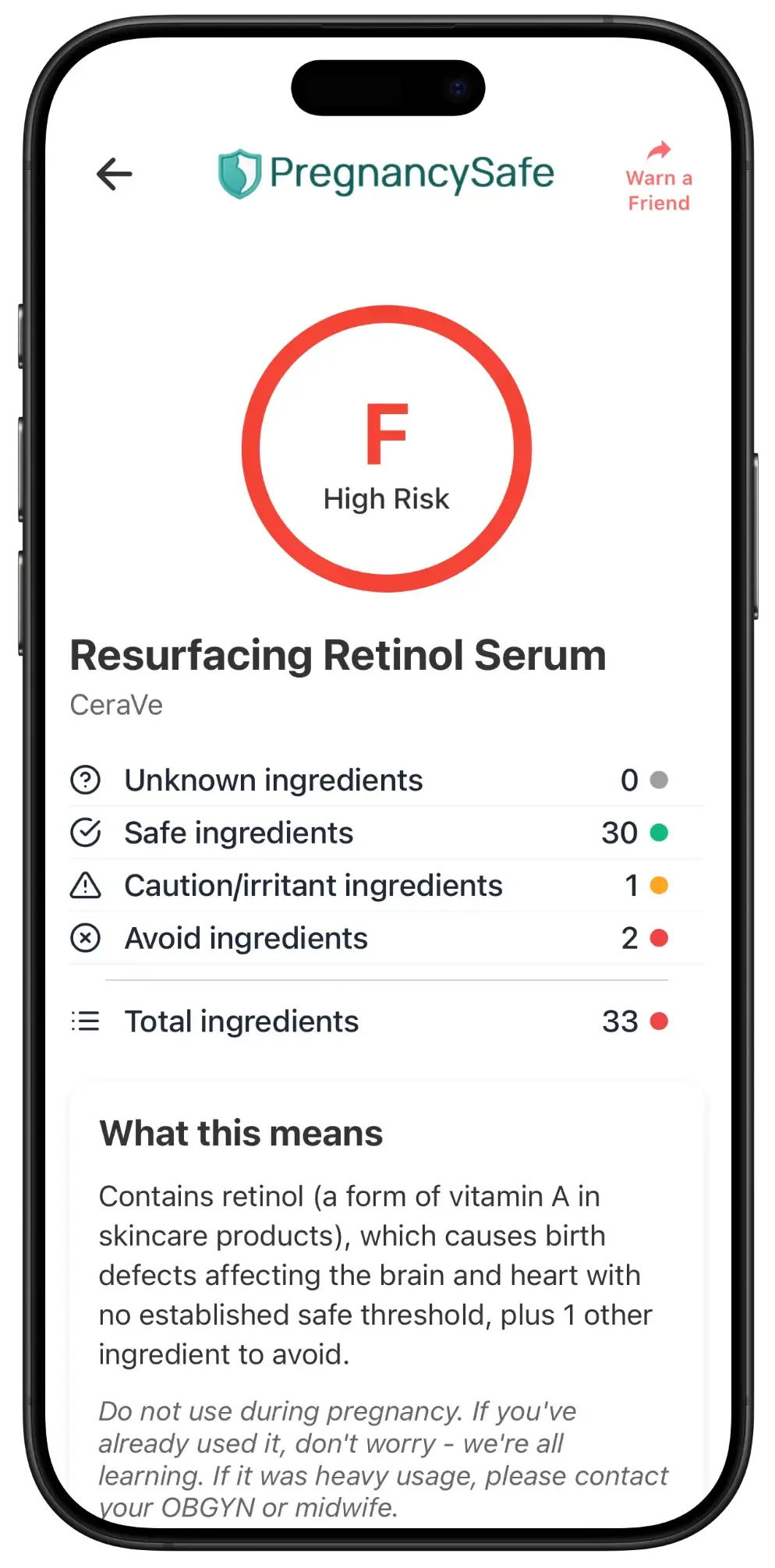
Stress Less This Pregnancy
Check your exact product in the app—the full formula matters
What Is Valerian?
You may also see it listed as: Valeriana officinalis, Garden heliotrope, baldrian
Valerian is the root of Valeriana officinalis, a flowering plant used in teas and oral supplements for sleep, stress, anxiety and mild nervous tension. You may find it as root material or extracts in herbal supplements and sleep aids. Root or rhizome extracts also condition skin, scalp or hair in topical products.
What Other Ingredients Should You Look Out for in Products With Valerian?
A product's full ingredient list determines whether it's pregnancy-safe or not. These ingredients also appear in some of the valerian products we analyzed and may deserve a closer look.
Cannabidiol
AvoidLook for cannabidiol, also called CBD, in herbal supplements: FDA and CDC advise against CBD during pregnancy because its effects are uncertain. Check for CBD even when the package says THC free; that claim does not resolve pregnancy concerns.
Flagged in 2 products (1.7%) in this analysis.
Dong Quai
AvoidCheck sleep aid blends for dong quai, the root of Angelica sinensis. Herb references recommend against medicinal use during pregnancy because of limited human data and uterine activity concerns; ask a pharmacist to review the blend, especially with blood thinning medicines.
Flagged in 2 products (1.7%) in this analysis.
Tulsi
AvoidHoly basil on a supplement label means tulsi, not simply a culinary herb amount. Health Canada contraindicates holy basil natural health products during pregnancy; flag it for clinician review because human data are limited and animal reproductive studies raise concerns.
Flagged in 1 product (0.8%) in this analysis.
Chamomile
CautionLook for chamomile, chamomile flowers or chamomile flower extract in sleep aids and supplements, then check the species and preparation. EMA's acceptance of German chamomile flower infusion does not establish safety for Roman chamomile or many extracts.
Flagged in 7 products (5.9%) in this analysis.
Melatonin
CautionCheck combination supplements for melatonin: supplemental melatonin is not equivalent to the hormone your body naturally makes, and pregnancy sleep use data are limited. Review the labeled dose and intended use with your clinician rather than assuming a sleep blend is suitable.
Flagged in 1 product (0.8%) in this analysis.
Tryptophan
CautionLook for L tryptophan in supplement blends; isolated supplements have limited pregnancy evidence, unlike normal tryptophan intake from protein foods. Ask a pharmacist to check for serotonin related interactions, especially with antidepressants or other serotonergic medicines.
Flagged in 1 product (0.8%) in this analysis.
Does the Form or Amount of Valerian Matter During Pregnancy?
Routine high dose oral supplementation deserves particular caution; the available evidence does not establish a pregnancy safe tea strength or supplement dose. Oral valerian may add sedation or interact with alcohol or sedative medicines. Those cautions have not been established for topical cosmetics. EMA's topical medicinal preparation is a 100 g whole root bath additive, not a typical cosmetic formulation, so its guidance should not be treated as direct evidence about ordinary cosmetic extracts.
What Products Contain Valerian?
Pregnancy Safe has looked at 301 products that have valerian as an ingredient. The category and grade breakdowns below use 119 products whose names mention Valerian or another name for it.
What Types of Products Contain Valerian?
Products You May Have That Contain Valerian
| Grade | Product | Brand | Type |
|---|---|---|---|
| C+ | Valerian Root 450 Mg | Absorb Health | Dietary Supplement |
| C+ | Valerian Root | Nature'S Way | Herbal Supplement |
| C- | Skinny Dreams With Melatonin & Valerian Root | Angry Supplements | Dietary Supplement |
| C+ | Valerian Root 450 Mg | Best Naturals | Dietary Supplement |
| F | A.Vogel Valerian Complex | Bioforce | Dietary Supplement |
| C+ | Valerian 250 Mg | Biovea | Dietary Supplement |
| C | Valerian 500 Mg | Biovea | Dietary Supplement |
| C+ | Valerian Root Extract | Bluebonnet | Herbal Supplement |
How Do Products Containing Valerian Score?
It can be helpful to see how products containing valerian generally score during pregnancy. This does not tell you whether your exact product is safe, but it gives you a general idea of what we found. In this breakdown of 119 products, 88% receive a C grade. A C grade means the complete formula has some pregnancy considerations, so use it sparingly and consider a higher scoring alternative when one is available.
Frequently Asked Questions About Valerian During Pregnancy
Is valerian root tea safer than a supplement?
The available pregnancy evidence does not establish that valerian tea is a safe alternative to supplements. Routine high dose supplements deserve particular caution, but no pregnancy safe tea strength or frequency has been established.
Can valerian root cause miscarriage?
The available human evidence does not establish that valerian causes miscarriage. It also cannot rule out pregnancy risks: human exposure numbers are low, and mixed animal and laboratory findings do not directly establish effects in pregnant people.
Can I take valerian every night for sleep during pregnancy?
Nightly use should not be assumed safe. Pregnancy data are limited, routine high dose oral use deserves particular caution, and EMA does not recommend valerian root medicines during pregnancy because safety data are insufficient.
Is a lower dose valerian supplement proven safe?
No pregnancy safe supplement dose has been established by the available evidence. A lower number on the label does not by itself demonstrate pregnancy safety.
Does valerian in a cream carry the same concerns as taking it orally?
Not the same evidence based concerns. Pregnancy and dermal absorption studies of cosmetic valerian extracts were not found, so topical use warrants caution because of uncertainty. Oral sedation and alcohol or sedative drug cautions have not been established for topical cosmetics.
Can valerian interact with other sleep medicines?
Oral valerian may add sedation or interact with sedative medicines and alcohol. Have a pharmacist or your pregnancy care clinician review the combination rather than judging valerian on its own.
How Do We Score Products for Pregnancy Safety?
We analyze each product's ingredients and category to flag known risks and provide cautionary notices for general category safety concerns.
A - Safe
Excellent choice! All ingredients are considered safe during pregnancy.
What to do: Use with confidence.
B - Likely Safe
Pretty much safe with very minimal risk. Some ingredients may have limited pregnancy studies, but no significant safety concerns have been identified.
What to do: Use with confidence.
C - Limit
Contains ingredients with some pregnancy considerations. Research shows these ingredients may have limited safety data, potential for minor hormonal effects, or require caution based on animal studies.
What to do: Use sparingly and consider safer alternatives when available.
D - Caution
Similar to C grade but contains multiple cautionary ingredients. The combination increases overall concern.
What to do: Try to avoid if that makes you feel better. If you've already used it, no need to panic.
F - Avoid
Contains an ingredient Pregnancy Safe recommends avoiding during pregnancy. This may reflect an established risk or a precaution based on limited evidence; check the ingredient guidance and exposure context.
What to do: Do not use during pregnancy. If you've already used it, don't worry - contact your OBGYN if concerned.
Sources
- https://ods.od.nih.gov/factsheets/Valerian-HealthProfessional/
- https://pubmed.ncbi.nlm.nih.gov/17611059/
- https://pubmed.ncbi.nlm.nih.gov/17992658/
- https://pubmed.ncbi.nlm.nih.gov/22500716/
- https://pubmed.ncbi.nlm.nih.gov/39128798/
- https://webprod.hc-sc.gc.ca/nhpid-bdipsn/atReq?atid=valerian2&lang=eng
- https://webprod.hc-sc.gc.ca/nhpid-bdipsn/ingredReq?id=13425
- https://www.aafp.org/afp/2023/1000/otc-medications-pregnancy
- https://www.ema.europa.eu/en/documents/herbal-monograph/final-european-union-herbal-monograph-valeriana-officinalis-l-radix_en.pdf
- https://www.ema.europa.eu/en/documents/herbal-report/final-assessment-report-valeriana-officinalis-l-radix-and-valeriana-officinalis-l-aetheroleum_en.pdf
- https://www.ema.europa.eu/en/medicines/herbal/valerianae-radix
- https://www.frontiersin.org/journals/pharmacology/articles/10.3389/fphar.2023.1123194/full
- https://www.nccih.nih.gov/health/valerian
- https://www.fda.gov/consumers/consumer-updates/what-you-should-know-about-using-cannabis-including-cbd-when-pregnant-or-breastfeeding
- https://www.cdc.gov/cannabis/about/about-cbd.html
- https://www.cdc.gov/cannabis/health-effects/pregnancy.html
- https://mothertobaby.org/fact-sheets/marijuana-pregnancy/
- https://www.acog.org/clinical/clinical-guidance/clinical-consensus/articles/2025/10/cannabis-use-during-pregnancy-and-lactation
- https://www.accessdata.fda.gov/drugsatfda_docs/label/2024/210365s021lbl.pdf
- https://pmc.ncbi.nlm.nih.gov/articles/PMC12053797/
- https://www.fda.gov/consumers/consumer-updates/what-you-need-know-and-what-were-working-find-out-about-products-containing-cannabis-or-cannabis
- https://pubmed.ncbi.nlm.nih.gov/40454463/
- https://www.mskcc.org/cancer-care/integrative-medicine/herbs/dong-quai
- https://www.drugs.com/npp/dong-quai.html
- https://mothertobaby.org/fact-sheets/herbal-products-pregnancy/
- https://www.ncbi.nlm.nih.gov/books/NBK501836/
- https://www.ema.europa.eu/en/documents/herbal-report/final-assessment-report-angelica-sinensis-oliv-diels-radix-first-version_en.pdf
- https://pubmed.ncbi.nlm.nih.gov/10417036/
- https://pubmed.ncbi.nlm.nih.gov/20110895/
- https://pubmed.ncbi.nlm.nih.gov/7646782/
- https://www.nccih.nih.gov/health/menopausal-symptoms-in-depth
- https://pubmed.ncbi.nlm.nih.gov/10730024/
- https://www.fhi.no/contentassets/f08343d5155e413284f5c31a6b415b51/fhi-report-holy-basil-271123.pdf
- https://webprod.hc-sc.gc.ca/nhpid-bdipsn/atReq?atid=ocimum.tenuliflorum.leaf.feuille&lang=eng
- https://www.merckmanuals.com/home/special-subjects/dietary-supplements-and-vitamins/holy-basil
- https://www.drugs.com/npp/holy-basil.html
- https://www.ncbi.nlm.nih.gov/books/NBK582743/
- https://bsh.ahpa.org/SampleHerb4.aspx
- https://www.phytojournal.com/archives/2022/vol11issue4/PartD/11-4-54-138.pdf
- https://pubmed.ncbi.nlm.nih.gov/12099405/
- https://www.nccih.nih.gov/health/chamomile
- https://www.ema.europa.eu/en/documents/herbal-monograph/final-european-union-herbal-monograph-matricaria-recutita-l-flos-first-version_en.pdf
- https://www.ema.europa.eu/en/documents/herbal-monograph/final-community-herbal-monograph-chamaemelum-nobile-l-all-flos_en.pdf
- https://pubmed.ncbi.nlm.nih.gov/22516883/
- https://pubmed.ncbi.nlm.nih.gov/20872924/
- https://www.ncbi.nlm.nih.gov/books/NBK501808/
- https://www.ecfr.gov/current/title-21/chapter-I/subchapter-B/part-182/subpart-A/section-182.10
- https://mothertobaby.org/fact-sheets/melatonin/
- https://www.nccih.nih.gov/health/melatonin-what-you-need-to-know
- https://pmc.ncbi.nlm.nih.gov/articles/PMC9169489/
- https://pmc.ncbi.nlm.nih.gov/articles/PMC7081745/
- https://pubmed.ncbi.nlm.nih.gov/29766570/
- https://pmc.ncbi.nlm.nih.gov/articles/PMC10130950/
- https://pmc.ncbi.nlm.nih.gov/articles/PMC5263083/
- https://www.ncbi.nlm.nih.gov/books/NBK501863/
- https://www.fda.gov/food/dietary-supplements
- https://medlineplus.gov/ency/article/002332.htm
- https://ods.od.nih.gov/factsheets/Pregnancy-HealthProfessional/
- https://www.ncbi.nlm.nih.gov/books/NBK235221/
- https://pubmed.ncbi.nlm.nih.gov/42137190/
- https://pubmed.ncbi.nlm.nih.gov/23077193/
- https://www.mskcc.org/cancer-care/integrative-medicine/herbs/5-htp-01
- https://medlineplus.gov/ency/article/007272.htm
- https://www.cdc.gov/mmwr/preview/mmwrhtml/00001739.htm
- https://www.fda.gov/food/information-consumers-using-dietary-supplements/questions-and-answers-dietary-supplements
- https://www.drugs.com/mtm/l-tryptophan.html