Is Kombucha Safe During Pregnancy? (Updated 2026 Guide)
Updated September 9, 2026
The Answer
Skip kombucha during pregnancy because it can contain alcohol and may be unpasteurized, especially raw, hard or homebrewed versions. Pasteurized, alcohol controlled products reduce some concerns but are not automatically pregnancy safe.
Kombucha fermentation can leave residual alcohol, and continued fermentation can change its alcohol content; raw or unpasteurized drinks also raise microbial safety concerns. Black and green tea contribute caffeine, which counts toward keeping your total below 200 mg per day during pregnancy. These concerns support choosing a nonfermented beverage, not assuming every kombucha is contaminated or that a past drink caused harm.
Pregnancy Safe is 100% independent and research driven. No companies pay to promote or sponsor products.
Stress Less This Pregnancy
Check your exact kombucha in the app

✓ What's Safe
- • Choose a nonfermented drink, such as plain still or sparkling water, instead of kombucha.
- • Choose pasteurized juice if you want a fruit flavored alternative.
- • Check whether a drink is actually fermented tea rather than relying on probiotic or wellness branding.
- • Check caffeine per serving and servings per bottle; keep your total from all sources below 200 mg daily.
- • Read storage instructions and follow any refrigeration requirements; refrigeration alone does not establish pregnancy safety.
✗ What to Avoid
- • Avoid hard kombucha and other alcoholic beverages during pregnancy.
- • Skip raw or unpasteurized kombucha because microbial safety is an additional concern.
- • Avoid homebrewed kombucha, where alcohol content and fermentation conditions can be uncertain.
- • Do not treat a nonalcoholic label or an alcohol content below 0.5% ABV as proof of zero alcohol.
- • Do not assume pasteurized, organic, zero sugar or live culture claims make kombucha pregnancy safe.
Most Common Ingredients in Kombucha Products
We analyzed 1,018 kombucha products. Here are the most common ingredients, ranked by how often they appear:
Ingredients to Watch Out For in Kombucha
These are the most common flagged ingredients across 1,018 kombucha products we analyzed.
organic black tea
Caution
Organic black tea is a naturally cultivated, antioxidant rich beverage made from fermented Camellia sinensis leaves, offering a bold and invigorating flavor.
Is generally compatible in normal servings but contributes to the pregnancy caffeine limit and may interfere with iron absorption if taken with meals or iron supplements.
Flagged in 277 of 1,018 products (27%)
kombucha culture
Caution
A kombucha culture is a symbiotic colony of bacteria and yeast (SCOBY) used to ferment sweetened tea into the probiotic rich beverage, kombucha.
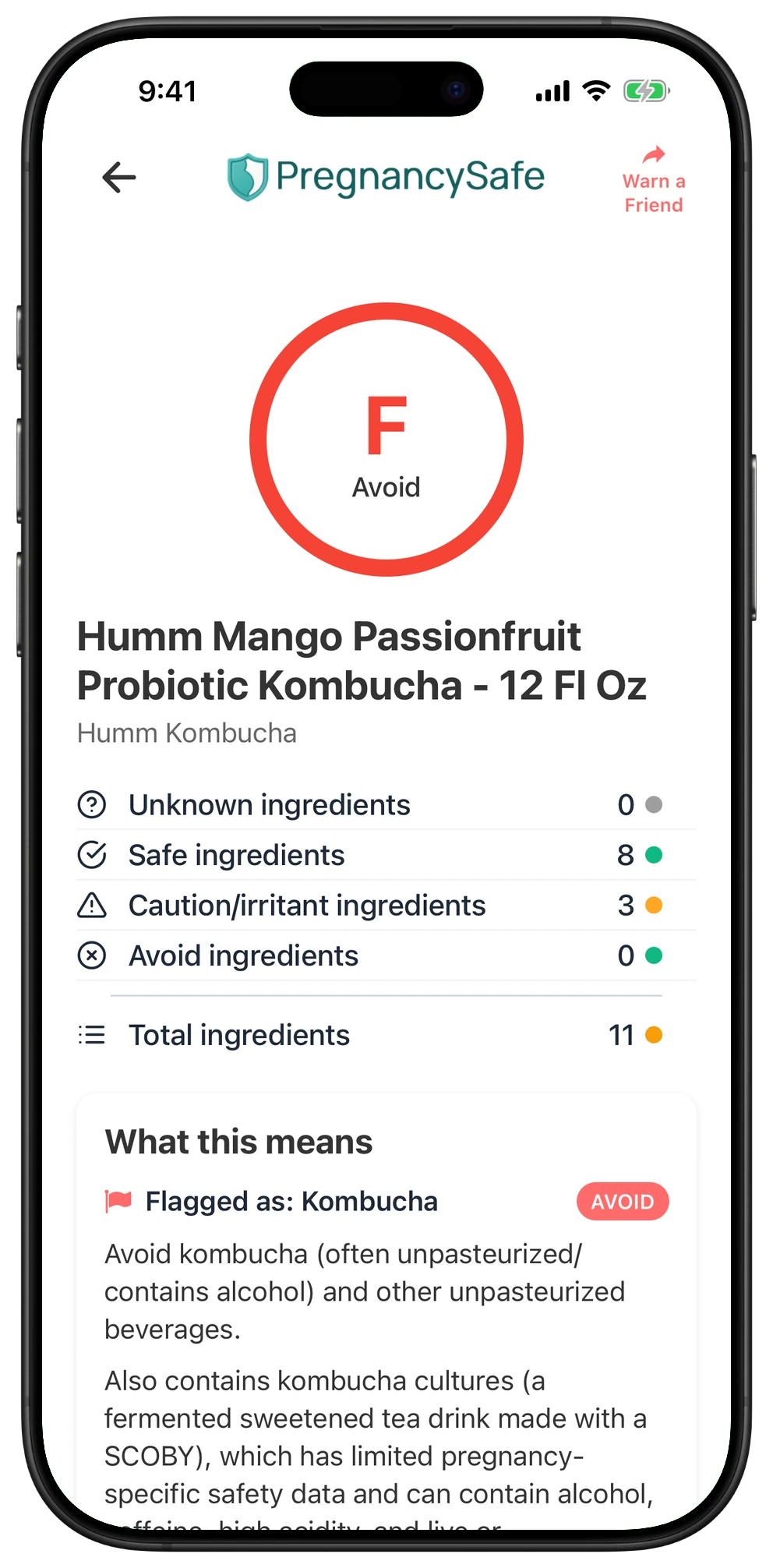
Has limited pregnancy specific safety data and can contain alcohol, caffeine, high acidity, and live or contaminating microbes, especially in raw, unpasteurized, hard, or home brewed products.
Flagged in 222 of 1,018 products (22%)
black tea
Caution
Black tea is a robust, oxidized tea known for its bold flavor and rich aroma.
Is generally compatible in normal servings but contributes to the pregnancy caffeine limit and may interfere with iron absorption if taken with meals or iron supplements.
Flagged in 165 of 1,018 products (16%)
organic kombucha culture
Caution
A living symbiotic culture of bacteria and yeast used to ferment sweetened tea into probiotic rich, naturally effervescent kombucha.
Has limited pregnancy specific safety data and can contain alcohol, caffeine, high acidity, and live or contaminating microbes, especially in raw, unpasteurized, hard, or home brewed products.
Flagged in 68 of 1,018 products (7%)
organic kombucha spring water
Caution
Organic kombucha spring water is pure, naturally sourced water infused with the probiotic rich fermentation byproducts of organic kombucha.
Has limited pregnancy specific safety data and can contain alcohol, caffeine, high acidity, and live or contaminating microbes, especially in raw, unpasteurized, hard, or home brewed products.
Flagged in 49 of 1,018 products (5%)
live kombucha cultures
Caution
Live kombucha cultures are active, symbiotic communities of bacteria and yeast that ferment sweet tea into probiotic rich, effervescent kombucha.
Has limited pregnancy specific safety data and can contain alcohol, caffeine, high acidity, and live or contaminating microbes, especially in raw, unpasteurized, hard, or home brewed products.
Flagged in 47 of 1,018 products (5%)
organic raw carbonated kombucha filtered water
Caution
A refreshing, naturally effervescent beverage made from organic raw kombucha and filtered water.
Has limited pregnancy specific safety data and can contain alcohol, caffeine, high acidity, and live or contaminating microbes, especially in raw, unpasteurized, hard, or home brewed products.
Flagged in 46 of 1,018 products (5%)
Caution
Hibiscus is a vibrant, tart flavored flower often used to make teas, infusions, and natural remedies.
Has limited human pregnancy safety data; medicinal teas or supplements may lower blood pressure and uterine or menstrual effects are uncertain.
Flagged in 45 of 1,018 products (4%)
Kombucha Products We've Analyzed
Our catalog contains ratings for 1,018 kombucha products. These are database grades, not independent safety certifications.
Grades do not determine actual ABV, fermentation history, contamination or total caffeine. The page does not endorse a kombucha product for pregnancy.
Your Questions Answered
What if I drank kombucha while pregnant?
An incidental past drink does not prove that harm occurred. Stop drinking kombucha for now, and note the amount, the exact beverage and whether it was hard, raw or homebrewed. Share those details with your prenatal clinician if you are concerned, especially after repeated consumption or an uncertain alcohol exposure.
Is all kombucha pasteurized?
No, kombucha can be sold raw or unpasteurized as well as pasteurized. Check the exact bottle rather than assuming all drinks from a brand are processed the same way. Pasteurization reduces microbial concerns, but it does not establish that the drink has no alcohol or caffeine.
Is nonalcoholic kombucha safe during pregnancy?
A nonalcoholic label does not necessarily mean zero alcohol. Fermentation can leave residual alcohol, and continued fermentation can change the alcohol by volume, or ABV. Even alcohol controlled commercial kombucha is not automatically pregnancy safe, so choose a suitable nonfermented drink instead.
How much kombucha can I drink during pregnancy?
There is no established pregnancy safe serving size for kombucha. Its alcohol content, processing and caffeine vary, so a small serving cannot be declared safe simply because it is small. Keeping total caffeine below 200 mg daily addresses caffeine exposure but does not resolve alcohol or unpasteurized beverage concerns.
What can I drink instead of kombucha during pregnancy?
Try plain sparkling water for fizz or still water for everyday hydration. If you want a fruit drink, choose pasteurized juice rather than an unpasteurized version. You do not need kombucha or its live culture marketing claims as part of prenatal care.
Do the catalog grades mean every kombucha is proven unsafe?
No. Our catalog contains 1,018 products in this category, all graded F, but those grades do not measure each drink's actual alcohol content, fermentation history, contamination or total caffeine. Incomplete product information is not proof of harm, and the grades do not establish that every drink is contaminated. The practical advice to skip kombucha rests on alcohol uncertainty and unpasteurized beverage concerns, not a clinical verdict derived from those grades.
How Do We Score Products for Pregnancy Safety?
We analyze each product's ingredients and category to flag known risks and provide cautionary notices for general category safety concerns.
Grades reflect the ingredient and category information available to us. They don’t verify a complete, current label or account for dose, preparation, or contamination. Read them alongside the guidance above, not as a guarantee of pregnancy safety or proof that every use is harmful.
A - Safe
Excellent choice! All ingredients are considered safe during pregnancy.
What to do: Use with confidence.
B - Likely Safe
Pretty much safe with very minimal risk. Some ingredients may have limited pregnancy studies, but no significant safety concerns have been identified.
What to do: Use with confidence.
C - Limit
Contains ingredients with some pregnancy considerations. Research shows these ingredients may have limited safety data, potential for minor hormonal effects, or require caution based on animal studies.
What to do: Use sparingly and consider safer alternatives when available.
D - Caution
Similar to C grade but contains multiple cautionary ingredients. The combination increases overall concern.
What to do: Try to avoid if that makes you feel better. If you've already used it, no need to panic.
F - Avoid
Contains an ingredient Pregnancy Safe recommends avoiding during pregnancy. This may reflect an established risk or a precaution based on limited evidence; check the ingredient guidance and exposure context.
What to do: Do not use during pregnancy. If you've already used it, don't worry - contact your OBGYN if concerned.
References
- https://www.mayoclinic.org/healthy-lifestyle/consumer-health/expert-answers/kombucha-tea/faq-20058126
- https://mothertobaby.org/baby-blog/kombucha-pregnancy-answers/
- https://www.cdc.gov/fasd/about/index.html
- https://www.acog.org/womens-health/experts-and-stories/ask-acog/how-much-coffee-can-i-drink-while-pregnant
- https://www.acog.org/clinical/clinical-guidance/committee-opinion/articles/2010/08/moderate-caffeine-consumption-during-pregnancy
- https://www.fda.gov/consumers/consumer-updates/spilling-beans-how-much-caffeine-too-much
- https://www.nhsinform.scot/ready-steady-baby/pregnancy/looking-after-yourself-and-your-baby/eating-well-in-pregnancy/
- https://www.mayoclinic.org/healthy-lifestyle/pregnancy-week-by-week/in-depth/pregnancy-nutrition/art-20043844
- https://pubmed.ncbi.nlm.nih.gov/10999016/
- https://pmc.ncbi.nlm.nih.gov/articles/PMC5998341/
- https://www.cdc.gov/food-safety/foods/pregnant-women.html
- https://www.fda.gov/food/people-risk-foodborne-illness/fruits-veggies-and-juices-food-safety-moms-be
- https://www.cdc.gov/alcohol-pregnancy/about/index.html
- https://www.ttb.gov/kombucha/kombucha-general/print
- https://pubmed.ncbi.nlm.nih.gov/20664420/
- https://www.mdpi.com/2311-5637/10/8/385
- https://www.cdc.gov/mmwr/preview/mmwrhtml/00039742.htm
- https://journals.sagepub.com/doi/10.1177/0885066609332963
- https://www.foodprotection.org/members/fpt-archive-articles/2025-03-determining-critical-food-safety-factors-for-safely-homebrewing-kombucha-a-study-on-microbia/
- https://mothertobaby.org/fact-sheets/herbal-products-pregnancy/
- https://www.ncbi.nlm.nih.gov/books/NBK501882/
- https://pubmed.ncbi.nlm.nih.gov/19434218/
- https://pubmed.ncbi.nlm.nih.gov/18066103/
- https://pmc.ncbi.nlm.nih.gov/articles/PMC9086798/
- https://www.nccih.nih.gov/health/hypertension-high-blood-pressure
- https://www.ffhdj.com/index.php/ffhd/article/view/1768