Is Glycolic Acid Safe During Pregnancy?
Updated September 8, 2026
The Answer
Low concentration, over the counter topical glycolic acid is generally compatible with pregnancy. This does not extend automatically to high strength or professional peels, especially on broken or irritated skin, large areas, or under occlusion.
Strength and exposure matter most: a low concentration OTC topical product is not equivalent to a high strength or professional glycolic acid peel.
ACOG includes OTC topical glycolic acid among acne products usable during pregnancy, while MotherToBaby notes that small skin absorption makes adverse pregnancy outcomes from OTC topical acne treatments unlikely.
Already used it? If you already used a low concentration OTC topical product, the limited skin absorption is reassuring. Ask your clinician about high strength or professional peels, particularly after use on broken skin or a large area.
Pregnancy Safe is 100% independent and research driven. No companies pay to promote or sponsor products.
Stressless Pregnancy
Check your exact product with glycolic acid in the app

What Is Glycolic Acid?
You may also see it listed as: hydroxyacetic acid, 2-hydroxyacetic acid, hydroxyethanoic acid
Glycolic acid is an alpha hydroxy acid, commonly derived from sugarcane, that removes dead surface cells. It is used for acne, uneven texture, dullness, and hyperpigmentation and appears in toners, serums, cleansers, body products, exfoliating treatments, and peels.
What Other Ingredients Should You Look Out for in Products With Glycolic Acid?
A product's full ingredient list determines whether it's pregnancy-safe or not. These ingredients also appear in some of the glycolic acid products we analyzed and may deserve a closer look.
Retinoid
AvoidLook for “retinyl palmitate,” a topical vitamin A derivative. Pregnancy guidance recommends avoiding routine cosmetic retinoids, so check whether the complete formula contains this ingredient rather than judging it by glycolic acid alone.
Flagged in 5 products (8.5%) in this analysis.
Phenoxyethanol
CautionPhenoxyethanol is a preservative with limited direct pregnancy data, although regulated cosmetic concentrations are generally considered low systemic risk. Check the product type and pay particular attention to leave on or nipple area use.
Flagged in 29 products (49.2%) in this analysis.
Fragrance
Caution“Fragrance” or “parfum” can represent an undisclosed scent mixture and may irritate sensitive skin or airways. If you want to reduce uncertain cumulative exposure, check for a fragrance free version.
Flagged in 17 products (28.8%) in this analysis.
Salicylic Acid
CautionSalicylic acid is another exfoliating acid; directed low dose topical acne use is generally low concern, but high concentration peels, large area use, occlusion, and broken skin need more caution. Check the product’s form and intended use.
Flagged in 7 products (11.9%) in this analysis.
Diazolidinyl Urea
CautionDiazolidinyl urea is a formaldehyde releasing preservative. Regulated topical exposure is lower concern than occupational formaldehyde exposure, but check for it if you have a formaldehyde allergy or want to limit multiple formaldehyde releasing preservatives.
Flagged in 2 products (3.4%) in this analysis.
Alpha Arbutin
CautionAlpha arbutin is a brightening ingredient with limited human pregnancy data that can release small amounts of hydroquinone. Check whether a brightening serum is high strength, intended for large areas, compounded, or also contains hydroquinone.
Flagged in 1 product (1.7%) in this analysis.
Does Glycolic Acid Strength or Product Type Matter During Pregnancy?
Lower pH, higher strength, longer contact time, application over large areas, occlusion, and broken or irritated skin can increase absorption or irritation. Glycolic acid may also increase sun sensitivity, and irritation can worsen melasma or post inflammatory hyperpigmentation. Direct human pregnancy studies are limited, so high strength and professional peels should be considered separately from routine low concentration OTC use.
What Products Contain Glycolic Acid?
Pregnancy Safe has looked at 993 products that have glycolic acid as an ingredient. The category and grade breakdowns below use 59 products whose names mention Glycolic Acid or another name for it.
What Types of Products Contain Glycolic Acid?
Products You May Have That Contain Glycolic Acid
| Grade | Product | Brand | Type |
|---|---|---|---|
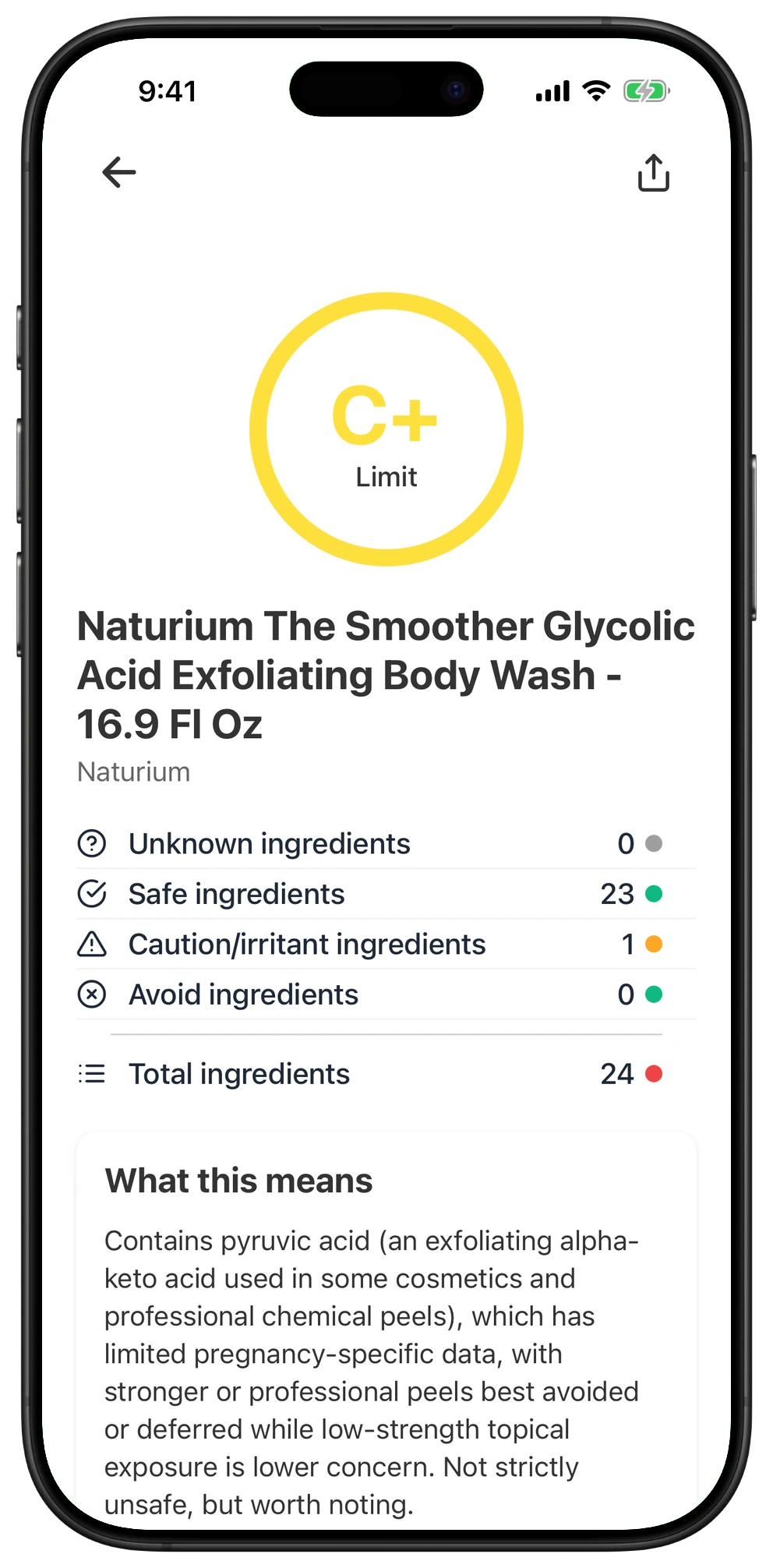
| C+ | Naturium The Smoother Glycolic Acid Exfoliating Body Wash - 16.9 Fl Oz | Naturium | Body Wash |
| F | The Ordinary Glycolic Acid 7% Toning Solution - Ulta Beauty | The Ordinary | Toner |
| C+ | The Smoother Glycolic Acid Exfoliating Body Wash | Naturium | Body Wash |
| B+ | Garnier Micellar Gentle Peeling Water With Pha & Glycolic Acid | Garnier | Facial Cleanser |
| C- | Kérastase Gloss Absolu Conditioner With Glycolic Acid, Hyaluronic Acid And Wild Rose In Oil 250Ml | Kérastase | Conditioner |
| C- | The Smoother Glycolic Acid Body Lotion | Naturium | Body Lotion |
| C+ | Prequel Gleanser + Glycolic Acid Non-Drying Cleanser 13.5 Fl Oz | Prequel | Cleanser |
| F | The Ordinary Glycolic Acid 7% Exfoliating Toner 100Ml | The Ordinary | Toner |
How Do Products Containing Glycolic Acid Score?
It can be helpful to see how products containing glycolic acid generally score during pregnancy. This does not tell you whether your exact product is safe, but it gives you a general idea of what we found. In this breakdown of 59 products, 53% receive a C grade. A C grade means the complete formula has some pregnancy considerations, so use it sparingly and consider a higher scoring alternative when one is available.
Frequently Asked Questions About Glycolic Acid During Pregnancy
Can I use a glycolic acid toner while pregnant?
A low concentration OTC topical toner is generally compatible with pregnancy. Consider its strength, contact time, application area, and whether your skin is irritated or broken.
Are glycolic acid peels safe during pregnancy?
Superficial glycolic acid peels are considered low concern because systemic exposure is limited, but high strength or professional peels should be treated differently from routine OTC products and used only with trained guidance.
Does the percentage of glycolic acid matter?
Yes. Higher strength can increase absorption and irritation, especially with lower pH or longer contact. The available evidence does not provide a single numeric pregnancy limit, so do not assume every concentration has the same exposure profile.
Can glycolic acid make pregnancy pigmentation worse?
Glycolic acid is used for hyperpigmentation, but irritation and increased sun sensitivity can worsen pregnancy melasma or post inflammatory hyperpigmentation.
Can I apply glycolic acid to broken or irritated skin?
Broken or irritated skin can increase absorption and irritation, so that exposure should not be treated like routine use on intact skin.
Does a product grade mean the whole glycolic acid product is safe during pregnancy?
No. Glycolic acid’s assessment does not establish the safety of the complete formula. Check the full ingredient list, product strength, format, and intended use.
How Do We Score Products for Pregnancy Safety?
We analyze each product's ingredients and category to flag known risks and provide cautionary notices for general category safety concerns.
A - Safe
Excellent choice! All ingredients are considered safe during pregnancy.
What to do: Use with confidence.
B - Likely Safe
Pretty much safe with very minimal risk. Some ingredients may have limited pregnancy studies, but no significant safety concerns have been identified.
What to do: Use with confidence.
C - Limit
Contains ingredients with some pregnancy considerations. Research shows these ingredients may have limited safety data, potential for minor hormonal effects, or require caution based on animal studies.
What to do: Use sparingly and consider safer alternatives when available.
D - Caution
Similar to C grade but contains multiple cautionary ingredients. The combination increases overall concern.
What to do: Try to avoid if that makes you feel better. If you've already used it, no need to panic.
F - Avoid
Contains an ingredient Pregnancy Safe recommends avoiding during pregnancy. This may reflect an established risk or a precaution based on limited evidence; check the ingredient guidance and exposure context.
What to do: Do not use during pregnancy. If you've already used it, don't worry - contact your OBGYN if concerned.
Sources
- https://journals.sagepub.com/doi/pdf/10.1177/1091581817716656
- https://mothertobaby.org/fact-sheets/topical-acne-treatments-pregnancy/
- https://pmc.ncbi.nlm.nih.gov/articles/PMC3114665/
- https://pmc.ncbi.nlm.nih.gov/articles/PMC9364454/
- https://pmc.ncbi.nlm.nih.gov/articles/PMC9823189/
- https://pubmed.ncbi.nlm.nih.gov/9865450/
- https://www.acog.org/womens-health/faqs/skin-conditions-during-pregnancy
- https://www.fda.gov/regulatory-information/search-fda-guidance-documents/guidance-industry-labeling-cosmetics-containing-alpha-hydroxy-acids
- https://www.ema.europa.eu/en/news/updated-measures-pregnancy-prevention-during-retinoid-use
- https://www.ncbi.nlm.nih.gov/books/NBK582989/
- https://www.ncbi.nlm.nih.gov/books/NBK582775/
- https://pubmed.ncbi.nlm.nih.gov/26215715/
- https://pubmed.ncbi.nlm.nih.gov/41365815/
- https://pubmed.ncbi.nlm.nih.gov/36447117/
- https://dailymed.nlm.nih.gov/dailymed/drugInfo.cfm?setid=9f1c8971-c6dc-4708-848b-5cee50b6c32a
- https://dailymed.nlm.nih.gov/dailymed/drugInfo.cfm?setid=993a5325-cd10-4450-b5ea-1c0a90510df6
- https://dailymed.nlm.nih.gov/dailymed/lookup.cfm?setid=34d79c31-1568-4797-a4f5-31200c7788db
- https://health.ec.europa.eu/system/files/2021-08/sccs_o_195_0.pdf
- https://ec.europa.eu/growth/tools-databases/cosing/details/28157
- https://journals.sagepub.com/doi/10.3109/10915819009078737
- https://link.springer.com/article/10.1007/s00204-024-03938-5
- https://www.sfda.gov.sa/en/warnings/1156
- https://www.industrialchemicals.gov.au/sites/default/files/Ethanol%2C%202-phenoxy-_Human%20health%20tier%20II%20assessment.pdf
- https://hero.epa.gov/reference/2857875
- https://books.publisso.de/sites/default/files/documents/series/mak/dam/Vol2019/Iss1/Alt006/mb12299kske6319_w.pdf
- https://www.fda.gov/cosmetics/cosmetic-ingredients/fragrances-cosmetics
- https://www.fda.gov/cosmetics/cosmetic-ingredients/phthalates-cosmetics
- https://www.fda.gov/cosmetics/cosmetic-ingredients/allergens-cosmetics
- https://pmc.ncbi.nlm.nih.gov/articles/PMC3110684/
- https://pmc.ncbi.nlm.nih.gov/articles/PMC4016195/
- https://pmc.ncbi.nlm.nih.gov/articles/PMC4097177/
- https://pmc.ncbi.nlm.nih.gov/articles/PMC8453372/
- https://pmc.ncbi.nlm.nih.gov/articles/PMC10999525/
- https://www.epa.gov/indoor-air-quality-iaq/volatile-organic-compounds-impact-indoor-air-quality
- https://www.aad.org/public/everyday-care/skin-care-secrets/routine/pregnancy-skin-care
- https://www.aad.org/public/diseases/acne/derm-treat/pregnancy
- https://www.accessdata.fda.gov/drugsatfda_docs/omuf/Order/Final%20Administrative%20Order%20OTC000013_M006-Topical%20Acne%20drug%20products%20for%20OTC%20Human%20Use.pdf
- https://health.ec.europa.eu/system/files/2023-06/sccs_o_268.pdf
- https://www.fda.gov/drugs/drug-safety-and-availability/fda-recommends-avoiding-use-nsaids-pregnancy-20-weeks-or-later-because-they-can-result-low-amniotic
- https://www.accessdata.fda.gov/drugsatfda_docs/omuf/monographs/OTCMonograph_M028-WartRemoverDrugProductsforOTCHumanUse10012021.pdf
- https://www.ncbi.nlm.nih.gov/books/NBK582985/
- https://pubmed.ncbi.nlm.nih.gov/9269866/
- https://pubmed.ncbi.nlm.nih.gov/10026401/
- https://pubmed.ncbi.nlm.nih.gov/24472429/
- https://www.ecfr.gov/current/title-21/chapter-I/subchapter-D/part-333/subpart-D/section-333.310
- https://pubmed.ncbi.nlm.nih.gov/38453786/
- https://www.accessdata.fda.gov/drugsatfda_docs/omuf/monographs/OTC%20Monograph_M006-Topical%20Acne%20drug%20products%20for%20OTC%20Human%20Use%2011.23.2021.pdf
- https://www.fda.gov/safety/medical-product-safety-information/nonsteroidal-anti-inflammatory-drugs-nsaids-drug-safety-communication-avoid-use-nsaids-pregnancy-20
- https://dermnetnz.org/topics/acne-in-pregnancy
- https://www.inchem.org/documents/icsc/icsc/eics0563.htm
- https://www.ncbi.nlm.nih.gov/books/NBK582985
- https://pubmed.ncbi.nlm.nih.gov/23914887
- https://www.fda.gov/drugs/drug-alerts-and-statements/fda-warns-against-purchasing-or-using-chemical-peel-skin-products-without-professional-supervision
- https://journals.sagepub.com/doi/pdf/10.3109/10915819009078735?download=true
- https://ec.europa.eu/health/archive/ph_risk/committees/sccp/documents/out188_en.pdf
- https://www.industrialchemicals.gov.au/sites/default/files/Formaldehyde%20donors_Human%20health%20tier%20II%20assessment.pdf
- https://pubmed.ncbi.nlm.nih.gov/21309789/
- https://www.cdc.gov/niosh/reproductive-health/prevention/formaldehyde.html
- https://uktis.org/monographs/exposure-to-formaldehyde-in-pregnancy/
- https://pmc.ncbi.nlm.nih.gov/articles/PMC3203331/
- https://www.atsdr.cdc.gov/toxprofiles/tp111.pdf
- https://eur-lex.europa.eu/legal-content/EN/TXT/PDF/?uri=CELEX%3A32022R1181
- https://health.ec.europa.eu/publications/safety-alpha-arbutin-and-beta-arbutin-cosmetic-products_en
- https://health.ec.europa.eu/system/files/2023-02/sccs_o_264.pdf
- https://pmc.ncbi.nlm.nih.gov/articles/PMC8884185/
- https://dermnetnz.org/topics/hydroquinone
- https://pmc.ncbi.nlm.nih.gov/articles/PMC8301119/
- https://pubmed.ncbi.nlm.nih.gov/18789053/