Is Ginseng Safe During Pregnancy?
Updated September 11, 2026
The Answer
Ginseng is not recommended as an oral supplement during pregnancy; any pregnancy use should be clinician directed. Topical ginseng has a separate caution rating, with lower concern evidence limited to identified Panax root ingredients in conventional skin and hair products.
Swallowing a ginseng supplement is not the same exposure as applying a conventional Panax root cosmetic: oral supplement warnings do not establish risk from normal topical use.
EMA and NCCIH identify insufficient pregnancy data or oral safety concerns; limited human research found no clear adverse signal in one study, while isolated ginsenosides caused developmental toxicity in animal or embryo culture experiments.
Already used it? If you have already taken ginseng, share the product label, amount taken, and frequency with your pregnancy care clinician. Human pregnancy data are limited, so the warning alone cannot tell you whether an individual exposure caused harm.
Pregnancy Safe is 100% independent and research driven. No companies pay to promote or sponsor products.
Stressless Pregnancy
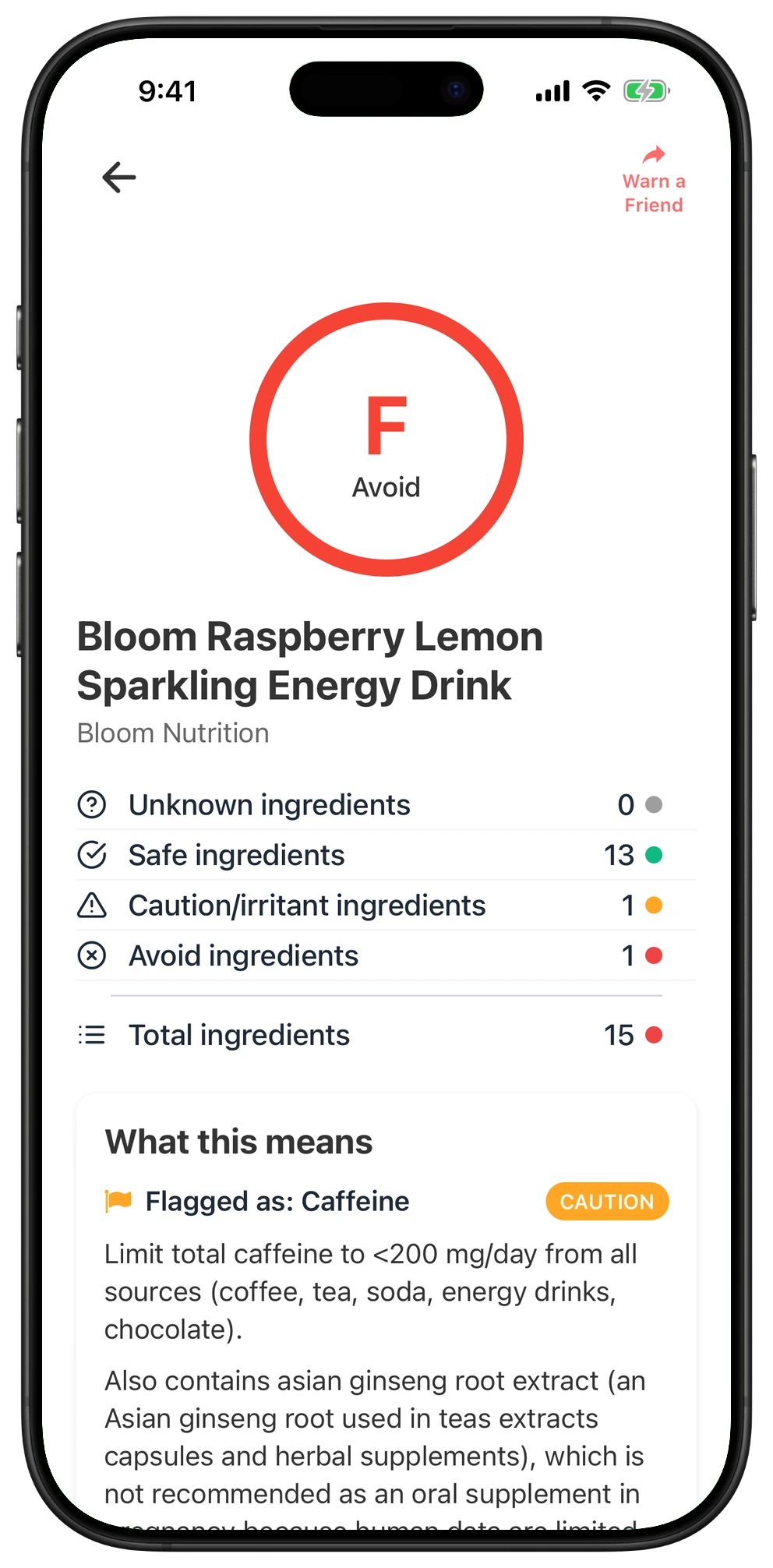
Check your exact product with ginseng in the app
What Is Ginseng?
Ginseng is an herbal ingredient usually referring to Panax ginseng, traditionally used as a tonic or adaptogen for energy and vitality. You may encounter roots and extracts in supplements, teas, other drinks, and soups, or Panax root extracts used to condition skin and hair. American ginseng and Siberian ginseng are different products, not interchangeable names for Panax ginseng.
What Other Ingredients Should You Look Out for in Products With Ginseng?
A product's full ingredient list determines whether it's pregnancy-safe or not. These ingredients also appear in some of the ginseng products we analyzed and may deserve a closer look.
Alcohol
AvoidLook for “alcohol” or “grain alcohol” in liquid herbal supplements: retained ethanol matters because no safe prenatal alcohol exposure amount has been established. Check the finished product's alcohol content and serving size; an extraction solvent mention alone does not prove alcohol remains in a dried extract.
Flagged in 7 products (5.4%) in this analysis.
Dong Quai
AvoidCheck herbal supplement blends for “dong quai”: medicinal use is discouraged during pregnancy because human data are very limited and uterine activity and bleeding interaction concerns exist. Ask your clinician to review the blend, particularly alongside anticoagulant or antiplatelet medicines.
Flagged in 2 products (1.6%) in this analysis.
Licorice Root
AvoidLook for “licorice root” in tea blends and check whether you drink it regularly rather than encounter a small incidental flavoring amount. Medicinal or high, regular exposure is discouraged in pregnancy because glycyrrhizin can raise blood pressure and lower potassium, and heavy intake has observational links to shorter gestation.
Flagged in 1 product (0.8%) in this analysis.
Tulsi
Avoid“Tulsi holy basil” in a tea blend deserves a separate check: medicinal tea and supplement use is discouraged during pregnancy because human data are limited and animal reproductive studies raise concerns. Review the preparation and intended frequency with your clinician rather than treating it like a tiny culinary herb amount.
Flagged in 1 product (0.8%) in this analysis.
High Fructose Corn Syrup
Caution“High fructose corn syrup” is added sugar in sweetened teas and energy drinks, not an established pregnancy teratogen at occasional food amounts. Check added sugars and servings per container, especially if you have individualized carbohydrate guidance for gestational diabetes.
Flagged in 9 products (7%) in this analysis.
Caffeine
CautionLook for “caffeine” or “natural caffeine from green tea” in energy and functional drinks, and check the caffeine amount per serving. ACOG recommends keeping total pregnancy caffeine below 200 mg per day, counting drinks, foods, supplements, and medicines together.
Flagged in 2 products (1.6%) in this analysis.
Does the Form or Amount of Ginseng Matter During Pregnancy?
The main oral concerns involve supplement dose exposure, variable preparations, and possible hormonal, blood glucose, bleeding or clotting effects and medicine interactions. The evidence does not establish a pregnancy safe amount for ginseng containing tea or food. For topical use, the lower concern findings apply only to identified Panax root derived ingredients in conventional products used as directed on intact skin or hair. They do not extend to Siberian ginseng, other unidentified species or plant parts, concentrated or enhanced delivery products, or broken skin; direct human pregnancy studies of topical ginseng are lacking.
What Products Contain Ginseng?
Pregnancy Safe has looked at 284 products that have ginseng as an ingredient. The category and grade breakdowns below use 129 products whose names mention Ginseng or another name for it.
What Types of Products Contain Ginseng?
Products You May Have That Contain Ginseng
| Grade | Product | Brand | Type |
|---|---|---|---|
| F | Arizona Green Tea With Ginseng And Honey | Arizona | Tea |
| F | Green Tea With Ginseng And Honey | Arizona | Tea |
| F | Green Tea With Ginseng Honey | Arizona | Tea |
| F | Arizona Diet Green Tea With Ginseng | Arizona | Green Tea |
| F | Zero Calorie Green Tea With Ginseng | Arizona, Ferolito Vultaggio & Sons | Green Tea |
| F | Vitality Super Shot Orange Turmeric, Ginseng & Ginger | Juice Lab | Energy Shot |
| F | Honey Ginger Tea Ginseng Flavor | Pocas | Tea |
| F | Green Tea With Ginseng And Honey | Turkey Hill Dairy Inc. | Green Tea |
How Do Products Containing Ginseng Score?
It can be helpful to see how products containing ginseng generally score during pregnancy. This does not tell you whether your exact product is safe, but it gives you a general idea of what we found. In this breakdown of 129 products, 100% receive an F grade. An F grade means the complete formula contains an ingredient Pregnancy Safe recommends avoiding during pregnancy. The reason may be an established risk or a precaution based on limited evidence; check the ingredient guidance and exposure context.
Frequently Asked Questions About Ginseng During Pregnancy
Can I drink green tea with ginseng while pregnant?
A ginseng containing tea is not automatically equivalent to a supplement dose, but the available evidence does not establish a pregnancy safe amount for it. Check the ginseng preparation and amount, if listed, and discuss regular use with your pregnancy care clinician.
Does the warning also apply to ginseng skin care?
Topical ginseng is rated caution rather than avoid. A cosmetic review found certain Panax root ingredients safe at the uses and concentrations assessed, but it was not direct pregnancy evidence. The lower concern findings apply to conventional products used as directed on intact skin or hair, not every ginseng extract or formulation.
Are American and Siberian ginseng the same as Panax ginseng?
No. American ginseng is Panax quinquefolius, while Siberian ginseng is Eleutherococcus senticosus. They are different products, so you should not transfer findings about Panax ginseng or assessed Panax root cosmetics to them simply because their names include “ginseng.”
Has ginseng been proven to harm human pregnancies?
The available evidence does not establish that conclusion. Human data are limited, and one pregnancy study found no clear adverse signal. Developmental concerns come partly from animal and embryo culture experiments with isolated ginsenosides, which do not establish the outcome of a particular human exposure.
Can ginseng interact with medicines during pregnancy?
Possible blood glucose, bleeding or clotting effects and drug interactions are among the concerns with oral ginseng. Have your clinician review your medicines alongside the exact ginseng product rather than assuming an herbal supplement is interaction free.
What if ginseng is included in my vitamin supplement?
Being included in a vitamin does not remove the concerns about oral ginseng. Show your pregnancy care clinician the full label and serving amount so they can review the formula and whether its use is appropriate for you.
How Do We Score Products for Pregnancy Safety?
We analyze each product's ingredients and category to flag known risks and provide cautionary notices for general category safety concerns.
A - Safe
Excellent choice! All ingredients are considered safe during pregnancy.
What to do: Use with confidence.
B - Likely Safe
Pretty much safe with very minimal risk. Some ingredients may have limited pregnancy studies, but no significant safety concerns have been identified.
What to do: Use with confidence.
C - Limit
Contains ingredients with some pregnancy considerations. Research shows these ingredients may have limited safety data, potential for minor hormonal effects, or require caution based on animal studies.
What to do: Use sparingly and consider safer alternatives when available.
D - Caution
Similar to C grade but contains multiple cautionary ingredients. The combination increases overall concern.
What to do: Try to avoid if that makes you feel better. If you've already used it, no need to panic.
F - Avoid
Contains an ingredient Pregnancy Safe recommends avoiding during pregnancy. This may reflect an established risk or a precaution based on limited evidence; check the ingredient guidance and exposure context.
What to do: Do not use during pregnancy. If you've already used it, don't worry - contact your OBGYN if concerned.
Sources
- https://pmc.ncbi.nlm.nih.gov/articles/PMC9864683/
- https://pubmed.ncbi.nlm.nih.gov/14507839/
- https://pubmed.ncbi.nlm.nih.gov/18204104/
- https://www.cir-safety.org/sites/default/files/Ginsen092012rep.pdf
- https://www.ema.europa.eu/en/documents/herbal-monograph/final-european-union-herbal-monograph-panax-ginseng-camey-radix-revision-1_en.pdf
- https://www.ema.europa.eu/en/documents/herbal-report/draft-assessment-report-panax-ginseng-camey-radix-revision-1_en.pdf
- https://www.mskcc.org/cancer-care/integrative-medicine/herbs/ginseng-american
- https://www.mskcc.org/cancer-care/integrative-medicine/herbs/ginseng-asian
- https://www.ncbi.nlm.nih.gov/books/NBK501814/
- https://www.nccih.nih.gov/health/asian-ginseng
- https://www.ncbi.nlm.nih.gov/books/NBK582563/
- https://www.ncbi.nlm.nih.gov/books/NBK582743/
- https://www.cdc.gov/alcohol-pregnancy/about/index.html
- https://www.fda.gov/food/dietary-supplements-guidance-documents-regulatory-information/dietary-supplement-labeling-guide-chapter-iv-nutrition-labeling
- https://pubmed.ncbi.nlm.nih.gov/28775124/
- https://www.iberogast.com/healthcare-professionals/instructions-resources
- https://www.herbalist-alchemist.com/shop-products-cyp-cyperus-extract
- https://www.mskcc.org/cancer-care/integrative-medicine/herbs/dong-quai
- https://www.drugs.com/npp/dong-quai.html
- https://mothertobaby.org/fact-sheets/herbal-products-pregnancy/
- https://www.ncbi.nlm.nih.gov/books/NBK501836/
- https://www.ema.europa.eu/en/documents/herbal-report/final-assessment-report-angelica-sinensis-oliv-diels-radix-first-version_en.pdf
- https://pubmed.ncbi.nlm.nih.gov/10417036/
- https://pubmed.ncbi.nlm.nih.gov/20110895/
- https://pubmed.ncbi.nlm.nih.gov/7646782/
- https://www.nccih.nih.gov/health/menopausal-symptoms-in-depth
- https://pubmed.ncbi.nlm.nih.gov/10730024/
- https://www.nccih.nih.gov/health/licorice-root
- https://webprod.hc-sc.gc.ca/nhpid-bdipsn/dbImages/mono_licorice_english.pdf
- https://www.ema.europa.eu/en/medicines/herbal/liquiritiae-radix
- https://www.medsafe.govt.nz/profs/PUArticles/December2019/Liquorice-side-effects-interactions.htm
- https://www.bfr.bund.de/cm/349/does-the-consumption-of-liquorice-by-pregnant-women-impair-the-mental-and-physical-development-of-children.pdf
- https://pubmed.ncbi.nlm.nih.gov/28158597/
- https://pubmed.ncbi.nlm.nih.gov/11390327/
- https://www.fhi.no/contentassets/f08343d5155e413284f5c31a6b415b51/fhi-report-holy-basil-271123.pdf
- https://webprod.hc-sc.gc.ca/nhpid-bdipsn/atReq?atid=ocimum.tenuliflorum.leaf.feuille&lang=eng
- https://www.merckmanuals.com/home/special-subjects/dietary-supplements-and-vitamins/holy-basil
- https://www.drugs.com/npp/holy-basil.html
- https://bsh.ahpa.org/SampleHerb4.aspx
- https://www.phytojournal.com/archives/2022/vol11issue4/PartD/11-4-54-138.pdf
- https://pubmed.ncbi.nlm.nih.gov/12099405/
- https://cdn.realfood.gov/DGA.pdf
- https://www.dietaryguidelines.gov/sites/default/files/2021-12/DGA_Pregnancy_FactSheet-508c.pdf
- https://www.acog.org/womens-health/faqs/healthy-eating-during-pregnancy
- https://www.cdc.gov/nutrition/php/data-research/added-sugars.html
- https://www.cdc.gov/diabetes/about/gestational-diabetes.html
- https://www.who.int/publications/i/item/9789241549028
- https://nesr.usda.gov/2025-dietary-guidelines-advisory-committee-systematic-reviews/dietary-patterns_gestational-diabetes
- https://www.acog.org/clinical/clinical-guidance/committee-opinion/articles/2010/08/moderate-caffeine-consumption-during-pregnancy
- https://www.acog.org/womens-health/experts-and-stories/ask-acog/how-much-coffee-can-i-drink-while-pregnant
- https://www.ncbi.nlm.nih.gov/books/NBK582613/
- https://www.who.int/tools/elena/interventions/caffeine-pregnancy
- https://www.fda.gov/consumers/consumer-updates/spilling-beans-how-much-caffeine-too-much
- https://pubmed.ncbi.nlm.nih.gov/25179792/
- https://pubmed.ncbi.nlm.nih.gov/25238871/