Is Caffeine Safe During Pregnancy?
Updated September 12, 2026
The Answer
Caffeine needs caution during pregnancy when consumed: keep your total below 200 mg a day across foods, drinks, supplements and medicines. Caffeine in ordinary leave on or rinse off cosmetics is likely safe with normal use, although direct pregnancy studies are lacking.
The key distinction is consuming caffeine versus applying an ordinary cosmetic: the daily intake guidance and the likely safe topical assessment cover different exposures.
ACOG considers caffeine intake below 200 mg a day unlikely to be a major contributor to miscarriage or preterm birth.
Already used it? If you have already consumed caffeine, add up the amount from all foods, drinks, supplements and medicines that day and compare it with the guidance to stay below 200 mg.
Pregnancy Safe is 100% independent and research driven. No companies pay to promote or sponsor products.
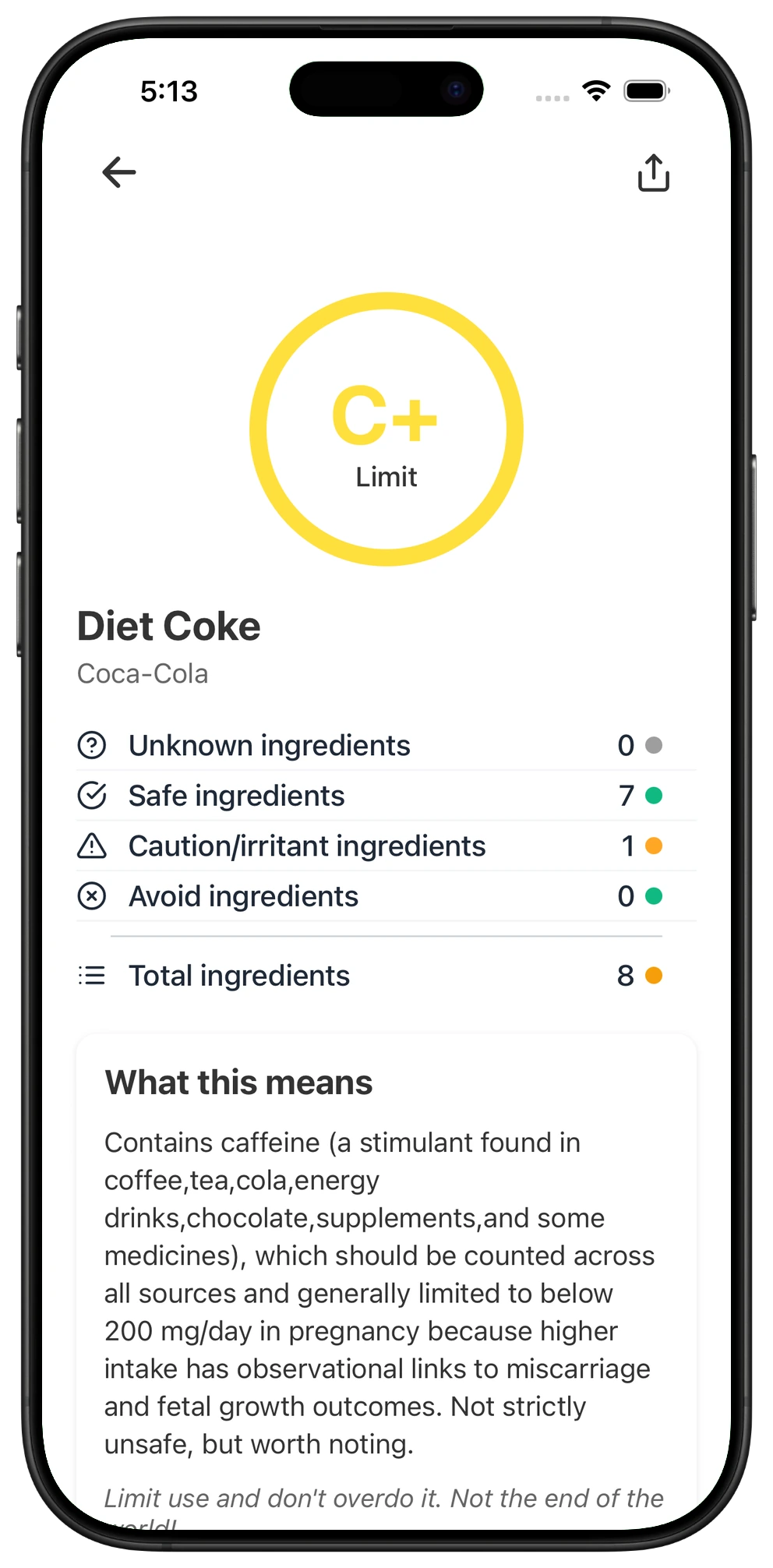
Stressless Pregnancy
Check your exact product with caffeine in the app

What Is Caffeine?
You may also see it listed as: theine
Caffeine is a stimulant found in coffee, tea and other plants that temporarily increases alertness and reduces fatigue. It appears in drinks, chocolate, supplements and some over the counter medicines, including dehydrated powdered caffeine called caffeine anhydrous. It is also used in eye creams, serums, moisturizers, body products and hair care.
What Other Ingredients Should You Look Out for in Products With Caffeine?
A product's full ingredient list determines whether it's pregnancy-safe or not. These ingredients also appear in some of the caffeine products we analyzed and may deserve a closer look.
Butylphenyl Methylpropional
AvoidLook for butylphenyl methylpropional, also called Lilial, on fragranced face cream labels. Regulatory reproductive toxicity concerns, based largely on animal evidence, support choosing a cosmetic without this fragrance during pregnancy.
Flagged in 1 product (0.5%) in this analysis.
Phenoxyethanol
CautionPhenoxyethanol is a preservative found in caffeine eye patches, skin care and hair products; cosmetic reviews accept typical use levels, although direct pregnancy data are limited. Check that the product is intended for ordinary cosmetic use and follows applicable concentration limits rather than treating this label term as an automatic avoid warning.
Flagged in 20 products (10.9%) in this analysis.
Fragrance
CautionFragrance or parfum in caffeine skin and hair products identifies a scent mixture, not proof that phthalates are present or that typical use causes pregnancy harm. If you want to reduce uncertain mixture exposure or have sensitive skin or airways, check for a fragrance free option.
Flagged in 14 products (7.7%) in this analysis.
Branched-Chain Amino Acids
CautionBCAA blend or branched chain amino acids on workout supplement labels means added leucine, isoleucine and valine, whose concentrated supplement use lacks adequate pregnancy safety evidence. Check the amounts and pregnancy cautions on the label; this concern is different from these essential amino acids in ordinary dietary protein.
Flagged in 11 products (6%) in this analysis.
Citrulline
CautionLook for L citrulline or citrulline malate in caffeine workout supplements: concentrated amounts have limited pregnancy data and can affect blood pressure. Check the amount with your clinician before using a high dose supplement rather than assuming it has the same evidence as food exposure.
Flagged in 8 products (4.4%) in this analysis.
High Fructose Corn Syrup
CautionHigh fructose corn syrup on an energy drink or soda label is added sugar, not a known pregnancy teratogen at occasional food amounts. Check total added sugars and how often you drink these products; if you have gestational diabetes, use your care team's individualized carbohydrate guidance.
Flagged in 5 products (2.7%) in this analysis.
Does the Form or Amount of Caffeine Matter During Pregnancy?
For caffeine you consume, the total across sources matters, not just your coffee intake. For topical caffeine, estimated systemic exposure from ordinary cosmetics is much lower than from foods and drinks, but caffeine can cross intact skin. Absorption depends on concentration, amount, formulation, application area, frequency and skin condition. The likely safe assessment does not extend to transdermal patches or unusually high strength, frequent, large area or broken skin use. A cosmetic review accepted reported leave on uses up to 6%; that is not a pregnancy specific concentration limit.
What Products Contain Caffeine?
Pregnancy Safe has looked at 6,999 products that have caffeine as an ingredient. The category and grade breakdowns below use 183 products whose names mention Caffeine or another name for it.
What Types of Products Contain Caffeine?
Products You May Have That Contain Caffeine
| Grade | Product | Brand | Type |
|---|---|---|---|
| C+ | Caffeine Eye Cream 15 Ml | The Inkey List | Eye Cream |
| C+ | Sparkling Ice +Caffeine Blue Raspberry - 16 Fl Oz Can | Sparkling Ice | Sparkling Water |
| F | Good Molecules Caffeine Energizing Hydrogel Eye Patches 60Ct | Good Molecules | Eye Patch |
| B+ | Green Tea Caffeine Bright-Eye Serum | Innisfree | Serum |
| C+ | Caffeine Solution 5% + Egcg Eye Serum | The Ordinary | Eye Serum |
| C | Vichy Mineral 89 Eyes Serum With Caffeine And Hyaluronic Acid | Vichy | Eye Serum |
| C+ | Bodyarmor Flash I.V. Caffeine Zero Sugar Watermelon Punch | Bodyarmor | Sports Drink |
| B+ | Caffeine De Puffing Jelly Eye Mask 40 Pcs | La Splash Cosmetics | Eye Mask |
How Do Products Containing Caffeine Score?
It can be helpful to see how products containing caffeine generally score during pregnancy. This does not tell you whether your exact product is safe, but it gives you a general idea of what we found. In this breakdown of 183 products, 77% receive a C grade. A C grade means the complete formula has some pregnancy considerations, so use it sparingly and consider a higher scoring alternative when one is available.
Frequently Asked Questions About Caffeine During Pregnancy
Do I need to avoid all caffeine while pregnant?
The guidance is to limit caffeine you consume, not automatically avoid it altogether. ACOG and other guidance generally recommend keeping the combined total below 200 mg a day.
Does the caffeine limit change in the first, second or third trimester?
The below-200-mg daily guidance applies during pregnancy; the available evidence does not establish separate trimester specific limits.
What counts toward my daily caffeine total?
Include coffee, tea, chocolate, cola, energy drinks, supplements and any medicines containing caffeine. Count all these sources together rather than giving each one a separate allowance.
What if I accidentally consumed 300 mg of caffeine?
That exceeds the recommended daily intake. Add up all sources to understand the total, but do not interpret 300 mg as a proven harm threshold: observational studies cannot predict the outcome of one day's exposure.
What pregnancy outcomes have been linked to higher caffeine intake?
Observational studies link higher intake with miscarriage, stillbirth, low birth weight and fetal growth restriction. Nausea, smoking, diet and other factors can affect these findings, so they do not prove causation or a clear causal threshold.
Is caffeine in eye cream or shampoo different from drinking coffee?
Yes. Normal use of caffeine in ordinary leave on or rinse off cosmetics is likely safe because estimated systemic exposure is much lower. Skin absorption still occurs, and direct pregnancy studies are lacking; this assessment does not cover transdermal patches or unusually intensive use.
Does a good product grade mean every caffeine product is pregnancy safe?
No. A product grade describes the complete formula, not caffeine alone. Check the other ingredients and whether the product is consumed or applied to skin.
How Do We Score Products for Pregnancy Safety?
We analyze each product's ingredients and category to flag known risks and provide cautionary notices for general category safety concerns.
A - Safe
Excellent choice! All ingredients are considered safe during pregnancy.
What to do: Use with confidence.
B - Likely Safe
Pretty much safe with very minimal risk. Some ingredients may have limited pregnancy studies, but no significant safety concerns have been identified.
What to do: Use with confidence.
C - Limit
Contains ingredients with some pregnancy considerations. Research shows these ingredients may have limited safety data, potential for minor hormonal effects, or require caution based on animal studies.
What to do: Use sparingly and consider safer alternatives when available.
D - Caution
Similar to C grade but contains multiple cautionary ingredients. The combination increases overall concern.
What to do: Try to avoid if that makes you feel better. If you've already used it, no need to panic.
F - Avoid
Contains an ingredient Pregnancy Safe recommends avoiding during pregnancy. This may reflect an established risk or a precaution based on limited evidence; check the ingredient guidance and exposure context.
What to do: Do not use during pregnancy. If you've already used it, don't worry - contact your OBGYN if concerned.
Sources
- https://journals.sagepub.com/doi/10.1177/10915818241260282
- https://mothertobaby.org/fact-sheets/caffeine-pregnancy/?print=pdf
- https://pmc.ncbi.nlm.nih.gov/articles/PMC2291387/
- https://pubmed.ncbi.nlm.nih.gov/25179792/
- https://pubmed.ncbi.nlm.nih.gov/25238871/
- https://pubmed.ncbi.nlm.nih.gov/8289121/
- https://vkm.no/download/18.56dfb53417a196f50953714/1623936027791/Risk%2520assessment%2520caffeine_final_revised_16.06.2021.pdf
- https://www.acog.org/clinical/clinical-guidance/committee-opinion/articles/2010/08/moderate-caffeine-consumption-during-pregnancy
- https://www.acog.org/womens-health/experts-and-stories/ask-acog/how-much-coffee-can-i-drink-while-pregnant
- https://www.fda.gov/consumers/consumer-updates/spilling-beans-how-much-caffeine-too-much
- https://www.ncbi.nlm.nih.gov/books/NBK582613/
- https://www.who.int/tools/elena/interventions/caffeine-pregnancy
- https://www.canada.ca/en/health-canada/services/chemicals-product-safety/lilial.html
- https://www.canada.ca/en/environment-climate-change/services/evaluating-existing-substances/draft-assessment-phenylpropanoids-aldehydes-group.html
- https://health.ec.europa.eu/publications/safety-butylphenyl-methylpropional-p-bmhca-cosmetic-products-submission-ii_en
- https://eur-lex.europa.eu/legal-content/EN/TXT/PDF/?uri=CELEX%3A32021R1902
- https://chem.echa.europa.eu/100.001.173/harmonised/113759
- https://chem.echa.europa.eu/obligation-lists/candidateList
- https://pubmed.ncbi.nlm.nih.gov/32461162/
- https://health.ec.europa.eu/system/files/2021-08/sccs_o_195_0.pdf
- https://ec.europa.eu/growth/tools-databases/cosing/details/28157
- https://journals.sagepub.com/doi/10.3109/10915819009078737
- https://link.springer.com/article/10.1007/s00204-024-03938-5
- https://www.sfda.gov.sa/en/warnings/1156
- https://www.industrialchemicals.gov.au/sites/default/files/Ethanol%2C%202-phenoxy-_Human%20health%20tier%20II%20assessment.pdf
- https://hero.epa.gov/reference/2857875
- https://books.publisso.de/sites/default/files/documents/series/mak/dam/Vol2019/Iss1/Alt006/mb12299kske6319_w.pdf
- https://www.fda.gov/cosmetics/cosmetic-ingredients/fragrances-cosmetics
- https://www.fda.gov/cosmetics/cosmetic-ingredients/phthalates-cosmetics
- https://www.fda.gov/cosmetics/cosmetic-ingredients/allergens-cosmetics
- https://pmc.ncbi.nlm.nih.gov/articles/PMC3110684/
- https://pmc.ncbi.nlm.nih.gov/articles/PMC4016195/
- https://pmc.ncbi.nlm.nih.gov/articles/PMC4097177/
- https://pmc.ncbi.nlm.nih.gov/articles/PMC8453372/
- https://pmc.ncbi.nlm.nih.gov/articles/PMC10999525/
- https://www.epa.gov/indoor-air-quality-iaq/volatile-organic-compounds-impact-indoor-air-quality
- https://www.canada.ca/en/health-canada/services/food-nutrition/supplemented-foods/list-permitted-food-ingredients.html
- https://www.canada.ca/en/health-canada/services/food-nutrition/legislation-guidelines/guidance-documents/supplemented-foods-regulations.html
- https://ods.od.nih.gov/factsheets/ExerciseAndAthleticPerformance-HealthProfessional/
- https://pmc.ncbi.nlm.nih.gov/articles/PMC4942872/
- https://pubmed.ncbi.nlm.nih.gov/39796608/
- https://pubmed.ncbi.nlm.nih.gov/35043647/
- https://pmc.ncbi.nlm.nih.gov/articles/PMC6743852/
- https://pmc.ncbi.nlm.nih.gov/articles/PMC10827856/
- https://pubmed.ncbi.nlm.nih.gov/39638148/
- https://pmc.ncbi.nlm.nih.gov/articles/PMC9318495/
- https://pubmed.ncbi.nlm.nih.gov/37789125/
- https://cdn.realfood.gov/DGA.pdf
- https://www.dietaryguidelines.gov/sites/default/files/2021-12/DGA_Pregnancy_FactSheet-508c.pdf
- https://www.acog.org/womens-health/faqs/healthy-eating-during-pregnancy
- https://www.cdc.gov/nutrition/php/data-research/added-sugars.html
- https://www.cdc.gov/diabetes/about/gestational-diabetes.html
- https://www.who.int/publications/i/item/9789241549028
- https://nesr.usda.gov/2025-dietary-guidelines-advisory-committee-systematic-reviews/dietary-patterns_gestational-diabetes