Is Ginger Safe During Pregnancy?
Updated September 8, 2026
The Answer
Yes ginger is generally compatible during pregnancy in food amounts and studied short term doses used for nausea. High dose extracts and use with anticoagulants, bleeding disorders, or late pregnancy bleeding concerns should be discussed with your clinician.
The key distinction is ordinary food or studied short term nausea use versus a concentrated, high dose extract, especially when bleeding risk is a concern.
ACOG recognizes ginger as a nonpharmacologic option for pregnancy related nausea and vomiting, while MotherToBaby reports that moderate dietary use is not known to cause pregnancy problems.
Already used it? If you already used ginger in food, tea, or a studied short term nausea product, the available evidence is generally reassuring. For a high dose extract or if you use anticoagulants or have bleeding concerns share the product and amount with your clinician.
Pregnancy Safe is 100% independent and research driven. No companies pay to promote or sponsor products.
Stressless Pregnancy
Check your exact product with ginger in the app

What Is Ginger?
You may also see it listed as: ginger rhizome, zingiber officinale, zingiberis rhizoma
Ginger is the aromatic rhizome of Zingiber officinale. It is used fresh or dried for flavor, brewed as tea, ground into powder, concentrated into extracts and supplements for nausea, and added to topical hair and skin products for conditioning or fragrance. Product labels commonly feature it in teas, supplements, sauces, drinks, candies, cookies, and spices.
What Other Ingredients Should You Look Out for in Products With Ginger?
A product's full ingredient list determines whether it's pregnancy-safe or not. These ingredients also appear in some of the ginger products we analyzed and may deserve a closer look.
Alcohol
Caution / Avoid (depends on product type)Check for alcohol, ethanol, ethyl alcohol, wine, mirin, sake, or similar beverage terms. Determine whether the finished product contains beverage alcohol or retained ethanol, since a processing or extraction reference alone does not establish exposure.
Flagged in 63 products (4.4%) in this analysis.
Licorice Root
AvoidLook for licorice root or liquorice root in teas and beverages. Regular or medicinal exposure can provide glycyrrhizin, so distinguish it from incidental flavoring and from candy that does not contain real licorice.
Flagged in 32 products (2.2%) in this analysis.
Ginseng
AvoidCheck for ginseng, ginseng root, or ginseng extract in teas and functional drinks. Because different plants may be marketed as ginseng and pregnancy data are limited, verify the species and whether the product provides a supplement like dose.
Flagged in 7 products (0.5%) in this analysis.
Tulsi
AvoidTulsi may also appear as holy basil, Rama tulsi, or Krishna tulsi in herbal teas. Medicinal tea and supplement use is the relevant concern, so check whether it is a primary herb rather than a tiny culinary amount.
Flagged in 3 products (0.2%) in this analysis.
Kombucha
CautionLook for kombucha culture, kombucha tea, live cultures, or SCOBY in fermented drinks. Check whether the finished beverage is pasteurized and alcohol controlled, since raw, hard, or home brewed products add microbial and residual alcohol concerns.
Flagged in 21 products (1.5%) in this analysis.
Caffeine
CautionCheck for caffeine, tea derived caffeine, and other caffeinated ingredients across the full day. Pregnancy guidance generally recommends keeping total intake from drinks, foods, supplements, and medicines below 200 mg per day.
Flagged in 7 products (0.5%) in this analysis.
Does the Form or Amount of Ginger Matter During Pregnancy?
Food level ginger and studied short term nausea doses are generally compatible with pregnancy, while concentrated high dose extracts warrant more care, particularly with anticoagulants, bleeding disorders, or late pregnancy bleeding concerns. Normal topical cosmetic use is considered a low pregnancy concern, although direct pregnancy studies of topical ginger were not found. Concentrated medicated or penetration enhanced transdermal products are different exposures, and topical ginger can still irritate or sensitize skin.
What Products Contain Ginger?
Pregnancy Safe has looked at 7,924 products that have ginger as an ingredient. The category and grade breakdowns below use 1,423 products whose names mention Ginger or another name for it.
What Types of Products Contain Ginger?
Products You May Have That Contain Ginger
| Grade | Product | Brand | Type |
|---|---|---|---|
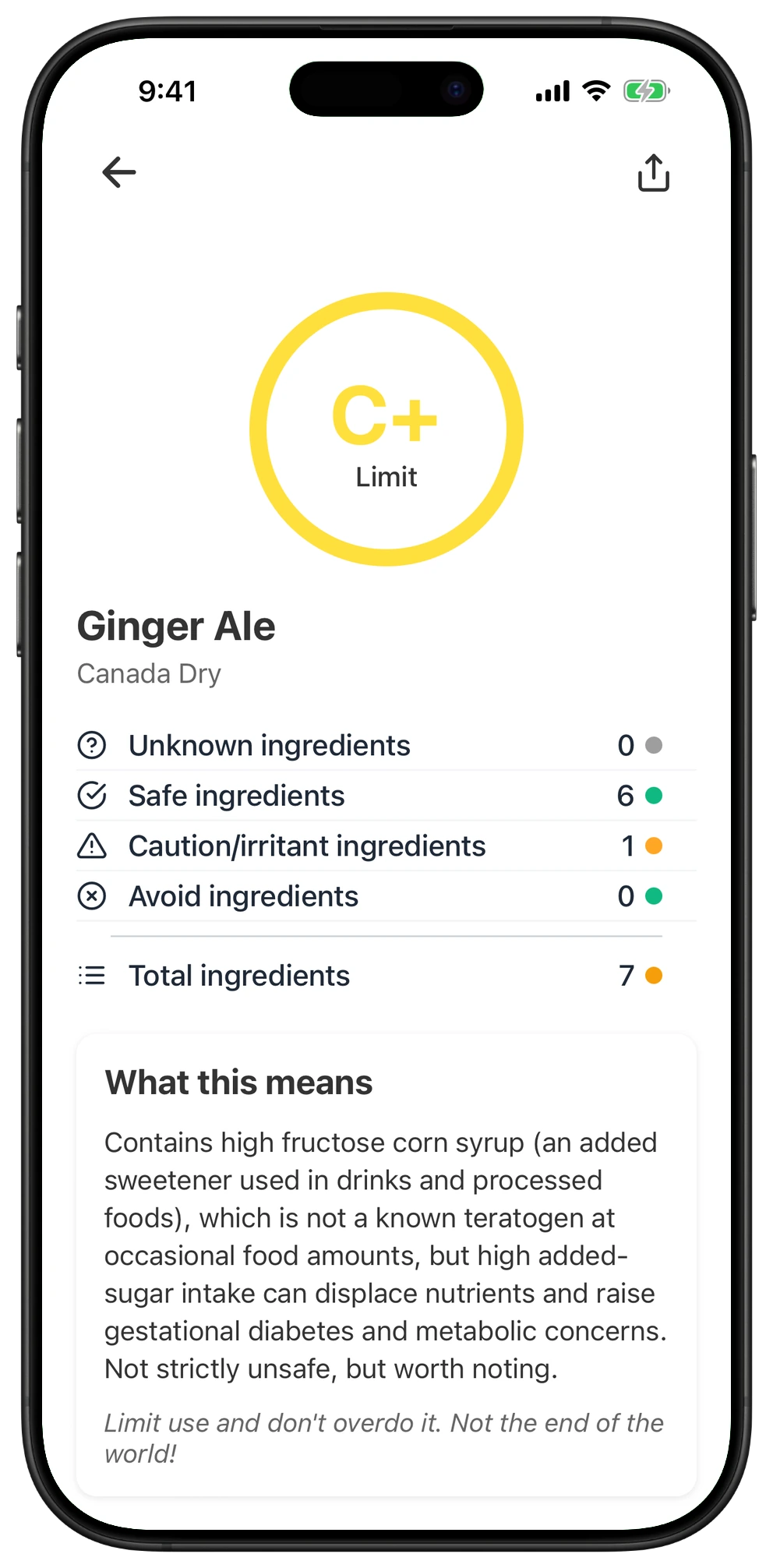
| C+ | Ginger Ale | Canada Dry | Soft Drink |
| B+ | Zero Sugar Ginger Ale | Canada Dry | Soft Drink |
| Varies B+ (1), C+ (1) | Canada Dry Ginger Ale | Canada Dry | Soft Drink |
| F | Bigelow Lemon Ginger Plus Probiotics Herbal Tea | Bigelow Tea | Herbal Tea |
| B+ | Dramamine Advanced Herbals Ginger 20 Softgels | Dramamine | Dietary Supplement |
| A | Premium Ginger Beer | Fever-Tree | Ginger Beer |
| A | Ginger People Hard Ginger Candy, Double Strength | Royal Pacific Foods | Candy |
| C+ | Ginger Honey Herbal Tea Bags, Ginger; Honey | Bigelow | Herbal Tea |
How Do Products Containing Ginger Score?
It can be helpful to see how products containing ginger generally score during pregnancy. This does not tell you whether your exact product is safe, but it gives you a general idea of what we found. In this breakdown of 1,423 products, 60% receive an A grade. An A grade means the complete formula is considered safe during pregnancy.
Frequently Asked Questions About Ginger During Pregnancy
Can ginger tea be used during pregnancy?
Ginger tea can fit within food level use during pregnancy. A strongly concentrated preparation or a product combined with other medicinal herbs is a different exposure, so check the full ingredient list and strength.
Can ginger help with pregnancy nausea?
ACOG says ginger has shown benefit for nausea and vomiting of pregnancy and may be considered as a nonpharmacologic option. The reassuring conclusion applies to studied short term use rather than any high dose extract.
Does ginger cause miscarriage in early pregnancy?
Moderate dietary ginger is not known to cause pregnancy problems. The available evidence does not justify treating food level ginger as a miscarriage risk, but it does not make every concentrated supplement equivalent to food.
Is ginger different in the first, second, or third trimester?
The available evidence does not establish separate trimester limits for ordinary food use. Late pregnancy bleeding concerns matter because high dose extracts or use alongside anticoagulants may require clinical review.
Are raw ginger and ginger powder acceptable during pregnancy?
Fresh ginger and dried ginger powder are common culinary forms and are generally compatible in food amounts. Concentrated extracts can deliver a different exposure and should not be assumed equivalent to seasoning food.
Is ginger extract safe in skin or hair products during pregnancy?
Normal topical cosmetic use is considered a low pregnancy concern when products are formulated to avoid sensitization. Direct pregnancy studies of topical ginger were not found, and concentrated medicated or penetration enhanced transdermal preparations are different exposures.
How Do We Score Products for Pregnancy Safety?
We analyze each product's ingredients and category to flag known risks and provide cautionary notices for general category safety concerns.
A - Safe
Excellent choice! All ingredients are considered safe during pregnancy.
What to do: Use with confidence.
B - Likely Safe
Pretty much safe with very minimal risk. Some ingredients may have limited pregnancy studies, but no significant safety concerns have been identified.
What to do: Use with confidence.
C - Limit
Contains ingredients with some pregnancy considerations. Research shows these ingredients may have limited safety data, potential for minor hormonal effects, or require caution based on animal studies.
What to do: Use sparingly and consider safer alternatives when available.
D - Caution
Similar to C grade but contains multiple cautionary ingredients. The combination increases overall concern.
What to do: Try to avoid if that makes you feel better. If you've already used it, no need to panic.
F - Avoid
Contains an ingredient Pregnancy Safe recommends avoiding during pregnancy. This may reflect an established risk or a precaution based on limited evidence; check the ingredient guidance and exposure context.
What to do: Do not use during pregnancy. If you've already used it, don't worry - contact your OBGYN if concerned.
Sources
- https://journals.lww.com/greenjournal/fulltext/2018/01000/acog_practice_bulletin_no__189__nausea_and.39.aspx
- https://journals.sagepub.com/doi/10.1177/10915818261425573
- https://pmc.ncbi.nlm.nih.gov/articles/PMC3995184/
- https://pmc.ncbi.nlm.nih.gov/articles/PMC5920415/
- https://pubmed.ncbi.nlm.nih.gov/18058610/
- https://pubmed.ncbi.nlm.nih.gov/22706624/
- https://pubmed.ncbi.nlm.nih.gov/24199775/
- https://pubmed.ncbi.nlm.nih.gov/39343171/
- https://www.gov.uk/government/publications/ginger/statement-on-the-safety-of-ginger-supplement-use-in-pregnancy
- https://www.ncbi.nlm.nih.gov/books/NBK582731/
- https://www.cdc.gov/alcohol-pregnancy/about/index.html
- https://www.cdc.gov/fasd/about/index.html
- https://www.acog.org/womens-health/infographics/alcohol-and-pregnancy
- https://www.niaaa.nih.gov/publications/brochures-and-fact-sheets/alcohol-and-your-pregnancy
- https://mothertobaby.org/fact-sheets/alcohol-pregnancy/
- https://pubmed.ncbi.nlm.nih.gov/26482673/
- https://pmc.ncbi.nlm.nih.gov/articles/PMC9543418/
- https://www.ncbi.nlm.nih.gov/books/NBK582563/
- https://www.ncbi.nlm.nih.gov/books/NBK582743/
- https://www.fda.gov/food/dietary-supplements-guidance-documents-regulatory-information/dietary-supplement-labeling-guide-chapter-iv-nutrition-labeling
- https://pubmed.ncbi.nlm.nih.gov/28775124/
- https://www.iberogast.com/healthcare-professionals/instructions-resources
- https://www.herbalist-alchemist.com/shop-products-cyp-cyperus-extract
- https://www.nccih.nih.gov/health/licorice-root
- https://webprod.hc-sc.gc.ca/nhpid-bdipsn/dbImages/mono_licorice_english.pdf
- https://www.ema.europa.eu/en/medicines/herbal/liquiritiae-radix
- https://www.medsafe.govt.nz/profs/PUArticles/December2019/Liquorice-side-effects-interactions.htm
- https://www.bfr.bund.de/cm/349/does-the-consumption-of-liquorice-by-pregnant-women-impair-the-mental-and-physical-development-of-children.pdf
- https://pubmed.ncbi.nlm.nih.gov/28158597/
- https://pubmed.ncbi.nlm.nih.gov/11390327/
- https://www.nccih.nih.gov/health/asian-ginseng
- https://www.ema.europa.eu/en/documents/herbal-report/draft-assessment-report-panax-ginseng-camey-radix-revision-1_en.pdf
- https://pubmed.ncbi.nlm.nih.gov/18204104/
- https://www.ncbi.nlm.nih.gov/books/NBK501814/
- https://www.mskcc.org/cancer-care/integrative-medicine/herbs/ginseng-asian
- https://www.mskcc.org/cancer-care/integrative-medicine/herbs/ginseng-american
- https://pubmed.ncbi.nlm.nih.gov/14507839/
- https://www.fhi.no/contentassets/f08343d5155e413284f5c31a6b415b51/fhi-report-holy-basil-271123.pdf
- https://webprod.hc-sc.gc.ca/nhpid-bdipsn/atReq?atid=ocimum.tenuliflorum.leaf.feuille&lang=eng
- https://www.merckmanuals.com/home/special-subjects/dietary-supplements-and-vitamins/holy-basil
- https://www.drugs.com/npp/holy-basil.html
- https://bsh.ahpa.org/SampleHerb4.aspx
- https://www.phytojournal.com/archives/2022/vol11issue4/PartD/11-4-54-138.pdf
- https://pubmed.ncbi.nlm.nih.gov/12099405/
- https://mothertobaby.org/baby-blog/kombucha-pregnancy-answers/
- https://www.cdc.gov/food-safety/foods/pregnant-women.html
- https://www.fda.gov/food/people-risk-foodborne-illness/fruits-veggies-and-juices-food-safety-moms-be
- https://www.ttb.gov/kombucha/kombucha-general/print
- https://pubmed.ncbi.nlm.nih.gov/20664420/
- https://www.mdpi.com/2311-5637/10/8/385
- https://www.cdc.gov/mmwr/preview/mmwrhtml/00039742.htm
- https://journals.sagepub.com/doi/10.1177/0885066609332963
- https://www.foodprotection.org/members/fpt-archive-articles/2025-03-determining-critical-food-safety-factors-for-safely-homebrewing-kombucha-a-study-on-microbia/
- https://www.acog.org/clinical/clinical-guidance/committee-opinion/articles/2010/08/moderate-caffeine-consumption-during-pregnancy
- https://www.acog.org/womens-health/experts-and-stories/ask-acog/how-much-coffee-can-i-drink-while-pregnant
- https://www.ncbi.nlm.nih.gov/books/NBK582613/
- https://www.who.int/tools/elena/interventions/caffeine-pregnancy
- https://www.fda.gov/consumers/consumer-updates/spilling-beans-how-much-caffeine-too-much
- https://pubmed.ncbi.nlm.nih.gov/25179792/
- https://pubmed.ncbi.nlm.nih.gov/25238871/