Is Coconut Water Safe During Pregnancy? (Updated 2026 Guide)
Updated September 9, 2026
The Answer
Yes properly treated and stored coconut water can be an ordinary beverage during pregnancy; check the exact version and added ingredients. Our catalog contains 730 A scored entries among 771 products, but ingredient scores do not establish processing safety or individual pregnancy suitability.
The main consideration is choosing coconut water treated for food safety and following its storage instructions, rather than relying on a natural or organic label. Blends containing oral aloe warrant caution, while added caffeine counts toward a total below 200 mg per day from all sources. Coconut water is not an oral rehydration solution or treatment for severe vomiting, and its potassium content may require individualized advice if you have kidney disease or take medicines affecting potassium.
Pregnancy Safe is 100% independent and research driven. No companies pay to promote or sponsor products.
Stress Less This Pregnancy
Check your exact coconut water in the app

✓ What's Safe
- • Choose coconut water confirmed as pasteurized or otherwise treated to control harmful bacteria; ask the manufacturer if the processing is unclear.
- • Read the exact carton’s ingredients rather than assuming every flavor or version has the same formula.
- • Compare serving sizes, total sugars and added sugars so you know what your usual portion contains.
- • Follow refrigeration and use after opening instructions on the package.
- • Check potassium per serving with your clinician if you have kidney disease or take medicines that affect potassium.
✗ What to Avoid
- • Avoid untreated coconut water or freshly poured drinks whose treatment and handling you cannot verify.
- • Skip drinks stored contrary to their label instructions, including opened cartons kept without required refrigeration.
- • Choose blends without aloe vera juice, aloe vera pulp or other oral aloe additions; pregnancy concerns are strongest for latex and whole leaf forms, and beverage safety is uncertain.
- • Avoid letting natural caffeine from tea or other added caffeine push your daily total to 200 mg or more.
- • Do not use coconut water instead of prescribed rehydration treatment, care for severe vomiting or prenatal vitamins.
Most Common Ingredients in Coconut Water Products
We analyzed 771 coconut water products. Here are the most common ingredients, ranked by how often they appear:
Ingredients to Watch Out For in Coconut Water
These are the most common flagged ingredients across 771 coconut water products we analyzed.
aloe vera juice
Caution
Aloe vera juice is a soothing, hydrating beverage made from the gel of the aloe vera plant, known for its potential health and skin benefits.
Is low concern on skin but oral latex, whole leaf, laxative, supplement, or juice forms may stimulate uterine contractions and cause laxative related fluid or electrolyte imbalance.
Flagged in 6 of 771 products (1%)
aloe vera pulp
Caution
Aloe vera pulp is the gel like substance extracted from the leaves of the aloe vera plant, known for its soothing, moisturizing, and healing properties.
Is low concern on skin but oral latex, whole leaf, laxative, supplement, or juice forms may stimulate uterine contractions and cause laxative related fluid or electrolyte imbalance.
Flagged in 5 of 771 products (1%)
Caution
Aloe vera is a soothing, gel like plant extract known for its moisturizing and healing properties.
Is low concern on skin but oral latex, whole leaf, laxative, supplement, or juice forms may stimulate uterine contractions and cause laxative related fluid or electrolyte imbalance.
Flagged in 2 of 771 products (0%)
aloe vera gel
Caution
Aloe vera gel is a soothing, natural extract known for its moisturizing and healing properties for skin and hair.
Is low concern on skin but oral latex, whole leaf, laxative, supplement, or juice forms may stimulate uterine contractions and cause laxative related fluid or electrolyte imbalance.
Flagged in 2 of 771 products (0%)
natural caffeine from tea
Caution
A natural source of energy, derived from tea leaves, providing a gentle and sustained caffeine boost.
Should be counted across all sources and generally limited to below 200 mg/day in pregnancy because higher intake has observational links to miscarriage and fetal growth outcomes.
Flagged in 2 of 771 products (0%)
aloe vera gel powder
Caution
Aloe vera gel powder is a concentrated, dehydrated form of aloe vera extract used for soothing, moisturizing, and healing skin and hair applications.
Is low concern on skin but oral latex, whole leaf, laxative, supplement, or juice forms may stimulate uterine contractions and cause laxative related fluid or electrolyte imbalance.
Flagged in 1 of 771 products (0%)
aloe vera juice aloe vera inner leaf powder
Caution
Aloe vera juice and inner leaf powder are natural extracts known for their soothing, hydrating, and healing properties for skin and digestive health.
Is low concern on skin but oral latex, whole leaf, laxative, supplement, or juice forms may stimulate uterine contractions and cause laxative related fluid or electrolyte imbalance.
Flagged in 1 of 771 products (0%)
aloe vera juice with pulp
Caution
Aloe vera juice with pulp is a refreshing, nutrient rich beverage made from the gel of aloe vera leaves, containing natural pulp for added texture and health benefits.
Is low concern on skin but oral latex, whole leaf, laxative, supplement, or juice forms may stimulate uterine contractions and cause laxative related fluid or electrolyte imbalance.
Flagged in 1 of 771 products (0%)
Coconut Water Products We've Analyzed
Our catalog contains ratings for 771 coconut water products. These are database grades, not independent safety certifications.
Grades are catalog ingredient scores, not measurements of current labels, preparation, pathogens, dose or clinical pregnancy suitability. Unreviewed products remain in the aggregate counts.
Pregnancy Safe Coconut Water Products
Popular options from our catalog, prioritizing A and B ingredient grades, with C grade options used to fill remaining places. Within each group, products are ordered by searches in Pregnancy Safe, not retail sales. Read the cautions and guidance above; grades do not verify a complete current label or guarantee pregnancy safety.
| Grade | Product | Brand |
|---|---|---|
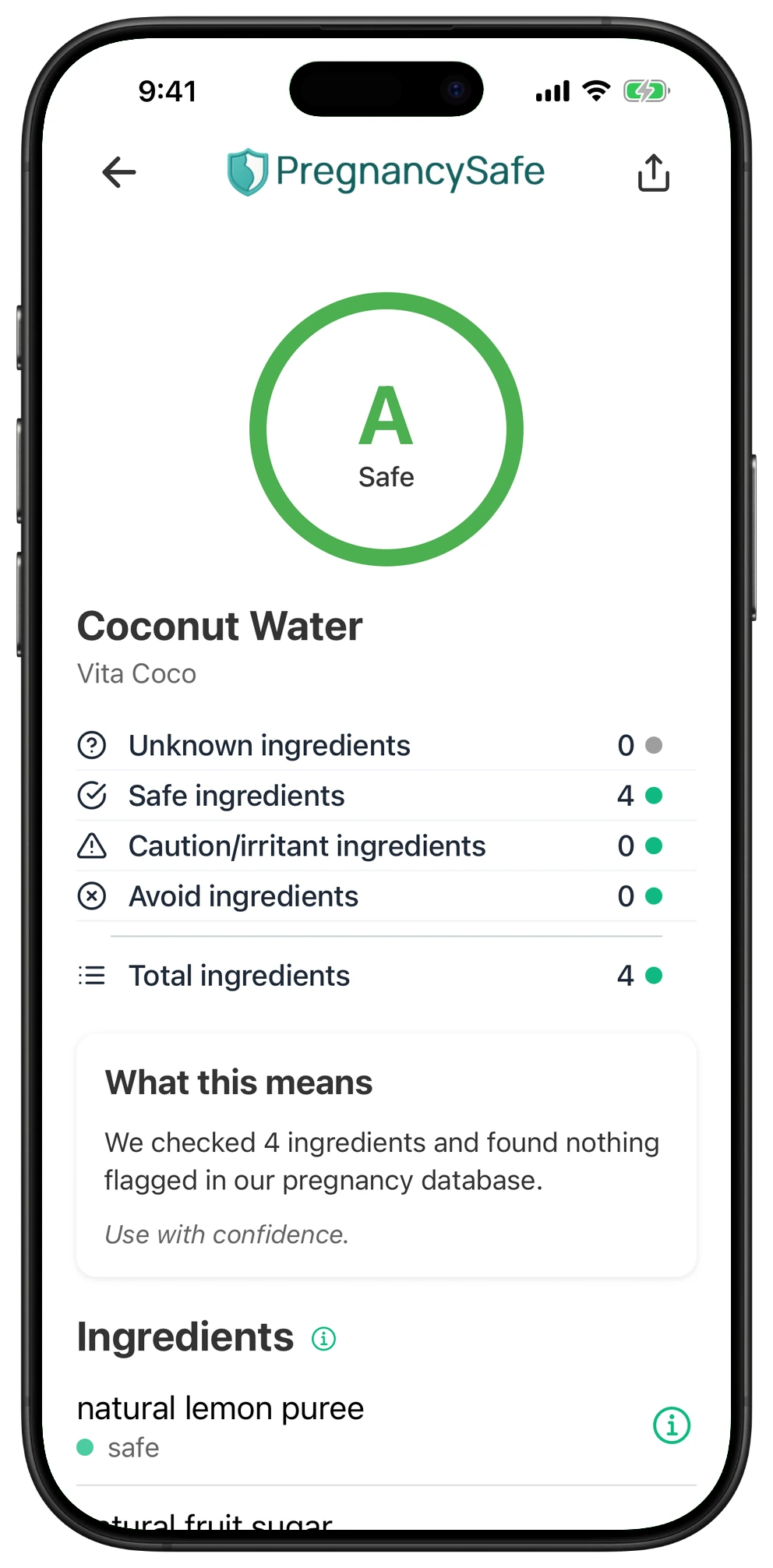
| A | Coconut Water | Vita Coco |
| A | Vita Coco Pure Coconut Water | Vita Coco |
| A | Organic Coconut Water | Kirkland Signature |
| A | Vita Coco The Original Coconut Water | Vita Coco |
| A | Pineapple Coconut Water, Pineapple | Vita Coco |
Your Questions Answered
What kind of coconut water is safe during pregnancy?
Choose coconut water that has been pasteurized or otherwise treated to control harmful bacteria, and follow its storage instructions. Natural, organic and cold pressed descriptions alone do not confirm that treatment. Check the exact version for additions such as aloe or caffeine rather than assuming all coconut water drinks are equivalent.
When should a pregnant woman drink coconut water?
There is no established pregnancy specific time of day when you need to drink it. Treat suitably processed coconut water as an optional beverage, not a trimester specific treatment. Choose a time and portion that suit you, while following any individualized dietary advice.
How much coconut water should I drink per day?
There is no established pregnancy specific daily dose to recommend. Use the serving size and nutrition label to understand your sugar and potassium intake rather than treating a whole carton as a required daily amount. If you have kidney disease or take medicines affecting potassium, ask your clinician what amount fits your circumstances.
Can coconut water treat morning sickness or dehydration?
Coconut water can contribute fluid if you can tolerate drinking it, but it is not a treatment for severe vomiting. Its electrolyte composition is not equivalent to a clinical oral rehydration solution. If vomiting is persistent or you cannot keep fluids down, contact your pregnancy care team rather than relying on coconut water.
Should I avoid coconut water with aloe vera?
Choosing a blend without added aloe is a practical precaution during pregnancy. Oral aloe concerns are strongest for latex, whole leaf extracts and laxative preparations, which can cause diarrhea and fluid or electrolyte imbalance. Those concerns do not establish that every small beverage exposure causes harm, but pregnancy safety for aloe containing drinks remains uncertain. Low concern for aloe applied to skin does not establish safety when you swallow it.
Does an A grade mean a coconut water product is verified safe?
No an A grade is a catalog ingredient score, not a pregnancy safety guarantee. Our catalog contains 771 products, including 730 with an A score, and those totals include unreviewed entries. Grades do not establish the current formula, treatment, storage conditions or suitability for your medical circumstances. Check the exact package even when a listed product is available.
Can coconut water clean the womb or change my baby’s complexion?
No coconut water does not clean the womb or change your baby’s complexion. It can be an ordinary beverage, but it is not a special prenatal treatment. It also does not replace prenatal vitamins or your pregnancy care.
How Do We Score Products for Pregnancy Safety?
We analyze each product's ingredients and category to flag known risks and provide cautionary notices for general category safety concerns.
Grades reflect the ingredient and category information available to us. They don’t verify a complete, current label or account for dose, preparation, or contamination. Read them alongside the guidance above, not as a guarantee of pregnancy safety or proof that every use is harmful.
A - Safe
Excellent choice! All ingredients are considered safe during pregnancy.
What to do: Use with confidence.
B - Likely Safe
Pretty much safe with very minimal risk. Some ingredients may have limited pregnancy studies, but no significant safety concerns have been identified.
What to do: Use with confidence.
C - Limit
Contains ingredients with some pregnancy considerations. Research shows these ingredients may have limited safety data, potential for minor hormonal effects, or require caution based on animal studies.
What to do: Use sparingly and consider safer alternatives when available.
D - Caution
Similar to C grade but contains multiple cautionary ingredients. The combination increases overall concern.
What to do: Try to avoid if that makes you feel better. If you've already used it, no need to panic.
F - Avoid
Contains an ingredient Pregnancy Safe recommends avoiding during pregnancy. This may reflect an established risk or a precaution based on limited evidence; check the ingredient guidance and exposure context.
What to do: Do not use during pregnancy. If you've already used it, don't worry - contact your OBGYN if concerned.
People Also Checked
References
- https://www.fda.gov/food/buy-store-serve-safe-food/what-you-need-know-about-juice-safety
- https://ods.od.nih.gov/factsheets/Pregnancy-HealthProfessional/
- https://www.nccih.nih.gov/health/aloe-vera
- https://webprod.hc-sc.gc.ca/nhpid-bdipsn/dbImages/mono_aloe--oral_english.pdf
- https://www.ema.europa.eu/en/documents/herbal-monograph/final-european-union-herbal-monograph-aloe-barbadensis-mill-and-aloe-various-species-mainly-aloe-ferox-mill-and-its-hybrids-folii-succus-siccatus_en.pdf
- https://www.utep.edu/herbal-safety/populations/herbs-to-avoid-during-pregnancy.html
- https://www.federalregister.gov/documents/2002/05/09/02-11510/status-of-certain-additional-over-the-counter-drug-category-ii-and-iii-active-ingredients
- https://pubmed.ncbi.nlm.nih.gov/33164294/
- https://pubmed.ncbi.nlm.nih.gov/28139161/
- https://journals.sagepub.com/doi/10.1080/10915810701351186
- https://www.acog.org/clinical/clinical-guidance/committee-opinion/articles/2010/08/moderate-caffeine-consumption-during-pregnancy
- https://www.acog.org/womens-health/experts-and-stories/ask-acog/how-much-coffee-can-i-drink-while-pregnant
- https://www.ncbi.nlm.nih.gov/books/NBK582613/
- https://www.who.int/tools/elena/interventions/caffeine-pregnancy
- https://www.fda.gov/consumers/consumer-updates/spilling-beans-how-much-caffeine-too-much
- https://pubmed.ncbi.nlm.nih.gov/25179792/
- https://pubmed.ncbi.nlm.nih.gov/25238871/
- https://hfpappexternal.fda.gov/scripts/fdcc/index.cfm?id=FDCYellow5&set=ColorAdditives
- https://www.ecfr.gov/current/title-21/chapter-I/subchapter-A/part-74#74.705
- https://www.fda.gov/food/color-additives-information-consumers/tracking-food-industry-pledges-remove-petroleum-based-food-dyes
- https://www.fda.gov/food/nutrition-food-labeling-and-critical-foods/food-allergies
- https://apps.who.int/food-additives-contaminants-jecfa-database/Home/Chemical/3885
- https://efsa.onlinelibrary.wiley.com/doi/10.2903/j.efsa.2009.1331
- https://oehha.ca.gov/risk-assessment/report/health-effects-assessment-potential-neurobehavioral-effects-synthetic-food-dyes-children
- https://pubmed.ncbi.nlm.nih.gov/1628860/
- https://pmc.ncbi.nlm.nih.gov/articles/PMC7023231/
- https://pmc.ncbi.nlm.nih.gov/articles/PMC6354951/