Best Pregnancy Safe Bronzer (Updated 2026 Guide)
Updated September 9, 2026
The Answer
For bronzer during pregnancy, prioritize the exact formula, ordinary use on intact skin, and application that avoids breathing powder rather than choosing by grade alone. Our catalog contains 113 products, with grades ranging from A to F and most in the C range; these scores are not clinical pregnancy safety verdicts.
Bronzer adds cosmetic color; it is not the same as DHA self tanner or UV tanning, and it does not replace sunscreen without appropriate sunscreen labeling. Practical considerations include airborne powder, possible talc contamination, and fragrance related irritation or allergy, which are distinct from fetal harm. Preservative flags often reflect limited or indirect pregnancy evidence, while oral antacid and high dose animal findings do not establish harm from ordinary topical bronzer use.
Pregnancy Safe is 100% independent and research driven. No companies pay to promote or sponsor products.
Stress Less This Pregnancy
Check your exact bronzer in the app
✓ What's Safe
- • Check the current ingredient list for your exact shade and version; older formulas and different sizes may not match.
- • Consider a cream or balm if you want to reduce airborne powder exposure; still check the full formula.
- • Choose fragrance free formulas if scents irritate your skin or airways, checking for fragrance and parfum on the label.
- • If choosing a talc containing powder, look for manufacturer information about asbestos testing; an ingredient grade is not a contaminant test.
- • Read whether the product is wash off cosmetic color or a DHA self tanner, and follow directions for that specific form.
- • Keep separate sun protection unless the exact bronzer has appropriate sunscreen labeling and you follow its sunscreen directions.
✗ What to Avoid
- • Avoid creating or breathing powder clouds, including when applying bronzer containing talc; apply gently rather than blowing excess powder off your brush.
- • Avoid parfum, fragrance, or fragrance parfum if they trigger irritation or airway symptoms; these are related scent label terms, not proof of fetal toxicity.
- • Avoid treating talc free or clean claims as proof that a bronzer is contaminant free or pregnancy certified.
- • Avoid rejecting a bronzer solely because it contains phenoxyethanol, methylparaben, propylparaben, or bht; concentration and topical exposure matter.
- • Avoid applying ordinary bronzer to damaged skin or using it in ways that lead to ingestion.
- • Avoid choosing solely by an A grade or assuming a D or F grade proves harm; verify the formula, exposure route, and directions.
Most Common Ingredients in Bronzer Products
We analyzed 113 bronzer products. Here are the most common ingredients, ranked by how often they appear:
Ingredients to Watch Out For in Bronzer
These are the most common flagged ingredients across 113 bronzer products we analyzed.
Caution
Phenoxyethanol is a preservative commonly used in cosmetics and skincare products to prevent microbial growth and extend shelf life.
Has limited direct pregnancy data and possible infant oral exposure concerns from nipple area products, while regulated cosmetic concentrations are generally considered low systemic risk.
This preservative helps prevent microbial growth in bronzer. Direct pregnancy data are limited, but reviewed cosmetic concentrations are considered acceptable; ordinary facial application is not equivalent to infant ingestion from a nipple area product.
Flagged in 44 of 113 products (39%)
talc
Caution
Talc is a soft mineral composed primarily of magnesium, silicon, and oxygen, commonly used in cosmetics and personal care products for its absorbent and smoothing properties.
Has limited pregnancy specific data plus contamination and inhalation concerns with loose body powders, while modern asbestos tested pressed cosmetics appear lower concern.
Talc improves powder bronzer's texture and helps prevent caking. The practical concerns are asbestos contamination and breathing airborne powder, not established reproductive harm from occasional asbestos tested pressed makeup. Consider talc free options or manufacturer testing information, and avoid dust clouds.
Flagged in 40 of 113 products (35%)
parfum
Caution
Parfum is a fragrant mixture of essential oils, aroma compounds, and solvents used to impart a pleasant scent.
Can hide product specific mixtures and has been associated with higher DEP metabolite exposure in some pregnancy studies; fragrance allergens and VOCs may also irritate sensitive skin or airways.
Parfum denotes a scent mixture in bronzer and is another label term for fragrance. It can cause irritation or allergy, and its individual components may not be disclosed. Choosing fragrance free is an optional exposure reduction step, not evidence that every parfum containing bronzer contains phthalates or harms pregnancy.
Flagged in 16 of 113 products (14%)
aluminum hydroxide
Caution
Aluminum hydroxide is a compound commonly used as an antacid to neutralize stomach acid and as an adjuvant in vaccines.
Is generally low concern for short term labeled antacid use but needs caution with chronic high dose use, kidney disease, constipation, or medication and iron interactions.
Aluminum hydroxide on a bronzer label represents topical cosmetic exposure, not an oral antacid dose. Evidence about chronic antacid use, kidney disease, or interactions with prenatal iron does not establish those concerns for facial bronzer. The oral evidence does not provide a bronzer specific pregnancy verdict.
Flagged in 15 of 113 products (13%)
methylparaben
Caution
Methylparaben is a synthetic preservative commonly used in cosmetics and personal care products to inhibit microbial growth and extend shelf life.
Has mixed human pregnancy biomonitoring signals and weak endocrine activity, while regulated cosmetic levels are generally considered low concern.
Methylparaben is a short chain preservative that protects bronzer from microbial growth. Pregnancy biomonitoring findings are mixed, and its weak endocrine activity does not establish harm from low dose topical use. Reviewed cosmetic levels are considered low concern; avoiding it is a preference rather than a demonstrated pregnancy requirement.
Flagged in 10 of 113 products (9%)
fragrance
Caution
A fragrant substance used to add a pleasant aroma to products or environments.
Can hide product specific mixtures and has been associated with higher DEP metabolite exposure in some pregnancy studies; fragrance allergens and VOCs may also irritate sensitive skin or airways.
Fragrance adds scent to bronzer and may represent an undisclosed mixture, also labeled parfum. Fragranced personal care use has been associated with higher exposure to some fragrance related chemicals, but that does not identify the contents or pregnancy risk of your bronzer. Fragrance free formulas can be useful if you experience skin or airway sensitivity.
Flagged in 9 of 113 products (8%)
magnesium aluminum silicate
Caution
Magnesium aluminum silicate is a naturally occurring mineral used as a thickening, stabilizing, and anti caking agent in various cosmetic and pharmaceutical products.
Has developmental concern at higher chronic exposures, but regulated vaccine adjuvants and occasional clinician directed antacid use should be considered separately.
Magnesium aluminum silicate is a mineral thickener, stabilizer, and anti caking ingredient used in cosmetic formulas. Its aluminum containing name does not make it equivalent to aluminum metal or high dose oral aluminum exposure. Broader aluminum findings do not establish developmental harm from this specific ingredient in ordinary topical bronzer use.
Flagged in 9 of 113 products (8%)
propylparaben
Caution
Propylparaben is a synthetic preservative commonly used in cosmetics and personal care products to inhibit microbial growth and extend shelf life.
Has mixed pregnancy biomonitoring signals and weak endocrine activity, but regulated cosmetic concentrations are considered low concern by FDA, SCCS and CIR.
Propylparaben preserves bronzer and has greater endocrine activity concerns than the shorter chain methylparaben. Human pregnancy findings are mixed and do not consistently establish causal harm at cosmetic use levels. Safety reviews consider it acceptable within specified concentration limits, so its presence alone is not a reason to declare a bronzer unsafe.
Flagged in 8 of 113 products (7%)
How Do Bronzer Products Stack Up?
Our catalog contains ratings for 113 bronzer products. These are database grades, not independent safety certifications.
Catalog ingredient scores are not clinical pregnancy verdicts or independent current-label/contaminant checks. Unreviewed, mixed-route or incompletely sourced records can affect counts. Follow exact product form, active ingredients, exposure and directions rather than choosing solely by grade.
Best Pregnancy Safe Bronzer
Popular options from our catalog, prioritizing A and B ingredient grades, with C grade options used to fill remaining places. Within each group, products are ordered by searches in Pregnancy Safe, not retail sales. Read the cautions and guidance above; grades do not verify a complete current label or guarantee pregnancy safety.
| Grade | Product | Brand |
|---|---|---|
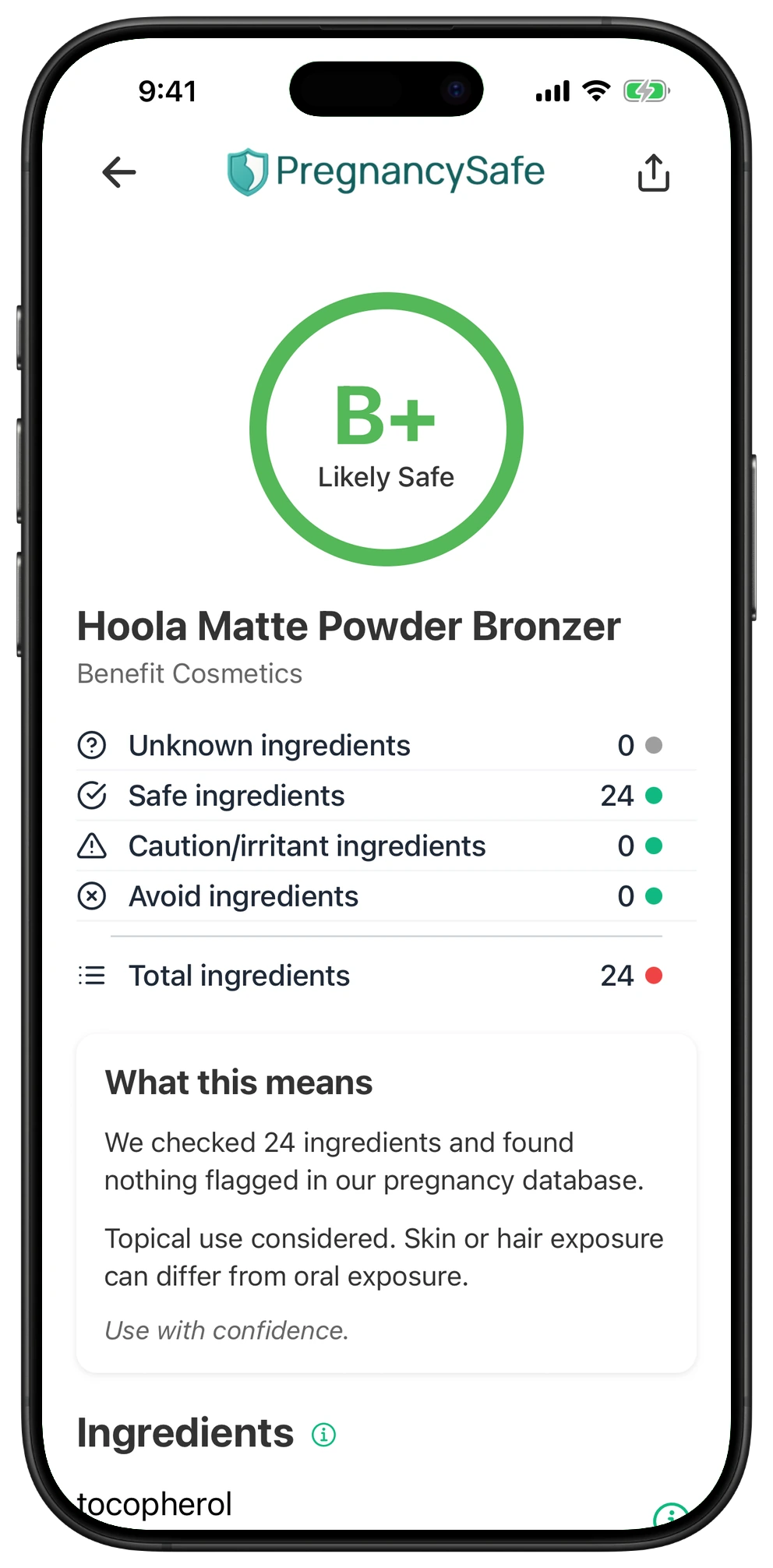
| B+ | Hoola Matte Powder Bronzer | Benefit Cosmetics |
| A | Warm Wishes Soft Matte Powder Bronzer Sun Blaze | Rare Beauty |
| B+ | Hoola Matte Bronzer | Benefit Cosmetics |
| B+ | Oceanly Bronzer Stick Golden | Attitude |
| B+ | Physiciansformula Bronze Booster Airbrush - Light/Medium - : Glow-Boosting, Contour, Cruelty-Free | Physicians Formula |
Your Questions Answered
Is bronzer safe during pregnancy?
Ordinary topical bronzer should not automatically be treated as a pregnancy hazard because an ingredient receives a caution score. Choose an identifiable formula, follow its directions, and avoid breathing airborne powder. Direct pregnancy evidence is limited for many cosmetic ingredients, so neither a favorable grade nor a short ingredient list guarantees safety. Cosmetic bronzer also needs to be distinguished from DHA self tanner and UV tanning.
What makeup brands are safe during pregnancy?
A brand name cannot establish pregnancy safety for every formula it sells. Check the exact product, shade, and current package rather than extending one formula's assessment to the whole brand. Even a listed product is not a pregnancy safety guarantee or independent contaminant check. Reformulations and older stock can have different ingredient lists.
What makeup is not allowed during pregnancy?
There is no basis here for a blanket ban on bronzer or on ordinary cosmetic preservatives, silicones, fragrance, and pigments as groups. For bronzer, focus on avoiding inhalation, unintended ingestion, and use on damaged skin rather than treating every caution ingredient as prohibited. Fragrance may warrant avoidance if it causes allergy or irritation, but that is different from established reproductive harm. If your makeup also contains treatment ingredients, have those assessed separately for pregnancy.
Is cream bronzer a better choice than powder bronzer?
A cream or balm can help you avoid the airborne dust created by powder application. That is an exposure management advantage, not proof that every cream formula is safer during pregnancy. Pressed powder can still be an option when applied without creating a dust cloud. Compare the actual ingredient lists and your skin's tolerance rather than relying on texture alone.
Should I stop using bronzer that contains talc or phenoxyethanol?
Neither ingredient automatically means you need to stop ordinary bronzer use. For talc, the main concerns are contamination and inhalation; pregnancy specific evidence does not establish asbestos tested cosmetic talc as a reproductive toxicant. Phenoxyethanol has limited direct pregnancy data, but safety reviews consider regulated cosmetic concentrations acceptable. Infant ingestion concerns from nipple area products do not establish harm from applying bronzer to your face during pregnancy.
Does an A grade mean a bronzer is proven pregnancy safe?
No. Our catalog contains one A grade bronzer, but that is an ingredient score, not a count of independently verified safe products. Grades do not establish current label accuracy, pregnancy outcomes, or absence of contaminants. Likewise, a low grade or incomplete record does not by itself show that a product is harmful.
How Do We Score Products for Pregnancy Safety?
We analyze each product's ingredients and category to flag known risks and provide cautionary notices for general category safety concerns.
Grades reflect the ingredient and category information available to us. They don’t verify a complete, current label or account for dose, preparation, or contamination. Read them alongside the guidance above, not as a guarantee of pregnancy safety or proof that every use is harmful.
A - Safe
Excellent choice! All ingredients are considered safe during pregnancy.
What to do: Use with confidence.
B - Likely Safe
Pretty much safe with very minimal risk. Some ingredients may have limited pregnancy studies, but no significant safety concerns have been identified.
What to do: Use with confidence.
C - Limit
Contains ingredients with some pregnancy considerations. Research shows these ingredients may have limited safety data, potential for minor hormonal effects, or require caution based on animal studies.
What to do: Use sparingly and consider safer alternatives when available.
D - Caution
Similar to C grade but contains multiple cautionary ingredients. The combination increases overall concern.
What to do: Try to avoid if that makes you feel better. If you've already used it, no need to panic.
F - Avoid
Contains an ingredient Pregnancy Safe recommends avoiding during pregnancy. This may reflect an established risk or a precaution based on limited evidence; check the ingredient guidance and exposure context.
What to do: Do not use during pregnancy. If you've already used it, don't worry - contact your OBGYN if concerned.
People Also Checked
References
- https://www.fda.gov/cosmetics/resources-consumers-cosmetics/cosmetics-pregnancy
- https://www.fda.gov/cosmetics/cosmetic-products/sunless-tanners-bronzers
- https://health.ec.europa.eu/system/files/2021-08/sccs_o_195_0.pdf
- https://ec.europa.eu/growth/tools-databases/cosing/details/28157
- https://journals.sagepub.com/doi/10.3109/10915819009078737
- https://link.springer.com/article/10.1007/s00204-024-03938-5
- https://www.sfda.gov.sa/en/warnings/1156
- https://www.industrialchemicals.gov.au/sites/default/files/Ethanol%2C%202-phenoxy-_Human%20health%20tier%20II%20assessment.pdf
- https://hero.epa.gov/reference/2857875
- https://books.publisso.de/sites/default/files/documents/series/mak/dam/Vol2019/Iss1/Alt006/mb12299kske6319_w.pdf
- https://www.fda.gov/cosmetics/cosmetic-ingredients/talc
- https://www.fda.gov/cosmetics/cosmetics-news-events/fda-releases-data-agencys-2023-testing-talc-containing-cosmetic-products-asbestos
- https://www.federalregister.gov/documents/2025/11/28/2025-21407/testing-methods-for-detecting-and-identifying-asbestos-in-talc-containing-cosmetic-products
- https://publications.iarc.who.int/Book-And-Report-Series/Iarc-Monographs-On-The-Identification-Of-Carcinogenic-Hazards-To-Humans/Talc-And-Acrylonitrile-2025
- https://www.cancer.org/cancer/risk-prevention/chemicals/talcum-powder-and-cancer.html
- https://www.cdc.gov/niosh/npg/npgd0584.html
- https://pmc.ncbi.nlm.nih.gov/articles/PMC6310682/
- https://recalls-rappels.canada.ca/en/alert-recall/talc-health-risks-associated-inhalation-and-exposure-female-genital-area
- https://www.fda.gov/cosmetics/cosmetic-ingredients/fragrances-cosmetics
- https://www.fda.gov/cosmetics/cosmetic-ingredients/phthalates-cosmetics
- https://www.fda.gov/cosmetics/cosmetic-ingredients/allergens-cosmetics
- https://pmc.ncbi.nlm.nih.gov/articles/PMC3110684/
- https://pmc.ncbi.nlm.nih.gov/articles/PMC4016195/
- https://pmc.ncbi.nlm.nih.gov/articles/PMC4097177/
- https://pmc.ncbi.nlm.nih.gov/articles/PMC8453372/
- https://pmc.ncbi.nlm.nih.gov/articles/PMC10999525/
- https://www.epa.gov/indoor-air-quality-iaq/volatile-organic-compounds-impact-indoor-air-quality
- https://www.ncbi.nlm.nih.gov/books/NBK573943/
- https://pmc.ncbi.nlm.nih.gov/articles/PMC9439837/
- https://pmc.ncbi.nlm.nih.gov/articles/PMC2821234/
- https://dailymed.nlm.nih.gov/dailymed/drugInfo.cfm?setid=27848ae0-3b2f-4bfe-8856-4b8de419091e
- https://pubmed.ncbi.nlm.nih.gov/39249590/
- https://pubmed.ncbi.nlm.nih.gov/7565498/
- https://www.ncbi.nlm.nih.gov/books/NBK526049/
- https://www.fda.gov/cosmetics/cosmetic-ingredients/parabens-cosmetics
- https://health.ec.europa.eu/system/files/2023-12/sccs_o_276_final.pdf
- https://pubmed.ncbi.nlm.nih.gov/19101832/
- https://pubmed.ncbi.nlm.nih.gov/32283359/
- https://pubmed.ncbi.nlm.nih.gov/33477047/
- https://pubmed.ncbi.nlm.nih.gov/36709902/
- https://pubmed.ncbi.nlm.nih.gov/40117576/
- https://pubmed.ncbi.nlm.nih.gov/27156397/
- https://wwwn.cdc.gov/TSP/ToxProfiles/ToxProfiles.aspx?id=191&tid=34
- https://pmc.ncbi.nlm.nih.gov/articles/PMC9681673/
- https://pmc.ncbi.nlm.nih.gov/articles/PMC10809980/
- https://www.cdc.gov/vaccine-safety/about/adjuvants.html
- https://www.fda.gov/vaccines-blood-biologics/safety-availability-biologics/common-ingredients-fda-approved-vaccines
- https://www.acog.org/womens-health/infographics/vaccines-during-pregnancy
- https://health.ec.europa.eu/publications/propylparaben_en
- https://journals.sagepub.com/doi/10.1177/1091581820925001
- https://pubmed.ncbi.nlm.nih.gov/32279061/
- https://pubmed.ncbi.nlm.nih.gov/30412856/
- https://pubmed.ncbi.nlm.nih.gov/32521303/
- https://pubmed.ncbi.nlm.nih.gov/35487354/
- https://pubmed.ncbi.nlm.nih.gov/16097138/
- https://health.ec.europa.eu/system/files/2022-08/sccs_o_257.pdf
- https://pubmed.ncbi.nlm.nih.gov/37751543/
- https://pubmed.ncbi.nlm.nih.gov/12396675/
- https://pmc.ncbi.nlm.nih.gov/articles/PMC13151845/
- https://www.ecfr.gov/current/title-21/chapter-I/subchapter-B/part-172/subpart-B/section-172.115
- https://www.ecfr.gov/current/title-21/chapter-I/subchapter-B/part-182/subpart-D/section-182.3173
- https://www.fda.gov/news-events/press-announcements/fda-finalizes-food-chemical-safety-post-market-assessment-program-launches-reassessment-bht-ada