Is Psyllium Safe During Pregnancy?
Updated September 11, 2026
The Answer
Yes psyllium is considered safe during pregnancy at usual food intakes and typical oral bulk forming supplement doses. Increase fiber gradually and drink adequate fluids.
Adequate fluid intake matters: taking a bulk forming fiber supplement with too little fluid needs care.
ACOG recommends fiber and fluids for pregnancy constipation, and a Cochrane review found that fiber supplementation increased stool frequency in pregnant people with constipation.
Already used it? If you have already taken psyllium, check your fluid intake and whether you recently increased your fiber sharply. If you also take oral medicines, ask a pharmacist about timing because bulk forming supplements can affect their absorption.
Pregnancy Safe is 100% independent and research driven. No companies pay to promote or sponsor products.
Stressless Pregnancy
Check your exact product with psyllium in the app

What Is Psyllium?
Psyllium is a soluble fiber derived from the seeds of Plantago ovata. It is used to support digestive health and bowel regularity. You may encounter it as whole psyllium husk, powder, capsules, or fiber thins, as well as an ingredient in foods such as bread and wraps.
What Other Ingredients Should You Look Out for in Products With Psyllium?
A product's full ingredient list determines whether it's pregnancy-safe or not. These ingredients also appear in some of the psyllium products we analyzed and may deserve a closer look.
Berberine
AvoidLook for goldenseal extract or Oregon grape powder in supplement blends; these herbs can contain berberine. MotherToBaby and NCCIH advise against unsupervised berberine use in pregnancy because of limited safety data and interaction concerns, so have your clinician review the blend.
Flagged in 2 products (1.5%) in this analysis.
Fennel
CautionCheck for fennel or fennel seed in fiber and dietary supplements, where use may differ from ordinary culinary amounts. Concentrated supplement use has limited pregnancy safety data and hormonal or uterine concerns; ask your clinician to review the form and amount.
Flagged in 3 products (2.3%) in this analysis.
Chlorella
CautionChlorella in a fiber supplement adds an algae ingredient with limited pregnancy evidence and product quality concerns. Check for quality control information addressing cyanotoxins, heavy metals, and microbes rather than relying on detox claims.
Flagged in 2 products (1.5%) in this analysis.
Hibiscus
CautionLook for hibiscus in fiber supplement blends: human pregnancy safety data are very limited, and adult studies show it can lower blood pressure. Ask your clinician to review it especially if you have low blood pressure or take blood pressure medicine.
Flagged in 2 products (1.5%) in this analysis.
Aloe Vera
CautionAloe vera gel extract in a dietary supplement is swallowed, so reassurance about aloe applied to skin does not apply. NCCIH cautions that oral aloe may be unsafe in pregnancy; ask a clinician to review the preparation rather than assuming it has the same effects as aloe latex.
Flagged in 1 product (0.8%) in this analysis.
Bacillus
CautionBacillus coagulans on a fiber supplement label identifies a probiotic species, but pregnancy evidence is limited and safety depends on the strain and product quality. Check for a named strain and quality control information; reassuring findings for other probiotic genera do not establish safety for this one.
Flagged in 1 product (0.8%) in this analysis.
Does the Form or Amount of Psyllium Matter During Pregnancy?
The pregnancy assessment covers oral psyllium at usual food intakes and typical bulk forming supplement doses. Sudden large increases can cause gas, bloating, and cramps. Medicine timing also matters, and swallowing difficulty or intestinal obstruction can make bulk forming supplements inappropriate. The pregnancy adequate intake of 28 g/day refers to total dietary fiber, not a psyllium supplement dose.
What Products Contain Psyllium?
Pregnancy Safe has looked at 1,049 products that have psyllium as an ingredient. The category and grade breakdowns below use 132 products whose names mention Psyllium or another name for it.
What Types of Products Contain Psyllium?
Products You May Have That Contain Psyllium
| Grade | Product | Brand | Type |
|---|---|---|---|
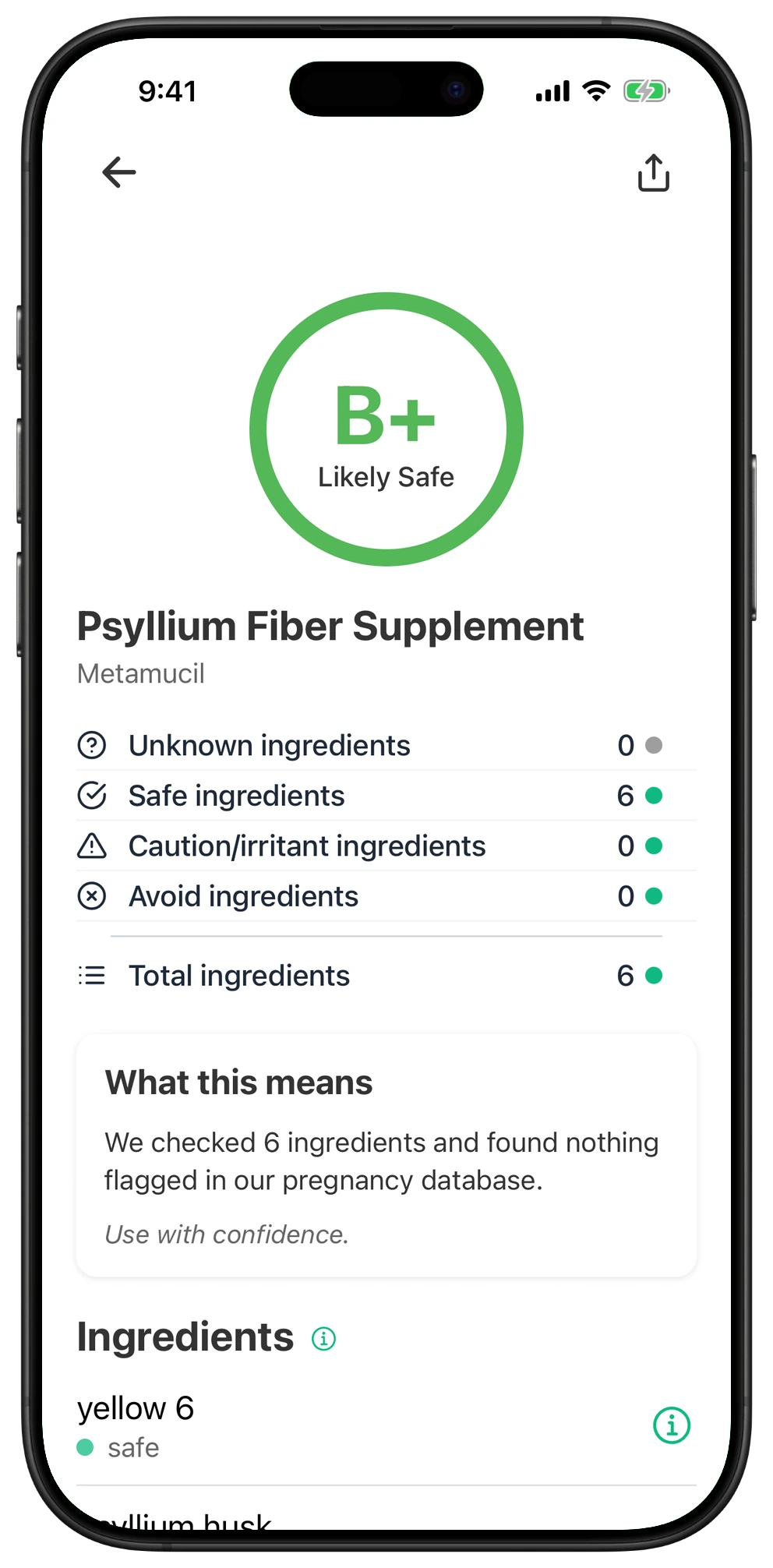
| B+ | Psyllium Fiber Supplement | Metamucil | Fiber Supplement |
| B+ | Metamucil Psyllium Fiber Supplement Sugar Free Powder - Orange | Metamucil | Fiber Supplement |
| B+ | Metamucil 4-In-1 Psyllium Husk Glp-1 Friendly Fiber Supplement Sugar Free Orange Powder | Metamucil | Fiber Supplement |
| A | Metamucil 3 In 1 Multihealth Psyllium Fiber Capsules | Metamucil | Fiber Supplement |
| B+ | Metamucil 4-In-1 Psyllium Powder Sugar-Free Orange | Metamucil | Fiber Supplement |
| A | Metamucil Psyllium Fiber Supplement With Sugar Powder - Orange | Metamucil | Fiber Supplement |
| B+ | Psyllium Fiber Powder | Up & Up | Fiber Supplement |
| B+ | Kids Chocolate Psyllium Fiber Thins, Chocolate | — | Fiber Supplement |
How Do Products Containing Psyllium Score?
It can be helpful to see how products containing psyllium generally score during pregnancy. This does not tell you whether your exact product is safe, but it gives you a general idea of what we found. In this breakdown of 132 products, 63% receive an A grade. An A grade means the complete formula is considered safe during pregnancy.
Frequently Asked Questions About Psyllium During Pregnancy
Can psyllium help with constipation during pregnancy?
Psyllium is a bulk forming fiber used to support bowel regularity. ACOG recommends fiber and fluids for pregnancy constipation, and a Cochrane review found improved stool frequency with fiber supplementation not specifically proof that psyllium is the best option.
How much psyllium should I take during pregnancy?
The evidence supports typical bulk forming supplement doses but does not establish a specific pregnancy psyllium dose. The 28 g/day adequate intake is for total dietary fiber, not 28 grams of psyllium.
Why should I be careful with psyllium husk?
A sudden increase can cause gas, bloating, and cramps, and adequate fluid intake is important. Bulk forming supplements may also be inappropriate if you have swallowing difficulty or intestinal obstruction; those circumstances need clinical advice.
Can I take psyllium with my oral medicines?
Bulk forming supplements can affect absorption of some oral medicines. Ask a pharmacist about timing for your specific medicines rather than assuming they can all be taken together.
Does this mean every Metamucil product is pregnancy safe?
No. Metamucil products include different psyllium powders and capsules, and the full formula needs its own assessment. A product grade describes the complete formula, not psyllium alone.
Are psyllium powder and capsules assessed differently?
Both are oral bulk forming supplement forms covered by the typical dose assessment. The available evidence does not establish one as safer during pregnancy; fluid intake, amount, medicine timing, and other ingredients still matter.
How Do We Score Products for Pregnancy Safety?
We analyze each product's ingredients and category to flag known risks and provide cautionary notices for general category safety concerns.
A - Safe
Excellent choice! All ingredients are considered safe during pregnancy.
What to do: Use with confidence.
B - Likely Safe
Pretty much safe with very minimal risk. Some ingredients may have limited pregnancy studies, but no significant safety concerns have been identified.
What to do: Use with confidence.
C - Limit
Contains ingredients with some pregnancy considerations. Research shows these ingredients may have limited safety data, potential for minor hormonal effects, or require caution based on animal studies.
What to do: Use sparingly and consider safer alternatives when available.
D - Caution
Similar to C grade but contains multiple cautionary ingredients. The combination increases overall concern.
What to do: Try to avoid if that makes you feel better. If you've already used it, no need to panic.
F - Avoid
Contains an ingredient Pregnancy Safe recommends avoiding during pregnancy. This may reflect an established risk or a precaution based on limited evidence; check the ingredient guidance and exposure context.
What to do: Do not use during pregnancy. If you've already used it, don't worry - contact your OBGYN if concerned.
Sources
- https://cir-safety.org/sites/default/files/QRT-Update-Dec2025.pdf
- https://cir-safety.org/sites/default/files/plpogu092015final.pdf
- https://medlineplus.gov/dietaryfiber.html
- https://medlineplus.gov/druginfo/meds/a601104.html
- https://pmc.ncbi.nlm.nih.gov/articles/PMC7010145/
- https://pubmed.ncbi.nlm.nih.gov/26342714/
- https://pubmed.ncbi.nlm.nih.gov/39473074/
- https://pubmed.ncbi.nlm.nih.gov/41963985/
- https://www.acog.org/womens-health/experts-and-stories/ask-acog/what-can-help-with-constipation-during-pregnancy
- https://www.dietaryguidelines.gov/sites/default/files/2021-12/DGA_Pregnancy_FactSheet-508c.pdf
- https://www.fda.gov/food/people-risk-foodborne-illness/dietary-advice-and-during-pregnancy
- https://www.ncbi.nlm.nih.gov/books/NBK32812/
- https://www.ncbi.nlm.nih.gov/books/NBK537246/
- https://www.ncbi.nlm.nih.gov/books/NBK600384/
- https://www.nccih.nih.gov/health/berberine-and-weight-loss-what-you-need-to-know
- https://pubmed.ncbi.nlm.nih.gov/8513024/
- https://pubmed.ncbi.nlm.nih.gov/22002596/
- https://www.ncbi.nlm.nih.gov/books/NBK559120/
- https://hfpappexternal.fda.gov/scripts/fdcc/index.cfm?id=FENNELCOMMON&set=FoodSubstances
- https://www.ema.europa.eu/en/documents/herbal-monograph/final-european-union-herbal-monograph-foeniculum-vulgare-miller-subsp-vulgare-var-dulce-mill-batt-trab-fructus-revision-1_en.pdf
- https://webprod.hc-sc.gc.ca/nhpid-bdipsn/dbImages/mono_fennel-sweet_english.pdf
- https://www.swissmedic.ch/swissmedic/en/home/news/mitteilungen/fencheltee-fuer-schwangere-kinder-unter-4-jahren.html
- https://www.efsa.europa.eu/en/news/have-your-say-estragole-fennel-seed-preparations
- https://www.ncbi.nlm.nih.gov/books/NBK501793/
- https://pubmed.ncbi.nlm.nih.gov/30969204/
- https://pubmed.ncbi.nlm.nih.gov/32733750/
- https://pubmed.ncbi.nlm.nih.gov/23275017/
- https://www.utep.edu/herbal-safety/populations/herbs-to-avoid-during-pregnancy.html
- https://www.ncbi.nlm.nih.gov/books/NBK501822/
- https://pmc.ncbi.nlm.nih.gov/articles/PMC10804112/
- https://pubmed.ncbi.nlm.nih.gov/20013055/
- https://pubmed.ncbi.nlm.nih.gov/17472477/
- https://pubmed.ncbi.nlm.nih.gov/15985279/
- https://pubmed.ncbi.nlm.nih.gov/24635025/
- https://www.fda.gov/food/information-consumers-using-dietary-supplements/questions-and-answers-dietary-supplements
- https://ods.od.nih.gov/factsheets/Pregnancy-HealthProfessional/
- https://pmc.ncbi.nlm.nih.gov/articles/PMC7551278/
- https://mothertobaby.org/fact-sheets/herbal-products-pregnancy/
- https://www.ncbi.nlm.nih.gov/books/NBK501882/
- https://pubmed.ncbi.nlm.nih.gov/19434218/
- https://pubmed.ncbi.nlm.nih.gov/18066103/
- https://pmc.ncbi.nlm.nih.gov/articles/PMC9086798/
- https://www.nccih.nih.gov/health/hypertension-high-blood-pressure
- https://www.ffhdj.com/index.php/ffhd/article/view/1768
- https://www.nccih.nih.gov/health/aloe-vera
- https://webprod.hc-sc.gc.ca/nhpid-bdipsn/dbImages/mono_aloe--oral_english.pdf
- https://www.ema.europa.eu/en/documents/herbal-monograph/final-european-union-herbal-monograph-aloe-barbadensis-mill-and-aloe-various-species-mainly-aloe-ferox-mill-and-its-hybrids-folii-succus-siccatus_en.pdf
- https://www.federalregister.gov/documents/2002/05/09/02-11510/status-of-certain-additional-over-the-counter-drug-category-ii-and-iii-active-ingredients
- https://pubmed.ncbi.nlm.nih.gov/33164294/
- https://pubmed.ncbi.nlm.nih.gov/28139161/
- https://journals.sagepub.com/doi/10.1080/10915810701351186
- https://pmc.ncbi.nlm.nih.gov/articles/PMC8308823/
- https://pmc.ncbi.nlm.nih.gov/articles/PMC5759212/
- https://pmc.ncbi.nlm.nih.gov/articles/PMC6811671/
- https://www.efsa.europa.eu/en/topics/topic/qualified-presumption-safety-qps
- https://www.fda.gov/files/food/published/GRAS-Notice-000660---Bacillus-coagulans-GBI-30--6086.pdf
- https://www.bccdc.ca/health-info/diseases-conditions/bacillus-cereus
- https://www.fda.gov/food/people-risk-foodborne-illness/food-safety-booklet-pregnant-women-their-unborn-babies-and-children-under-five