Is Magnesium Safe During Pregnancy?
Updated September 14, 2026
The Answer
Yes, magnesium is safe during pregnancy at normal dietary and prenatal supplement levels used to meet nutritional needs. High dose oral supplements and magnesium containing laxatives or antacids need separate consideration, especially if you have kidney impairment.
The 350 mg/day upper limit applies to magnesium from supplements and medications, not magnesium naturally present in food.
NIH pregnancy guidance identifies magnesium as an essential nutrient and distinguishes nutritional requirements from the upper limit for supplements and medicines, where excessive intake can cause adverse effects.
Already used it? If you have already taken magnesium, check the amount from your prenatal, other supplements, and magnesium containing medicines together. Ask your clinician to review high dose use, particularly if you have kidney impairment or develop diarrhea, nausea, or cramping.
Pregnancy Safe is 100% independent and research driven. No companies pay to promote or sponsor products.
Stressless Pregnancy
Check your exact product with magnesium in the app

What Is Magnesium?
You may also see it listed as: elemental magnesium
Magnesium is an essential mineral that supports muscle and nerve function, energy production, and bone health. It occurs naturally in leafy greens, legumes, nuts, seeds, and whole grains. Supplements come as capsules, tablets, powders, and gummies, using forms such as magnesium glycinate, citrate, carbonate, and oxide. Some magnesium salts also serve formulation or conditioning roles in skin, scalp, and hair products.
What Other Ingredients Should You Look Out for in Products With Magnesium?
A product's full ingredient list determines whether it's pregnancy-safe or not. These ingredients also appear in some of the magnesium products we analyzed and may deserve a closer look.
Licorice Root
AvoidLook for “licorice root extract” in magnesium supplement blends: medicinal licorice is discouraged during pregnancy because glycyrrhizin can raise blood pressure and lower potassium. Ask your clinician to review the extract and its glycyrrhizin content rather than treating it like incidental food flavoring.
Flagged in 1 product (0.1%) in this analysis.
Tulsi
Avoid“Holy basil leaf extract” is tulsi, an herbal supplement with very limited human pregnancy data and animal reproductive concerns. Health Canada contraindicates holy basil natural health products in pregnancy; flag this extract for your clinician when reviewing a magnesium blend.
Flagged in 1 product (0.1%) in this analysis.
Melatonin
CautionCheck magnesium supplement blends for “melatonin,” a supplemental sleep wake hormone with limited pregnancy evidence and potentially variable dosing. Review its amount and intended use with your clinician rather than assuming it is safe because your body makes melatonin.
Flagged in 7 products (0.5%) in this analysis.
Spirulina
CautionLook for “spirulina,” “organic spirulina,” or “spirulina extract” in supplements and multivitamin gummies: pregnancy evidence is limited, and poorly tested algae products can contain contaminants. Ask about contaminant testing and review supplement use with your healthcare provider, as FDA advises for blue green algae supplements.
Flagged in 7 products (0.5%) in this analysis.
Seaweed
CautionCheck supplement labels for kelp or dulse, including “kelp ascophyllum nodosum”: seaweed iodine content varies, and kelp can supply very high amounts. Review the iodine amount alongside your prenatal with your clinician rather than assuming all seaweed ingredients provide comparable exposure.
Flagged in 6 products (0.5%) in this analysis.
Tryptophan
CautionLook for “l tryptophan” in magnesium supplements: isolated L tryptophan has limited pregnancy safety evidence and can interact with medicines that raise serotonin. Ask your clinician or pharmacist to check the combination against your medicines; normal tryptophan in protein foods is a different exposure.
Flagged in 5 products (0.4%) in this analysis.
Does the Form or Amount of Magnesium Matter During Pregnancy?
Nutritional supplementation, laxative or antacid use, and topical cosmetics are different exposures. High oral doses can cause digestive side effects and toxicity, with greater concern in kidney impairment. Normal topical cosmetic use is considered safe based on cosmetic assessments and low expected exposure through intact skin, but direct pregnancy studies are lacking. Follow product directions; irritation or significantly broken skin can change exposure. Intravenous magnesium sulfate belongs to supervised obstetric care, not routine nutritional supplementation.
What Products Contain Magnesium?
Pregnancy Safe has looked at 10,798 products that have magnesium as an ingredient. The category and grade breakdowns below use 1,299 products whose names mention Magnesium or another name for it.
What Types of Products Contain Magnesium?
Products You May Have That Contain Magnesium
| Grade | Product | Brand | Type |
|---|---|---|---|
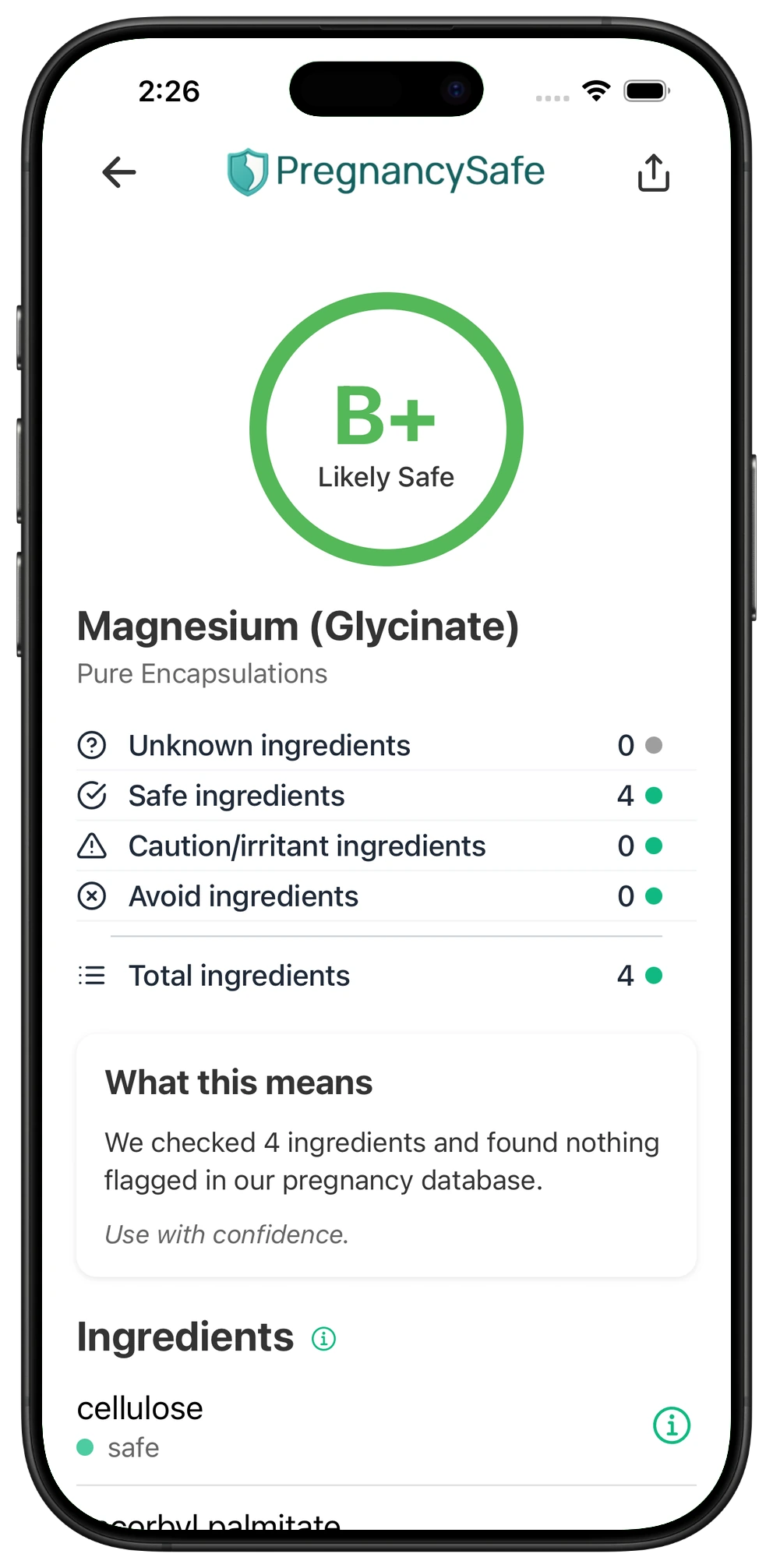
| B+ | Magnesium (Glycinate) | Pure Encapsulations | Dietary Supplement |
| B+ | High Absorption Magnesium Glycinate 240 Mg | Nature'S Bounty | Dietary Supplement |
| C+ | Trip Mindful Blend Raspberry Blossom Magnesium Seltzer | Trip | Seltzer |
| A | Unwind Berry Dragonfruit Liquid Water Enhancer With Magnesium & B Vitamins | Mio | Liquid Water Enhancer |
| A | Natural Vitality Calm Magnesium Citrate Powder 20 Oz | Natural Vitality | Dietary Supplement |
| B+ | Nature'S Bounty Magnesium Glycinate 240Mg | Nature'S Bounty | Dietary Supplement |
| B+ | Magnesium Breakthrough | Bioptimizers | Dietary Supplement |
| A | High Absorption Magnesium Glycinate, 240Mg | Natrol | Dietary Supplement |
How Do Products Containing Magnesium Score?
It can be helpful to see how products containing magnesium generally score during pregnancy. This does not tell you whether your exact product is safe, but it gives you a general idea of what we found. In this breakdown of 1,299 products, 59% receive a B grade. A B grade means the complete formula is likely safe, with minimal identified risk.
Frequently Asked Questions About Magnesium During Pregnancy
Is 400 mg or 500 mg of magnesium too much during pregnancy?
The source matters. NIH recommends total daily magnesium intake of 350–360 mg for pregnant adults and 400 mg for pregnant adolescents. Separately, the upper limit from supplements and medications is 350 mg/day. If 400 mg or 500 mg is your supplemental magnesium amount, it exceeds that limit and needs clinician review; magnesium naturally present in food does not count toward that supplemental limit.
Which form of magnesium is best when pregnant?
The available pregnancy evidence does not establish a best form. Glycinate, citrate, oxide, and other salts are different magnesium forms, not interchangeable names. The amount of magnesium and whether it is being used for nutrition or as a medicine matter more to this safety assessment than the form's name alone.
What side effects can oral magnesium cause?
High dose supplements and magnesium containing laxatives or antacids can cause diarrhea, nausea, and abdominal cramping. Toxicity is another concern, particularly with kidney impairment.
Which foods naturally contain magnesium?
Leafy greens, legumes, nuts, seeds, and whole grains contain magnesium. Normal dietary magnesium is compatible with pregnancy and contributes toward your nutritional needs.
Can I use magnesium on my skin during pregnancy?
Normal topical cosmetic use is considered safe based on cosmetic safety assessments and low expected absorption through intact skin, not direct proof from pregnancy studies. Use products as directed; irritation or significantly broken skin can change exposure.
Is a magnesium supplement the same as magnesium given for preeclampsia?
No. Intravenous magnesium sulfate used under obstetric supervision for preeclampsia or eclampsia, or for fetal neuroprotection, is separate from nutritional magnesium. The guidance for food and prenatal level supplements does not apply to that treatment.
How Do We Score Products for Pregnancy Safety?
We analyze each product's ingredients and category to flag known risks and provide cautionary notices for general category safety concerns.
A - Safe
Excellent choice! All ingredients are considered safe during pregnancy.
What to do: Use with confidence.
B - Likely Safe
Pretty much safe with very minimal risk. Some ingredients may have limited pregnancy studies, but no significant safety concerns have been identified.
What to do: Use with confidence.
C - Limit
Contains ingredients with some pregnancy considerations. Research shows these ingredients may have limited safety data, potential for minor hormonal effects, or require caution based on animal studies.
What to do: Use sparingly and consider safer alternatives when available.
D - Caution
Similar to C grade but contains multiple cautionary ingredients. The combination increases overall concern.
What to do: Try to avoid if that makes you feel better. If you've already used it, no need to panic.
F - Avoid
Contains an ingredient Pregnancy Safe recommends avoiding during pregnancy. This may reflect an established risk or a precaution based on limited evidence; check the ingredient guidance and exposure context.
What to do: Do not use during pregnancy. If you've already used it, don't worry - contact your OBGYN if concerned.
Sources
- https://cir-safety.org/sites/default/files/carbon122016rep.pdf
- https://medlineplus.gov/druginfo/meds/a601072.html
- https://medlineplus.gov/lab-tests/magnesium-blood-test/
- https://ods.od.nih.gov/factsheets/MVMS-HealthProfessional/
- https://ods.od.nih.gov/factsheets/Magnesium-HealthProfessional/
- https://ods.od.nih.gov/factsheets/Pregnancy-HealthProfessional/
- https://ods.od.nih.gov/factsheets/magnesium-healthprofessional/
- https://pmc.ncbi.nlm.nih.gov/articles/PMC6507506/
- https://pubmed.ncbi.nlm.nih.gov/19514931/
- https://pubmed.ncbi.nlm.nih.gov/24861367/
- https://pubmed.ncbi.nlm.nih.gov/27624531/
- https://pubmed.ncbi.nlm.nih.gov/28403154/
- https://pubmed.ncbi.nlm.nih.gov/42372834/
- https://www.acog.org/clinical/clinical-guidance/committee-opinion/articles/2010/03/magnesium-sulfate-before-anticipated-preterm-birth-for-neuroprotection
- https://www.acog.org/womens-health/faqs/healthy-eating-during-pregnancy
- https://www.nccih.nih.gov/health/licorice-root
- https://webprod.hc-sc.gc.ca/nhpid-bdipsn/dbImages/mono_licorice_english.pdf
- https://www.ema.europa.eu/en/medicines/herbal/liquiritiae-radix
- https://www.medsafe.govt.nz/profs/PUArticles/December2019/Liquorice-side-effects-interactions.htm
- https://www.bfr.bund.de/cm/349/does-the-consumption-of-liquorice-by-pregnant-women-impair-the-mental-and-physical-development-of-children.pdf
- https://pubmed.ncbi.nlm.nih.gov/28158597/
- https://pubmed.ncbi.nlm.nih.gov/11390327/
- https://www.fhi.no/contentassets/f08343d5155e413284f5c31a6b415b51/fhi-report-holy-basil-271123.pdf
- https://webprod.hc-sc.gc.ca/nhpid-bdipsn/atReq?atid=ocimum.tenuliflorum.leaf.feuille&lang=eng
- https://www.merckmanuals.com/home/special-subjects/dietary-supplements-and-vitamins/holy-basil
- https://www.drugs.com/npp/holy-basil.html
- https://www.ncbi.nlm.nih.gov/books/NBK582743/
- https://bsh.ahpa.org/SampleHerb4.aspx
- https://www.phytojournal.com/archives/2022/vol11issue4/PartD/11-4-54-138.pdf
- https://pubmed.ncbi.nlm.nih.gov/12099405/
- https://mothertobaby.org/fact-sheets/melatonin/
- https://www.nccih.nih.gov/health/melatonin-what-you-need-to-know
- https://pmc.ncbi.nlm.nih.gov/articles/PMC9169489/
- https://pmc.ncbi.nlm.nih.gov/articles/PMC7081745/
- https://pubmed.ncbi.nlm.nih.gov/29766570/
- https://pmc.ncbi.nlm.nih.gov/articles/PMC10130950/
- https://pmc.ncbi.nlm.nih.gov/articles/PMC5263083/
- https://www.ncbi.nlm.nih.gov/books/NBK501863/
- https://www.fda.gov/food/dietary-supplements
- https://www.fda.gov/food/natural-toxins-food/blue-green-algae-products-and-microcystins
- https://www.ncbi.nlm.nih.gov/books/NBK548312/
- https://www.ncbi.nlm.nih.gov/books/NBK501849/
- https://pubmed.ncbi.nlm.nih.gov/21793723/
- https://journal.ugm.ac.id/v3/InaJBCS/article/view/23573
- https://doi.org/10.4236/ojog.2017.71016
- https://pubmed.ncbi.nlm.nih.gov/37317149/
- https://pubmed.ncbi.nlm.nih.gov/37368655/
- https://pubmed.ncbi.nlm.nih.gov/23036452/
- https://pubmed.ncbi.nlm.nih.gov/21842336/
- https://journals.sagepub.com/doi/10.1177/10507256261445624
- https://ods.od.nih.gov/factsheets/Iodine-HealthProfessional/
- https://www.foodstandards.gov.au/consumer/nutrition/pregnancy/iodine-and-pregnancy
- https://www.foodstandards.gov.au/consumer/prevention-of-foodborne-illness/arseniciodine
- https://inspection.canada.ca/en/food-safety-consumers/fact-sheets/specific-products-and-risks/chemical-hazards/inorganic-arsenic
- https://pubmed.ncbi.nlm.nih.gov/35947162/
- https://pubmed.ncbi.nlm.nih.gov/20919974/
- https://pubmed.ncbi.nlm.nih.gov/30632947/
- https://pmc.ncbi.nlm.nih.gov/articles/PMC8077470/
- https://medlineplus.gov/ency/article/002332.htm
- https://www.ncbi.nlm.nih.gov/books/NBK235221/
- https://pubmed.ncbi.nlm.nih.gov/42137190/
- https://pubmed.ncbi.nlm.nih.gov/23077193/
- https://www.mskcc.org/cancer-care/integrative-medicine/herbs/5-htp-01
- https://medlineplus.gov/ency/article/007272.htm
- https://www.cdc.gov/mmwr/preview/mmwrhtml/00001739.htm
- https://www.fda.gov/food/information-consumers-using-dietary-supplements/questions-and-answers-dietary-supplements
- https://www.drugs.com/mtm/l-tryptophan.html