Is Camphor Safe During Pregnancy?
Updated September 14, 2026
The Answer
Camphor warrants caution during pregnancy, but small amounts in shop bought cosmetics and directed use of camphor containing decongestant rubs are unlikely to harm. This reassurance does not extend to swallowing camphor or applying concentrated oil to large areas or broken skin.
The key distinction is exposure: small topical amounts are not equivalent to swallowed camphor or concentrated camphor oil.
BUMPS considers small cosmetic amounts and directed decongestant rub use unlikely to harm; a topical exposure series found no birth defect signal, although human pregnancy data remain limited.
Already used it? Check the product form, how much you used, and whether it was applied to intact skin or swallowed. If you swallowed camphor oil or a camphor containing rub, seek urgent medical or poison control advice because toxicity can develop rapidly.
Pregnancy Safe is 100% independent and research driven. No companies pay to promote or sponsor products.
Stressless Pregnancy
Check your exact product with camphor in the app

What Is Camphor?
You may also see it listed as: alcanfor
Camphor is a crystalline aromatic compound with a strong smell, used for fragrance and a cooling sensation in balms, chest rubs, muscle rubs, and some cosmetics. You may encounter it in ointments, roll ons, and pain relief sprays, as well as in concentrated oil preparations.
What Other Ingredients Should You Look Out for in Products With Camphor?
A product's full ingredient list determines whether it's pregnancy-safe or not. These ingredients also appear in some of the camphor products we analyzed and may deserve a closer look.
Phenoxyethanol
CautionLook for phenoxyethanol, a preservative and fragrance solvent, on the pain relief spray label, and check its application directions. SCCS and CIR reviews support typical cosmetic use levels, but direct pregnancy data are limited and those assessments do not establish inhalation safety.
Flagged in 1 product (33.3%) in this analysis.
Does Camphor Strength or Product Type Matter During Pregnancy?
Camphor can be absorbed through skin and can cross the placenta, so the amount and application site matter. Recommended topical analgesic exposures were far below toxic doses in a systematic review, but this does not establish a pregnancy specific concentration limit. Avoid swallowing camphor or applying concentrated oil to large areas or broken skin; reassurance about directed decongestant rub use should not be extended to prolonged or concentrated inhalation.
What Products Contain Camphor?
Pregnancy Safe has looked at 480 products that have camphor as an ingredient. The category and grade breakdowns below use 3 products whose names mention Camphor or another name for it.
What Types of Products Contain Camphor?
Products You May Have That Contain Camphor
| Grade | Product | Brand | Type |
|---|---|---|---|
| C+ | Asutra Magnesium With Menthol & Camphor Recovery Roll-On Muscle Pain Reliever - 1.7 Fl Oz | Asutra | Muscle Pain Relief |
| C+ | De La Cruz Maximum Strength Pain Relieving Ointment With 11% Camphor | De La Cruz | Ointment |
| C | J.R. Watkins Relief Mist, Menthol Camphor | J.R. Watkins | Pain Relief Spray |
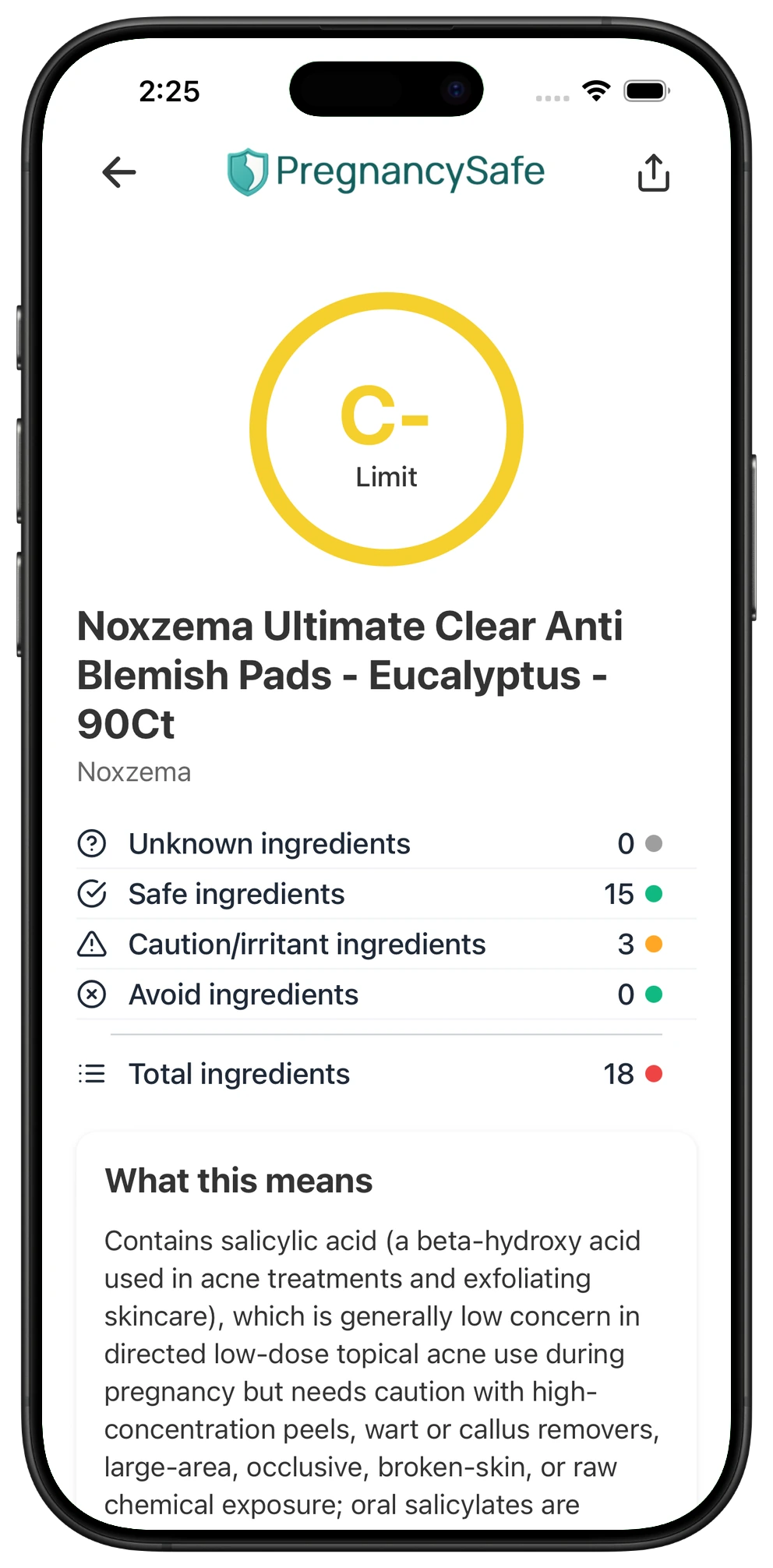
| C- | Noxzema Ultimate Clear Anti Blemish Pads - Eucalyptus - 90Ct | Noxzema | Facial Cleansing Pad |
| D+ | Kitsch Volumizing Rosemary & Biotin Shampoo 12Oz | Kitsch | Shampoo |
| D- | Noxzema Classic Clean Moisturizing Cleansing Cream - 12Oz | Noxzema | Cleansing Cream |
| D- | Noxzema Classic Clean Original Deep Cleansing Cream - Eucalyptus Scented - 12Oz | Noxzema | Cleansing Cream |
| C | Vicks Vapoinhaler Non-Medicated Menthol Scent | Vicks | Inhaler |
How Do Products Containing Camphor Score?
It can be helpful to see how products containing camphor generally score during pregnancy. This does not tell you whether your exact product is safe, but it gives you a general idea of what we found. In this breakdown of 3 products, 100% receive a C grade. A C grade means the complete formula has some pregnancy considerations, so use it sparingly and consider a higher scoring alternative when one is available.
Frequently Asked Questions About Camphor During Pregnancy
Can I use a camphor containing chest rub while pregnant?
BUMPS considers directed use of camphor containing decongestant rubs unlikely to harm during pregnancy. That conclusion concerns camphor in this use context, not every ingredient in a particular brand or formula.
Is smelling camphor the same as applying a chest rub?
No. Reassurance about using a decongestant rub as directed does not establish the safety of deliberately inhaling concentrated camphor or smelling it for prolonged periods. The available evidence does not establish a separate safe inhalation amount or duration.
Can camphor cause birth defects?
A topical exposure series found no birth defect signal, but human pregnancy data are limited. Ingestion related poisoning has been associated with case reports of fetal or neonatal harm; those reports should not be treated as evidence of the same risk from small topical amounts.
Is camphorated oil interchangeable with a camphor cosmetic?
No. Camphorated oil is a preparation, not another name for an ordinary cosmetic containing a small amount of camphor. Swallowing camphorated or concentrated essential oil has caused rapid toxicity and seizures.
What percentage of camphor is safe during pregnancy?
The available evidence does not establish a pregnancy specific percentage limit. Concentration alone is not enough to judge exposure: the amount applied, skin condition, application area, and whether you follow the product directions also matter.
Does this guidance also cover menthol and camphor products?
It covers the camphor component only. Menthol and any other active ingredients need their own assessment, and a product's grade reflects the complete formula rather than camphor alone.
How Do We Score Products for Pregnancy Safety?
We analyze each product's ingredients and category to flag known risks and provide cautionary notices for general category safety concerns.
A - Safe
Excellent choice! All ingredients are considered safe during pregnancy.
What to do: Use with confidence.
B - Likely Safe
Pretty much safe with very minimal risk. Some ingredients may have limited pregnancy studies, but no significant safety concerns have been identified.
What to do: Use with confidence.
C - Limit
Contains ingredients with some pregnancy considerations. Research shows these ingredients may have limited safety data, potential for minor hormonal effects, or require caution based on animal studies.
What to do: Use sparingly and consider safer alternatives when available.
D - Caution
Similar to C grade but contains multiple cautionary ingredients. The combination increases overall concern.
What to do: Try to avoid if that makes you feel better. If you've already used it, no need to panic.
F - Avoid
Contains an ingredient Pregnancy Safe recommends avoiding during pregnancy. This may reflect an established risk or a precaution based on limited evidence; check the ingredient guidance and exposure context.
What to do: Do not use during pregnancy. If you've already used it, don't worry - contact your OBGYN if concerned.
Sources
- https://dailymed.nlm.nih.gov/dailymed/drugInfo.cfm?setid=0a3086b7-a670-474e-81cf-8f989af425c2
- https://pmc.ncbi.nlm.nih.gov/articles/PMC4356057/
- https://pubmed.ncbi.nlm.nih.gov/16809137/
- https://pubmed.ncbi.nlm.nih.gov/9306672/
- https://svelic.se/utredning/?id=19-17711
- https://www.accessdata.fda.gov/drugsatfda_docs/omuf/monographs/OTC%20Monograph_M017-External%20Analgesic%20Drug%20Products%20for%20OTC%20Human%20Use%2005.02.2023.pdf
- https://www.canada.ca/en/health-canada/services/healthy-living/your-health/lifestyles/safe-use-health-products-containing-camphor-eucalyptus-oils.html
- https://www.e-lactation.com/en/camphor-pr/
- https://www.medicinesinpregnancy.org/leaflets-a-z/camphor-oil/
- https://health.ec.europa.eu/system/files/2021-08/sccs_o_195_0.pdf
- https://ec.europa.eu/growth/tools-databases/cosing/details/28157
- https://journals.sagepub.com/doi/10.3109/10915819009078737
- https://link.springer.com/article/10.1007/s00204-024-03938-5
- https://www.sfda.gov.sa/en/warnings/1156
- https://www.industrialchemicals.gov.au/sites/default/files/Ethanol%2C%202-phenoxy-_Human%20health%20tier%20II%20assessment.pdf
- https://hero.epa.gov/reference/2857875
- https://books.publisso.de/sites/default/files/documents/series/mak/dam/Vol2019/Iss1/Alt006/mb12299kske6319_w.pdf