Is Vinegar Safe During Pregnancy? (Updated 2026 Guide)
Updated September 9, 2026
The Answer
Yes vinegar can be used during pregnancy in ordinary condiment amounts, rather than as undiluted shots or a treatment. Our catalog contains mostly A graded records, but ingredient grades do not establish clinical pregnancy safety or verify current labels.
The main distinction is vinegar used in food versus concentrated supplements or medicinal use; follow the package’s storage and preparation instructions, and never rely on acidity to sterilize other food. Blends containing kelp, oral aloe vera or concentrated elderberry need separate consideration because iodine content, ingredient form and dose matter. Wine vinegar is distinct from beverage wine, and routine sugar, salt or culinary spices do not by themselves establish fetal harm.
Pregnancy Safe is 100% independent and research driven. No companies pay to promote or sponsor products.
Stress Less This Pregnancy
Check your exact vinegar in the app

✓ What's Safe
- • Choose vinegar intended for food use, and use it as a condiment in dressings, sauces or meals.
- • Read the complete label on your actual bottle, including added ingredients and preparation instructions.
- • Distinguish apple cider vinegar from apple juice or cider, and wine vinegar from beverage wine.
- • Follow the exact package’s storage instructions and handle the rest of your meal safely.
- • For sweetened or seasoned varieties, check sugar and sodium amounts against any individualized dietary advice.
- • Check whether a vinegar blend contains kelp, aloe vera or concentrated herbal ingredients before making it a daily habit.
✗ What to Avoid
- • Avoid undiluted vinegar shots and using vinegar as a detox or treatment for gestational diabetes.
- • Do not use vinegar marinades as a substitute for safe cooking or storage.
- • Avoid beverage wine during pregnancy; do not assume wine vinegar is the same exposure just because its name includes wine.
- • Avoid using kelp or organic kelp blends as an iodine supplement without guidance; repeated high intake can supply excessive iodine.
- • Skip oral aloe vera wellness blends unless your clinician has assessed the formulation, especially products containing latex or whole leaf extracts.
- • Avoid treating concentrated elderberry or horseradish preparations as equivalent to ordinary food seasoning; supplement and medicinal doses require separate consideration.
Most Common Ingredients in Vinegar Products
We analyzed 1,669 vinegar products. Here are the most common ingredients, ranked by how often they appear:
Ingredients to Watch Out For in Vinegar
These are the most common flagged ingredients across 1,669 vinegar products we analyzed.
organic kelp
Caution
Organic kelp is a nutrient rich seaweed packed with vitamins, minerals, and antioxidants that support overall health and wellness.
Can contain highly variable iodine, with high dose brown seaweed or kelp products and hijiki arsenic exposure requiring caution in pregnancy.
Flagged in 7 of 1,669 products (0%)
wine
Caution
Wine is a fermented beverage made from crushed grapes or other fruits, often enjoyed for its rich flavors and cultural significance.
Avoid wine beverages entirely. Be extremely careful when using in cooking or even with small percentages.
Flagged in 4 of 1,669 products (0%)
Caution
Aloe vera is a soothing, gel like plant extract known for its moisturizing and healing properties.
Is low concern on skin but oral latex, whole leaf, laxative, supplement, or juice forms may stimulate uterine contractions and cause laxative related fluid or electrolyte imbalance.
Flagged in 3 of 1,669 products (0%)
bacillus coagulans gbi 30 6086
Caution
Has strain specific safety with limited pregnancy specific data and includes species that can cause foodborne illness or carry toxin genes.
Flagged in 3 of 1,669 products (0%)
high fructose corn syrup
Caution
High fructose corn syrup is a sweet, liquid sweetener made from corn starch, commonly used in processed foods and beverages.
Is not a known teratogen at occasional food amounts, but high added sugar intake can displace nutrients and raise gestational diabetes and metabolic concerns.
Flagged in 3 of 1,669 products (0%)
kelp
Caution
Kelp is a nutrient rich, brown seaweed commonly used as a savory, mineral dense ingredient in soups, salads, and health supplements.
Can contain highly variable iodine, with high dose brown seaweed or kelp products and hijiki arsenic exposure requiring caution in pregnancy.
Flagged in 3 of 1,669 products (0%)
organic elderberry juice powder
Caution
Organic elderberry juice powder is a concentrated, nutrient rich powder made from dried, crushed elderberries, known for its immune boosting and antioxidant properties.
Has little pregnancy specific safety data for supplement doses and can be toxic if raw, unripe, or made with leaves, stems, bark, or roots.
Flagged in 3 of 1,669 products (0%)
white wine
Avoid
White wine is a crisp, pale yellow alcoholic beverage made from fermented white grapes, often used to enhance the flavor of dishes or enjoyed on its own.
Has no established safe amount in pregnancy and is linked to fetal alcohol spectrum disorders and other adverse pregnancy outcomes.
Flagged in 3 of 1,669 products (0%)
Types of Vinegar
Vinegar Products We've Analyzed
Our catalog contains ratings for 1,669 vinegar products. These are database grades, not independent safety certifications.
Catalog ingredient grades do not measure current-label completeness, pathogens, preparation, caffeine or clinical pregnancy suitability. These counts include unreviewed records and are not a percentage of independently verified safe products.
Pregnancy Safe Vinegar Products
Popular options from our catalog, prioritizing A and B ingredient grades, with C grade options used to fill remaining places. Within each group, products are ordered by searches in Pregnancy Safe, not retail sales. Read the cautions and guidance above; grades do not verify a complete current label or guarantee pregnancy safety.
| Grade | Product | Brand |
|---|---|---|
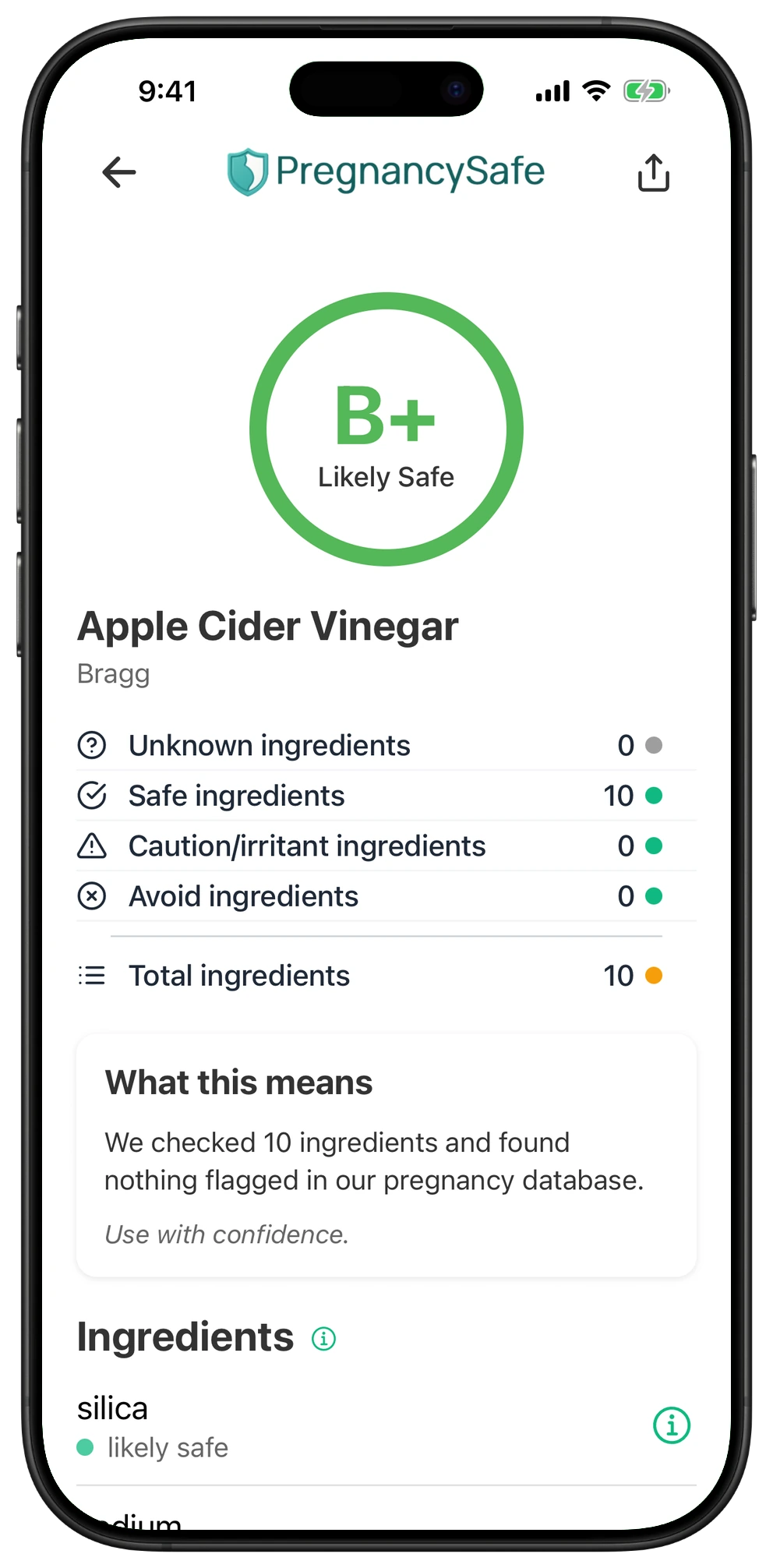
| A | Apple Cider Vinegar | Bragg |
| A | Bragg Apple Cider Vinegar, Organic | Bragg |
| A | Pompeian Organic Red Wine Vinegar | Pompeian |
| A | Marukan Genuine Brewed Rice Vinegar | Marukan Vinegar (U.S.A.) Inc. |
| A | Bragg Organic Apple Cider Vinegar | Bragg |
Your Questions Answered
Can I take vinegar while pregnant?
You can use vinegar in ordinary food amounts, such as in a dressing or sauce. That is different from taking undiluted shots, supplements or repeated medicinal doses. Use it for flavor, not as a detox or a replacement for pregnancy care.
Is apple cider vinegar safe during pregnancy?
Ordinary condiment use is distinct from concentrated apple cider vinegar supplements or wellness drinks. Apple cider vinegar is also not the same product as unpasteurized apple juice, so juice precautions should not automatically become a verdict on vinegar. Read the actual label and follow its storage and preparation instructions. Added herbs or other active ingredients need their own assessment.
Can I have balsamic or wine vinegar while pregnant?
These vinegars can be used in ordinary condiment amounts. Wine vinegar is distinct from drinking wine, and its name alone does not establish beverage alcohol exposure. If a blend separately lists wine or white wine, clarify the formulation rather than assuming it is simply vinegar. For sweetened balsamic preparations, consider the serving size within any individualized carbohydrate advice.
Can vinegar treat gestational diabetes or pregnancy symptoms?
Do not use vinegar as a treatment for gestational diabetes or as a detox. Condiment use does not establish that repeated treatment doses are effective or appropriate during pregnancy. Ask your pregnancy care team about symptom treatment or glucose management rather than replacing recommended care with vinegar.
Does vinegar make raw or improperly stored food safe?
No vinegar’s acidity does not sterilize other food. Marinating food in vinegar does not replace safe cooking, handling or storage. Follow the preparation requirements for every ingredient in your meal, along with the vinegar package’s instructions.
Does an A grade mean a vinegar is verified safe for pregnancy?
No. Our catalog contains 1,669 vinegar records, including 1,551 graded A, but these are ingredient grades rather than independently verified pregnancy safety results. They do not establish current label completeness, pathogen status or safe preparation, and the counts include unreviewed records. A lower grade or incomplete record is not, by itself, proof that a product is harmful.
How Do We Score Products for Pregnancy Safety?
We analyze each product's ingredients and category to flag known risks and provide cautionary notices for general category safety concerns.
Grades reflect the ingredient and category information available to us. They don’t verify a complete, current label or account for dose, preparation, or contamination. Read them alongside the guidance above, not as a guarantee of pregnancy safety or proof that every use is harmful.
A - Safe
Excellent choice! All ingredients are considered safe during pregnancy.
What to do: Use with confidence.
B - Likely Safe
Pretty much safe with very minimal risk. Some ingredients may have limited pregnancy studies, but no significant safety concerns have been identified.
What to do: Use with confidence.
C - Limit
Contains ingredients with some pregnancy considerations. Research shows these ingredients may have limited safety data, potential for minor hormonal effects, or require caution based on animal studies.
What to do: Use sparingly and consider safer alternatives when available.
D - Caution
Similar to C grade but contains multiple cautionary ingredients. The combination increases overall concern.
What to do: Try to avoid if that makes you feel better. If you've already used it, no need to panic.
F - Avoid
Contains an ingredient Pregnancy Safe recommends avoiding during pregnancy. This may reflect an established risk or a precaution based on limited evidence; check the ingredient guidance and exposure context.
What to do: Do not use during pregnancy. If you've already used it, don't worry - contact your OBGYN if concerned.
People Also Checked
References
- https://www.nhs.uk/pregnancy/keeping-well/foods-to-avoid/
- https://www.fda.gov/food/people-risk-foodborne-illness/cooking-food-safety-moms-be
- https://journals.sagepub.com/doi/10.1177/10507256261445624
- https://ods.od.nih.gov/factsheets/Iodine-HealthProfessional/
- https://www.foodstandards.gov.au/consumer/nutrition/pregnancy/iodine-and-pregnancy
- https://www.foodstandards.gov.au/consumer/prevention-of-foodborne-illness/arseniciodine
- https://inspection.canada.ca/en/food-safety-consumers/fact-sheets/specific-products-and-risks/chemical-hazards/inorganic-arsenic
- https://pubmed.ncbi.nlm.nih.gov/35947162/
- https://pubmed.ncbi.nlm.nih.gov/20919974/
- https://pubmed.ncbi.nlm.nih.gov/30632947/
- https://pmc.ncbi.nlm.nih.gov/articles/PMC8077470/
- https://www.nccih.nih.gov/health/aloe-vera
- https://webprod.hc-sc.gc.ca/nhpid-bdipsn/dbImages/mono_aloe--oral_english.pdf
- https://www.ema.europa.eu/en/documents/herbal-monograph/final-european-union-herbal-monograph-aloe-barbadensis-mill-and-aloe-various-species-mainly-aloe-ferox-mill-and-its-hybrids-folii-succus-siccatus_en.pdf
- https://www.utep.edu/herbal-safety/populations/herbs-to-avoid-during-pregnancy.html
- https://www.federalregister.gov/documents/2002/05/09/02-11510/status-of-certain-additional-over-the-counter-drug-category-ii-and-iii-active-ingredients
- https://pubmed.ncbi.nlm.nih.gov/33164294/
- https://pubmed.ncbi.nlm.nih.gov/28139161/
- https://journals.sagepub.com/doi/10.1080/10915810701351186
- https://pmc.ncbi.nlm.nih.gov/articles/PMC8308823/
- https://pmc.ncbi.nlm.nih.gov/articles/PMC5759212/
- https://pmc.ncbi.nlm.nih.gov/articles/PMC6811671/
- https://www.efsa.europa.eu/en/topics/topic/qualified-presumption-safety-qps
- https://www.fda.gov/files/food/published/GRAS-Notice-000660---Bacillus-coagulans-GBI-30--6086.pdf
- https://www.bccdc.ca/health-info/diseases-conditions/bacillus-cereus
- https://www.fda.gov/food/people-risk-foodborne-illness/food-safety-booklet-pregnant-women-their-unborn-babies-and-children-under-five
- https://cdn.realfood.gov/DGA.pdf
- https://www.dietaryguidelines.gov/sites/default/files/2021-12/DGA_Pregnancy_FactSheet-508c.pdf
- https://www.acog.org/womens-health/faqs/healthy-eating-during-pregnancy
- https://www.cdc.gov/nutrition/php/data-research/added-sugars.html
- https://www.cdc.gov/diabetes/about/gestational-diabetes.html
- https://www.who.int/publications/i/item/9789241549028
- https://nesr.usda.gov/2025-dietary-guidelines-advisory-committee-systematic-reviews/dietary-patterns_gestational-diabetes
- https://www.nccih.nih.gov/health/elderberry
- https://pmc.ncbi.nlm.nih.gov/articles/PMC3941201/
- https://pmc.ncbi.nlm.nih.gov/articles/PMC8026097/
- https://pmc.ncbi.nlm.nih.gov/articles/PMC7961730/
- https://www.cdc.gov/mmwr/preview/mmwrhtml/00000311.htm
- https://www.fda.gov/food/information-consumers-using-dietary-supplements/questions-and-answers-dietary-supplements
- https://pubmed.ncbi.nlm.nih.gov/11518905/
- https://infantrisk.com/content/management-cold-and-flu-during-pregnancy
- https://www.cdc.gov/alcohol-pregnancy/about/index.html
- https://www.cdc.gov/fasd/about/index.html
- https://www.acog.org/womens-health/infographics/alcohol-and-pregnancy
- https://www.niaaa.nih.gov/publications/brochures-and-fact-sheets/alcohol-and-your-pregnancy
- https://mothertobaby.org/fact-sheets/alcohol-pregnancy/
- https://pubmed.ncbi.nlm.nih.gov/26482673/
- https://pmc.ncbi.nlm.nih.gov/articles/PMC9543418/
- https://webprod.hc-sc.gc.ca/nhpid-bdipsn/atReq?atid=horseradish.raifort&lang=eng
- https://inchem.org/documents/jecfa/jeceval/jec_71.htm
- https://hfpappexternal.fda.gov/scripts/fdcc/index.cfm?id=ALLYLISOTHIOCYANATE&set=FoodSubstances
- https://pmc.ncbi.nlm.nih.gov/articles/PMC13085108/
- https://pubmed.ncbi.nlm.nih.gov/22129740/
- https://www.drugs.com/npp/horseradish.html